Most websites vanish when their owners stop paying. Hosting fees lapse. Servers shut down. Links break. Even big platforms delete content. But what if you could store data so it lasts forever? That’s what Arweave does. It’s not just another cloud service. It’s a blockchain built to store information permanently - no recurring payments, no expiration date, no corporate control.
How Arweave Makes Data Last Forever
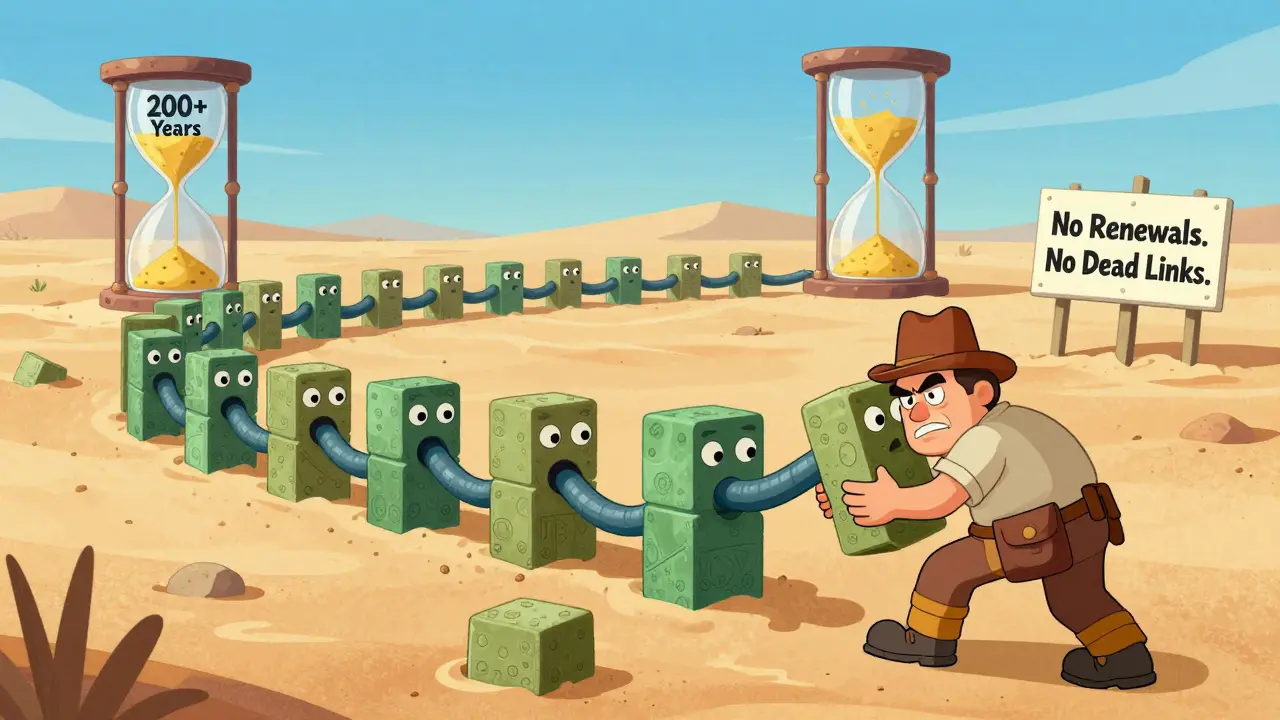
Arweave doesn’t rely on companies to keep your data alive. Instead, it uses a clever economic trick. When you upload something to Arweave, you pay once - in AR tokens - and that one payment covers storage for at least 200 years. The system doesn’t ask you to renew. It doesn’t send you a bill. It just works.
This works because of something called the endowment model. About 15% of your payment goes directly to miners who store your data right now. The other 85% is locked into a smart contract that grows over time. As storage hardware gets cheaper (and it always does), that endowment buys more storage. If costs drop faster than 0.5% per year - which they have for decades - your data could last thousands of years.
Compare that to AWS S3, which charges $0.023 per GB per month. Pay for 10 years? That’s $2.76 per GB. Pay for 200 years? That’s over $55 per GB. Arweave charges roughly $0.10 to store 1 GB permanently. That’s not a typo. One-time fee. Forever.
The Blockweave: How It’s Different From Blockchain
Arweave doesn’t use a regular blockchain. It uses something called a Blockweave. In Bitcoin or Ethereum, each new block links only to the one before it. In Arweave, each new block links to the previous one and to a random block from the past.
Here’s why that matters: to mine a new block, miners must have access to that randomly chosen old block. That means they can’t just delete old data to save space. They have to keep it. Every time someone mines, they’re forced to verify and store historical data. No choice. No shortcut.
This turns data preservation into a mining incentive. The more data gets stored, the more miners need to keep it. It’s self-sustaining. No one has to remember to back it up. The system forces them to.
What Can You Store on Arweave?
You can upload anything. Text, images, videos, websites, entire apps. Once uploaded, it becomes part of the Permaweb - a permanent, decentralized web. No central server. No domain registrar. Just data you can access forever using a unique address.
For example, the Internet Archive has used Arweave to preserve over 250,000 historical web pages. Journalists in authoritarian countries upload reports to Arweave so they can’t be deleted. Developers store open-source documentation, codebases, and even entire websites. Some people have uploaded entire movies, music albums, and digital art.
There’s a catch: Arweave is write-once. You can’t edit or update data after it’s uploaded. If you need to fix a typo, you upload a new version. The old one stays. That’s not a bug - it’s the point. It’s meant for history, not drafts.
How Does It Compare to Other Storage Options?
Other decentralized storage projects like Filecoin and Sia work like renting a hard drive. You pay monthly. If you stop paying, your data disappears. Arweave is the only one that makes storage permanent.
| Feature | Arweave | Filecoin | Traditional Cloud (e.g., AWS) |
|---|---|---|---|
| Payment Model | One-time fee | Monthly subscription | Monthly subscription |
| Data Longevity | 200+ years guaranteed | Only as long as you pay | Only as long as you pay |
| Editing Data | No - write-once | Yes | Yes |
| Censorship Resistance | High - decentralized | Moderate | Low - corporate control |
| Best For | Archives, history, immutable records | Temporary backups, active data | Active websites, apps |
Arweave isn’t meant to replace your Dropbox or Google Drive. It’s meant to replace the idea that digital content has to disappear.
Real-World Use Cases
People aren’t just theorizing about Arweave. They’re using it.
- Open-source documentation: Developers store GitHub READMEs, API docs, and tutorials. One user uploaded their entire project guide in 2021. It’s still live today under the same URL.
- Journalism: Reporters in Hong Kong, Russia, and Iran use Arweave to archive sensitive stories that might be censored.
- Digital heritage: Museums and libraries are experimenting with storing cultural artifacts - photos, audio recordings, manuscripts - on the Permaweb.
- Blockchain applications: Over 37% of Arweave’s data comes from Ethereum-based projects that need permanent logs, metadata, or smart contract histories.
There are failures too. Some users try to store live blogs or constantly updated apps. That doesn’t work. Arweave isn’t for dynamic content. It’s for things you want to preserve.
Getting Started: What You Need to Know
Using Arweave isn’t hard, but it’s different.
- Get an AR token wallet. You can use Arweave Wallet, Phantom, or other crypto wallets that support AR.
- Buy AR tokens. As of early 2026, one AR token is worth around $8.50. You can buy it on major exchanges like KuCoin or Binance.
- Go to arweave.net - the main gateway. Upload your file. It’ll give you a unique address like
https://arweave.net/abc123xyz. - Pay the fee in AR. The system estimates how much you need based on file size.
The tricky part? Estimating cost. File size isn’t the only factor. Compression, redundancy, and AR’s price affect the final fee. For small files (under 10 MB), it’s easy. For large ones, use the ArweaveJS library. It’s open source, has over 2,800 GitHub stars, and helps developers automate uploads.
Most developers say it takes 2-3 weeks to get comfortable. Beginners find the docs confusing at first. But the community is active. Discord has 18,000+ members. Reddit’s r/arweave has 15,000+ users sharing tips and fixes.
What’s Next for Arweave?
Arweave isn’t standing still. In Q2 2024, it’s rolling out something called Blockshadows. This update will make data retrieval up to 400% faster by caching frequently accessed blocks closer to users. Right now, downloading a 100MB video might take 30 seconds. After Blockshadows, it’ll be under 5.
Data on Arweave grew from 380 million items in early 2023 to 450 million by the end of 2023. That’s an 18.4% jump in one year. Transaction volume rose 32.7%. Adoption is accelerating, especially among developers building decentralized apps that need permanent backing.
Some critics say the 200-year guarantee is too optimistic. What if AI changes storage tech overnight? What if AR’s value crashes? The endowment model is mathematically sound, but it’s built on historical trends - not predictions. Still, no other system even tries to solve permanence. Arweave is the only one that does.
Why This Matters
The internet was supposed to be permanent. But it’s not. Half of all web pages vanish within five years. URLs die. Memories disappear. Arweave flips that. It says: data should last as long as humanity does.
This isn’t just for techies. It’s for historians. Artists. Journalists. Families. Anyone who wants to leave something behind that won’t rot.
Arweave doesn’t promise perfection. It doesn’t handle edits. It’s not fast for daily use. But for one thing - permanent, uncensorable, unbreakable storage - it’s the only solution that works today.
Is Arweave really permanent? Can data be deleted?
Yes, Arweave data is permanent by design. Once uploaded, it’s stored across thousands of miners globally. No single entity controls it. You can’t delete it, and no government or company can shut it down. The Blockweave system forces miners to keep old data to mine new blocks. If even one miner holds the data, it stays accessible. There’s no backdoor. No delete button.
How much does it cost to store data on Arweave?
It costs a one-time fee in AR tokens. For 1 GB, it’s roughly $0.10 as of early 2026. The price depends on file size and AR token value. The system calculates it automatically when you upload. You pay once, and it lasts 200+ years. Compare that to AWS S3, where storing 1 GB for 200 years would cost over $55.
Can I edit or update files after uploading?
No. Arweave is write-once. Once a file is uploaded, it’s immutable. If you need to fix something, you upload a new version. The old one stays unchanged. This is intentional - it ensures data integrity and prevents tampering. Think of it like a historical archive: you don’t edit the original documents. You preserve them as-is.
What’s the difference between Arweave and Filecoin?
Filecoin is like renting cloud storage - you pay monthly, and if you stop, your data disappears. Arweave is like buying a forever storage space - one payment, permanent access. Filecoin is better for active data you update often. Arweave is for data you want to preserve forever - like legal records, historical archives, or open-source projects.
Do I need crypto experience to use Arweave?
Not much. You need a crypto wallet that supports AR tokens and a small amount of AR to pay for storage. The upload process through arweave.net is simple - drag and drop, pay, get a link. But if you’re building apps or automating uploads, you’ll need basic blockchain knowledge. The documentation has improved a lot since 2021, and the community offers free help.
Is Arweave legal? Can governments block it?
Arweave is decentralized, so no government can shut it down. But if a country bans cryptocurrency, citizens might have trouble buying AR tokens. The data itself is stored globally - on servers in over 50 countries. Even if one region blocks access, others still serve it. Some governments have tried to censor content on Arweave, but since there’s no central server to target, they can’t delete it. Only the user who uploaded it can remove access - and even then, copies remain on miners’ drives.
What happens if AR token value crashes?
Your data stays safe. The endowment model is designed to work regardless of AR’s price. The fee you paid covers storage based on the value of AR at the time of upload. The endowment grows as storage hardware gets cheaper, not as AR’s price rises. Even if AR drops 90%, your data is still stored because the miners are paid in AR for their work - and they’re still incentivized to keep the data to earn new mining rewards.
Can I use Arweave to host a live website?
Yes, but with limits. You can host static websites - HTML, CSS, JavaScript - on Arweave. They’ll load from any browser using the Arweave gateway. But you can’t run dynamic servers, databases, or real-time updates. For live apps, you’d combine Arweave (for static files) with a traditional server (for backend logic). Many decentralized apps use this hybrid model.
Arweave isn’t about making money. It’s about making memory. The internet forgot how to remember. Arweave is trying to fix that.
Comments (20)
Christina Young
March 5, 2026 AT 11:16
Arweave's 'permanent' storage is a fantasy built on optimistic math. Storage costs don't decline linearly forever. AI-driven compression? Quantum storage? These could render the endowment model useless in 50 years, not 200. You're betting on a trend that's already slowing.
Steven Lefebvre
March 7, 2026 AT 03:41
I love this idea. The fact that you pay once and it just works? That’s the future. No more worrying about domain renewals or cloud bills. I uploaded my grandma’s photo album last week. It’s alive now. Forever.
nalini jeyapalan
March 7, 2026 AT 12:40
Stop glorifying this like it’s magic. You’re paying in crypto. If AR crashes, miners stop caring. The system doesn’t care about your grandma’s photos-it cares about token value. This isn’t preservation, it’s a gamble wrapped in blockchain hype.
Drago Fila
March 8, 2026 AT 12:13
This is actually one of the most exciting things I’ve seen in web tech. Think about it-your kid’s first drawing, your wedding video, your life’s work-all preserved without a single company holding it hostage. No one’s perfect, but Arweave’s the closest we’ve got to digital immortality. Just don’t upload your cat memes expecting them to be searchable in 2070.
Bill Pommier
March 9, 2026 AT 12:20
Let me be clear: Arweave is not a storage solution. It is a speculative asset with a side effect. The endowment model is mathematically elegant, but it ignores macroeconomic reality. Inflation, energy costs, hardware obsolescence-these are not linear trends. The 0.5% annual decline assumption is a fantasy. This is not innovation. It is a Ponzi scheme with a blockchain veneer.
Olivia Parsons
March 10, 2026 AT 12:27
I tried uploading a 50MB PDF. Paid 0.015 AR. Got my link in 2 minutes. Worked perfectly. No drama. No login. Just a URL that works. I’ve used AWS and S3 for years. This is simpler. It’s not perfect, but it’s real. And it works today.
Issack Vaid
March 10, 2026 AT 14:15
How quaint. You believe in permanence? The internet was supposed to be eternal too. And yet, 90% of Geocities sites vanished. Arweave is just the next iteration of the same delusion. You can’t outsmart entropy. You can only delay it. And you’re paying for the delay in volatile tokens. That’s not preservation. That’s insurance with a 200-year deductible.
Shawn Warren
March 11, 2026 AT 19:59
Arweave is the only thing that actually solves the problem of digital decay. No more lost family videos. No more dead links. No more corporate deletion. One payment. Forever. It’s not about tech. It’s about legacy. And that matters more than you think.
Jackson Dambz
March 12, 2026 AT 12:00
So you pay once and it lasts 200 years? That’s cute. What if the miners all die? What if the internet collapses? What if someone finds a way to hack the Blockweave? You think a smart contract is magic? It’s code. Code breaks. Systems fail. This is not eternal. It’s just poorly understood.
Megan Lutz
March 14, 2026 AT 03:02
There’s a deeper philosophical point here. Arweave doesn’t just store data-it enshrines it. It treats information as a cultural artifact, not a commodity. That’s revolutionary. We’ve spent decades optimizing for change, for updates, for iteration. Arweave says: some things deserve to be frozen. Not because they’re perfect, but because they’re true.
Austin King
March 15, 2026 AT 20:25
Used it to archive my open-source project. Took 5 minutes. Paid less than $1. Now it’s live at https://arweave.net/abc123. No server. No domain. Just pure, uncensorable history. Best decision I’ve made this year.
Emily Pegg
March 16, 2026 AT 18:26
OMG this is literally the answer to everything 💖 I uploaded my entire childhood journal and now I feel so safe. Like, finally, something that won’t disappear. I’m crying. I’m so grateful. Arweave is my digital soulmate 🥹
Ethan Grace
March 18, 2026 AT 09:08
Permanence is an illusion. All things decay. Even stars. Even black holes. Even blockchain. Arweave is a beautiful metaphor for human longing-not a technical solution. We crave permanence because we fear oblivion. This doesn’t stop oblivion. It just makes us feel better while it comes.
Jamie Hoyle
March 18, 2026 AT 09:29
Wow. You really believe this? Let me guess-you also think the moon landing was real and that the earth is flat. Arweave’s 'endowment model' ignores that storage hardware gets cheaper because demand drops. If everyone used Arweave, the cost to store data would skyrocket. Miners would be overwhelmed. The system collapses. It’s not sustainable. It’s a bubble with a whitepaper.
Jeffrey Dean
March 19, 2026 AT 02:24
You say it’s permanent. But what if the code is buggy? What if a bug deletes a block? What if a miner’s drive fails and no one has the copy? You’re trusting randomness. You’re trusting a system that relies on the assumption that someone, somewhere, will always care. That’s not engineering. That’s prayer.
Brian T
March 19, 2026 AT 12:17
So you pay once. But what if the AR token becomes worthless? Then the miners stop. The data is still there. But no one can access it. It’s like burying a letter in a vault and throwing away the key. You didn’t preserve it. You just hid it.
Nash Tree Service
March 19, 2026 AT 15:28
Arweave is not a storage protocol. It is a social contract. It works because people believe in it. If trust evaporates, the system fails. The math is elegant. The sociology is fragile. You cannot store permanence. You can only cultivate it. And cultivation requires ongoing attention. Arweave pretends otherwise. That is its fatal flaw.
Jane Darrah
March 20, 2026 AT 12:54
I spent three days trying to upload a 2GB video. The interface was confusing. The fee estimator was wrong. I paid 0.8 AR. Then I realized I had to use a CLI tool because the web interface choked. I’m not mad-I’m disappointed. This isn’t for normal people. It’s for devs who want to feel like pioneers while they wrestle with JSON configs. And don’t get me started on how slow it is to download. I waited 45 minutes for a 50MB file. That’s not permanent. That’s punitive.
Denise Folituu
March 20, 2026 AT 21:46
They say it’s uncensorable. But what if the government bans AR tokens? What if they block the gateways? What if they arrest miners? You think decentralization makes you safe? It just makes you harder to find. And if they want your data bad enough, they’ll find it. Arweave doesn’t protect you. It just makes you feel brave while you’re still vulnerable.
jack carr
March 21, 2026 AT 22:45
Just uploaded my dad’s last letter. It’s there. Forever. No app. No login. Just a link. I didn’t need to understand blockchain. I just clicked. And now, when I’m gone, my kid can still read it. That’s worth more than any crypto price. Thank you, Arweave.