Binance DEX Transaction Cost Calculator
Calculate the exact costs for trading on Binance DEX - including the 0.1% trading fee plus network fee. Know what you're paying before you trade.
Most people think crypto exchanges are all the same - you deposit, trade, withdraw. But Binance DEX doesn’t work like that. It doesn’t hold your coins. It doesn’t ask for your ID. It doesn’t freeze your account. That’s the whole point. If you’ve ever lost sleep wondering if Binance.com could get hacked (and take your Bitcoin with it), Binance DEX was built to make that fear disappear. But is it actually good to trade on? Or is it just a security gimmick with slow trades and limited coins?
What Binance DEX Actually Is
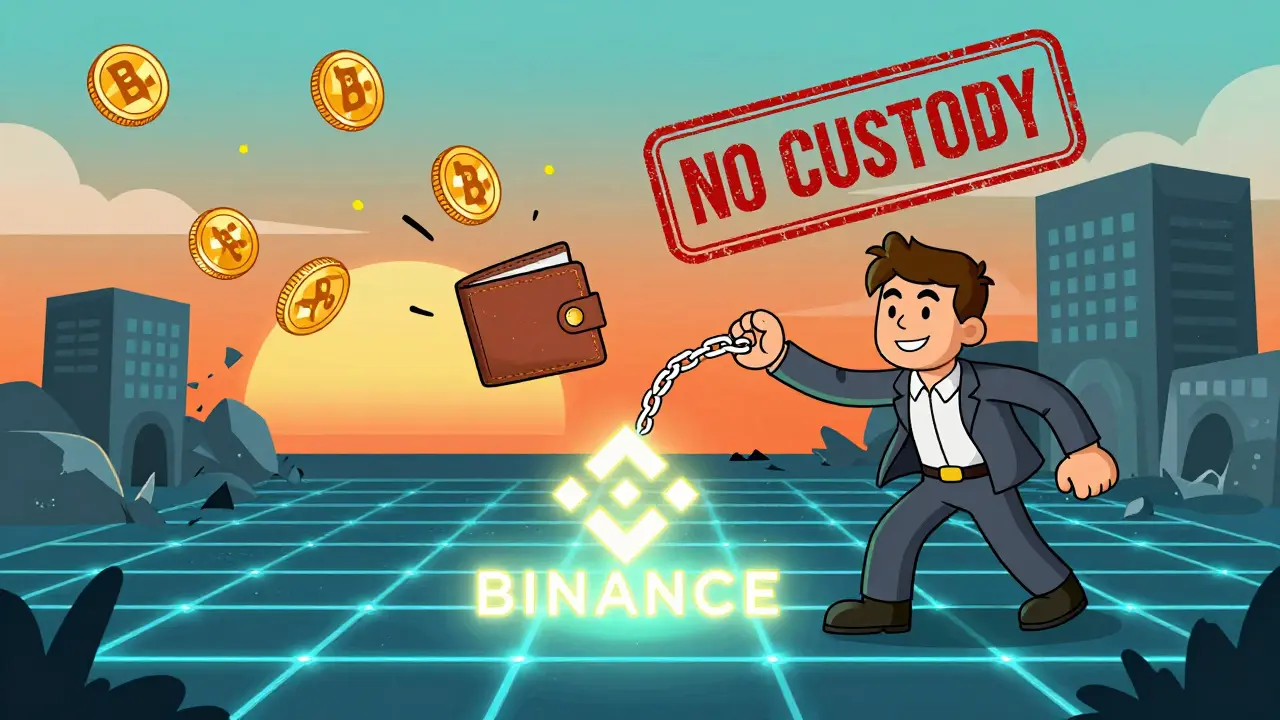
Binance DEX is a decentralized exchange built on the Binance Chain blockchain. Launched in February 2019, it’s not a website that stores your money - it’s a peer-to-peer trading system where your wallet holds your coins the whole time. You never send them to Binance. You never give up control. That’s what makes it decentralized. The platform uses Tendermint Core, a high-speed blockchain engine that confirms trades in under one second. That’s faster than most Ethereum-based DEXs, which often take minutes during high traffic.
It’s not a copy of Binance.com. It doesn’t have margin trading, futures, or staking. It doesn’t support Ethereum, Solana, or Polygon tokens. It only trades BEP-2 tokens - coins built specifically on Binance Chain. That’s a big limitation. But it’s also the reason it’s so fast. No Ethereum congestion. No $50 gas fees. Just clean, direct trades between wallets.
How It Works: No Middleman, No Hassle
To use Binance DEX, you need a Web3 wallet that supports Binance Chain. Popular options include Trust Wallet, Ledger, and MathWallet. You don’t sign up. You don’t verify your email. You just connect your wallet. That’s it. Your private keys stay on your device. No one else has them. Not Binance. Not hackers. Not governments.
When you place a trade, your order goes directly onto the blockchain as a limit order. Buyers and sellers match up automatically. Trades settle on-chain. Every transaction is public, permanent, and verifiable. There’s no central server to crash. No customer support team to call if you send funds to the wrong address. That’s the trade-off: total control means total responsibility.
Trading fees are low - typically 0.1% per trade, paid in BNB. That’s cheaper than most centralized exchanges. But you also pay a tiny network fee (in BNB) to broadcast your transaction. It’s usually less than a penny. No surprise charges. No hidden fees. What you see is what you pay.
Why It’s Secure - And Why That Matters
The biggest advantage of Binance DEX is security. Since you control your keys, there’s no single point of failure. Centralized exchanges like Coinbase or Kraken have been hacked dozens of times. In 2024 alone, over $1.2 billion was stolen from centralized platforms. Binance DEX? Zero breaches. Ever.
Why? Because hackers can’t steal what they can’t access. If your wallet is secure, your coins are safe. Even if Binance’s servers went down tomorrow, you could still trade on Binance DEX using any compatible wallet. The blockchain keeps running. Your assets remain yours.
This isn’t just theory. In 2021, when Binance.com was targeted by a major phishing attack, users on Binance DEX were unaffected. Their funds were untouched because they never left their wallets. That’s the power of decentralization. No custody = no risk of exchange insolvency or theft.

The Downside: Limited Tokens and Liquidity
But here’s the catch: Binance DEX only supports BEP-2 tokens. That means no Bitcoin, no Ethereum, no USDT on Ethereum. You can’t trade SOL, ADA, or DOT. You’re locked into the Binance Chain ecosystem. There are over 200 BEP-2 tokens available - including BNB, ATOM, DOT (BEP-2 version), and some lesser-known altcoins. But compared to centralized exchanges with thousands of pairs, it’s a small pool.
Liquidity is another issue. Because it’s an order-book DEX (not an AMM like Uniswap), you need someone to take your order. If you want to sell 10,000 BNB, you might not find a buyer at your price. You could end up with a worse rate than on Binance.com. That’s why professional traders still use Binance.com for large orders - it has deeper order books.
Compare that to PancakeSwap, which runs on Binance Smart Chain and offers $1.73 billion in locked liquidity as of mid-2024. PancakeSwap lets you swap any BEP-20 token instantly, even obscure ones. It also has yield farming, staking, and NFTs. Binance DEX? None of that. It’s a pure trading platform. No DeFi bells and whistles.
Who Is It For? And Who Should Avoid It
Binance DEX is perfect for experienced traders who:
- Own BEP-2 tokens and want to trade them without trusting a third party
- Value privacy and don’t want to submit KYC documents
- Prefer fast, low-cost spot trading over complex derivatives
- Are tired of centralized exchanges freezing accounts or restricting withdrawals
It’s not for you if:
- You’re new to crypto and don’t know how to manage private keys
- You want to trade Bitcoin, Ethereum, or stablecoins like USDT on Ethereum
- You need customer support to recover lost funds (they can’t help you)
- You’re in the U.S. - Binance DEX blocks American users due to regulatory pressure
Most retail traders in the U.S. are better off using Coinbase or Kraken. But if you’re outside the U.S. and hold BNB or other BEP-2 assets, Binance DEX is one of the most secure ways to trade them.
How It Compares to Other DEXs
Here’s how Binance DEX stacks up against the top decentralized exchanges in 2025:
| Feature | Binance DEX | PancakeSwap | Uniswap | dYdX |
|---|---|---|---|---|
| Blockchain | Binance Chain | Binance Smart Chain | Ethereum | Ethereum |
| Trading Model | Order Book | AMM | AMM | AMM + Perps |
| Block Time | 1 second | 3 seconds | 15+ seconds | 12 seconds |
| Supported Tokens | BEP-2 only | BEP-20 only | ERC-20 only | ERC-20 only |
| Liquidity (TVL) | $1.2B (est.) | $1.73B | $12.5B | $890M |
| Margin/Perps Trading | No | No | No | Yes |
| Yield Farming | No | Yes | No | No |
| U.S. Access | No | No | Yes (with restrictions) | Yes |
Uniswap has way more liquidity and token options, but it’s slow and expensive. PancakeSwap is faster and has DeFi features, but it’s built on Binance Smart Chain - which is technically a different chain than Binance DEX. dYdX is the only one offering leveraged trading. Binance DEX? It’s the fastest pure spot trader - if you’re on the right chain.

The Learning Curve: Not for Beginners
If you’ve only used Coinbase or Binance.com, Binance DEX will feel alien. You need to understand:
- How to generate and store a private key
- What a wallet address is
- How to connect your wallet to a DEX
- That transactions are irreversible
- That there’s no password reset button
It takes 10 to 30 minutes for someone with crypto experience to get started. For a complete newbie? It could take hours. And if you lose your private key? Your coins are gone forever. No Binance support team can help you. That’s the price of true decentralization.
Binance’s help docs are solid - clear, detailed, and well-organized. But the community support is thin. Reddit threads and Discord channels are helpful, but you won’t find 24/7 live chat like on centralized exchanges.
Future Outlook: Niche, But Stable
Binance DEX isn’t growing like it used to. PancakeSwap and Uniswap are eating its lunch with DeFi features and multi-chain support. Binance hasn’t announced any major upgrades to Binance DEX in 2025. It’s not integrating with Binance Smart Chain. It’s not adding new token standards. It’s staying focused.
That’s not necessarily bad. It means Binance DEX won’t bloat with features it doesn’t need. It’s a clean, fast, secure spot trading platform. For traders who want to swap BEP-2 tokens without trusting anyone, it’s still the best option.
But if you want yield farming, NFTs, or trading Bitcoin on a DEX? Look elsewhere. Binance DEX isn’t trying to be everything. It’s trying to be the most secure way to trade on Binance Chain. And for that, it still delivers.
Final Verdict: Trust Your Keys, Not a Company
Binance DEX isn’t perfect. It’s not easy. It’s not for everyone. But if you understand what it is - a fast, secure, non-custodial spot trading platform - then it’s one of the most reliable tools in crypto.
It’s not a replacement for Binance.com. It’s a complement. Use Binance.com for large trades, margin, and new tokens. Use Binance DEX to trade your BEP-2 assets without ever handing over your keys.
Security isn’t free. It requires responsibility. But if you’re serious about owning your crypto - not just renting it from an exchange - Binance DEX is one of the few platforms that actually lets you do it.
Can I use Binance DEX if I live in the United States?
No. Binance DEX blocks all U.S.-based IP addresses due to regulatory pressure. Even if you use a VPN, your wallet address may be flagged later. If you’re in the U.S., use Uniswap or dYdX instead - they allow U.S. users with some restrictions.
Is Binance DEX safer than Binance.com?
Yes, by design. On Binance.com, your coins are held by Binance. If they get hacked or freeze your account, you lose access. On Binance DEX, your coins stay in your wallet. Only you control them. There’s no central point of failure. That makes it far safer from theft or censorship.
What wallets work with Binance DEX?
Trust Wallet, Ledger (via Ledger Live), MathWallet, and Binance Chain Wallet are the most popular. Make sure your wallet supports Binance Chain (BEP-2), not Binance Smart Chain (BEP-20). They’re different networks. Using the wrong one will result in lost funds.
Can I trade Bitcoin on Binance DEX?
Not directly. Bitcoin isn’t a BEP-2 token. But you can trade wrapped Bitcoin (WBTC) if it’s issued on Binance Chain - though this is rare. Most Bitcoin trading on DEXs happens on Ethereum or other chains. For Bitcoin on a DEX, use Uniswap (via WBTC) or a bridge service.
What happens if I lose my private key?
Your funds are permanently lost. Binance DEX has no recovery process. No customer service can restore your account. This is the core principle of decentralization: you are your own bank. Always back up your private key offline - on paper, in a hardware wallet, or encrypted on a secure device. Never store it online.
Why doesn’t Binance DEX support Ethereum tokens?
Binance DEX runs on Binance Chain, which is a separate blockchain from Ethereum. It’s optimized for speed and low fees, not compatibility. Adding Ethereum tokens would require complex bridges, slower confirmations, and higher costs - which defeats its purpose. Binance Smart Chain handles BEP-20 tokens (like ETH-based ones), but that’s a different platform.
Does Binance DEX have mobile apps?
There’s no official Binance DEX app. But you can access it through mobile wallets like Trust Wallet or Ledger Live. Just open your wallet, connect to Binance DEX via the browser, and trade. The interface works fine on phones - it’s just not a standalone app.
Comments (16)
Jerry Perisho
December 6, 2025 AT 07:21
Binance DEX is the only way to trade if you actually own your crypto. No KYC, no custody, no excuses. If you're still using Binance.com for anything beyond liquidity, you're already compromised. Simple as that.
Martin Hansen
December 7, 2025 AT 03:44
Wow. Another crypto bro pretending decentralization is a virtue instead of a liability. You people act like not having customer support is some kind of moral victory. If you lose your keys, you're not a 'true degenerate' - you're just dumb. And yes, I'm talking to you, the guy who thinks 0.1% fees are 'cheap' while paying $50 in gas on Ethereum. 🤡
Chloe Hayslett
December 7, 2025 AT 21:47
U.S. users can't use it? Good. Let the rest of the world deal with their own crypto chaos. We don't need another foreign platform telling us how to do finance. Stick to Coinbase like a responsible adult.
Tom Van bergen
December 8, 2025 AT 13:41
security is not a feature its a mindset you either own your keys or you rent your coins and if you rent them you dont own crypto you own a debt instrument wrapped in a whitepaper
Annette LeRoux
December 9, 2025 AT 18:18
I love how Binance DEX is like a minimalist art piece - no frills, no noise, just pure trading. 🤍 It’s not for everyone, but when you want to move BEP-2 tokens without drama, it’s the quiet giant. Also, no one talks about how clean the UI is on desktop. So refreshing.
Renelle Wilson
December 10, 2025 AT 18:07
It's important to recognize that the trade-off between convenience and control is not merely technical - it's philosophical. Binance DEX embodies the principle that financial sovereignty requires personal responsibility, not institutional trust. While this may be daunting for newcomers, it is precisely this rigor that protects users from systemic risk. The absence of customer support is not a flaw - it is a feature of autonomy. Those who seek safety in centralized entities may find temporary comfort, but they surrender their agency. True security lies in self-custody, and this platform, despite its limitations, delivers that with unwavering consistency.
Adam Bosworth
December 11, 2025 AT 05:58
lol i tried to trade on binance dex once and i sent my bnb to the wrong address and now my portfolio is 0.00000001 bnb and i cry every night. why did no one tell me there was no reset button?? also why is the interface so ugly??
Lore Vanvliet
December 11, 2025 AT 18:26
OMG I JUST LOST MY ENTIRE LIFE SAVINGS BECAUSE I USED THE WRONG WALLET 😭😭😭 I THOUGHT BEP-2 WAS BEP-20 AND NOW I'M BROKE AND MY CAT IS STARVING AND MY BOYFRIEND LEFT ME BECAUSE I'M 'TOO DEEP IN CRYPTO' AND I JUST WANT TO CRY FOREVER 😭😭😭
Cristal Consulting
December 12, 2025 AT 19:19
Hey, if you're new to DEXs, start small. Use Trust Wallet, connect to Binance DEX, and try swapping 0.1 BNB first. It's scary at first, but once you see your transaction go through and your coins stay in your wallet? Magic. You'll never go back to centralized exchanges. You got this 💪
Manish Yadav
December 13, 2025 AT 22:43
why no support? if i lose money i need someone to call. this is not fair. i want my money back. binance should help me.
Joe West
December 15, 2025 AT 19:47
Just want to clarify something - Binance DEX and Binance Smart Chain are different. People mix them up all the time. DEX is on Binance Chain (BEP-2), Smart Chain is BEP-20 and runs PancakeSwap. Don't send ETH to your Binance DEX wallet - you'll lose it. Been there. Done that. Learned the hard way.
Glenn Jones
December 16, 2025 AT 22:36
yo so i just spent 3 hours trying to connect my ledger to binance dex and the interface froze and now my 2000 bnb is stuck in pending and the whole thing is just a scam designed by crypto bros to make newbs feel stupid and im 100% sure they track your ip and ban you if you're american and also the gas fees are actually 0.5% not 0.1% they just hide it in the tx details and i think this is a pump and dump scheme
Isha Kaur
December 16, 2025 AT 23:59
I’ve been using Binance DEX for over a year now, and honestly, it’s been the most peaceful experience I’ve had in crypto. No account freezes, no surprise withdrawals, no ‘we’re upgrading our system’ delays. I trade my BEP-2 tokens every week, and even though the selection is small, I don’t miss the chaos of centralized exchanges. The only thing I wish was better is the mobile experience - it’s functional but clunky. Maybe one day they’ll improve the UI without adding bloat. But for now? It’s clean, reliable, and mine. That’s enough.
Thomas Downey
December 17, 2025 AT 11:27
It is not merely a technological platform; it is an ideological statement. The refusal to integrate with Ethereum, to adopt DeFi mechanisms, to offer customer service - these are not failures of vision. They are acts of purity. Binance DEX refuses to dilute its purpose in pursuit of mass adoption. It is the crypto equivalent of a monk in a digital monastery - silent, steadfast, and utterly uncompromising. To criticize its lack of liquidity is to misunderstand its essence. It does not seek to be the largest. It seeks to be the truest.
Jonathan Sundqvist
December 19, 2025 AT 10:04
used it once. hated the interface. too slow to load. no mobile app. just gave up. use pancake swap now. easier. faster. same chain basically.
Frank Cronin
December 20, 2025 AT 19:52
Oh wow. Another post pretending Binance DEX is revolutionary. It's a glorified order book with no liquidity, no support, and zero innovation since 2019. Meanwhile, Uniswap V3 has concentrated liquidity, dYdX has perpetuals, and PancakeSwap has yield farms. Binance DEX? Still just trading BEP-2 tokens like it's 2020. If you're still using this in 2025, you're not a degenerate - you're obsolete.