
When you send Bitcoin, how long do you have to wait before you can be sure the money is truly gone from your wallet and safely in the recipient’s? It’s not instant. Unlike Venmo or PayPal, where funds appear almost immediately, Bitcoin works differently. And understanding Bitcoin transaction finality time isn’t just technical-it affects how you use it, who trusts it, and why it still matters in a world of faster blockchains.
What Does "Finality" Mean in Bitcoin?
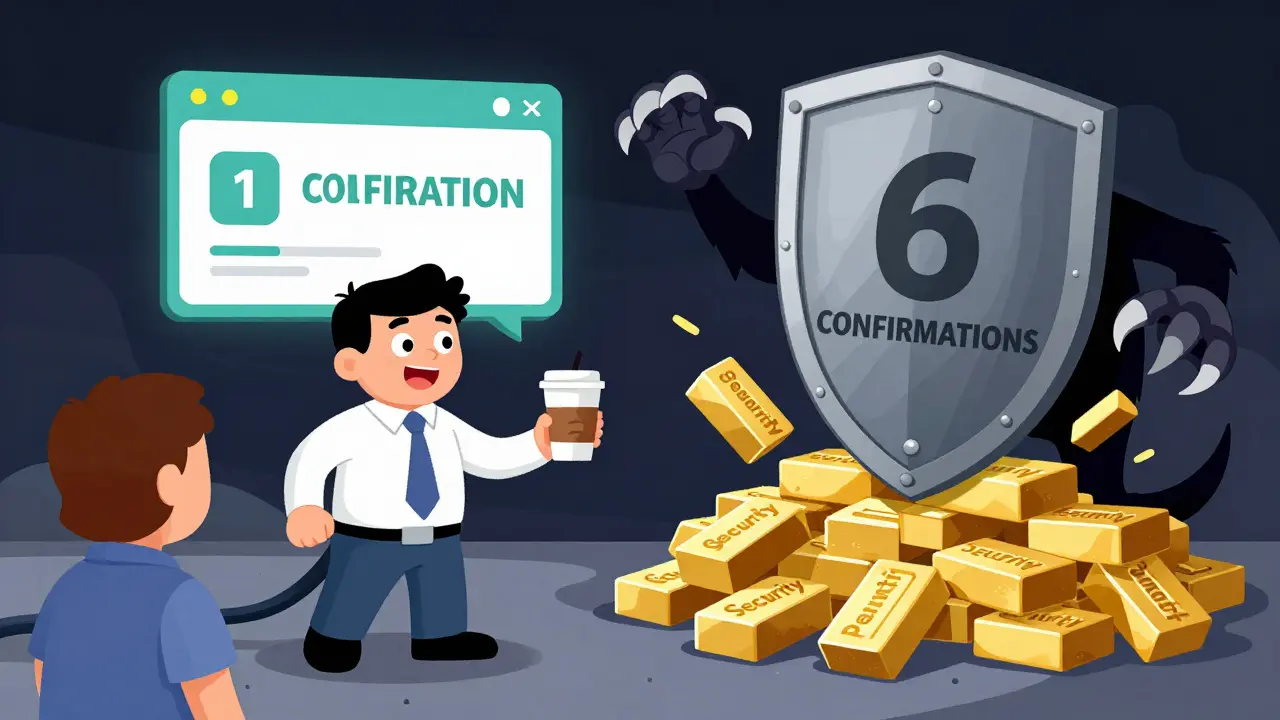
Finality means a transaction can’t be undone. In traditional banking, a payment can be reversed via chargebacks, fraud claims, or errors. Bitcoin doesn’t allow that. Once confirmed, it’s permanent. But Bitcoin doesn’t confirm instantly. It uses a system called probabilistic finality, which means security builds over time. The more blocks get added on top of your transaction, the harder it becomes to reverse.Think of it like stacking bricks. One brick? Easy to knock over. Ten bricks? Much harder. Each new block added after your transaction is another brick. After six blocks, it’s practically impossible to knock the whole tower down without controlling more than half of the entire Bitcoin network’s computing power-a cost that runs into billions of dollars.
Why Six Confirmations?
Bitcoin mines a new block roughly every 10 minutes. So, six confirmations mean about 60 minutes. That’s not arbitrary. It’s the result of years of observation, testing, and real-world risk modeling.Here’s how it works: When you send Bitcoin, your transaction gets bundled into a block. That’s one confirmation. But at this point, a miner could still, in theory, create an alternate version of that block and try to replace it. If they do, your transaction disappears. It’s rare, but it happens.
After two blocks, the chance of a successful attack drops sharply. After four, it’s extremely unlikely. By six, the probability of a reorganization is so low-less than one in a trillion-that exchanges, wallets, and businesses treat it as final. This standard is used by Coinbase, Binance, Kraken, and nearly every major platform.
Why not one? Or three? Because Bitcoin isn’t designed for speed. It’s designed for security. A single confirmation might be fine for a $5 coffee, but not for a $500,000 real estate transfer. The six-block rule balances practicality with safety.
How Long Does It Actually Take?
You might think 60 minutes is fixed. But it’s not. Bitcoin’s block time averages 10 minutes, but it varies. Sometimes blocks come every 5 minutes. Other times, it takes 15 or even 20. Network congestion plays a big role.If you’re sending Bitcoin during a spike in activity-like after a major price move or a new ETF announcement-your transaction might sit in the mempool (the waiting room) for hours. Miners prioritize transactions with higher fees. If you pay too little, your transaction can get stuck. That’s why you should always check the recommended fee before sending.
Blockchain explorers like Blockchair or Bitaps show you exactly how many confirmations your transaction has. You can watch it go from 0 to 1, then 2, then 3… and so on. Most wallets automatically show this progress. But don’t assume it’s final until you see at least six.
Why Isn’t Bitcoin Faster?
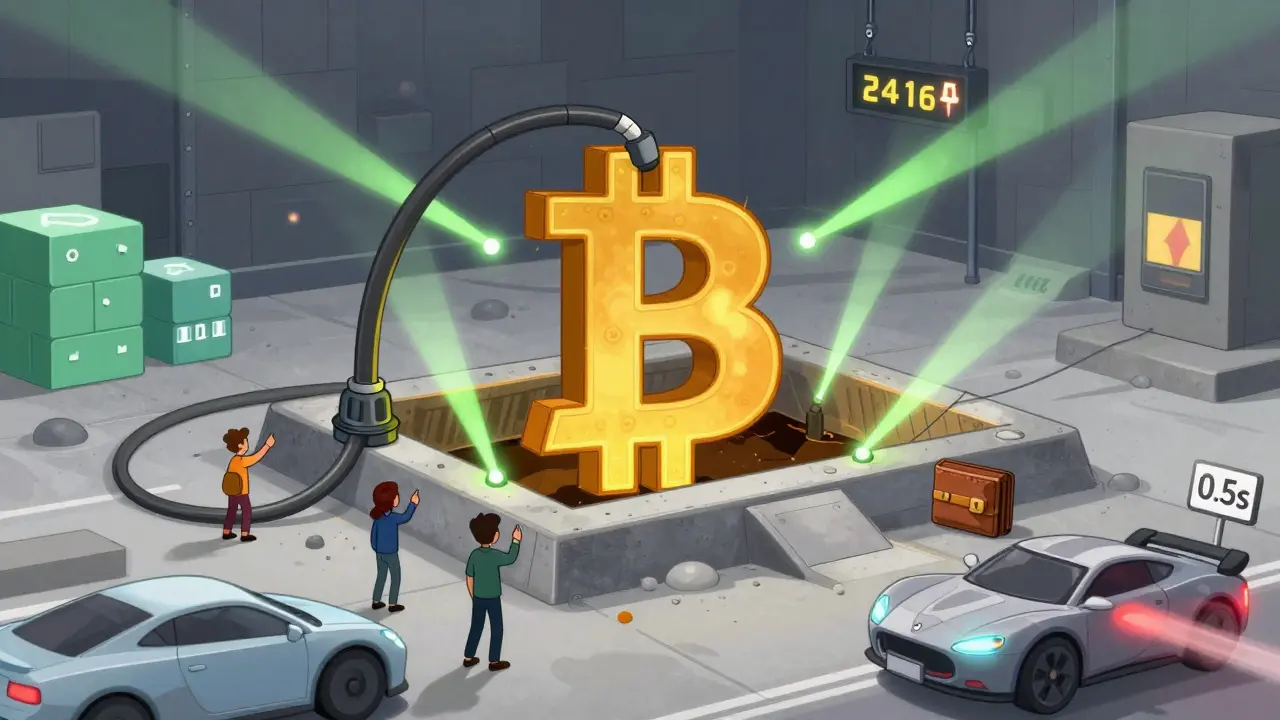
You’ve probably heard of blockchains that confirm in seconds. Solana. Sei. Polygon. Even Ethereum now finishes in under a minute. So why doesn’t Bitcoin change?Because speed isn’t the goal. Bitcoin’s designers wanted a system that could survive attacks, censorship, and government interference. Faster chains often rely on centralized validators or fewer nodes. Bitcoin has over 15,000 full nodes spread across the globe. That decentralization slows things down-but it also makes it nearly unbreakable.
Compare it to a vault. A bank vault opens in seconds if you have the right code. But if it’s buried under 10 feet of concrete, guarded by lasers, and has a 24-hour lockout? It’s slower, but no one’s ever stolen from it. Bitcoin is that vault.
What About Lightning Network and Layer 2?
If Bitcoin’s base layer is slow, how do people make daily payments? That’s where the Lightning Network comes in. It’s a second layer built on top of Bitcoin. Lightning transactions settle in under a second, with near-zero fees. But here’s the catch: Lightning is for small, frequent payments. Think coffee, snacks, or tips.When you want to move large amounts-say, $10,000 or more-you still settle on the Bitcoin blockchain. That’s when the six-block wait kicks in. Lightning handles the day-to-day. Bitcoin handles the big, permanent moves.
The Taproot upgrade in 2021 made Lightning more efficient and private, but it didn’t change Bitcoin’s core finality rules. The 60-minute standard remains.
How Do Exchanges and Businesses Handle It?
Most exchanges require 3 to 6 confirmations before crediting your deposit. Why not just one? Because they’ve been burned before. In 2018, a double-spend attack on a small exchange cost them $1 million. They now wait for six confirmations as insurance.Merchants who accept Bitcoin for goods usually wait for at least one confirmation before shipping. But for high-value items-electronics, cars, jewelry-they wait for three or more. Automated systems monitor the blockchain and send alerts when the transaction reaches the required depth.
Some services offer zero-confirmation transactions. That means they accept your payment before any block is mined. It’s risky. If the transaction gets rejected later (due to a conflict or fee issue), they lose money. Only trusted, low-risk merchants use this-and even then, they limit it to small amounts.
What Do Users Really Think?
Reddit and BitcoinTalk are full of debates about this. New users often complain: "Why does it take an hour? I just want to send money!" They compare Bitcoin to Apple Pay and get frustrated.But long-time users? They appreciate it. One user on BitcoinTalk wrote: "I sent my life savings in Bitcoin last year. I waited 72 minutes. I didn’t care. I knew it was safe. That’s worth more than speed."
For institutional investors, hedge funds, and custody providers, Bitcoin’s slow finality is a feature, not a bug. It means their assets won’t vanish overnight due to a hack, a bug, or a malicious validator. In finance, finality isn’t about speed-it’s about certainty.
Finality vs. Other Blockchains
Here’s how Bitcoin stacks up:| Blockchain | Average Finality Time | Consensus Mechanism | Use Case Focus |
|---|---|---|---|
| Bitcoin | 60 minutes (6 confirmations) | Proof-of-Work | Store of Value, Large Transfers |
| Ethereum | 1-5 minutes | Proof-of-Stake | DeFi, Smart Contracts |
| Solana | 2-4 seconds | Proof-of-History + Stake | High-Frequency Trading, Apps |
| Sei Network | Under 400 milliseconds | Twin-Turbo Consensus | Trading, Low-Latency DApps |
| Lightning Network | Under 1 second | Off-Chain Channels | Microtransactions, Daily Spending |
Notice something? Bitcoin is the slowest. But it’s also the only one with a 15-year track record of zero successful double-spends. Speed matters-but not if you lose your money.
What Should You Do?
- For small payments (< $100): One confirmation is often enough. Wait 10-20 minutes. - For medium amounts ($100-$10,000): Wait for three confirmations (~30 minutes). - For large transfers (> $10,000): Wait for six confirmations (~60 minutes). Don’t skip this. - Always check fees. Low fees = slow confirmation. - Use a blockchain explorer to track your transaction. Don’t rely on wallet notifications alone. - If you’re a merchant, set up automated confirmations. Never ship until the number matches your risk tolerance.Bitcoin’s finality time isn’t a flaw. It’s the price of trust. In a world where banks can freeze accounts and payment processors can reverse charges, Bitcoin offers something rarer: permanence. That’s why, even in 2026, it remains the most secure digital asset ever created.
How long does it take for a Bitcoin transaction to be confirmed?
A Bitcoin transaction gets its first confirmation when it’s included in a mined block, which usually takes 10 minutes. Most services consider it safe after six confirmations, which takes about 60 minutes on average. However, during high network traffic, this can stretch to 2 hours or more if fees are too low.
Why is Bitcoin slower than other cryptocurrencies?
Bitcoin prioritizes security and decentralization over speed. Its 10-minute block time and proof-of-work consensus make it resistant to attacks and censorship. Faster blockchains use fewer nodes or centralized validators, which sacrifices some of that security. Bitcoin’s design means it’s slower-but also more battle-tested.
Can a Bitcoin transaction be reversed after confirmation?
No, not after six confirmations. Bitcoin transactions are irreversible by design. Even if you send Bitcoin to the wrong address, there’s no way to undo it. This is why double-checking addresses and waiting for full confirmations is critical. Some services claim to "recover" funds-but they’re scams.
Do all exchanges require six confirmations?
Most major exchanges like Coinbase, Binance, and Kraken require six confirmations for deposits. Smaller platforms may accept fewer, especially for small amounts. But if you’re depositing a large sum, six is the industry standard for safety. Always check your exchange’s policy before sending.
Is Lightning Network faster than Bitcoin’s base layer?
Yes, Lightning Network transactions settle in under a second and have near-zero fees. But it’s designed for small, frequent payments like buying coffee or tipping. For large transfers, you still need to settle on Bitcoin’s main chain, which requires the standard six confirmations. Lightning complements Bitcoin-it doesn’t replace its finality model.
What happens if my transaction gets stuck?
If your transaction stays unconfirmed for hours, it’s likely because you paid too low a fee. You can’t speed it up directly. Your options are: wait it out (it may eventually drop from the mempool), or use a replace-by-fee (RBF) tool if your wallet supports it. Never resend the same Bitcoin-it will create a conflict and may be rejected by the network.
Comments (19)
Justin Credible
March 23, 2026 AT 09:48
I just sent 0.5 BTC yesterday and it took 45 mins. Didn't panic, checked Blockchair, saw it hit 6 confirmations. Chill. Bitcoin's patience pays off.
John Alde
March 23, 2026 AT 12:14
The six-confirmations standard isn't arbitrary-it's rooted in probabilistic security models from Nakamoto's original paper. Each additional block exponentially reduces the likelihood of a reorg. At 6, the probability drops below 1e-12. That's not 'slow'-that's mathematically robust.
Mohammed Tahseen Shaikh
March 24, 2026 AT 06:13
People whine about 60 minutes but they'd lose their damn minds if their life savings vanished because some miner flipped a block after 2 confirmations. Bitcoin's not for people who want instant gratification. It's for people who want to sleep at night.
Neil MacLeod
March 24, 2026 AT 06:55
You call it slow. I call it sacred. Solana’s got 4-second finality? Cool. Let me know when it’s survived 15 years of nation-states trying to murder it. Bitcoin’s not a payment app. It’s a monument.
Mike Yobra
March 24, 2026 AT 21:48
So Bitcoin’s finality is slower than a dial-up connection... but somehow it’s the only thing that hasn’t been hacked, frozen, or regulated into oblivion. Funny how that works.
Anna Lee
March 25, 2026 AT 01:42
I used to think 6 confirmations was overkill until I lost a payment to a double-spend on a sketchy exchange. Now I wait 10. Better safe than sorry. Trust the process.
Brad Zenner
March 26, 2026 AT 05:16
Lightning’s great for coffee. But when I moved my entire portfolio? Six confirmations. No shortcuts. The base layer is the bedrock. Everything else is just scaffolding.
Marie Mapilar
March 27, 2026 AT 05:59
I love how Bitcoin forces you to slow down. In a world of instant everything, waiting 60 minutes for a transaction feels like a meditation. You’re not just sending money-you’re participating in a global, decentralized consensus. It’s kinda beautiful.
Anand Makawana
March 28, 2026 AT 09:23
The probabilistic finality model is elegantly designed: the cumulative computational work required to reverse a transaction scales exponentially with each additional block. The 6-block threshold represents the point at which the economic cost of a successful 51% attack exceeds the potential gain, rendering the attack irrational. This is not a flaw-it is an economic equilibrium.
Andrew Midwood
March 29, 2026 AT 09:45
I once sent BTC during a mempool spike and it took 3 hours. I panicked. Then I learned about RBF. Now I just set fees properly. Bitcoin’s not broken-it’s just misunderstood. Learn the tools, not the fear.
Alice Clancy
March 30, 2026 AT 18:33
USA has PayPal. Europe has SEPA. India has UPI. And we’re all like 'oh no Bitcoin takes an hour' like it's 1999. Newsflash: if you want speed, use a bank. If you want freedom, wait 60 mins. Simple.
Abhishek Thakur
March 30, 2026 AT 20:58
Don't forget: even with 6 confirmations, a transaction can still be replaced if RBF is enabled. But that's not a flaw-it's a feature for users who want to fix mistakes. Bitcoin gives you control.
manoj kumar
March 31, 2026 AT 05:09
Six confirmations? That's just tradition. Why not 3? Or 4? Everyone just copies Binance because they're lazy. I've seen blocks reorg after 5 confirmations. The whole system is a meme.
Pradip Solanki
April 1, 2026 AT 18:20
You think Bitcoin is slow? Look at Ethereum. They changed consensus. They changed rules. They changed everything. Bitcoin stays the same. That's why it's the only one that matters.
kavya barikar
April 2, 2026 AT 03:25
Finality is not speed. Finality is certainty. And certainty is priceless.
Misty Williams
April 2, 2026 AT 13:12
If you're using Bitcoin for anything less than a sovereign store of value, you're using it wrong. Speed is for children. Security is for adults.
Andrea Zaszczynski
April 3, 2026 AT 22:00
I just sent $5000 and waited 70 minutes. My heart was racing. Then I saw 6 confirmations. I cried. Not because I was rich. Because I knew it was safe. Forever.
Tammy Stevens
April 4, 2026 AT 09:09
I work with crypto funds. We wait 6 confirmations. Always. But we also monitor the mempool, use fee estimators, and track block propagation. It’s not magic-it’s diligence. Bitcoin rewards preparation.
Tony Phillips
April 4, 2026 AT 20:44
The real win isn’t speed. It’s that no one can freeze your money. No one can reverse your payment. No one can take it back. That’s worth waiting for.