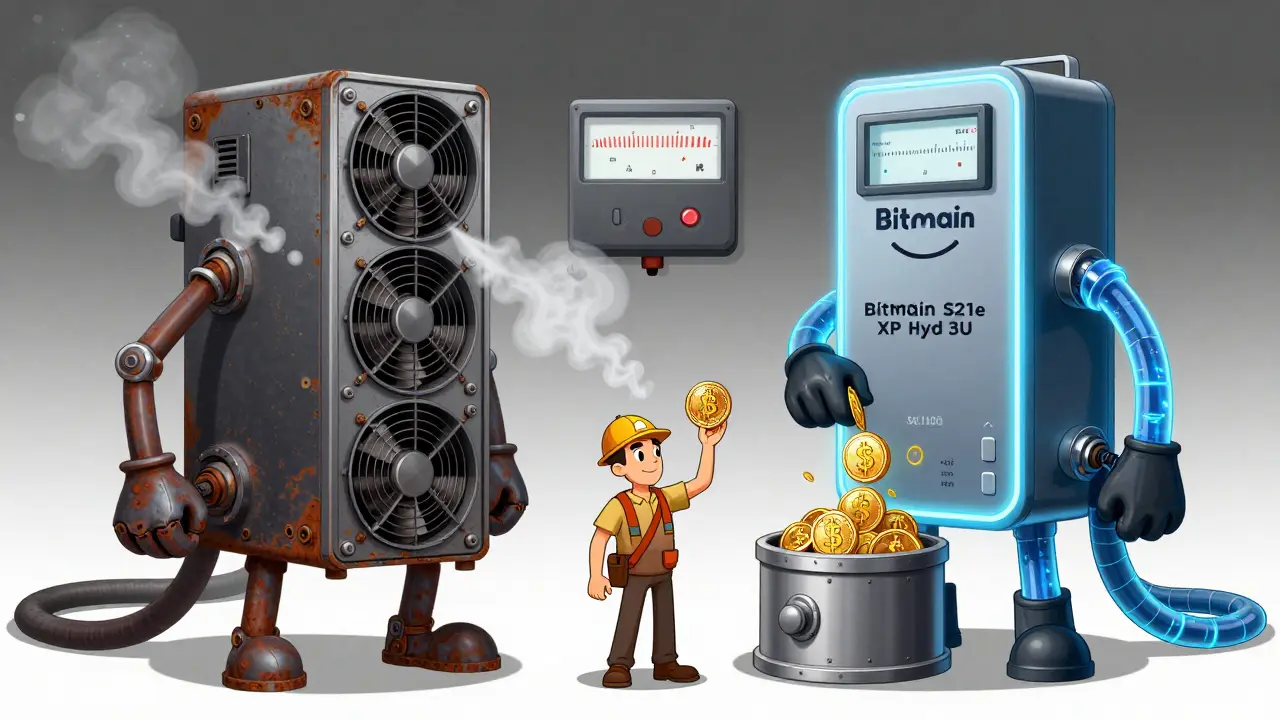
When you're serious about Bitcoin mining in 2025, the first real decision you face isn't which coin to mine - it's whether to buy used or new mining hardware. At first glance, a $600 used Antminer S9 looks like a steal. But by the time you pay your electricity bill at the end of the month, you might realize you're paying more to run it than you're earning from it. Meanwhile, a brand-new Bitmain Antminer S21e XP Hyd 3U costs over $17,000. That’s a lot of cash upfront. So which one actually makes sense? The answer isn’t as simple as "go cheap" or "go new." It’s about efficiency, hidden costs, and how long you plan to mine.
Efficiency Is Everything Now
In 2025, mining isn’t about brute force anymore. It’s about how much hash power you get per watt of electricity. The numbers don’t lie. The old Antminer S9, released in 2016, churns out 14 TH/s while using 95 joules per terahash (J/TH). That’s ancient by today’s standards. The new Bitmain S21e XP Hyd 3U, released in January 2025, does 860 TH/s at just 13 J/TH. That’s more than seven times more efficient. At a electricity rate of $0.10/kWh, the S9 burns through $250-$300 a month just in power, while the S21e uses under $40 for the same time period - and mines over 15 times more Bitcoin.That gap keeps growing. Network difficulty adjusts every two weeks, and in 2025, it’s hitting record highs. Miners with older hardware are getting squeezed out. A miner that was profitable last year might now be losing money. The math is brutal: if your machine uses more than 50 J/TH, you’re already on thin ice. By mid-2026, machines above 50 J/TH will likely stop mining profitably at all. That’s why experts say it plainly: "Miners of older generations that run on factory settings won’t be able to compete with new flagship models - that is a hard fact, a reality of 2025."
The Hidden Costs of Used Hardware
Sure, a used miner looks cheap. But the price tag doesn’t tell the whole story. Many buyers think they’re getting a bargain - until the fans start failing, the power supply dies, or the hashboard overheats. Used ASICs, especially older models like the S9 or DG Home 1, were never designed for 24/7 operation beyond a few years. Most have already lived through multiple Bitcoin cycles. Their components are worn out.On Reddit, user u/MiningMaster45 bought an S9 for $600. Within 11 months, he spent $320 on replacement fans and power supplies. His new S21? Ran flawlessly for 14 months with zero repairs. That’s not unusual. Community data from Bitcointalk.org shows used miners require 30-50% more maintenance than new ones. You’re looking at $150-$300 per year just in spare parts - and that’s if you’re handy enough to fix them yourself. If you need to pay someone, those costs double.
Warranty is another blind spot. New ASICs from Bitmain or MicroBT come with 180-day coverage. Used units? Most sellers offer "tested working" - which means it ran when they plugged it in. No guarantees. One Trustpilot review from September 2025 said their "refurbished" S9 failed within three weeks. Another user praised their refurbished S19j for hitting ROI in five months - but that’s the exception, not the rule. You’re gambling on a machine that’s already been pushed hard.

Why New Hardware Pays for Itself
The upfront cost of a new miner is intimidating. But look at the long game. The Bitmain S21e XP Hyd 3U costs $17,210. Sounds insane. But here’s the real math: at $0.10/kWh and current Bitcoin prices, it earns about $1,100 per month after electricity. That’s $13,200 a year. It pays for itself in under 16 months - and then keeps earning. After two years, you’ve cleared over $10,000 in profit. That’s not counting Bitcoin price increases.Compare that to a used S9. Even if you get it for $600 and mine profitably for six months, you’re lucky to make $800 total. Then the power bills eat you alive. By month eight, you’re spending more on electricity than you earn. And by year two? You’re looking at a brick. No resale value. No warranty. No upgrades. Just a noisy, hot, expensive paperweight.
New miners also come with better cooling. The S21e XP Hyd 3U uses hydro-cooling - liquid cooling designed for data centers. It runs at 50dB, quieter than a dishwasher. Old air-cooled models like the S9? They scream at 75dB. You need a dedicated room. Soundproofing. Extra ventilation. That adds $1,000+ in setup costs you didn’t budget for.
Who Should Buy Used?
Let’s be clear: used miners aren’t dead. They just aren’t for everyone. There’s one scenario where they make sense: short-term speculation. If you’re planning to mine for less than a year - maybe you’re testing the waters, or you think Bitcoin will spike before the next halving - then a used miner could give you quick exposure with low risk.Some miners use used hardware as a "bridge." They buy an S19j for $1,200, mine for six months, and sell it before it becomes unprofitable. That’s a strategy. But it requires timing, market awareness, and the ability to sell before the value drops. According to ECOS’s resale data, S9s lost 40% of their value in Q3 2025. S21s held 75% of theirs. If you’re not ready to flip, you’re stuck with a money pit.
Another group: hobbyists with very low electricity rates. If you have access to free or subsidized power - say, from solar panels or a rural grid - then even inefficient miners might break even. But that’s rare. Most home miners pay $0.12-$0.15/kWh. At those rates, any miner over 30 J/TH is a net loss.

Market Trends Are Pushing You Toward New
The industry is shifting fast. In 2023, only 12% of large mining operations used immersion cooling. By 2025, that number is 35%. Why? Because it cuts power use by 20-30%. But you can’t retrofit an old S9 into an immersion tank. The hardware wasn’t built for it. New ASICs like the S21e XP Hyd 3U are designed from the ground up for liquid cooling. They’re sealed. They’re modular. They’re built to last.Enterprise miners now control 82% of Bitcoin’s hashrate. That’s up from 75% in 2023. These are companies with deep pockets and engineering teams. They don’t buy used hardware. They buy new, they optimize it, and they scale it. If you’re an individual miner, you’re competing against machines that are 7x more efficient than yours. The odds are stacked.
Regulations are tightening too. California’s BTC-MIN-2024 rule requires miners to use at least 30% renewable energy. That’s not a problem if you’re running a 13 J/TH miner. But if you’re using a 95 J/TH machine? You need three times the solar panels. That’s not practical.
The Bottom Line
Buying used mining hardware feels smart - until it isn’t. The savings are real, but so are the risks. If you’re in this for the long haul - and you want to make money, not just try mining - new ASICs are the only choice that makes sense. The upfront cost is high, but the payoff is real: lower bills, fewer repairs, better uptime, and real profits.Used miners can work as a stopgap. But if you’re planning to mine beyond 12 months, you’re better off saving up for new. Because by 2026, the machines that aren’t under 20 J/TH won’t just be unprofitable - they’ll be worthless.
Is it worth buying a used Antminer S9 in 2025?
No, not for serious mining. The Antminer S9 uses 95 J/TH, which is far too inefficient for today’s network difficulty. Even at $600, the electricity costs alone can eat up 87% of your daily earnings. Most users report needing multiple fan and PSU replacements within a year, adding hundreds in hidden costs. Unless you’re mining for under six months with very cheap power, the S9 will lose money.
What’s the most efficient Bitcoin miner available in 2025?
The Bitmain Antminer S21e XP Hyd 3U leads the market with 13 J/TH efficiency at 860 TH/s. It’s designed for hydro-cooling, runs quieter than older models, and has the lowest power cost per hash. Other strong contenders include the MicroBT Whatsminer M56S++ (14 J/TH) and the Auradine Teraflux AH3880 (14.5 J/TH), but the S21e XP Hyd 3U remains the efficiency benchmark.
How long does it take to break even on a new ASIC miner?
At current Bitcoin prices and $0.10/kWh electricity, most new ASICs like the S21e XP Hyd 3U break even in 14-18 months. Cheaper models like the Canon Avalon Q (18.5 J/TH) can hit ROI in 12-14 months. Factors like Bitcoin price, network difficulty, and local electricity rates can shorten or extend this window. After break-even, the miner becomes pure profit.
Can I make money mining with a used GPU instead of ASIC?
No, not for Bitcoin. ASICs are 100-1,000x more efficient than GPUs for SHA-256 mining. A high-end GPU like the RTX 4090 might get 100 MH/s for Bitcoin - while a single S21e does 860 TH/s. That’s 8.6 million times more power. Even if you mine altcoins with GPUs, you’re competing against farms of ASICs that dominate the market. ASICs are the only viable option for Bitcoin mining.
Do used miners have resale value?
Very little - and it drops fast. In Q3 2025, S9 models lost 40% of their value. S21 models held 75%. Once a miner’s efficiency falls below 50 J/TH, its resale value plummets. Most used miners are bought for parts or scrapped. If you plan to sell later, only buy new models designed for longevity and cooling upgrades.
Comments (10)
Tracy Peterson
February 22, 2026 AT 03:37
Let’s be real - if you’re mining in 2025 and still clinging to an S9, you’re not a pioneer, you’re a fossil. Efficiency isn’t a suggestion, it’s the law of the land now. The math doesn’t care how attached you are to your old rig. The S21e doesn’t just outperform it - it makes the S9 look like a toaster with a GPU taped to it.
Amita Pandey
February 23, 2026 AT 09:26
One must consider the ethical implications of energy consumption in the context of global climate imperatives. To deploy antiquated hardware that squanders electricity at 95 J/TH is not merely economically unsound - it is a moral failure in an age of scarcity. The pursuit of profit at the expense of planetary equilibrium cannot be rationalized through cost-benefit analysis alone.
Phillip Marson
February 23, 2026 AT 13:40
Used miners are for suckers who think they’re getting a deal but end up paying twice - once for the box and again for the replacement parts, the electric bill, and the therapy after realizing they just bought a space heater that prints fake Bitcoin receipts. I’ve seen guys cry over their S9s. Not joking. One guy named his rig ‘Dave’ and buried it in the backyard. Dave was a bad friend.
Dianna Bethea
February 24, 2026 AT 13:38
I started with a used S19j - thought I was being smart. Turned out the hashboard was fried after three months. I lost two months of earnings just waiting for a replacement. Then I saved up and got the S21e. Zero issues. Quiet. Efficient. My电费 dropped by 70%. If you’re serious about this, don’t gamble on used. Buy new once. It’s cheaper in the long run. Trust me, I’ve been there.
Jeff French
February 25, 2026 AT 03:15
From a systems perspective, the TCO of legacy ASICs is distorted by externalized maintenance and obsolescence costs. The 13 J/TH efficiency threshold represents the marginal equilibrium point for grid-constrained operations. Anything above 30 J/TH is functionally non-viable under current network dynamics. The hydro-cooled architectures aren’t just improvements - they’re evolutionary adaptations to regulatory and economic pressures.
Tracy Whetsel
February 26, 2026 AT 17:51
you’re not wrong about the s9 being a brick… but i’ve got a buddy in texas who runs 3 of them on his solar farm. zero grid cost. he says it’s like having free money in a slow drip. not profitable? maybe. but he says it’s peaceful. like watching grass grow. 🌱⚡
Alyssa Herndon
February 27, 2026 AT 22:43
I think about this like buying a car. Would you buy a 2008 Honda Civic and expect it to keep up with a Tesla Model S on the highway? Sure, it’ll move - but you’ll be sweating, spending on repairs, and wondering why you didn’t just save up for something that actually works. The S21e isn’t just a miner - it’s the future. And the future doesn’t wait.
Elana Vorspan
February 28, 2026 AT 20:31
i’ve been mining for 4 years and i’ve tried everything. used, new, air, liquid. the truth? if you’re not starting with new hardware in 2025, you’re already behind. not because you’re dumb - because the game changed. the s21e isn’t flashy, it’s just… right. 🤍
Ifeanyi Uche
March 1, 2026 AT 08:33
you all talk like you got money to burn but here in nigeria we dont have choice. we take used miners and fix them with duct tape and hope. if you got power you lucky. we use generator and pay 3x rate. but we still mine. because if you dont mine you dont eat. so dont judge us for using s9. we aint here for profit. we here for survival.
George Suggs
March 2, 2026 AT 03:59
Used miners aren’t dead. They’re just resting. But if you’re planning to mine past 2026, you’re not saving money - you’re just delaying the inevitable. Buy new once. Run it hard. Let it pay for itself. Then upgrade. That’s the game now. No drama. Just math.