
If you’ve ever tried to trade crypto and got blocked by a message like "This service isn’t available in your country," you’ve hit one of the biggest real-world barriers in crypto: geographic restrictions. It doesn’t matter how much you know about blockchain or how confident you are in your trades - if your location locks you out, you’re stuck. And the difference between how centralized exchanges (CEX) and decentralized exchanges (DEX) handle these restrictions isn’t just technical - it’s life-changing for users in places like Nigeria, Russia, Iran, or even parts of the U.S.
How CEXs Block Users by Location
Centralized exchanges like Binance, Coinbase, and Kraken act like banks. They need licenses. They report to governments. They collect your ID, your address, your tax number. If you’re in a country where crypto is tightly controlled - or outright banned - these platforms have no choice but to block you. It’s not about technology. It’s about legal risk.For example, in China, all major CEXs shut down services completely after the 2021 crackdown. In India, while crypto isn’t illegal, exchanges like Binance had to stop offering INR deposits because local banks refused to process crypto-related transactions. In the U.S., derivatives trading is blocked in states like New York unless the exchange gets a BitLicense - which only a handful have.
These blocks aren’t just about country borders. Even within the same country, access can vary. Some CEXs disable margin trading for users in California but allow it in Texas. Others restrict staking in certain EU countries due to MiCA regulations. The system is messy, inconsistent, and always changing.
Behind the scenes, CEXs use multiple layers to enforce these rules: IP address checks, KYC document verification, bank account matching, and even device fingerprinting. If your VPN changes your IP but your ID says you’re in Brazil and your bank is in Germany, the system flags you. You don’t just get blocked - you might get your account frozen.
Why DEXs Feel Like a Workaround
Decentralized exchanges like Uniswap, PancakeSwap, and Curve don’t ask for your name, your passport, or your address. You connect your wallet - MetaMask, Phantom, or Ledger - and start trading. No sign-up. No waiting. No paperwork.This is why DEXs are the go-to for users in countries with strict capital controls or hostile crypto policies. In Nigeria, where the central bank once shut down bank accounts linked to crypto, traders moved to DEXs. In Venezuela, where the bolívar collapsed, people swapped USDT on DEXs to preserve value. In Russia, after SWIFT bans and sanctions, DEXs became one of the few ways to trade crypto without relying on Western financial infrastructure.
DEXs don’t have a central server to shut down. They run on smart contracts deployed on blockchains like Ethereum, BSC, or Solana. As long as you can access the blockchain, you can trade. No one can turn off Uniswap. No regulator can force it to stop serving users in Iran.
But here’s the catch: DEXs aren’t magic. They still rely on gateways. You need to buy ETH or SOL first - usually through a CEX or a peer-to-peer platform. If your country blocks access to those on-ramps, you’re still locked out. A DEX won’t help if you can’t get crypto into your wallet in the first place.
The Fiat Problem: CEXs Win, DEXs Lose
Most people don’t start with crypto. They start with dollars, euros, or pesos. That’s where CEXs have a huge advantage. Coinbase lets you deposit USD via bank transfer. Binance lets you buy BTC with local currency in over 100 countries. Kraken supports SEPA, Faster Payments, and even PayMaya in the Philippines.DEXs don’t do any of this. You can’t deposit euros into Uniswap. You can’t buy Bitcoin with cash on PancakeSwap. You need to already own crypto. That means if you live in a place where buying crypto is hard - because banks won’t touch it, or P2P platforms are banned - you’re stuck before you even get to the DEX.
So while DEXs give you freedom once you’re in, CEXs give you the key to get in. For most people, that’s the bigger barrier.
Regulators Are Starting to Target DEXs
For years, DEXs operated in a gray zone. Regulators didn’t know how to handle them. Now they’re figuring it out - and they’re not happy.In 2024, the U.S. SEC sued Uniswap Labs, claiming the platform was operating as an unregistered securities exchange. The EU’s MiCA regulation now requires DEXs to implement “reasonable measures” to prevent access from restricted jurisdictions. South Korea is pushing for mandatory KYC on all wallet-to-wallet trades above a certain amount.
Some DEXs are already responding. Uniswap has started blocking access from IP addresses in sanctioned countries like Syria and North Korea. SushiSwap added a geo-blocking layer for users in the U.S. and Canada. Even decentralized protocols are building compliance tools - not because they want to, but because they have to if they want to survive.
This is the turning point. DEXs were supposed to be unblockable. Now, they’re being pressured to become just like CEXs - with location filters, KYC checks, and compliance teams. The dream of truly borderless finance is fading.
Security and Responsibility: Who Really Controls Your Assets?
When you use a CEX, you’re trusting them with your money. They hold your keys. They control withdrawals. If they freeze your account - because of a compliance flag, a false report, or a hack - you’re at their mercy. In 2022, over $2 billion was lost when CEXs like FTX collapsed. Users couldn’t access their funds because the exchange owned them.With DEXs, you hold your own keys. No one can freeze your wallet. No regulator can demand your assets be seized - unless they come after you personally. But that freedom comes with risk. If you send crypto to the wrong address? Gone forever. If you lose your seed phrase? Gone forever. If you trade on a scam token? You’re on your own.
And here’s the quiet truth: even if you’re using a DEX, you’re still subject to your country’s laws. If your government bans crypto trading, using a DEX doesn’t make it legal. You might avoid the exchange’s blocks, but you’re still breaking local rules.
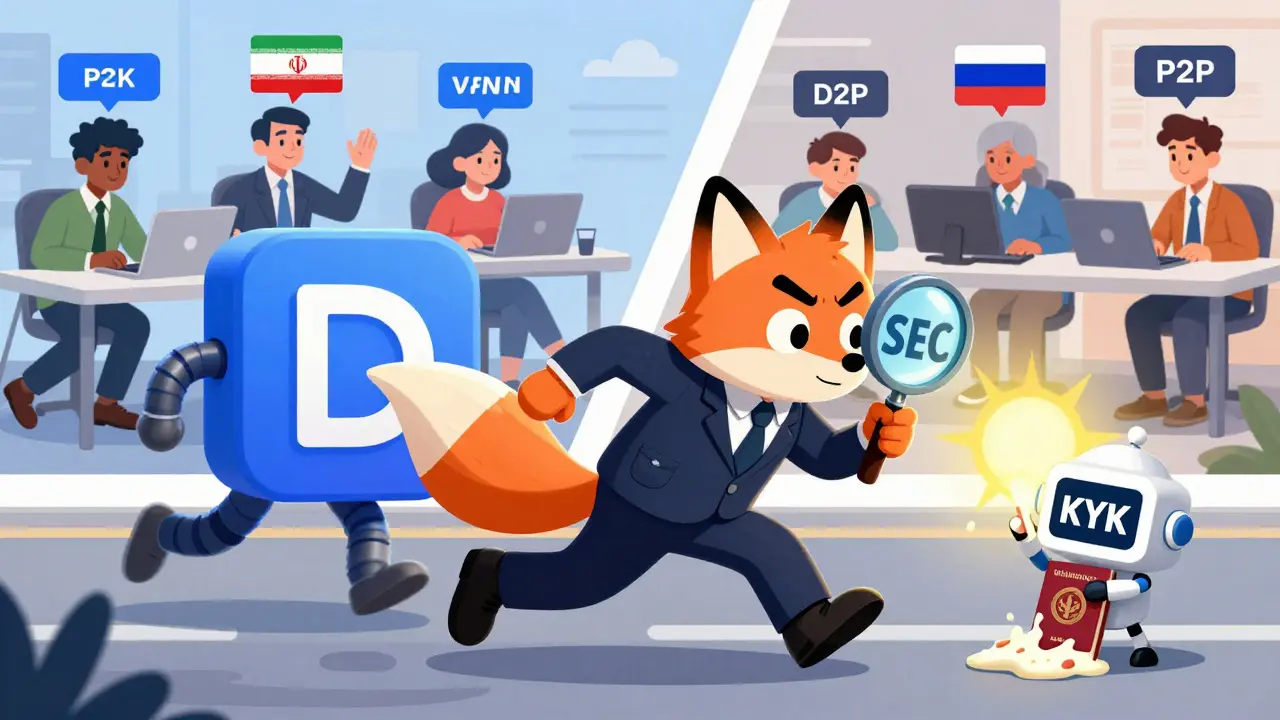
What Works Where? A Quick Global Snapshot
Here’s how things break down in real-world scenarios:
- United States: CEXs are the norm. DEXs are popular among advanced users but require a CEX to buy crypto first. State-level rules vary - New York is the strictest.
- Nigeria: CEXs are blocked by banks. DEXs thrive. P2P platforms like Paxful are the main on-ramp.
- Russia: CEXs like Binance and Kraken are restricted. DEXs on BSC and Ethereum are used with crypto acquired via P2P or mining.
- India: CEXs operate with heavy restrictions. DEXs are growing fast, but users rely on foreign wallets and crypto bought abroad.
- Iran: CEXs are inaccessible. DEXs and mining are the only options. Many use TOR to bypass blocks.
- EU: CEXs comply with MiCA. DEXs are under pressure to add KYC. Some DEXs now block EU IPs.
There’s no global standard. What’s legal in one country is illegal in the next. And the rules change every few months.
The Future: Blurred Lines Between CEX and DEX
The line between CEX and DEX is disappearing. Some CEXs now offer non-custodial wallets. Some DEXs are adding KYC layers. Some wallets are building compliance into their interfaces. Even MetaMask now warns users about sanctioned addresses.What’s clear is that geography still matters - a lot. Crypto was sold as a tool to escape borders. But in practice, it’s still bound by them. The real winners aren’t the platforms. They’re the users who understand the trade-offs:
- If you need to deposit fiat quickly - use a CEX.
- If you’re in a restricted country and already have crypto - use a DEX.
- If you care about control and privacy - DEXs win.
- If you want customer support and legal recourse - CEXs win.
The next five years won’t be about which is better. It’ll be about which one you can actually use - and whether your government lets you keep using it.
Can I use a DEX if my country bans crypto?
Technically, yes - DEXs don’t require registration or KYC, so you can connect your wallet from anywhere. But if your country bans crypto trading, using a DEX still violates the law. You might avoid the exchange’s blocks, but you’re not avoiding legal risk. Authorities can track wallet activity, seize assets, or even prosecute individuals.
Why can’t DEXs just block users like CEXs do?
DEXs run on public blockchains - there’s no central server to block IPs or ban accounts. Smart contracts execute automatically when triggered. You can’t easily stop a transaction from happening if the code allows it. Some DEXs now add geo-blocking at the frontend level (like blocking access from certain IPs), but that’s not foolproof. Users can still use VPNs or access the DEX through alternative gateways.
Is it safer to use a CEX or a DEX in a high-risk country?
It depends on your risk. CEXs are easier to target - if your government cracks down, your account gets frozen or seized. DEXs are harder to shut down, but if you’re identified as a user, you could face personal legal consequences. For most people in high-risk countries, DEXs offer more operational safety - but only if you’re careful with your wallet and don’t link your identity to transactions.
Do I need to pay taxes if I trade on a DEX?
Yes. Tax authorities in most countries treat crypto trades the same regardless of whether they happen on a CEX or DEX. Every swap, every trade, every conversion is a taxable event. DEXs don’t report to the IRS or other tax agencies, but that doesn’t mean you’re exempt. You’re still responsible for tracking and reporting your activity.
Can I use a VPN to access a blocked CEX?
You can try, but it’s risky. Most major CEXs detect and ban VPN usage. If you’re caught, your account can be permanently frozen, and you could lose your funds. Some users do it anyway - but they’re gambling. The platform isn’t just blocking your IP - it’s checking your KYC data, bank details, and device fingerprint. A VPN won’t hide those.
Are DEXs really more private than CEXs?
They’re more anonymous, but not fully private. CEXs know your identity. DEXs don’t - but blockchain is public. Anyone can see your wallet’s transaction history. If you ever link your wallet to an exchange, a service, or an email, your identity can be traced. True privacy requires advanced tools like mixers or privacy coins - which aren’t available on most DEXs.
Comments (12)
Ziv Kruger
December 5, 2025 AT 07:33
Crypto was sold to us as the great equalizer - a digital frontier beyond borders. But here we are, trapped in the same old game of nation-states drawing lines in the sand. The blockchain doesn’t care where you live. The regulators do. And that’s the tragedy. We built a system that could’ve freed people from financial tyranny… and now we’re teaching it to obey them.
Heather Hartman
December 6, 2025 AT 19:04
So true. I’ve seen friends in Nigeria use DEXs to send money to family overseas - no bank delays, no fees, no red tape. It’s not about speculation. It’s survival. And that’s beautiful. 🌍💛
Catherine Williams
December 7, 2025 AT 06:56
Let’s not romanticize this. DEXs aren’t magic. They’re just the next frontier for regulation. The moment a DEX gets popular enough, governments will demand KYC - and the devs will comply because they need to survive. The same thing happened with PayPal. With Venmo. With Stripe. This isn’t rebellion. It’s evolution. And evolution always gets co-opted.
Mohamed Haybe
December 8, 2025 AT 12:02
Westerners whining about crypto restrictions while their banks are still printing money like toilet paper? India never banned crypto. We just stopped letting foreign exchanges rape our economy with fake volume. DEXs? Fine. But don’t come here with your Coinbase and expect free access. We’re not your sandbox.
Marsha Enright
December 9, 2025 AT 03:44
If you’re new to this, just remember: CEX = convenience, DEX = control. Pick based on what you value more. And always backup your seed phrase. Like, write it on paper. Like, keep it in a safe. Like, don’t screenshot it. You’ll thank me later. 💪
Andrew Brady
December 10, 2025 AT 05:06
They’re lying. All of them. The SEC didn’t sue Uniswap because of securities. They did it because they want to control every digital transaction. This is the first step toward a digital ID system where your wallet is tied to your social credit score. Next they’ll ban anonymous wallets entirely. You think this is about compliance? It’s about total surveillance.
Sharmishtha Sohoni
December 10, 2025 AT 15:59
DEXs need on-ramps. That’s the real bottleneck. No one cares about smart contracts if they can’t buy the first ETH.
Britney Power
December 11, 2025 AT 14:32
It is profoundly disingenuous to suggest that DEXs represent any form of financial liberation. The notion that peer-to-peer token swaps constitute autonomy is a romanticized delusion propagated by libertarian ideologues who have never once held a wallet without a custodial intermediary. The blockchain is not a sanctuary - it is a ledger. And ledgers are always subject to interpretation, jurisdiction, and ultimately, coercion. The only true sovereignty lies in physical assets, gold, and silence.
Maggie Harrison
December 13, 2025 AT 04:10
People think crypto is about money. Nah. It’s about freedom. 🌱✨ The fact that a kid in Tehran can trade USDT with someone in Lagos without a bank’s permission? That’s the future. And yeah, regulators will try to crush it. But you can’t un-invent the internet. We’re just getting started.
Lawal Ayomide
December 14, 2025 AT 22:20
In Nigeria we don’t wait for permission. We just do it. If your bank blocks you, use P2P. If DEXs are slow, use BSC. If you get flagged? Switch wallets. Simple. No drama. No crying to the government. We built this with our own hands.
justin allen
December 15, 2025 AT 01:45
CEXs are corporate puppets. DEXs are the resistance. But guess what? The resistance is getting bought out. Uniswap blocking IPs? SushiSwap adding KYC? That’s not progress - that’s surrender. They’re becoming the very thing they promised to destroy. The revolution was sold to a VC fund. And now we’re all just users in a new kind of cage.
ashi chopra
December 15, 2025 AT 14:15
I used to think DEXs were the answer… until I lost $200 because I sent to the wrong address. No one to call. No support. Just silence. I get the freedom thing. But sometimes… you just want someone to answer the phone. Even if it’s a robot.