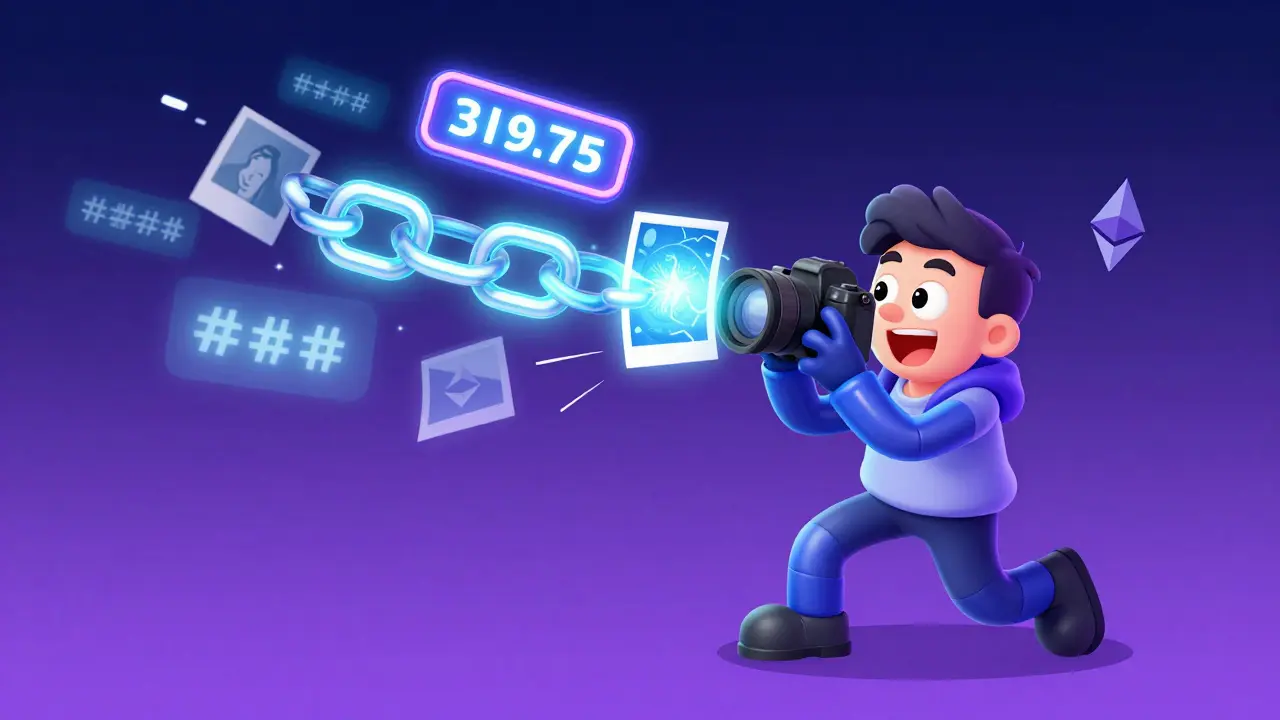
What if you could prove you created a song, photo, or piece of code before anyone else-even if you never filed paperwork with a government office? That’s the promise of blockchain copyright registration. It’s not magic. It’s not a replacement for the official system. But for digital creators, it’s becoming a powerful first line of defense.
How Blockchain Copyright Works (Simply)
Blockchain copyright registration stores a digital fingerprint of your work on a public, unchangeable ledger. Think of it like a timestamped receipt that no one can erase or alter. You don’t upload the full file-usually, you upload a cryptographic hash, a unique string of letters and numbers generated from your file. That hash gets recorded on the blockchain along with a date and time. If someone later claims your work is theirs, you can prove you had it first.
This happens through smart contracts on networks like Ethereum. These are self-executing programs that automatically record your hash when you pay a small fee-often less than $1. The hash is linked to metadata: your name, the title, the date, sometimes even a description. That data is stored off-chain on IPFS (InterPlanetary File System), a decentralized storage network, so the blockchain doesn’t get bloated with huge files.
For example, a photographer uploads a photo. The system generates a pHash (perceptual hash), which captures the visual essence of the image. That hash is written to Ethereum. Later, if someone copies the photo and uploads it to Instagram, a matching hash can be detected automatically. The blockchain doesn’t stop the theft-but it gives you undeniable proof you were there first.
Why Creators Are Turning to Blockchain
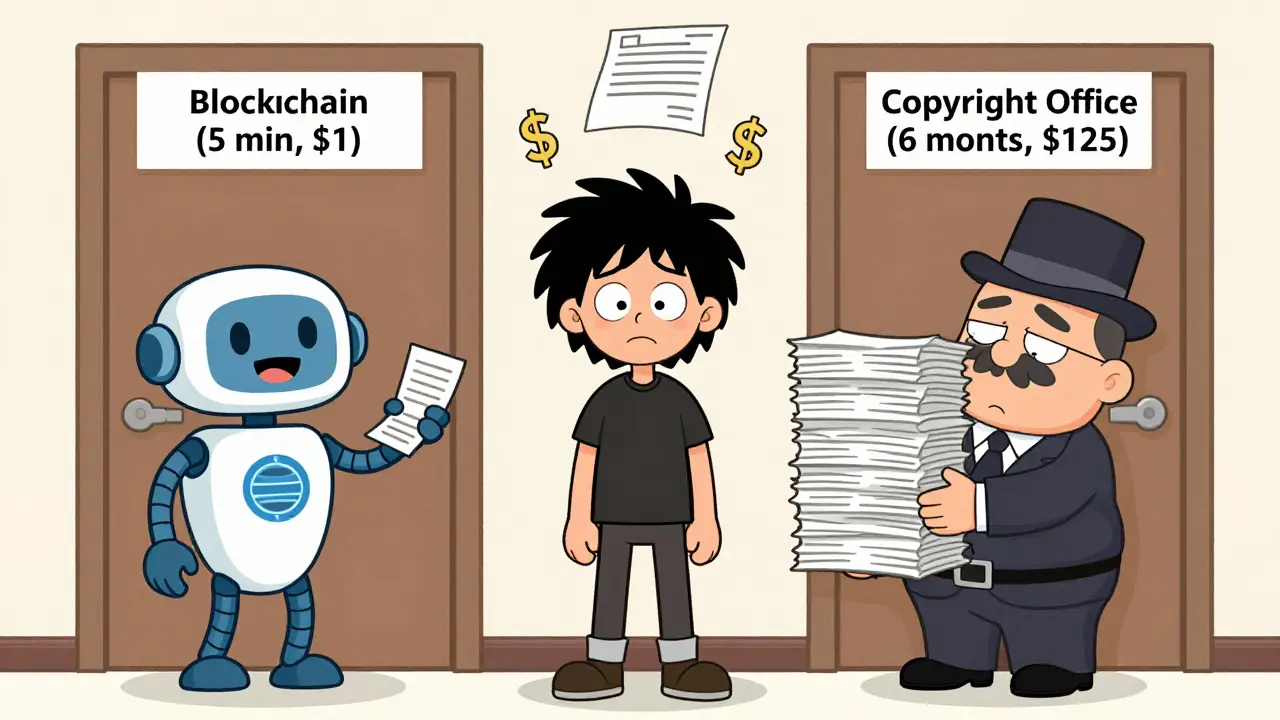
Traditional copyright registration takes months. In the U.S., the Copyright Office takes 3 to 9 months to process a single application, and it costs between $45 and $125. By then, your work could have been copied a hundred times online. Blockchain registration takes under 5 minutes. You don’t need a lawyer. You don’t need to fill out forms. You just need a digital wallet and internet access.
For indie musicians, digital artists, and software developers, this speed matters. A 2023 Creative Commons survey found that 78% of digital creators who used blockchain tools felt immediate peace of mind. One Reddit user, a photographer, said: “I used Ethereum to timestamp my image before posting it. Someone stole it and claimed it as theirs on Instagram. I showed the blockchain record. They took it down.”
It’s not just about proving ownership. Some platforms are building royalty automation into the system. If your music is streamed or your art is sold, smart contracts can trigger automatic payments to your wallet-no middlemen, no delays. Sony Music already uses an internal blockchain system to track royalties for over 1.2 million artists.
What Blockchain Can’t Do
Here’s the hard truth: blockchain registration is not legal copyright. In the U.S., the Copyright Office is clear-blockchain records don’t replace official registration. You can’t sue for statutory damages or attorney’s fees unless you’ve registered with them. A 2022 case study from the Copyright Alliance showed a musician’s blockchain timestamp was admitted in court, but the judge gave it far less weight than the official registration.
Same goes for the EU and most other countries. Only a few, like Switzerland and the UAE, have started accepting blockchain evidence in IP disputes. The rest still require government registration for full legal power.
Another risk? Wrong information stays forever. If you accidentally register someone else’s work as yours, you can’t undo it. Blockchain is immutable. There’s no “delete” button. TechnoLlama’s 2023 analysis warned: “Once entered, the record is immutable-in which case wrong authors would be forever recorded.”
And if you’re not tech-savvy, the process can be confusing. Setting up a wallet, understanding gas fees, generating hashes-these aren’t beginner-friendly. A 2023 UI/UX study found 63% of non-technical creators struggled with the first few steps. Platforms like Copyrobo and Verisart are trying to fix this with one-click interfaces, but the learning curve is still real.
Blockchain vs. Traditional Registration: The Real Comparison
| Feature | Blockchain Registration | Official Copyright Registration (U.S.) |
|---|---|---|
| Cost | $0.10-$1.50 | $45-$125 |
| Processing Time | Minutes | 3-9 months |
| Legal Standing | Supplementary evidence only | Required for statutory damages |
| Proof of Creation | Immutable timestamp | Official certificate |
| Automated Royalties | Possible with smart contracts | No |
| Accessibility | Anyone with internet and wallet | Requires form filing |
The takeaway? Use blockchain for speed and proof. Use the government system for legal power. They’re not rivals-they’re teammates.
Who’s Using It-and Who Should?
Adoption is growing but still small. As of 2023, about 15% of digital creators use blockchain for copyright. That’s up from 3% in 2020. The biggest users are in music, visual art, photography, and software development-fields where works are easily copied and quickly distributed.
Large media companies are experimenting. The European Union Intellectual Property Office launched a pilot in April 2023 to explore linking blockchain records with official registration. The U.S. Copyright Office is also studying feasibility. Gartner predicts that by 2025, 20% of major media firms will use blockchain as supplementary proof.
But for most individual creators? If you’re posting art online, releasing music on Bandcamp, or publishing code on GitHub, blockchain gives you instant proof. If you’re planning to sue someone for infringement, you still need the official registration. The smart move? Do both. Register on the blockchain today. File with the U.S. Copyright Office (or your country’s equivalent) within a month.
How to Get Started in 2026
Here’s a simple 3-step plan:
- Choose a platform. For beginners, try Copyrobo or Verisart-they simplify the process. For tech-savvy users, platforms like Po.et or Bernstein offer more control.
- Prepare your work. Save your file. If it’s a video or image, make sure it’s the final version. You can’t change it later.
- Upload and pay. Connect your wallet (MetaMask works for most), upload the file or its hash, fill in metadata, and pay the fee. You’ll get a transaction ID and a link to your blockchain record.
Keep that link safe. Print it. Save it in your cloud drive. That’s your digital notary stamp.
For extra security, use a service like Verisart that adds a notarized certificate for $15-$50. It doesn’t change the blockchain record, but it gives you a legally recognizable document to show lawyers or judges.
The Future: Integration, Not Replacement
Blockchain won’t kill the Copyright Office. But it’s forcing it to evolve. WIPO’s 2023 report predicts that by 2027, 30-40% of countries will have clear rules for how blockchain evidence is used in IP cases. Juniper Research forecasts that by 2027, 65% of digital creators will use blockchain for preliminary proof.
The goal isn’t to replace the system. It’s to make it faster, fairer, and more accessible. Imagine a future where you file your official copyright registration, and the system automatically pulls your blockchain timestamp as proof of creation date. That’s the direction we’re heading.
For now, treat blockchain like your digital alibi. It doesn’t grant you rights-it proves you had them first. And in the wild west of online creativity, that’s worth more than you think.
Can I use blockchain to register copyright in the U.S.?
No, blockchain registration does not replace official U.S. Copyright Office registration. The U.S. Copyright Office states clearly that blockchain records are not legally equivalent to formal registration. You still need to file with the government to claim statutory damages in court. But blockchain can serve as strong supporting evidence of when you created your work.
How much does blockchain copyright registration cost?
Most blockchain services charge between $0.10 and $1.50 per registration, depending on network fees and the platform. Ethereum-based services may cost slightly more during peak usage. This is far cheaper than the $45-$125 fee for official U.S. registration.
Is blockchain copyright registration secure?
Yes, the blockchain record itself is secure and tamper-proof. Once your work’s hash is written to the chain, it cannot be altered. However, the security of your registration depends on you. If you give your wallet keys to someone else or upload the wrong file, the mistake is permanent. Always double-check your file and metadata before submitting.
Can I register a song, photo, or code with blockchain?
Yes. Blockchain works for any digital file: images, audio, video, text, software code, and design files. Most platforms accept common formats like JPG, PNG, MP3, MP4, PDF, and ZIP. The system creates a cryptographic hash of the file, not a copy of it, so even large files can be registered quickly.
Do I need to be a tech expert to use blockchain copyright?
Not anymore. Platforms like Copyrobo and Verisart have simplified the process into one-click registration. You’ll still need to create a digital wallet (like MetaMask), but many services walk you through it. If you can send an email or post on social media, you can register your work on the blockchain. The real challenge is understanding that it’s not a legal substitute-just a fast, cheap proof tool.
What happens if I lose my blockchain registration proof?
You don’t lose the record-it’s on the blockchain forever. But you’ll lose access to your personal copy. Always save your transaction ID, the link to your record, and a screenshot. Store them in multiple places: cloud drive, email, printed copy. If you lose your wallet keys, you can’t access your account, but the record still exists publicly. You just won’t be able to prove it’s yours without the original wallet connection.
Comments (11)
Katrina Recto
January 11, 2026 AT 20:12
Been using Copyrobo for my photography since last year. No more panic when someone steals my shots. Just drop the link and they back down. Fast, cheap, works.
Not legal gold but it’s my digital alibi and I’ll take it.
Veronica Mead
January 12, 2026 AT 18:24
While the technological novelty is intriguing, it is imperative to underscore that blockchain-based timestamping does not constitute a legally recognized form of copyright protection under U.S. Code Title 17. To assert statutory damages, formal registration with the U.S. Copyright Office remains an absolute prerequisite. Relying upon decentralized ledgers as a substitute for statutory compliance is both legally perilous and academically unsound.
Surendra Chopde
January 14, 2026 AT 02:27
Interesting. But how does this work if your work is in a non-Latin script? Like Devanagari or Arabic? Do the hashing algorithms handle Unicode properly? I’m curious because I’ve seen tools fail with non-English text before.
Also, what happens if the IPFS node storing your metadata goes down? Is there redundancy?
Tiffani Frey
January 14, 2026 AT 02:47
For those new to this: always verify the platform’s privacy policy. Some services collect your metadata and may sell it. I use Verisart because they’re GDPR-compliant and don’t retain anything beyond the hash. Also, always save your transaction ID in three places-cloud, email, and printed. I lost access to my wallet once and had to dig through old backups for 3 days. Don’t make that mistake.
And yes, it’s not a legal substitute-but for indie creators? It’s the only thing standing between you and being erased from the internet.
Krista Hoefle
January 15, 2026 AT 21:25
blockchain copyright? lmao. you still gotta pay the govt 125 bucks to actually sue anyone. this is just digital bragging rights. save your gas fees and just email yourself the file with timestamp. same thing.
Emily Hipps
January 16, 2026 AT 04:22
If you’re a musician, artist, or coder-just do it. It takes 5 minutes. You’re not replacing the system, you’re just giving yourself a fighting chance. I registered 12 tracks last week. Two days later, one got copied on SoundCloud. I sent the link. They apologized. No lawyer needed.
It’s not magic. It’s just power. And you deserve it.
Jessie X
January 16, 2026 AT 09:08
I used to think this was all hype until I got my design stolen on Etsy. I had the blockchain hash. The thief didn’t even know what it was. I just sent them the link and said 'you’re on record.' They took it down. No drama.
It’s not perfect but it’s better than nothing. And honestly? It feels good to have proof.
Frank Heili
January 17, 2026 AT 14:54
Most people don’t realize that the real value isn’t in the blockchain-it’s in the metadata. If you don’t include your real name, correct title, and date, the hash is useless. I’ve seen people register ‘Untitled.jpg’ with no info. That’s not proof. That’s noise.
Also, don’t use Ethereum during peak hours. Gas fees spike. Use Polygon or Arbitrum. Saves you 80% and the hash is just as secure.
And yes, it’s still not a substitute for the Copyright Office-but it’s the best damn first step you can take.
Dennis Mbuthia
January 17, 2026 AT 20:00
Look, I get it-you wanna be techy and save a few bucks. But this ain’t America’s way. We don’t let some crypto bros with wallets decide who owns what. The U.S. Copyright Office exists for a reason. It’s got lawyers, judges, and actual authority. Blockchain? That’s a toy for people who think Bitcoin is money.
You think some decentralized ledger is gonna hold up in court? Nah. You’ll still need the real paper. And if you’re not filing with the U.S. government, you’re not serious about protecting your work. You’re just playing with fire.
Becky Chenier
January 19, 2026 AT 18:11
One thing no one mentions: what if the blockchain network becomes obsolete? Like, what if Ethereum dies in 10 years? Will the hash still be readable? Or will we be left with a string of gibberish that means nothing?
It’s secure now-but what about 2035? Just food for thought.
Staci Armezzani
January 20, 2026 AT 18:03
For anyone nervous about wallets: start with Verisart. They handle everything. You don’t even need to know what a private key is. Just upload, pay, get your certificate. Then, when you’re ready, learn how to do it yourself.
This isn’t about being a hacker. It’s about being smart. You wouldn’t skip a seatbelt because you think you’re a good driver. Don’t skip this because you think you’ll never get copied. You will. And when you do-you’ll be glad you did.