
There’s a lot of confusion out there about "Curve (Celo)" - like they’re the same thing. They’re not. Curve Finance and Celo are two completely different blockchains with different goals, different tech, and different users. If you’re looking at Curve as a crypto exchange, you’re not wrong - but Celo has nothing to do with it. This review cuts through the noise and gives you the real story on Curve Finance: what it actually does, how it works, and whether it’s right for you.
What Is Curve Finance?
Curve Finance is a decentralized exchange (DEX) built for one thing: swapping stablecoins and other low-volatility assets with almost no slippage. Launched in 2020, it didn’t try to compete with Uniswap or SushiSwap by offering every coin under the sun. Instead, it went narrow and deep - focusing on assets like USDT, USDC, DAI, and frax. That’s it. And that’s why it works.
Most DEXs use a simple constant product formula (x * y = k) that causes big price swings when you trade large amounts. Curve changed that. It uses a custom algorithm called the "stableswap invariant," which keeps prices rock steady when trading assets that are meant to have the same value - like $1 USDC for $1 DAI. The result? You get trades that feel almost like centralized exchanges, but without giving up control of your funds.
By 2025, Curve had already processed over $1.2 trillion in trading volume. That’s not a typo. It’s the most used DEX for stablecoin swaps in the entire crypto world.
How Curve Works: The Mechanics Behind the Magic
Curve doesn’t use order books. It uses liquidity pools. You deposit assets like USDT and USDC into a pool, and other users trade against that pool. In return, you earn fees - usually around 0.04% per swap. That might sound small, but when you’re handling millions in daily volume, it adds up fast.
Here’s the catch: you’re not just earning swap fees. You’re also earning CRV, Curve’s native governance token. The platform distributes CRV rewards to liquidity providers based on how much they stake and how long they lock it in. Some pools offer over 10% APY in CRV alone - not counting the swap fees.
But Curve doesn’t stop at trading. In mid-2024, it launched its own stablecoin: crvUSD. Unlike other stablecoins, crvUSD is over-collateralized and backed by a system called PegKeepers. These are automated bots that adjust collateral ratios in real time to keep the price stable. By early 2026, crvUSD had over $150 million in circulation and was integrated into dozens of lending protocols, including Aave and Compound.
Curve also handles deposits and withdrawals with near-zero fees - as long as your pool is balanced. If one asset in the pool gets too lopsided (say, 90% USDC and 10% DAI), you’ll pay a 0.02% fee to rebalance it. That’s still cheaper than most centralized exchanges.
Multi-Chain Presence: Curve Beyond Ethereum
When Curve started, it lived on Ethereum. That meant high gas fees and slow transactions. By 2025, it had solved that.
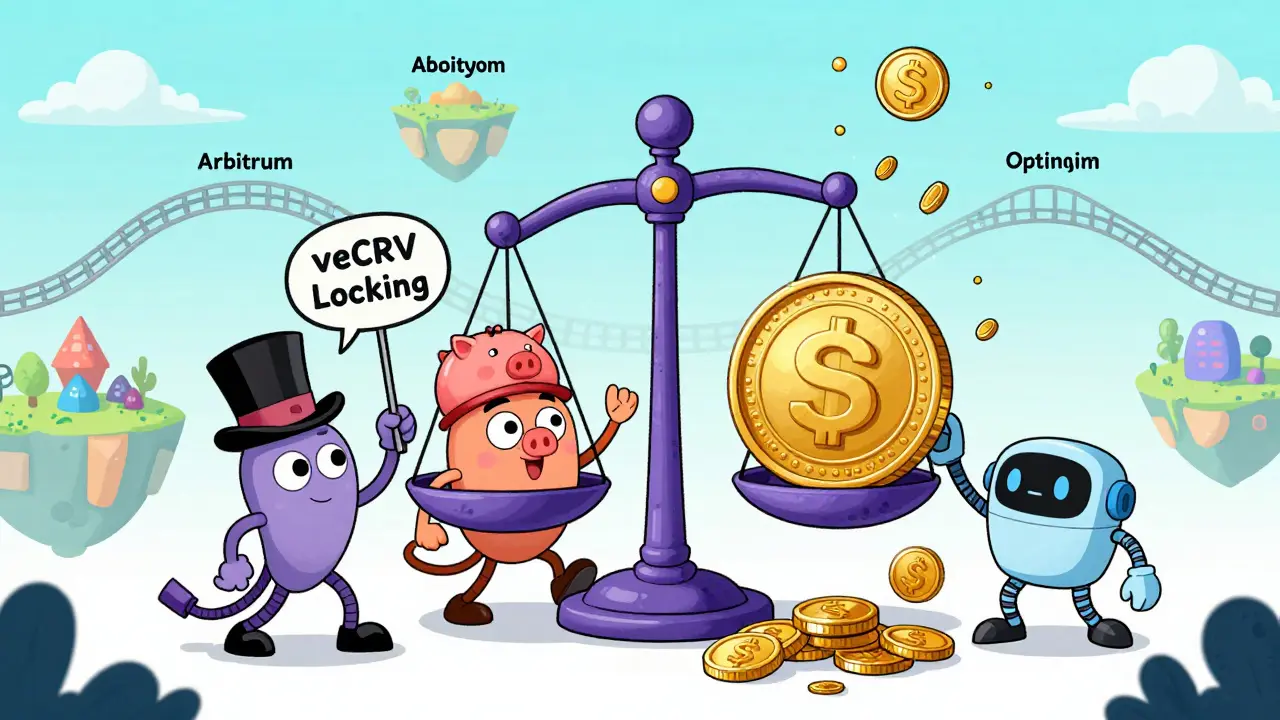
Curve now operates natively on Arbitrum, Optimism, Polygon, Fantom, and Avalanche. Each chain has its own pools, its own CRV emissions, and its own fee structure. Want to trade stablecoins without paying $10 in gas? Go to Polygon. Need faster trades? Use Arbitrum. The platform uses bridges like LayerZero and Wormhole to move liquidity between chains - so you can deposit on one chain and withdraw on another.
This multi-chain approach isn’t just a workaround - it’s the future. Curve’s web interface lets you see all your liquidity positions across networks in one place. No more juggling five different wallets or remembering which pool is on which chain.
Who Uses Curve - And Who Should Avoid It
Curve isn’t for beginners. If you’ve never heard of impermanent loss, liquidity mining, or gauges, you’re going to get lost.
But if you’re already trading stablecoins, holding USDC, or providing liquidity on DeFi platforms - Curve is probably already part of your workflow. It’s used by:
- Yield farmers looking for low-risk APYs
- Traders who need to swap between stablecoins without slippage
- DAOs managing treasury assets
- Protocols like Aave and Yearn that use Curve pools as core liquidity
It’s not for people who want to trade Bitcoin, Solana, or meme coins. Curve doesn’t list them. It doesn’t want them. That’s the point.
And if you’re still using centralized exchanges like Binance or Coinbase just to swap USDT for USDC? You’re paying more in fees and getting worse prices. Curve is faster, cheaper, and more transparent.
CRV Token: More Than Just a Reward
CRV isn’t a coin you buy and hold. It’s a governance tool. Holders vote on:
- Which liquidity pools get rewarded
- How much CRV is distributed each week
- Whether to add new chains or stablecoins
- Changes to the fee structure
There are over 300 active voters in Curve’s DAO. The top 10 accounts control about 40% of the votes - which some critics say is too centralized. But the system is evolving. In 2025, Curve introduced a new voting mechanism called "veCRV," which lets users lock CRV for up to four years to gain voting power and boosted rewards. The longer you lock, the more influence you have.
CRV’s price has been volatile, but its utility is solid. As of early 2026, over 80% of CRV supply was locked in veCRV contracts - meaning real users, not speculators, are running the platform.

Security, Wallets, and User Experience
Curve is non-custodial. That means your assets never leave your wallet. You connect via MetaMask, Ledger, WalletConnect, or any EVM-compatible wallet. No KYC. No sign-ups. Just connect and trade.
The interface has improved dramatically since 2022. The old version was a maze of tabs and charts. The 2025 redesign added:
- A dashboard showing all your liquidity positions
- Real-time APY estimates across all chains
- Slippage previews before every trade
- Gas fee estimators for each network
Still, it’s not beginner-friendly. If you’re new to DeFi, start with a simple swap on Uniswap first. Once you understand how liquidity pools work, Curve will feel like a precision tool - not a gamble.
Curve vs. Other Stablecoin DEXs
| Feature | Curve Finance | Uniswap V3 | SushiSwap | Swapline |
|---|---|---|---|---|
| Primary Focus | Stablecoins and low-volatility assets | All tokens, wide range | All tokens, high APY pools | Stablecoins only |
| Swap Fee | 0.04% | 0.05%-0.30% (variable) | 0.05% | 0.02% |
| Slippage (1M USDT swap) | 0.01% | 0.25% | 0.30% | 0.03% |
| Native Stablecoin | crvUSD ($150M+ TVL) | None | None | SLINE |
| Multi-Chain Support | Yes (5+ chains) | Yes (Ethereum, Arbitrum, Optimism) | Yes (Ethereum, Polygon, BSC) | Ethereum only |
| Governance Token | CRV (veCRV locking) | UNI | SUSHI | SLINE |
Curve wins on slippage and stability. Swapline has lower fees, but it’s new and has less liquidity. Uniswap and SushiSwap are better for trading volatile assets - but terrible for stablecoin swaps.
Is Curve Finance Right for You?
If you’re trading stablecoins regularly - whether for yield, hedging, or cross-chain swaps - Curve is the best tool available. It’s battle-tested, secure, and continuously improving.
If you’re new to crypto, skip it for now. Learn how wallets, gas fees, and liquidity pools work first.
If you’re a long-term DeFi user, you’re probably already using Curve. If you’re not - you’re leaving money on the table.
Is Curve Finance a centralized exchange?
No. Curve Finance is a decentralized exchange (DEX). You trade directly from your wallet using smart contracts. No one holds your funds. No KYC. No account creation. It’s fully non-custodial.
Can I trade Bitcoin or Ethereum on Curve?
Not directly. Curve specializes in stablecoins and pegged assets like sETH and sBTC - synthetic versions of Ethereum and Bitcoin. You can’t swap BTC for ETH on Curve. For that, use Uniswap or a centralized exchange.
How do I earn CRV tokens?
By providing liquidity to Curve pools. When you deposit assets like USDC or DAI into a pool, you receive LP tokens. These tokens earn swap fees and CRV rewards. You can lock your CRV into veCRV to boost rewards and gain voting power.
Is Curve safe from hacks?
Curve has been audited multiple times by firms like CertiK and OpenZeppelin. It’s been live since 2020 with no major exploits. Its code is open-source and widely reviewed. That said, no DeFi protocol is 100% risk-free. Always use a hardware wallet and never invest more than you can afford to lose.
What’s the difference between Curve and Celo?
Curve is a DEX for stablecoin swaps. Celo is a mobile-first blockchain that lets people send money using phone numbers. They’re unrelated. Celo has its own tokens (CELO, CUSD), its own blockchain, and its own community. Confusing them is common, but they serve completely different purposes.
Do I need Ethereum to use Curve?
Not anymore. While Curve started on Ethereum, it now runs natively on Arbitrum, Optimism, Polygon, Fantom, and Avalanche. You can use any of these chains to avoid high Ethereum gas fees. Just connect your wallet to the chain you prefer.
Can I lose money on Curve?
Yes - but not from the exchange itself. You can lose money if the value of the assets in your liquidity pool drops (impermanent loss), or if the CRV token price falls. Curve doesn’t guarantee returns. It’s a tool - not an investment. Always do your own research before providing liquidity.
Curve Finance isn’t flashy. It doesn’t need to be. It’s the quiet workhorse of DeFi - the place where stablecoins move with precision, efficiency, and low cost. If you’re serious about DeFi, you’ll find yourself here - sooner or later.
Comments (18)
Shannon Holliday
February 22, 2026 AT 12:19
This is why I love Curve 🚀 Stablecoin swaps without slippage? Yes please. Just did a $50k USDC→DAI swap and it felt like a centralized exchange but without the middleman. 🤯
John Fuller
February 23, 2026 AT 12:52
Curve’s great until you try to withdraw and gas spikes.
Mary Scott
February 24, 2026 AT 18:10
They say it’s decentralized but the top 10 wallets control 40% of CRV votes. That’s not DeFi. That’s a cartel. And crvUSD? Just another ponzi with fancy math. 🤡
Molley Spencer
February 24, 2026 AT 21:40
The real innovation isn't the stableswap invariant-it's the veCRV lockup mechanism. It’s the only DeFi protocol that forces long-term alignment. Everyone else is just rent-seeking with liquidity mining. You’re not a participant unless you’re locked in for 2+ years. Period.
Andrew Hadder
February 25, 2026 AT 18:15
I thought curve only did usdt/dai... turns out i was wrong. just added my usdc pool on polygon and got 12% apy. mind blown.
Fiona Monroe
February 26, 2026 AT 01:08
The technical architecture of Curve Finance represents a paradigm shift in decentralized liquidity provision. The stableswap invariant, as elucidated in the whitepaper, effectively decouples price impact from asset volatility-a feat unattainable via constant-product models. Furthermore, the multi-chain deployment strategy demonstrates exceptional foresight in scalability architecture.
Neeti Sharma
February 26, 2026 AT 09:26
USA thinks it owns crypto. Curve? Built by Americans. CRV? American token. India has real blockchain vision. We don’t need your stablecoins. We have UPI. And we don’t need your gas fees
Nadia Shalaby
February 26, 2026 AT 12:39
I’ve been using Curve for a year now. Honestly? It’s just… there. Like plumbing. You don’t notice it until it breaks. And when it does? You’re glad it was there.
Cameron Pearce Macfarlane
February 28, 2026 AT 02:14
They say 'no slippage' but have you checked the front-running bots? They’re harvesting liquidity before you even click swap. Curve’s just a fancy trap for retail.
Maggie House
March 1, 2026 AT 12:35
I’m new to DeFi but I tried Curve after reading this and wow. The interface is way better than I expected. Just swapped 500 USDC for DAI and it was instant. No drama. Just smooth. I think I’m hooked 😊
Michelle Xu
March 1, 2026 AT 15:38
I appreciate the clarity on Celo vs. Curve-so many people conflate them. I’ve been using Curve for treasury management in our DAO since 2023. The liquidity pool fees combined with CRV emissions have generated over 18% annual returns on our stablecoin reserves. We’ve never used a centralized exchange for stablecoin swaps since. The crvUSD integration with Aave has been a game-changer for our borrowing strategy.
Daisy Boliaan
March 2, 2026 AT 00:07
I just lost $22k because my LP got wiped out by impermanent loss. Curve’s not magic. It’s a gamble dressed up like finance. And now I’m stuck in a 4-year veCRV lock with no way out. Why did I trust this? 😭
Derek Sasser
March 2, 2026 AT 08:27
I read the whole thing. Honestly? Curve is the only DEX that actually works like it says. I used to trade on Uniswap and kept getting wrecked on stable swaps. Now I only use Curve. The multi-chain thing is clutch-switched to Arbitrum and gas is like 10 cents. No more crying over $15 fees.
Dana Sikand
March 3, 2026 AT 20:25
I’ve been in crypto since 2017 and I’ve seen so many 'revolutionary' platforms crash and burn. Curve? It’s the one that just kept going. Quiet. Reliable. No hype. No memes. Just steady, boring, beautiful engineering. I cry every time I see my APY update. Not because it’s high-but because it’s real.
Lucy Simmonds
March 5, 2026 AT 05:33
CRV is a scam. veCRV is a trap. They want you to lock your tokens so they can manipulate votes. And crvUSD? It’s backed by bots? That’s not stable-it’s a puppet show. I’ve seen this movie before. It ends with the devs rug-pulling and the community left holding bag. You’re being played.
Elizabeth Smith
March 5, 2026 AT 22:49
The real question isn’t whether Curve is good-it’s whether we’ve surrendered our autonomy to algorithmic governance. veCRV doesn’t empower users-it creates a new aristocracy. Those who lock longest become the priests of the blockchain temple. Is this liberation? Or just feudalism with a smart contract?
Robert Kromberg
March 5, 2026 AT 22:52
I used to think Curve was overhyped. Then I tried swapping frax for sUSD on Polygon. It was seamless. No slippage. No drama. I’m not a DeFi guru. I just want to move money without paying $20 in fees. Curve does that. So I’m not going anywhere.
Leslie Cox
March 6, 2026 AT 14:22
You call this 'precision'? It’s just a well-oiled machine for the rich. The 1% don’t trade $100k stablecoin swaps-they farm CRV and lock it for 4 years. Meanwhile, regular people get fleeced by gas spikes and impermanent loss. Curve isn’t for the people. It’s for the algorithmic elite. And you’re all just cheering for your own enslavement.