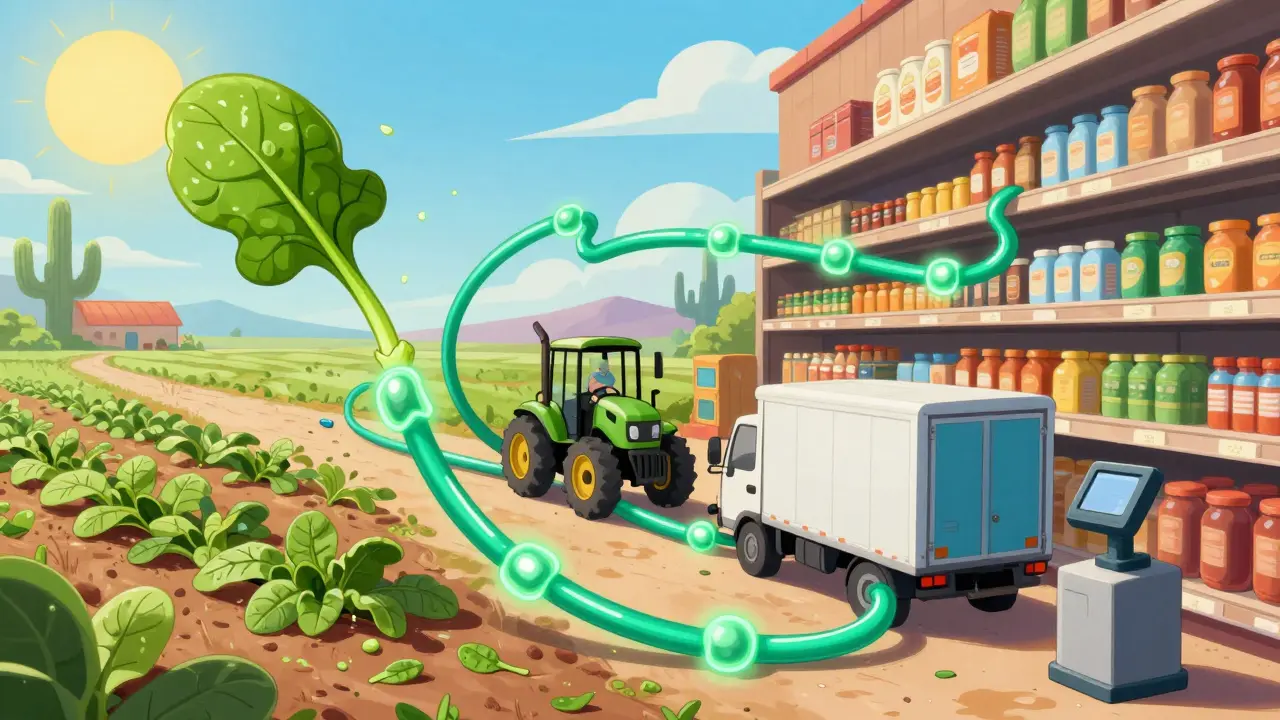
What if you could trace a contaminated spinach leaf back to the exact farm it came from - in under 10 seconds?
That’s not science fiction. It’s what blockchain food traceability does today. For years, food recalls took days or even weeks. A single outbreak of E. coli could spread across dozens of states before anyone knew where it started. Now, with blockchain, the entire journey of a product - from soil to shelf - is recorded in real time, and every step is locked in place. No edits. No deletions. No guesswork.
Why traditional traceability fails
Before blockchain, food traceability relied on paper logs, spreadsheets, and barcodes. If a shipment of lettuce was linked to an outbreak, companies had to call suppliers, check receipts, cross-reference batch numbers, and wait for replies. In many cases, the data was incomplete or outdated. One retailer once spent 7 days tracing a single case of contaminated mangoes. Seven days. That’s seven days of people getting sick.
Why? Because each player in the supply chain - farmer, processor, distributor, wholesaler, retailer - used different systems. No one talked to each other properly. Data got lost. Paper got torn. Spreadsheets got mislabeled. And when something went wrong, no one could answer: Where did this come from?
How blockchain fixes this
Blockchain is a digital ledger that records every transaction in a chain of encrypted blocks. Once data is added, it can’t be changed. It’s shared across a network of computers, not stored in one company’s server. That means no single entity controls the data. Everyone sees the same version.
In food traceability, every time a product changes hands, information is added:
- Harvest date and location (GPS coordinates)
- Batch number and lot code
- Temperature during transport
- Inspection results
- Who handled it and when
This data uses GS1 standards - the same global system used for barcodes - so it works across different software platforms. No more custom systems. No more data silos.
The Walmart breakthrough
In 2016, Walmart started testing blockchain with IBM. They picked leafy greens - one of the hardest products to trace because it’s harvested from dozens of farms, mixed in processing plants, and shipped to hundreds of stores.
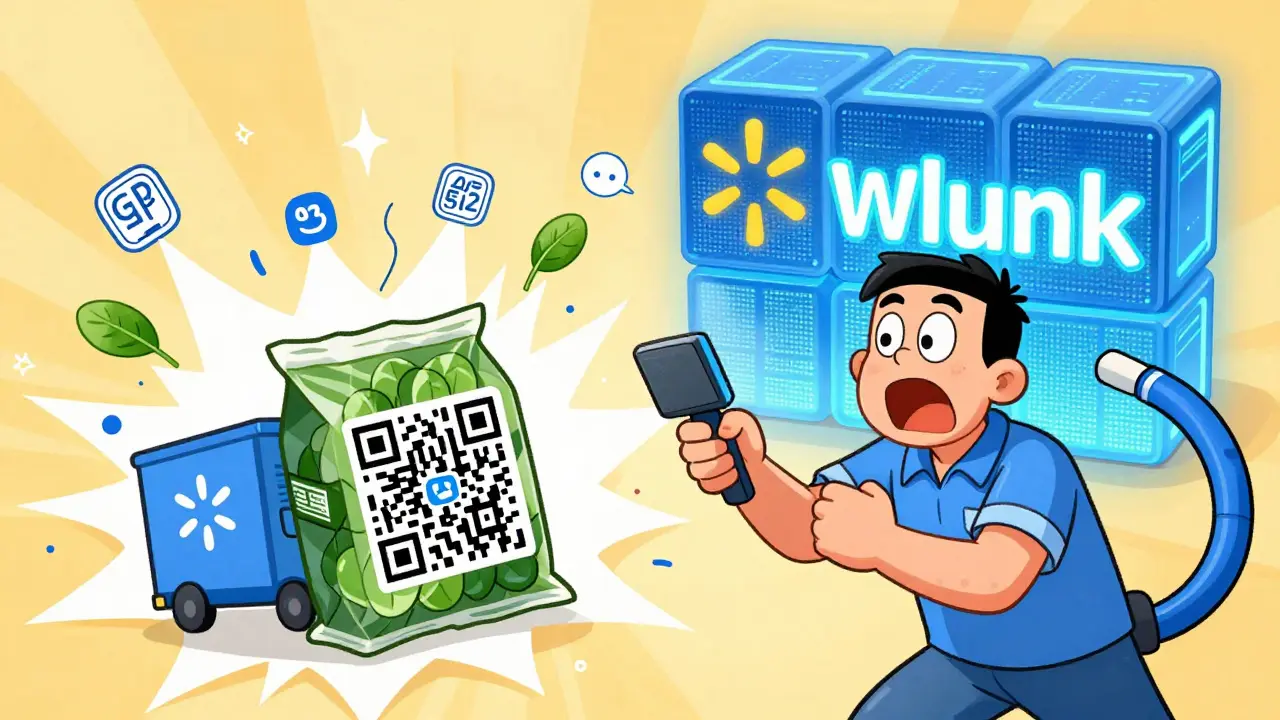
By 2018, they had a working system. A customer bought a bag of spinach. Someone got sick. Instead of calling 10 suppliers and waiting for faxed records, Walmart scanned a QR code on the bag. Within 2.2 seconds, they saw:
- The farm in Arizona where the spinach was grown
- The truck that carried it
- The cooling facility where it was packed
- The distributor who shipped it to the store
They pulled every bag from that exact batch. No guesswork. No waste. No delay.
That’s the power of blockchain. It turns a 7-day hunt into a 2-second search.
Who’s using it now?
Walmart didn’t do this alone. They brought in Dole, Nestlé, Tyson, and Unilever. Today, the IBM Food Trust is a network used by over 200 companies worldwide. Albertsons, Carrefour, Kroger, and even small organic farms have joined.
It’s not just big names. A farmer in Idaho can now prove his potatoes were grown without pesticides. A sushi restaurant in Chicago can show customers the exact fishing vessel that caught their tuna. A parent buying baby food can verify the source of every ingredient.
How it saves lives
Foodborne illness kills 3,000 Americans every year. Another 48 million get sick. Most outbreaks are linked to produce, meat, and dairy.
With blockchain, when contamination is found, you don’t recall all spinach. You recall only the spinach from Farm X, Truck Y, Warehouse Z. That means:
- Less food wasted
- Less money lost
- Less panic in stores
- More trust from customers
One study showed that blockchain reduced recall time by 99%. That’s not efficiency. That’s survival.
What suppliers need to do
It’s not magic. It takes work. To join a blockchain traceability system:
- Use GS1 standards for product identification (GTIN-14, EPCIS)
- Install barcode scanners or RFID tags at each transfer point
- Train staff to log data in real time - not after the fact
- Connect to a platform like IBM Food Trust
- Share data openly - no hoarding
There’s a learning curve. But the cost of not doing it is higher. A single recall can cost a supplier millions. A reputation lost? Priceless.
The hidden benefit: Fair pay for farmers
Most farmers get paid based on bulk sales. They have no way to prove their produce is safer, cleaner, or more sustainable.
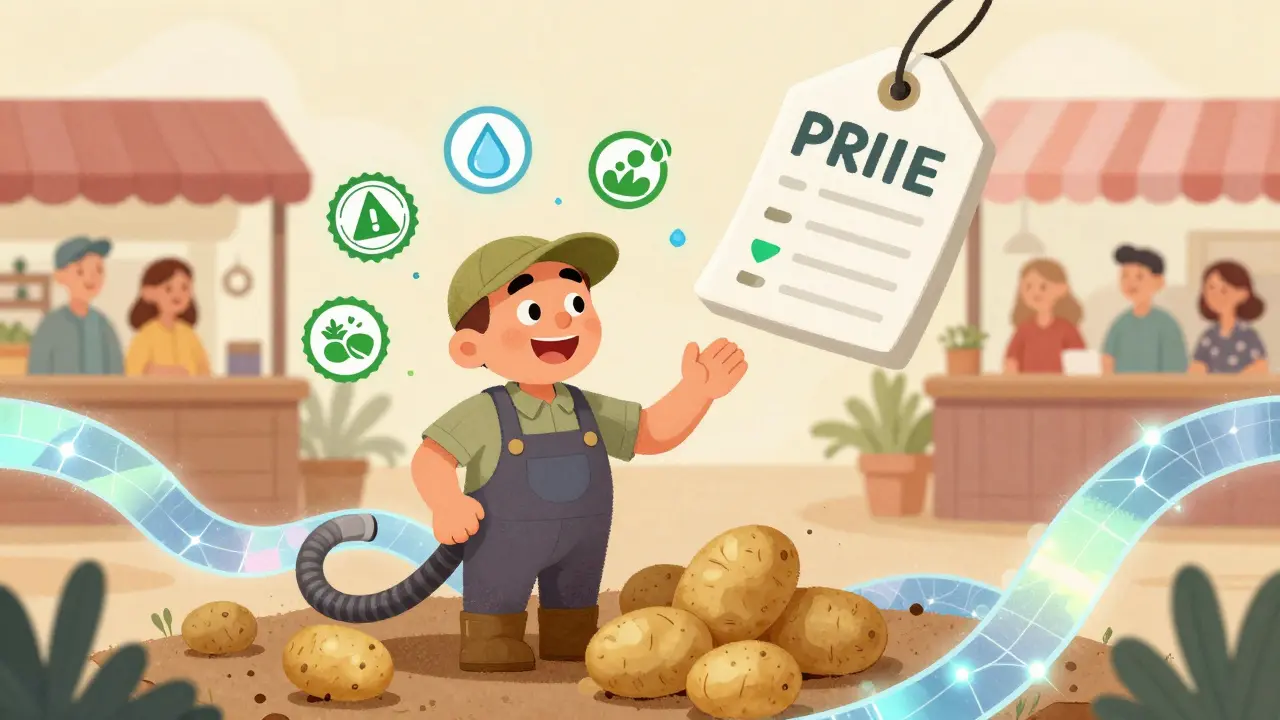
With blockchain, a grower who uses no pesticides, conserves water, or pays fair wages can prove it. Buyers see the data. They pay more. It’s not marketing. It’s verified truth.
One organic lettuce farm in California saw a 22% price increase after joining the blockchain network. Not because they said they were organic. Because the system proved it.
What’s next?
Blockchain isn’t just for big companies anymore. Startups are building affordable tools for small farms. Governments are starting to require blockchain traceability for imported food. The EU and China already have pilot programs.
In 2026, if you’re selling food - even a single product - you’ll need to prove its journey. Customers are asking. Regulators are demanding. And the technology is ready.
Why blockchain works when nothing else did
It’s not about being high-tech. It’s about being trustworthy.
Traditional systems asked you to believe. Blockchain shows you. Every step. Every person. Every timestamp. Locked. Shared. Unchangeable.
Food safety isn’t about fancy software. It’s about knowing where your food came from - and being able to prove it. Blockchain doesn’t just track food. It restores trust.
Can blockchain prevent all foodborne illnesses?
No, blockchain can’t stop contamination at the source - like a dirty water supply or unsanitary handling. But it stops the spread. If E. coli is found in lettuce, you can instantly pull every affected batch instead of recalling everything. That cuts exposure by 80-95%. It’s not a cure, but it’s the fastest way to contain outbreaks.
Is blockchain only for big companies like Walmart?
No. The IBM Food Trust network includes small farms, regional distributors, and independent grocers. Many platforms now offer low-cost or free entry for small suppliers. The key is using GS1 standards - not the size of your business. A single farmer with a smartphone and a barcode scanner can join.
What if someone enters fake data into the blockchain?
You can’t change data once it’s on the chain - but you can add false data at the start. That’s why verification matters. Trusted third parties (like auditors or government inspectors) can validate critical data before it’s recorded. A farm’s location, temperature logs, and inspection reports are often verified before going on-chain. The system doesn’t trust users - it trusts evidence.
How is blockchain different from a regular database?
A regular database is controlled by one company. If that company gets hacked or changes the records, you’re stuck. Blockchain is distributed. Thousands of computers hold copies. No one can delete or alter entries without control of over half the network - which is nearly impossible. It’s not just secure. It’s self-governing.
Do I need to understand cryptocurrency to use blockchain for food traceability?
No. Blockchain for food has nothing to do with Bitcoin or crypto trading. It uses the same underlying technology - a secure, shared ledger - but without money or mining. Think of it like a digital logbook that everyone can see but no one can edit. You don’t need to know how the engine works to drive the car.
How long does it take to implement blockchain traceability?
For a small supplier, it can take 6-12 weeks. The biggest hurdle isn’t tech - it’s training. You need to update your workflow to capture data at every handoff: harvest, wash, pack, ship, receive. Most companies start with one product line - like leafy greens - and expand from there. The first 30 days are the hardest. After that, it becomes routine.
Comments (17)
Sarah Terry
March 21, 2026 AT 08:17
This is exactly the kind of innovation we need in food safety. No more guessing games when people get sick. Real data, real accountability. It’s not just tech-it’s ethics in action.
Shayne Cokerdem
March 21, 2026 AT 15:52
blockchain? lol so now we gotta track every leaf like its a nasa rocket? what next, qr codes on my grandma’s homegrown tomatoes?
kavya barikar
March 22, 2026 AT 13:04
The transparency offered by blockchain is a significant step toward global food security. It respects both consumer safety and producer integrity.
aravindsai pandla
March 23, 2026 AT 06:37
This is a quiet revolution. No hype, no buzzwords-just clean, verifiable data flowing where it matters. Small farmers aren’t being left behind. They’re being empowered.
namrata singh
March 23, 2026 AT 10:38
I never thought about how much fear goes into buying groceries. This system doesn’t just track food-it brings peace of mind. And that’s priceless.
Andrea Zaszczynski
March 25, 2026 AT 00:41
I love this but why is Walmart the only one talking about it? Why aren’t the FDA and USDA screaming this from the rooftops? This should be mandatory, not optional.
Cordany Harper
March 26, 2026 AT 13:33
Been in this industry 15 years. Paper logs, fax machines, spreadsheets with typos. This? This is the first time I’ve seen tech actually fix a real problem instead of just making a PowerPoint.
DarShawn Owens
March 26, 2026 AT 14:15
My cousin runs a small organic farm in Oregon. They just joined IBM Food Trust. Last month, they got 30% more orders because customers could see the whole story behind their kale. No marketing. Just truth.
Andy Green
March 27, 2026 AT 04:12
Of course it works. Because we’re talking about a system built on trust-something corporations have been lying about for decades. This isn’t innovation. It’s damage control with a fancy name.
Zion Banks
March 28, 2026 AT 23:21
Blockchain? You know what else uses a distributed ledger? The government. And the military. And the NSA. This isn’t about food safety-it’s about control. They’re tracking your groceries so they can track YOU.
Annette Gilbert
March 29, 2026 AT 12:07
Oh wow, so now we’re going to spend $200k to scan a lettuce leaf so a CEO can say ‘look how ethical we are’? Meanwhile, the workers picking it still make minimum wage. Real progress.
John Alde
March 30, 2026 AT 09:36
Let me break this down simply: Before blockchain, traceability was like trying to find one specific grain of sand on a beach using a blindfold and a spoon. Now? You’ve got a GPS tracker on every grain. The system doesn’t just improve efficiency-it eliminates the entire category of human error that used to kill people. And yes, it’s that simple. The real challenge isn’t the tech. It’s convincing mid-sized suppliers that this isn’t a cost-it’s insurance. One recall can wipe out a family business. This? This is the shield they didn’t know they needed. The data doesn’t lie. The timeline doesn’t bend. And when you can prove your product is clean, you don’t need to beg for trust-you earn it. Every single time.
manoj kumar
March 31, 2026 AT 05:58
All this for spinach? Why not fix the water supply first? Or stop using pesticides? Blockchain’s just a bandaid on a broken system.
JOHN NGEH
April 1, 2026 AT 16:12
I work at a small grocery store. We started using this last year. Customers ask us questions now. Like, ‘Where was this apple grown?’ and ‘Was it tested?’ We can answer. Honestly. It’s changed how we talk to people. It’s not tech. It’s connection.
Jenni Moss
April 2, 2026 AT 19:51
This is the future. And it’s beautiful. Imagine your kid eating a strawberry and knowing exactly where it came from-no guesswork, no fear. That’s safety. That’s love.
vu phung
April 4, 2026 AT 00:51
The real win here is EPCIS compliance. Once you standardize on GS1, interoperability becomes trivial. The supply chain friction drops exponentially. This isn’t blockchain magic-it’s logistics hygiene. And we’ve been starving for it for decades.
Lorna Gornik
April 5, 2026 AT 17:11
this is actually kinda cool 😊 i never thought about how much i trust my food until now. like… i just assume it’s safe. but now? i wanna know. and i can. 🥬✨