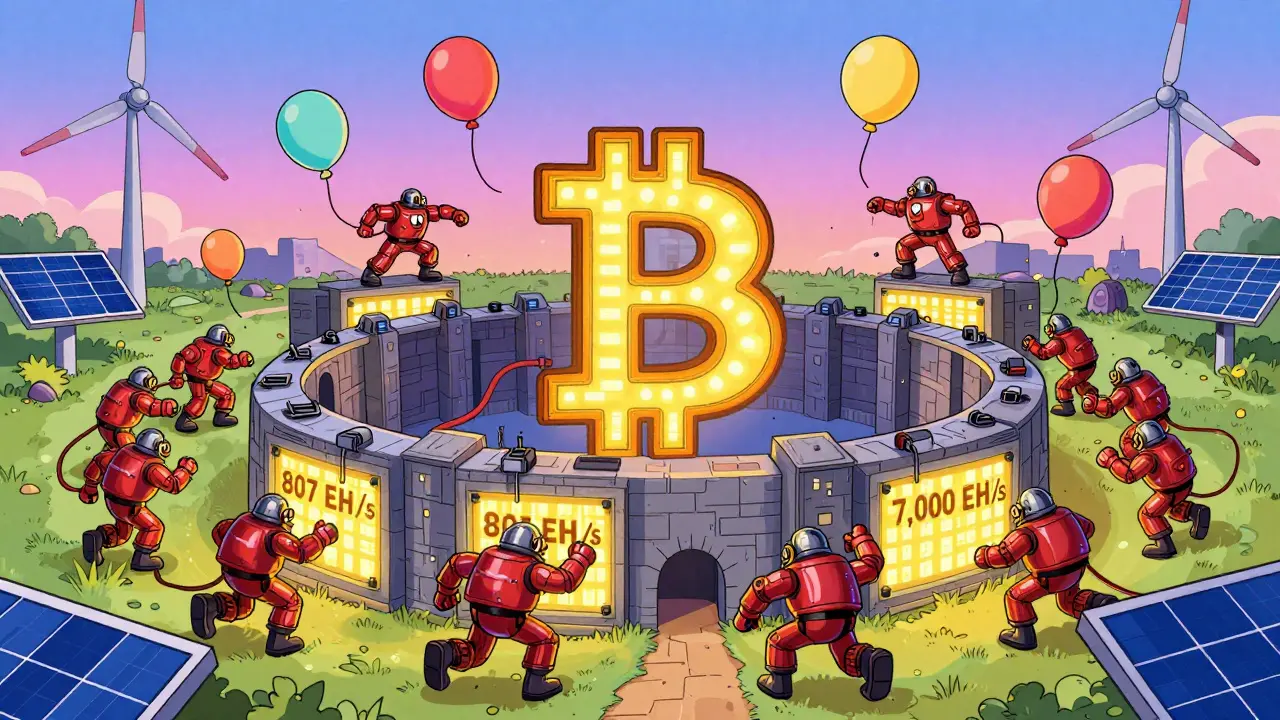
By April 2025, the Bitcoin network hit a milestone no one expected just five years ago: 1 Zetahash per second. That’s 1 sextillion calculations every second-enough to simulate every human brain on Earth doing math at the same time. This isn’t science fiction. It’s the real-world security layer keeping Bitcoin safe. And it’s still growing fast.
Why Hash Rate Matters More Than Price
People talk about Bitcoin’s price like it’s the only thing that matters. But the real heartbeat of Bitcoin isn’t the chart. It’s the hash rate-the total computing power miners are using to validate transactions and secure the network. Higher hash rate means more security. More miners competing means it’s harder for anyone to hack or manipulate the blockchain. Think of it like a fortress. The more guards you have patrolling the walls, the less likely someone can break in. Bitcoin’s hash rate is those guards. In 2018, the network ran at just 14 EH/s. Today, it’s over 900 EH/s. That’s a 65x increase in just seven years. And projections show it could hit 7,000 EH/s by 2030.The Numbers Behind the Growth
Most projections start from January 2025, when the network stabilized at 807 EH/s. From there, analysts use historical trends to guess what comes next. The most aggressive model, from GoMining, uses a 52.5% compound annual growth rate (CAGR)-the same rate Bitcoin’s hashrate has averaged since 2018. That math leads to 6,891 EH/s by 2030. But not everyone agrees. Some analysts think that pace is unsustainable. They point to energy limits, hardware shortages, and regulatory risks. A more conservative estimate, at 35% CAGR, puts the 2030 hash rate at 2,543 EH/s. A middle-ground forecast-45% CAGR-lands at 4,128 EH/s. Here’s what those numbers look like side by side:| Projection Scenario | CAGR | 2030 Estimate |
|---|---|---|
| Conservative | 35% | 2,543 |
| Base Case | 45% | 4,128 |
| High Growth | 52.5% | 6,891 |
What’s Driving the Growth?
It’s not just speculation. Real companies are investing billions. HIVE Digital Technologies hit 22 EH/s in October 2025-up 267% in just one year. Bitmain and Bitfury are shipping newer ASIC miners every quarter. The WhatsMiner M20S and Antminer S21 now deliver over 200 TH/s each, with power efficiency under 15 J/TH. The key driver? Profitability. Miners only keep running machines if they make money. And that depends on two things: Bitcoin’s price and electricity costs. Right now, the break-even price for most modern ASICs is between $5,000 and $6,000. If Bitcoin stays above that, miners keep expanding. If it drops below, older machines shut off. That’s why price projections matter. AInvest forecasts Bitcoin hitting $1.16 million by 2030. If that happens, even older hardware becomes profitable again.
Where the Energy Comes From
Energy costs make up 40-60% of a miner’s expenses. That’s why mining has moved to places with cheap, reliable power. Texas, Kazakhstan, and parts of Canada now dominate global hashrate. Electricity there can be as low as $0.045 per kWh. On the U.S. East Coast, it’s over $0.12-too expensive for most operations. But here’s the twist: mining isn’t just using energy-it’s helping stabilize grids. Companies like Lancium and Great American Mining now use excess renewable energy that would otherwise go to waste. Wind and solar farms often produce more power than the grid can handle at night. Miners step in, absorbing that surplus. The Bitcoin Mining Council’s Q3 2025 report says 56.1% of global mining now runs on sustainable energy-up from 39% in 2022. This shift is changing the narrative. Critics used to call Bitcoin a climate villain. Now, many see it as a tool for clean energy utilization.Halvings and the Roller Coaster
Every four years, Bitcoin’s block reward cuts in half. The next one is in 2028. That means miners get 50% less Bitcoin for the same work. Historically, this causes a short-term drop in hash rate as weaker miners get squeezed out. But here’s what’s different now: the industry is bigger, smarter, and better capitalized. After the 2020 halving, hash rate dropped 20%-then climbed back up 300% in 12 months. After 2024, it bounced back even faster. Why? Because institutional players with deep pockets don’t panic. They buy up discounted hardware and wait for the price to rebound. If Bitcoin hits $1 million by 2030, as many expect, the 2028 halving might not even cause a noticeable dip. The financial incentive to mine will still be massive.The Real Risks No One Talks About
The biggest threat to hash rate growth isn’t technology. It’s regulation. China banned mining in 2021. The network lost 40% of its hash rate overnight. But within a year, it recovered-and grew stronger. That proved Bitcoin’s resilience. But what if the next ban isn’t in China? What if the U.S. or EU imposes strict limits on mining energy use, or forces miners to pay carbon taxes? AInvest warns that regulatory costs could rise by up to 150% in some regions. That’s not theoretical. In Germany, mining licenses now require environmental impact assessments. In France, new mining projects face multi-year approval delays. These aren’t headline risks-they’re slow, grinding obstacles that can kill profitability. Another quiet threat: semiconductor supply chains. ASICs rely on cutting-edge chips. If geopolitical tensions disrupt Taiwan’s chip production-or if the U.S. tightens export controls-new hardware could become scarce. That would slow down hashrate growth, even if demand is high.
What This Means for Miners and Investors
If you’re a miner: focus on location, efficiency, and long-term contracts. Don’t chase the latest ASIC if your electricity costs are too high. Upgrade only when your ROI clears 12 months. And always have a backup plan if regulations change. If you’re an investor: don’t just look at Bitcoin’s price. Watch the hash rate. When it keeps climbing despite price dips, that’s a sign of strong network confidence. When it stalls or drops sharply without a clear reason, that’s a red flag. The companies that will win aren’t the ones with the biggest rigs. They’re the ones with the lowest costs, the best energy deals, and the most flexible operations. HIVE Digital’s move to convert data centers into AI-capable facilities isn’t just a diversification play-it’s a hedge against Bitcoin’s volatility.Can This Keep Going?
Some say we’re hitting physical limits. That we can’t keep adding more computing power without burning through the planet’s electricity. But that’s not how it works. Bitcoin mining doesn’t create demand for energy-it follows it. It uses waste energy, underutilized power plants, and excess renewables. As global energy capacity grows, so will Bitcoin’s ability to absorb it. And if the price keeps rising, the economics will keep improving. Even at $50,000, Bitcoin mining is profitable. At $1 million, it’s a gold rush. The network’s security isn’t just getting stronger-it’s becoming smarter, more resilient, and more integrated into the global energy system. That’s the real story behind the hash rate numbers.What’s Next?
By 2030, Bitcoin’s hash rate could be anywhere from 2,500 to 7,000 EH/s. The exact number depends on price, regulation, and energy access. But one thing is clear: the network is no longer a hobbyist experiment. It’s a global infrastructure project. The next big milestone won’t be another Zetahash. It’ll be when Bitcoin mining becomes a standard part of how the world manages energy-like hydroelectric dams or wind farms. Not as a side hustle. As a core utility. And when that happens, the hash rate won’t just be a number on a screen. It’ll be the heartbeat of the most secure digital currency the world has ever seen.What is Bitcoin hash rate and why does it matter?
Bitcoin hash rate is the total computational power being used to mine Bitcoin and secure its blockchain. It’s measured in hashes per second. Higher hash rate means more miners are competing to validate transactions, making the network more secure against attacks. It’s not about how much Bitcoin is worth-it’s about how hard it is to break.
How is hash rate projected into the future?
Projections use historical growth trends, usually from 2018 onward when mining became industrialized. Analysts apply compound annual growth rates (CAGR) to past data. For example, a 52.5% CAGR based on 2018-2024 growth leads to an estimate of nearly 7,000 EH/s by 2030. Other models factor in Bitcoin price, energy costs, and regulatory risks to create more conservative estimates.
Will the 2028 Bitcoin halving crash the hash rate?
It might cause a short dip, but not a crash. After the 2020 and 2024 halvings, hash rate dropped briefly but rebounded faster than before. Why? Because professional miners with deep pockets buy up cheaper hardware during the dip and wait for the price to recover. If Bitcoin hits $1 million by 2030, the halving’s impact will be minimal.
Can Bitcoin mining be sustainable?
Yes-and it already is. The Bitcoin Mining Council reported in 2025 that 56.1% of global mining uses sustainable energy sources like wind, solar, and hydro. Many miners now use excess energy that would otherwise be wasted, helping stabilize power grids. The industry is shifting from being seen as a climate risk to a tool for clean energy utilization.
What’s the biggest threat to future hash rate growth?
Regulation. While energy costs and hardware shortages matter, unpredictable government policies pose the biggest risk. Bans, carbon taxes, or licensing delays can shut down entire mining regions overnight. The 2021 China ban proved Bitcoin can recover-but it also showed how vulnerable the network is to political decisions.
Should I invest in Bitcoin mining hardware?
Only if you have access to electricity under $0.05/kWh and can run the machines 24/7. Most individual miners lose money because they underestimate costs and overestimate prices. The real winners are companies with scale, energy contracts, and global operations. For most people, buying Bitcoin directly is a simpler, safer bet than mining.
Comments (10)
Alexandra Wright
December 27, 2025 AT 17:53
So let me get this straight-we’re celebrating a network that uses more electricity than some countries, and calling it ‘sustainable’ because it eats up wind farm leftovers? Cute. The grid doesn’t need Bitcoin to ‘stabilize’ it-it needs less garbage energy waste disguised as innovation. This isn’t progress, it’s a tax on the planet with a blockchain sticker on it.
Jackson Storm
December 27, 2025 AT 20:23
hash rate go brrrr but who’s actually paying for all this? i mean, yeah the price might hit 1.16 mil but what if it dont? miners are gonna be left with $20k rigs that eat power like a teenager with a fridge full of soda. also-why does everyone act like 56% sustainable energy is some kind of win? it’s still burning through resources just to make digital gold. 🤷♂️
Raja Oleholeh
December 29, 2025 AT 13:22
USA thinks it owns crypto. India has real problems. This is waste.
Vernon Hughes
December 30, 2025 AT 04:40
The real story isn't the hash rate it's the infrastructure shift. Mining is becoming part of the energy ecosystem not a parasite on it. That's the quiet revolution
Phil McGinnis
December 31, 2025 AT 04:55
One must ask: if the network’s security is measured in computational brute force, then what does that say about the moral architecture of the system? A fortress built on energy excess, funded by speculation, defended by machines-this is not civilization. It is entropy dressed in whitepaper.
Andy Reynolds
December 31, 2025 AT 11:34
Imagine if all that hash power was redirected to climate modeling or cancer research instead of chasing a digital token. But hey, at least we’re not burning coal for it anymore-just wind and sun that could’ve powered schools. Still feels like trading one kind of madness for another. 🤔
Alex Strachan
January 1, 2026 AT 06:43
So we’re gonna let miners run on surplus solar because… it’s *convenient*? That’s like saying a drunk guy who only drinks when the bar’s about to close is a responsible drinker. It’s not sustainable-it’s opportunistic. But hey, if it makes you feel better about your bag of BTC, go nuts 😎
Antonio Snoddy
January 1, 2026 AT 16:51
There’s a metaphysical paradox here: the more secure Bitcoin becomes, the more it demands from the physical world. The hash rate climbs, the grid groans, the planet sighs-and we call it progress because the numbers on the screen keep going up. But what is security, really? Is it the unbreakable chain of hashes… or the quiet integrity of a world that doesn’t need to burn itself to prove something exists? We’re not mining Bitcoin. We’re mining meaning out of entropy. And maybe, just maybe, we’re running out of both.
Amy Garrett
January 2, 2026 AT 04:38
you guys are overthinking this. mining is just crypto’s way of turning electricity into digital gold. if the power’s cheap and the price goes up, it’s a win. no guilt needed. go make your money and stop pretending you’re saving the planet 😘
Haritha Kusal
January 2, 2026 AT 19:43
hash rate up, price up, life good. if u cant mine, buy. if u cant buy, learn. the future is digital. dont be scared, be smart 💪