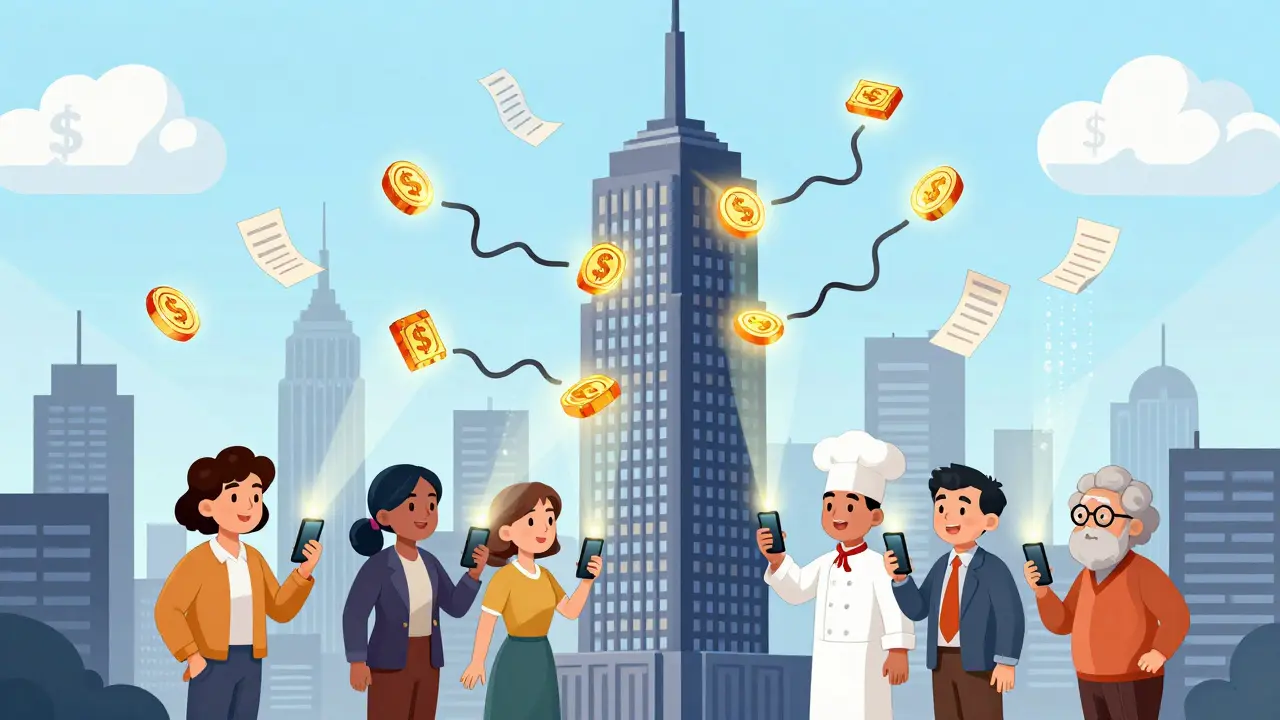
Imagine owning a piece of a skyscraper in New York, a hotel in Miami, or a warehouse in Chicago - not as a shareholder in a fund, but as a direct owner of a digital fraction of the actual asset. That’s what property tokenization is making possible today. It’s not science fiction. It’s happening right now, and the shift is accelerating fast.
What Exactly Is Property Tokenization?
Property tokenization turns real estate into digital tokens on a blockchain. Each token represents a share of ownership in a physical property - a house, an office building, a retail center. These tokens can be bought, sold, and traded like stocks, but they’re tied directly to the underlying asset. Unlike traditional Real Estate Investment Trusts (REITs), where you own shares in a company that owns properties, tokenization lets you own a slice of the actual building itself.This isn’t just about convenience. It’s about breaking down barriers. Real estate has always been illiquid. Selling a property can take months. You need lawyers, appraisers, inspectors, banks, and notaries. With tokenization, that process shrinks to hours. A token representing 0.1% of a $10 million apartment building can be transferred instantly, with no middlemen. Ownership is verified through cryptographic signatures - your private key is your deed.
There are two main types of tokens used. Non-fungible tokens (NFTs) represent full ownership of a single property - one token equals one building. Fungible tokens divide a property into hundreds or thousands of identical shares. For example, a hotel might issue 10,000 tokens, each representing 0.01% ownership. You could buy 50 tokens and earn 0.05% of the hotel’s rental income every month, automatically distributed via smart contract.
How It Works: The Step-by-Step Process
Tokenizing a property isn’t as simple as uploading a photo to a website. It’s a multi-stage legal, technical, and financial process.- Asset Selection and Valuation - Not every property is a good candidate. Appraisers assess location, rental income, occupancy rates, and market trends. High-value commercial properties - hotels, warehouses, office towers - are leading the way because their cash flows are predictable.
- Legal Structuring - This is the hardest part. Lawyers must design a legal entity (often a trust or LLC) that holds the property and issues tokens. The structure must comply with local property laws and securities regulations. In the U.S., the Howey Test determines if a token is a security. If yes, it must be registered or exempted under SEC rules.
- Smart Contract Development - The blockchain logic is coded here. Smart contracts automate everything: who gets paid when, how transfers are approved, voting rights for major decisions, and even tax withholding. These contracts are immutable - once deployed, they can’t be changed. That’s a feature, not a bug.
- Token Issuance and Compliance - Tokens are minted on a blockchain platform like Ethereum, Hedera, or Chintai. Access controls are added so only accredited or qualified investors can buy. KYC/AML checks are built into the platform.
- Integration with Land Registries - This is where most projects stall. In most countries, land titles are still recorded in paper or legacy digital systems. Only 17% of tokenized real estate platforms have successfully synced with government registries, according to MIT research. Most still operate in parallel - the blockchain records ownership, but the government still holds the official deed.
From start to finish, a full tokenization project takes 6 to 9 months and costs between $150,000 and $500,000. That’s a lot for a small landlord - which is why early adopters are institutions, not individuals.
Why Institutional Investors Are Leading the Charge
Retail investors are excited, but institutions are the ones with the capital and legal teams to make this work. In 2025, Kin Capital plans to launch a $100 million real estate debt fund on the Chintai blockchain. Investors need only $50,000 to participate - far below the $1 million minimums of traditional private real estate funds.Why? Because tokenization gives them something they’ve always wanted: precision. Instead of investing in a fund that owns 50 properties across 10 states, they can pick exactly which assets they want - a logistics hub in Atlanta, a medical office in Denver, a data center in Dallas. They can build custom portfolios aligned with their risk profile and geographic strategy.
Deloitte’s 2024 report confirms this trend. Real estate funds are the perfect test case for tokenization. They’re already structured as pooled investments. Adding blockchain just makes them faster, cheaper, and more transparent. No more quarterly reports that take weeks to compile. Every transaction is recorded in real time on a public ledger.
Switzerland and Luxembourg have already created clear legal frameworks for tokenized assets. That’s why European institutional investors are moving there. In the U.S., the SEC hasn’t issued clear rules - so companies are working with lawyers to navigate the Howey Test case by case. It’s messy, but progress is happening.

The Big Advantages Over Traditional Real Estate
The benefits aren’t theoretical. They’re measurable.- Liquidity - Traditional real estate takes 30 to 60 days to sell. Tokenized property can trade in minutes on secondary markets.
- Lower Entry Barriers - Instead of needing $500,000 to buy a small apartment building, you can buy $5,000 worth of tokens.
- Automated Income - Rent, parking fees, laundry revenue - all distributed automatically to token holders. No more waiting for a property manager to cut a check.
- Reduced Costs - No more title insurance, notary fees, or transfer taxes (in theory). EY estimates tokenization cuts transaction costs by 60-80%.
- Transparency - Every transaction is recorded on the blockchain. No hidden fees. No manipulated appraisals.
Compare that to traditional REITs. With a REIT, you don’t know which properties your money is tied to. You can’t vote on management decisions. You’re at the mercy of fund managers. With tokenization, you know exactly what you own - and you have a direct claim on its value.
The Hurdles: Why It’s Not Everywhere Yet
Despite the promise, adoption is still slow. Here’s why.- Regulation is a patchwork - The U.S., EU, Asia, and Latin America all have different rules. What’s legal in Luxembourg might be illegal in Texas. The IMF warns that blockchain-based property rights are still untested in courts.
- Liquidity is thin - There are few active marketplaces for trading tokenized real estate. Most tokens are locked up for months or years. Without buyers, the value can’t be realized.
- Legacy systems won’t disappear overnight - Land registries, banks, and title companies still run on 1990s software. Integrating blockchain with them is like trying to plug a USB-C cable into a dial-up modem.
- Cost and complexity - Only large players can afford the legal and technical overhead. A single-family home won’t be tokenized anytime soon - the cost to tokenize it exceeds its value.
And then there’s the trust issue. People are used to paper deeds. They don’t trust code. What if the smart contract has a bug? What if someone hacks the wallet? What if the government decides blockchain ownership isn’t valid? These aren’t hypotheticals. They’re real risks that have already caused delays and lawsuits.

What’s Next? The Road Ahead to 2030
The market is tiny today. Tokenized real estate assets totaled just $1.2 billion by late 2023 - less than 0.004% of the $29 trillion global real estate market. But growth is exponential.JPMorgan predicts tokenized real estate could hit $5-10 trillion by 2030. The IMF thinks it’s more likely to reach $1-2 trillion - if regulators get their act together. Either way, the direction is clear.
Commercial real estate will lead. Office buildings, warehouses, hotels - assets with clear income streams - are the low-hanging fruit. Residential real estate will follow, but only after regulatory clarity and better infrastructure.
Interoperability is the next big frontier. The InterWork Alliance - backed by IBM, Microsoft, and SAP - is building open standards so tokens can move across blockchains and platforms. That’s essential for liquidity. If your token only works on one network, it’s useless.
By 2030, we’ll likely see:
- Tokenized real estate funds as common as mutual funds
- Real estate brokers offering tokenized listings alongside traditional ones
- Blockchain-based land registries in at least 10 major countries
- Mobile apps letting you buy a share of a rental property in under 10 minutes
The biggest barrier won’t be technology. It’ll be law. Until courts recognize blockchain deeds as legally binding, adoption will be limited to investors who accept the risk. But when that happens - when a judge rules that a digital token equals a deed - real estate will never be the same.
Final Thought: It’s Not About Replacing Real Estate - It’s About Making It Work Better
Property tokenization isn’t trying to kill the housing market. It’s trying to fix its broken parts. The slow sales. The high fees. The lack of access. The opacity.It’s about letting a teacher in Ohio invest $1,000 in a warehouse in Ohio that pays rent every month. It’s about letting a small business owner in Texas own a piece of a medical office building that funds their retirement. It’s about making real estate less like a luxury and more like a public utility - accessible, transparent, and fair.
The future isn’t about replacing bricks and mortar. It’s about giving them a digital heartbeat - one that ticks with every payment, every transfer, every new owner who joins the chain.
Can anyone buy tokenized real estate?
Not yet. Most tokenized real estate offerings are restricted to accredited or qualified institutional investors due to securities regulations. In the U.S., you generally need a net worth of $1 million or an annual income of $200,000+ to qualify. Retail access is growing slowly, but it’s still limited. Some platforms are testing regulated crowdfunding models, but widespread public access is still years away.
Is tokenized real estate safe?
It’s as safe as the legal structure behind it. The blockchain itself is secure - transactions can’t be altered. But if the underlying legal entity is poorly structured, or if the smart contract has a bug, you could lose your investment. Always verify that the project is legally compliant, audited, and backed by a reputable entity. Never invest based on hype alone.
How do I get paid from tokenized property?
Payments are automated through smart contracts. If the property generates rent, fees, or other income, the contract distributes a proportional share to token holders on a set schedule - usually monthly or quarterly. The funds are sent directly to your crypto wallet. You’ll need a wallet that supports the blockchain the tokens are built on (like Ethereum or Hedera).
Can I live in a tokenized property?
Only if you own the entire property or have a lease agreement with the entity that holds it. Tokenization doesn’t automatically give you the right to occupy a property. Most tokenized assets are commercial or rental properties. If you want to live in one, you’d need to buy the whole thing or negotiate a rental deal with the token holders’ governing body - which is rare and complex.
What happens if the blockchain network fails?
The blockchain won’t “fail” in the way a website crashes. Networks like Ethereum and Hedera are decentralized and have been running for years. But if the legal entity holding the property goes bankrupt or the smart contract is invalid, the tokens lose their value - not because the blockchain broke, but because the asset behind it did. The blockchain records ownership; it doesn’t guarantee the asset’s existence or performance.
Is tokenized real estate taxed differently?
In most countries, yes. Tokenized real estate is treated as a security or capital asset. Rental income is taxed as ordinary income. Gains from selling tokens are taxed as capital gains. The IRS and other tax authorities treat them the same as traditional real estate investments - but tracking your cost basis across multiple small purchases can be complicated. Use crypto tax software and consult a tax professional familiar with blockchain assets.
What’s the difference between tokenization and REITs?
With a REIT, you own shares in a company that owns real estate. You have no direct claim to any specific property. With tokenization, you own a digital share of the actual building itself. You can track its performance, vote on major decisions (if allowed), and your returns are tied directly to that asset’s income. Tokenization offers more control and transparency - but also more complexity and risk.
Can I sell my tokens anytime?
Theoretically, yes - but in practice, it depends on market demand. Most tokenized real estate platforms have limited secondary markets. Some tokens are locked for 1-3 years. Others can be traded on decentralized exchanges, but buyers are scarce. Liquidity is the biggest challenge. Don’t assume you can cash out quickly.
Comments (10)
Dave Lite
January 8, 2026 AT 00:24
Tokenization is the future, no cap. Imagine buying 0.02% of a data center in Dallas for $2K and getting quarterly Distributions straight to your MetaMask. No more REIT middlemen, no quarterly reports that take weeks. Smart contracts handle everything - rent, tax withholding, even voting on major repairs. The tech is ready. The regulators? Still stuck in 2012.
Tiffani Frey
January 9, 2026 AT 09:59
...I'm just nervous about the legal gap. The blockchain records ownership, sure-but if the county recorder’s office doesn’t recognize it, and the property gets foreclosed on? What happens then? I’ve seen too many crypto projects promise ‘decentralized ownership’ and then vanish when the law catches up. This isn’t just tech-it’s a new legal framework, and we’re not ready.
Michael Richardson
January 11, 2026 AT 03:26
So let me get this straight-you’re telling me a guy in Ohio can buy a slice of a warehouse… but can’t even vote on who manages it? Cool. Next you’ll tell me my crypto wallet is my passport.
Sabbra Ziro
January 12, 2026 AT 22:10
Hey, I get the excitement-but let’s not forget the people who built this system before blockchain. Property managers, title insurers, local governments-they’re not villains. They’re just slow. Maybe we need to build bridges, not burn them. Tokenization can help, but it shouldn’t erase the human infrastructure that made real estate work in the first place.
Emily Hipps
January 13, 2026 AT 14:55
Y’all are missing the real win: accessibility. My cousin, a single mom making $45K a year, just bought $500 in tokenized storage units in Atlanta. She gets $12/month. It’s not life-changing-but it’s *something*. That’s the magic. Not billionaires buying skyscrapers. Regular people getting a slice of the pie. That’s the future.
Mujibur Rahman
January 15, 2026 AT 03:20
UK’s already ahead on this. We’ve got real legal clarity, actual regulatory sandboxes, and institutions moving fast. US is still debating whether a token is a security or a digital baseball card. Meanwhile, Singapore and Luxembourg are eating your lunch. Stop pretending you’re leading the charge-you’re just loud.
Danyelle Ostrye
January 16, 2026 AT 12:56
Everyone’s hyped about liquidity-but what if no one wants to buy your 0.005% of a Miami hotel in 2027? You’re stuck. The market’s thin. The tech’s cool. But don’t mistake novelty for value.
Jennah Grant
January 17, 2026 AT 05:51
True liquidity requires interoperability. Right now, you can’t move a token from Chintai to Ethereum without a bridge that might not exist next year. The InterWork Alliance is trying, but without standardization, we’re just building digital silos. And silos don’t create markets-they create dead assets.
Dennis Mbuthia
January 18, 2026 AT 20:13
Oh wow, so now we’re gonna let anyone with a crypto wallet own part of a building? That’s just gonna end in chaos. Who’s gonna fix the AC when it breaks? Who pays for the fire code inspection? The blockchain doesn’t care if the sprinklers work. And you think a 19-year-old in Boise who bought 0.001% of a NYC office tower is gonna care about the plumbing? This isn’t progress-it’s a Ponzi scheme dressed up as innovation.
Becky Chenier
January 19, 2026 AT 07:33
While the technology holds promise, the legal and operational challenges remain substantial. Until regulatory frameworks are harmonized across jurisdictions and land registries are integrated with blockchain systems, the risk profile for retail investors remains high. Caution, due diligence, and professional advice are essential.