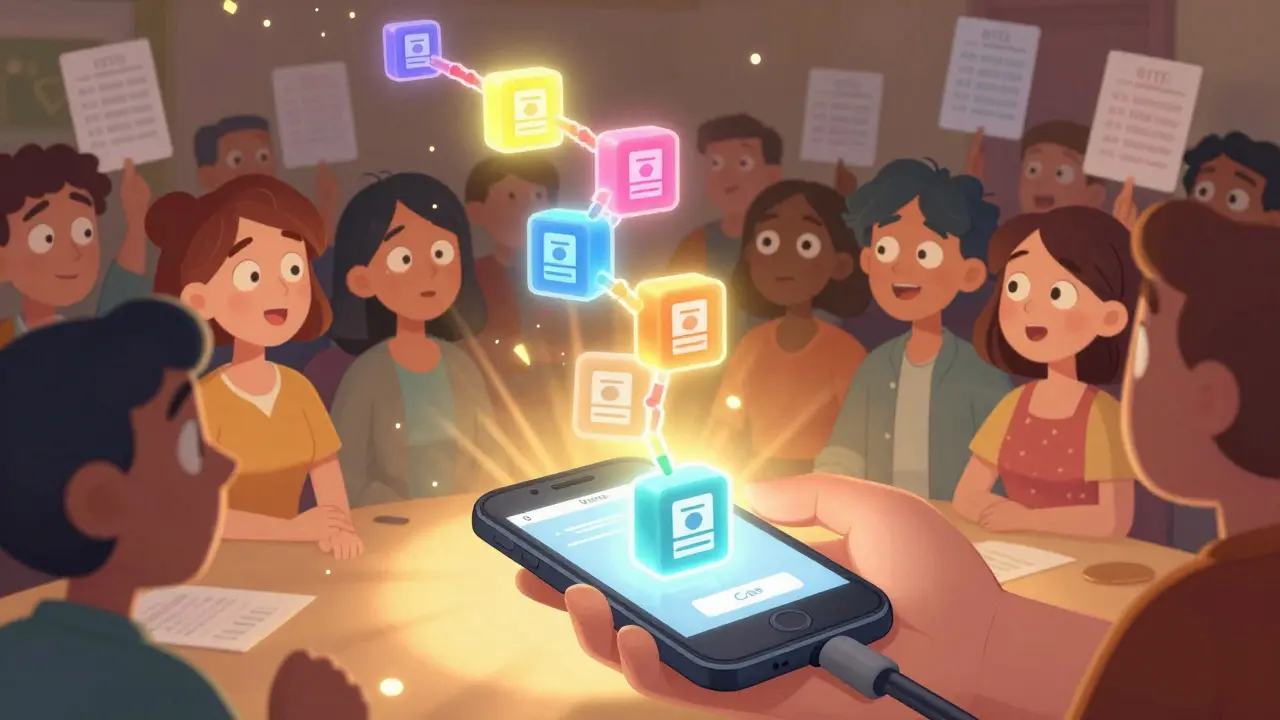
Imagine casting your vote from your phone, knowing it was counted exactly as you intended - and anyone, anywhere, could verify that it was counted correctly. No manual recounts. No suspicious delays. No centralized authority that could, intentionally or accidentally, alter the results. This isn’t science fiction. It’s what blockchain voting promises - and why transparency and auditability are its core strengths.
What Makes Blockchain Voting Different?
Traditional voting relies on physical ballots, centralized databases, and human operators. Even digital voting systems often depend on a single server or authority to store and count votes. That creates a single point of failure. If that server gets hacked, or if someone inside the system manipulates the data, there’s no easy way to prove it - or fix it. Blockchain voting changes that. Instead of one central database, votes are recorded across thousands of computers (nodes) around the world. Each vote is encrypted, timestamped, and linked to the one before it in a chain. Change even one vote? The entire chain breaks. The network instantly rejects it. This isn’t just about security. It’s about transparency. Every vote is publicly visible on the ledger. Anyone can check it - journalists, candidates, independent auditors, voters themselves. You don’t need to trust a government or vendor. You can verify the results yourself.How Transparency Works in Practice
Transparency in blockchain voting doesn’t mean everyone sees who you voted for. It means everyone can see that your vote was cast, received, and counted - without being altered. Here’s how it works step by step:- When you register to vote, you’re given a unique, random digital key - not your name or ID. This keeps your identity private.
- You cast your vote using a secure app or website. Your vote is encrypted and turned into a transaction on the blockchain.
- That transaction is broadcast to the network. Every node receives it and checks if it’s valid (e.g., you’re registered, you haven’t voted before).
- Once verified, the vote is added to a block. That block is then permanently linked to the previous one using cryptography.
- From that moment on, the vote exists on every node in the network. No one can delete it. No one can change it without being caught.
Auditability: The Mathematical Guarantee
Auditability is what turns transparency into trust. It’s not enough to see votes. You need to know they’re accurate. Blockchain voting systems use smart contracts - self-executing code that runs automatically when conditions are met. These contracts define the rules of the election: who can vote, when voting opens and closes, how votes are tallied, and what happens if there’s a tie. Because smart contracts run on the blockchain, they can’t be changed after deployment. No human can override them. No election official can manually adjust the count. The code does the counting - and everyone can inspect the code to confirm it’s fair. This is the real breakthrough. In traditional elections, you’re told the results are accurate. In blockchain voting, you can prove it. You can run an independent audit by:- Downloading the full blockchain ledger
- Running the same smart contract code
- Verifying that every vote matches the public record
- Confirming the final tally matches the official result

Privacy Without Anonymity
A common concern: If votes are public, how is voter privacy protected? Blockchain voting doesn’t make votes anonymous. It makes them pseudonymous. Your vote is tied to a random, one-time digital ID - not your name, Social Security number, or email. That ID is public, but it doesn’t reveal who you are. Only the election authority, using secure cryptographic keys, can link your ID to your real identity - and only to verify you voted once. Once your vote is recorded, your identity is permanently separated from your ballot. Even the election commission can’t see who voted for whom after the fact. This system was tested in West Virginia’s 2018 pilot program. Overseas military voters used a mobile app to cast ballots. Their identities were verified using biometrics (like thumbprints), but their votes were encrypted and recorded on a blockchain. The results were publicly verifiable. No one knew who voted for whom - but everyone knew the count was correct.Why This Beats Traditional Systems
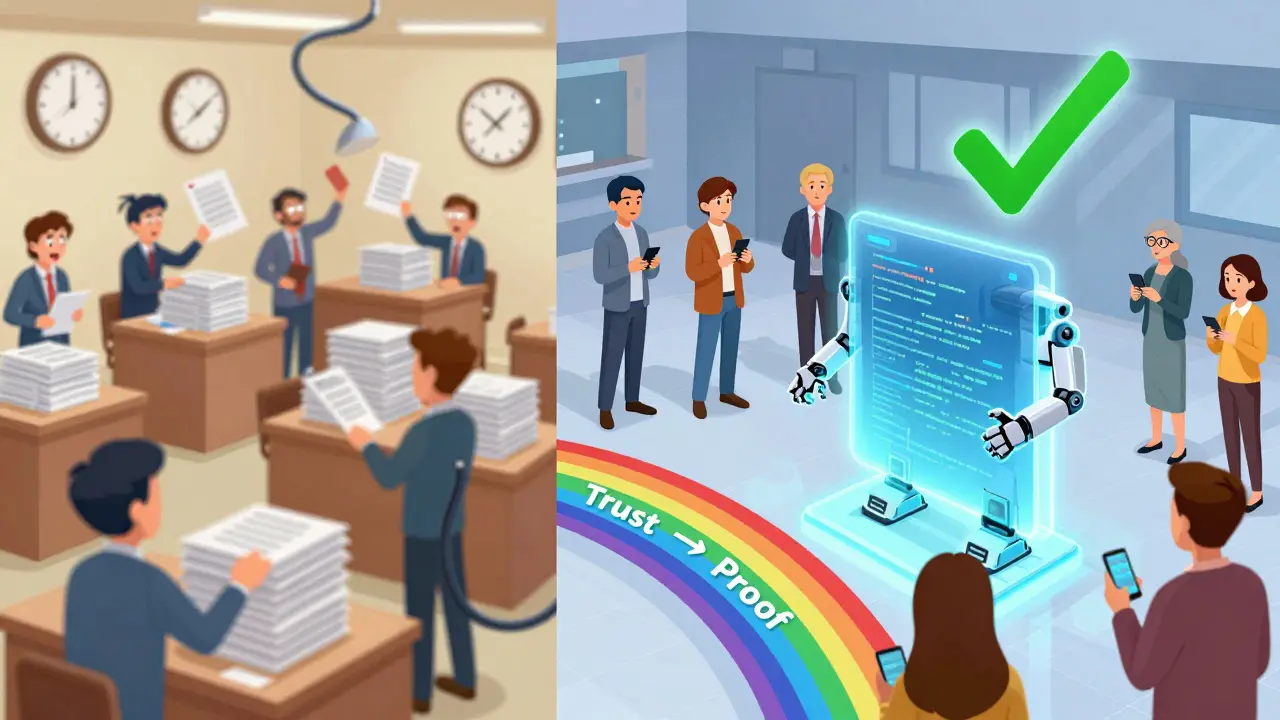
Compare this to a typical election:- Traditional: Ballots are counted in a room with sealed machines. Only election staff see the raw data. Recounts take days. No public verification.
- Blockchain: Votes are live on a public ledger. Audits take minutes. Results are available in seconds. Anyone can verify.
Real Challenges - And Why They’re Not Dealbreakers
Blockchain voting isn’t perfect. It’s still early. Scalability: Can a blockchain handle millions of votes in a single day? Right now, most public blockchains (like Ethereum) can process 15-30 transactions per second. A national election might need 10,000+ per second. Solutions like layer-2 networks and specialized blockchains are being built for this. They’re not ready yet - but they’re coming. Accessibility: Not everyone has a smartphone or reliable internet. This isn’t a flaw in blockchain - it’s a flaw in digital access. The solution isn’t to abandon the tech, but to pair it with public access points: libraries, community centers, kiosks with trained staff. Public Trust: Many voters don’t understand blockchain. That’s okay. You don’t need to understand how a car engine works to drive. What you need is confidence that the system works. That’s why independent audits, open-source code, and public demonstrations matter. The biggest risk isn’t the technology. It’s poor implementation. If a blockchain voting system is built with backdoors, or if the private keys are poorly managed, it can be hacked. But that’s true of any system. The difference? With blockchain, you can prove it was hacked - and trace exactly how.The Bigger Picture: Trust in Democracy
Elections only work if people believe in them. When voters doubt the system, they lose faith in the outcome - no matter how fair it is. Blockchain voting doesn’t fix politics. But it fixes the mechanics. It turns elections from a black box into an open book. It gives power back to the people - not just to choose their leaders, but to verify the process that chooses them. Countries like Estonia have used blockchain for voting since 2014. Switzerland is testing it for municipal elections. The U.S. has run small pilots. Each time, the results are the same: voters feel more confident. Auditors find fewer errors. Costs go down. The future of voting isn’t about replacing humans with machines. It’s about using technology to make human democracy more honest, more open, and more resilient.What’s Next?
The next five years will see more pilot programs - not just in the U.S., but in Canada, the EU, and beyond. We’ll see hybrid systems: blockchain for verification, paper ballots as backup. We’ll see more open-source tools so cities and counties can build their own secure systems. The goal isn’t to make every vote digital overnight. It’s to make every vote verifiable - no matter how it’s cast. Transparency and auditability aren’t just technical features. They’re democratic rights. And blockchain is the first technology that makes them possible at scale.Can blockchain voting be hacked?
Blockchain voting is extremely hard to hack because votes are stored across thousands of computers, not one server. Changing a vote would require hacking every single node at the same time - which is practically impossible. Even if someone tried, the network would reject the change instantly because the cryptographic chain would break. The real risk isn’t the blockchain itself - it’s weak software on the voter’s device or poor key management. That’s why security depends on good design, not just the tech.
Does blockchain voting reveal who I voted for?
No. Your vote is linked to a random, one-time digital ID, not your name or personal details. Only the election authority, using secure cryptographic methods, can match your ID to your identity - and only to confirm you voted once. After that, your identity is permanently separated from your ballot. Everyone can see the vote count, but no one can see how you voted.
Can I verify my own vote was counted?
Yes. Most blockchain voting systems give you a unique transaction ID after you vote. You can use that ID to look up your vote on the public blockchain ledger. You’ll see that your vote was received and included in the final tally - but you won’t see what you voted for, to protect your privacy. This gives you direct proof your vote was counted, without exposing your choice.
Is blockchain voting faster than traditional voting?
Yes - especially for counting. Traditional elections can take days or weeks to finalize results because ballots must be collected, transported, and manually counted. Blockchain voting counts votes automatically in real time using smart contracts. Results can be available within minutes after polls close. That doesn’t mean you get results faster if voters still need to show up in person - but for mail-in or online voting, the difference is dramatic.
Why aren’t all elections using blockchain yet?
Because it’s still new, expensive to build properly, and requires public trust. Governments move slowly, especially with elections. There are also legal and regulatory hurdles. Most places are running small pilots first - like West Virginia’s military voting test - to prove it works before scaling up. The technology is ready. The political will and infrastructure are catching up.
Comments (10)
Linda Prehn
January 24, 2026 AT 04:01
Blockchain voting sounds like a fancy solution to a problem that doesn’t exist. People don’t care if the system is transparent-they care if their candidate wins. And let’s be real, most voters can’t even spell ‘blockchain’ without Google.
Stop trying to tech-solve democracy. We need more voters, not more code.
Adam Lewkovitz
January 24, 2026 AT 21:42
So now we’re letting hackers from Russia or China vote in our elections just because some nerd says ‘it’s secure’? No thanks. I’ll take paper ballots any day. At least with paper, I know someone’s watching it. With blockchain? Some guy in a basement in Estonia is deciding who wins.
This isn’t progress. It’s surrender.
Clark Dilworth
January 26, 2026 AT 03:03
From a systems architecture standpoint, the Byzantine Fault Tolerance (BFT) consensus mechanism inherent in permissioned blockchain implementations-such as Hyperledger Fabric or Tendermint-provides deterministic finality without reliance on proof-of-work, thereby mitigating latency bottlenecks while preserving immutability.
The real bottleneck isn’t the chain-it’s the identity attestation layer. Zero-knowledge proofs (ZKPs) applied to voter credentialing could enable verifiable anonymity at scale, but current implementations lack interoperability with legacy voter rolls. That’s the true technical hurdle, not scalability.
Brenda Platt
January 26, 2026 AT 13:34
Y’all are overcomplicating this 😊
Imagine if your vote was like a TikTok comment-everyone could see it got counted, but no one knew it was yours. That’s the magic. No more ‘my vote didn’t count’ drama. No more shady backrooms.
We’ve got the tech. We just need the guts to use it. Let’s stop being scared and start being smart 💪🗳️
Barbara Rousseau-Osborn
January 27, 2026 AT 08:00
Oh wow, another tech bro who thinks code can fix everything. You think people are gonna trust a system they don’t understand? You think the elderly, the poor, the non-tech-savvy are just gonna ‘use an app’? This is elitist garbage.
And don’t even get me started on ‘open-source code’-you think the average person can audit smart contracts? Please. This isn’t transparency. It’s digital colonialism disguised as progress.
Go read a book on civic history before you try to ‘fix’ democracy.
Arnaud Landry
January 27, 2026 AT 23:33
While I acknowledge the theoretical elegance of distributed ledger technology in electoral contexts, I must express profound skepticism regarding its practical implementation. The potential for adversarial manipulation through endpoint compromise-namely, voter device infection via phishing or malware-remains unaddressed in most promotional narratives.
Moreover, the geopolitical implications of foreign actors exploiting cryptographic vulnerabilities in national voting infrastructure are not merely speculative-they are documented in state-sponsored cyber operations since 2016.
One must ask: Is the marginal gain in auditability worth the systemic risk?
steven sun
January 29, 2026 AT 06:34
bro this is the future. imagine voting from your bed at 2am after a shift. no lines. no waiting. no ‘oh we lost your ballot’. i voted in a pilot last year. it was slick. like buying coffee on your phone.
stop being scared of stuff you dont get. the system dont need you to understand it. it just needs you to trust it. and it works.
also i saw my vote on the public ledger. it was there. no cap.
Athena Mantle
January 31, 2026 AT 00:51
Blockchain voting is just the latest manifestation of techno-spiritualism-the belief that algorithms can replace moral responsibility.
Democracy isn’t about audit trails. It’s about presence. About the shared ritual of walking to the polls, shaking hands, seeing your neighbor, feeling the weight of choice.
When we outsource our civic soul to a blockchain, we don’t gain transparency-we lose humanity.
And yes, I know this sounds poetic. But poetry is the only language left that still tells the truth.
Paru Somashekar
February 1, 2026 AT 04:28
While blockchain-based voting presents significant advantages in terms of verifiability and reduction of administrative overhead, it is imperative to consider the digital divide in developing nations. In India, for instance, only 48% of the population has consistent internet access, and smartphone penetration remains uneven across rural regions.
Therefore, any implementation must be hybrid-blockchain for verification, with paper-based fallbacks for accessibility. The technology must serve the people, not exclude them.
Also, open-source audit frameworks must be localized and translated into regional languages to ensure true public participation in verification.
katie gibson
February 2, 2026 AT 15:04
so like… what if someone just… deletes the blockchain? like, what if a gov just pulls the plug? and then what? all the votes just… gone? nope. nope nope nope. i’m not buying it.
also why do i need to know how my vote was counted? i just want my candidate to win. that’s it. you overthinkers are exhausting.