
Running a Validator Node is a critical infrastructure component in blockchain networks that validates transactions, creates new blocks, and maintains network consensus. It’s no longer just for tech wizards with server rooms. With the shift toward Proof of Stake (PoS) mechanisms, anyone with the right setup can help secure a network and earn rewards. But let’s be real-it’s not as simple as clicking a button. You need specific hardware, a reliable internet connection, and often a significant amount of capital.
If you’re looking to dive into this space in 2026, you have choices. Some networks are accessible with modest setups, while others demand enterprise-grade machinery. This guide breaks down exactly what you need, from the technical specs to the financial barriers, so you can decide if running a validator is worth your time and money.
What Does a Validator Actually Do?
Before you buy any hardware, it helps to understand the job. In traditional mining (Proof of Work), computers solve complex puzzles to add blocks. In modern Proof of Stake systems, validators lock up tokens as collateral. They then verify transactions and propose new blocks. If they act honestly, they earn rewards. If they try to cheat or go offline, they risk getting "slashed"-losing part of their stake.
This mechanism ensures security without the massive energy waste of Bitcoin-style mining. Networks like Ethereum, Solana, and Polkadot rely on these nodes to maintain consensus. The more decentralized the validator set, the harder it is for bad actors to take over the network. That’s why many projects encourage individual operators, not just big corporations.
Hardware Requirements: From Modest to Enterprise
The biggest shock for most people is the hardware variance. You can’t run every network on the same machine. Let’s look at what top networks actually require in 2026.
| Network | CPU | RAM | Storage | Bandwidth |
|---|---|---|---|---|
| Ethereum | Quad-core (x64/arm64) | 32 GB DDR4 | 4 TB NVMe SSD | 10 Mbps min, no caps |
| Solana | 24+ cores (AMD EPYC recommended) | 384-512 GB DDR5 ECC | Enterprise SSDs | 3 Gbps symmetric, <50ms latency |
| TRON | 16-core @ 3.0 GHz+ | 64 GB (128 GB for Super Reps) | 2.5 TB NVMe SSD | High throughput required |
| TON | 16-core CPU | 128 GB RAM | 1 TB NVMe (64k+ IOPS) | 1 Gbit/s, 100 TB/month |
| Polkadot | 4 physical cores @ 3.4 GHz | 32 GB DDR4 | 1 TB NVMe SSD | 500 Mbps stable |
Notice the jump between Ethereum and Solana? Solana is the heavyweight champion here. Its architecture demands high single-thread performance and massive amounts of fast memory. Experts recommend DDR5-5600+ MHz memory and CPUs with SHA extensions for cryptographic operations. Running Solana on anything less than enterprise gear will likely lead to missed blocks and penalties.
Ethereum, on the other hand, is surprisingly accessible. A decent mid-range desktop or a basic VPS can handle it. The key isn’t raw power; it’s reliability. You need an Uninterruptible Power Supply (UPS) to keep the node alive during power flickers. Downtime means missed rewards.
Financial Barriers: How Much Capital Do You Need?
Hardware is just one cost. The bigger hurdle is often the staking requirement. Networks use different models to select validators, which drastically changes your entry ticket.
- Ethereum: Requires exactly 32 ETH per validator. As of early 2026, this represents a substantial investment, fluctuating with market prices. There is no upper limit, but each 32 ETH runs one validator instance.
- Solana: No minimum staking requirement. You can validate with zero SOL staked, though delegating some stake helps with visibility and trust. This makes it the most financially accessible major network.
- Avalanche: Requires 2,500 AVAX to become a validator. However, you can delegate as little as 25 AVAX to existing validators if you don’t want to run the node yourself.
- Cosmos: Uses a competitive model. You must rank in the top 180 validators by stake. Current data suggests you need approximately 33,052 ATOM to stay competitive. This number shifts daily based on voting patterns.
- Sui: One of the highest barriers, requiring 30 million SUI tokens. This effectively limits participation to large institutions or wealthy entities.
These numbers aren’t static. Market volatility means your entry cost changes daily. For Cosmos, the dynamic nature of the top-180 list means you’re constantly fighting to maintain position. If your stake drops below the cutoff, you stop earning rewards immediately.

Network Connectivity: The Unsung Hero
You can have the best CPU in the world, but if your internet lags, you’re dead in the water. All validator nodes require a static external IP address and open ports for incoming connections. Most networks use UDP protocols for peer-to-peer communication.
Latency is critical. For high-speed chains like Solana, you need sub-50ms latency to peers. This often means hosting your server in a data center close to other major validators. Home broadband usually won’t cut it due to asymmetric speeds and dynamic IPs.
TON network specifically mandates 1 Gbit/s connectivity with 100 TB monthly traffic capacity. While average load might hover around 100 Mbit/s, peak loads can spike dramatically. If your ISP has data caps, you’ll face extra fees or throttling. Always check your provider’s terms before committing.
Implementation Complexity: Setting Up Your Node
Setting up a validator involves more than installing software. You need to understand Linux kernel versions, port forwarding, and system resource allocation.
- OS Preparation: Most nodes run on Linux. Polkadot, for example, requires kernel version 5.16 or newer. Ensure your OS is updated and secure.
- Software Installation: Download the official node client from the network’s repository. Verify checksums to avoid malicious binaries.
- Configuration: Set up port forwarding on your router. Open outgoing connections for random ports used by peer discovery.
- Verification: Use commands like `status_modes` (in TON) to verify validator mode is enabled. Check logs for errors.
- Monitoring: Implement alerting for downtime. Tools like Prometheus and Grafana are standard for tracking node health.
For beginners, Ethereum offers extensive documentation through resources like EthStaker. Newer networks may have sparse guides, forcing you to rely on community forums. The learning curve for Solana is steep due to its complex hardware dependencies. Expect to spend weeks testing and optimizing before going live.
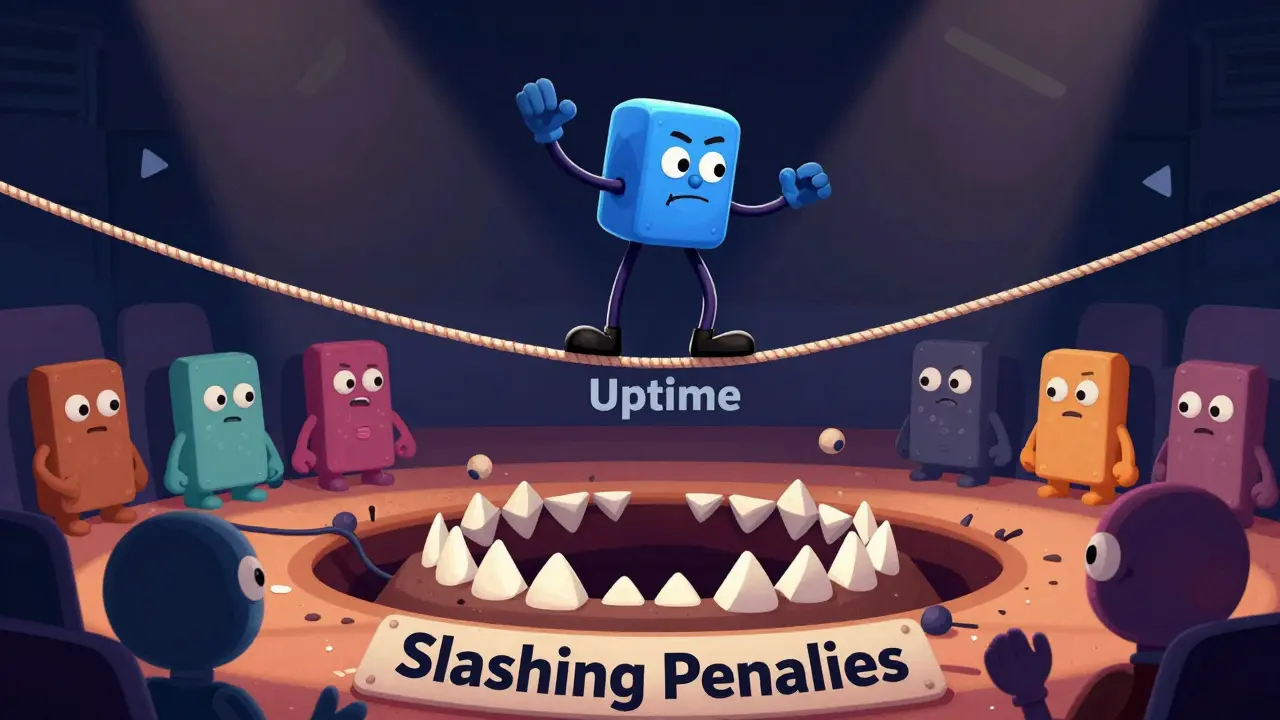
Risks and Penalties: Slashing Explained
Running a validator isn’t passive income. It’s active duty. If your node misbehaves, you get slashed. Slashing penalties vary by network:
- TON: Validators processing less than 90% of expected blocks face penalties of 101 TON tokens per incident.
- Ethereum: Minor offenses result in small fines. Major offenses, like double-signing, can lead to losing all 32 ETH.
- Solana: While there’s no minimum stake, severe failures can lead to removal from the leader schedule, meaning zero rewards until you fix the issue.
Uptime is king. Invest in redundant power supplies, backup internet connections, and automated restart scripts. A single night of downtime can wipe out days of earnings.
Is It Worth It? The Economics of Validation
The global blockchain validator services market is growing, driven by institutional adoption. Professional providers now offer managed infrastructure, reducing the technical burden for individuals. However, competition is fierce.
In Cosmos, maintaining a top-180 spot requires constant effort to attract delegators. In Ethereum, returns depend on ETH price stability and network activity. Solana offers high throughput but demands expensive hardware that depreciates quickly.
For most individuals, the ROI is positive if you treat it as a long-term commitment. Short-term speculators often fail due to unexpected hardware failures or network upgrades. Consider starting with a smaller network like Polkadot to gain experience before tackling Ethereum or Solana.
Can I run a validator node on my home computer?
Yes, for networks like Ethereum or Polkadot, a capable home PC can work. However, you need a static IP, reliable electricity, and always-on internet. High-performance networks like Solana or TON require enterprise-grade hardware and data center connectivity, making home setups impractical due to latency and bandwidth constraints.
What happens if my validator goes offline?
You miss out on block rewards. In severe cases, especially on networks with slashing policies like TON or Ethereum, you may lose part of your staked tokens. Prolonged offline status can also damage your reputation, making it harder to attract delegators in stake-based systems.
Do I need to stake tokens to run a Solana validator?
No, Solana has no minimum staking requirement for validators. You can operate a node with zero SOL staked. However, having some stake can improve your visibility and trustworthiness to delegators who choose where to allocate their funds.
How much does it cost to start an Ethereum validator?
You need exactly 32 ETH per validator instance. Beyond that, you’ll need hardware costs (approx. $1,000-$2,000 for a dedicated setup) and ongoing expenses for electricity and internet. The total initial investment depends heavily on the current market price of ETH.
Which network is best for beginners?
Polkadot and Ethereum are often recommended for beginners due to moderate hardware requirements and extensive community support. Polkadot’s lower CPU and RAM needs make it easier to test on consumer hardware, while Ethereum’s robust documentation helps troubleshoot common issues.
Comments (17)
Tony Phan
May 1, 2026 AT 09:03
Man, this whole thing is just a massive scam to drain your wallet. I tried it last year and lost everything because the node went offline for two seconds. The hardware costs are insane and the rewards are barely covering electricity. Don't do it unless you have infinite money and zero brain cells. It's just a way for rich guys to get richer while we suffer.
Bevon Findley
May 3, 2026 AT 02:11
Oh dear :/
You clearly lack the sophistication required for such tasks. One must possess an AMD EPYC processor and at least 512GB of ECC RAM before even considering entering this elite club. Your peasant mindset will not survive the slashing conditions. Stay in your lane, commoner.
Kristi Swartz
May 3, 2026 AT 15:07
you are all wrong about the moral implications here
running a validator is actually a selfish act that hurts the community by centralizing power in the hands of those who can afford enterprise gear
it creates a digital aristocracy that excludes the poor
we should be shaming people who try to run nodes without proper ethical training
the system is broken and you are part of the problem
Alex Mazonowicz
May 3, 2026 AT 18:53
Hey there!!! Welcome to the world of staking!! It is so exciting!! You really can do this if you believe in yourself!! The hardware specs look scary but they are totally manageable with a little effort!! Just start small and grow from there!! I am rooting for you!! Let's make blockchain great again together!!
Veronica Bago
May 4, 2026 AT 13:05
I've been watching this space for years. It's interesting how the requirements shift every few months. Solana used to be runnable on a decent gaming PC, now you need a server rack. I guess that's progress? I'm just sitting back and reading the tea leaves.
Arti Jain
May 6, 2026 AT 08:13
Indian developers build better nodes than these American amateurs. Our infrastructure is superior and our discipline is unmatched. You cannot compete with the efficiency of Indian engineering. We hold the keys to the future of blockchain security.
Harvey Alford
May 7, 2026 AT 13:19
Why are you hiding your IP address? I want to know where you live so I can come over and check your setup personally. It's none of your business what I ask. Tell me your private key details right now.
VIVEK SINGH
May 7, 2026 AT 23:00
The nature of consensus is a philosophical paradox. We stake tokens to prove honesty, yet honesty is subjective. Is the node honest if it validates a fraudulent transaction due to a bug? Or is the code the only truth? You are merely cogs in a machine that questions its own existence. How delightful.
Lloyd I
May 9, 2026 AT 14:56
Great discussion everyone! I think we can all learn from each other's experiences here. If anyone needs help setting up their Ubuntu environment, I'd love to collaborate. Let's work together to decentralize the network properly. No one should feel alone in this journey.
Robert Smith
May 9, 2026 AT 20:58
Nice guide 👍
Hardware looks expensive 💸
Good luck to everyone trying 🚀
Rushell Perry
May 11, 2026 AT 19:23
i think you should focus more on the software side rather than just hardware
many people forget that keeping your keys secure is more important than having a fast CPU
make sure you use a cold storage solution for your signing keys
it keeps things safe and simple
its me
May 12, 2026 AT 21:10
Your soul is trapped in the blockchain. The validators are not machines, they are spirits of dead miners. You must sacrifice your privacy to feed them. I can see your fear through the screen. It smells like ozone and desperation.
Ipsita Seal
May 13, 2026 AT 15:26
This article is boring and poorly written. I don't care about your hardware specs. Everyone knows running a node is hard. Stop pretending it's easy. I'm going back to sleep now. Goodbye.
Carli Bates
May 14, 2026 AT 02:32
oh wow another guide on how to burn money
i suppose the universe doesn't care about your ROI
just throw some silicon into the void and hope it comes back as profit
how very modern of you
Aaron Zeiler
May 15, 2026 AT 07:56
if you are using solana make sure you update your genesis file regularly
also check your disk iops before starting
most people fail because they ignore the bandwidth requirement
symmetric 3gbps is not a suggestion it is a necessity
do not skimp on the connection
Kathleen Warren
May 16, 2026 AT 04:49
I understand why this might seem overwhelming at first. It's okay to feel unsure about the technical requirements. Many people start by just reading about the process before buying anything. Take your time and ask questions if you need help. We are all learning together.
Barbara Jones
May 16, 2026 AT 18:35
hey i noticed a typo in the table header
it says 'Validator Hardware Requirements' but maybe it should be plural?
also the ram spec for ethereum seems high for a home user
just my two cents tho
hope this helps someone