
OpenSwap Fee Calculator
Calculate Your Savings
See how much you'd save by trading on OpenSwap compared to standard DEXs. OpenSwap charges 0% fees while most DEXs charge 0.25% to 0.5% per trade.
Note: For trades under $100, OpenSwap provides significant savings. However, for larger trades, liquidity may be limited and slippage could impact your trade.
OpenSwap on Optimism isn’t another big-name crypto exchange. It doesn’t have millions of users, flashy ads, or a team of influencers pushing it. But if you’re tired of paying trading fees on every swap-especially on Ethereum-OpenSwap might be worth a closer look. It’s a tiny decentralized exchange built on Optimism, and it charges zero fees for both makers and takers. That’s rare. Almost unheard of. So is it a hidden gem or a risky experiment?
How OpenSwap Works on Optimism
OpenSwap runs entirely on Optimism, a Layer 2 blockchain built to make Ethereum faster and cheaper. Instead of sending every trade through the congested Ethereum mainnet, OpenSwap uses optimistic rollups. This means transactions are batched off-chain and then verified on Ethereum. The result? Faster swaps, lower gas fees, and smoother user experience.
Because Optimism is EVM-compatible, OpenSwap doesn’t need to rewrite its code from scratch. It works just like Uniswap or SushiSwap, but with much lower costs. If you’ve used a DEX before, the interface will feel familiar: connect your wallet, pick tokens, and swap. No KYC, no account creation, no middleman.
The whole platform is accessible at app.openxswap.exchange. There’s no mobile app, no desktop client-just a clean web interface. It’s minimal, but functional.
Zero Fees: The Big Draw
Most DEXs charge around 0.25% to 0.3% per trade. Centralized exchanges like Binance or Coinbase charge even more-up to 0.5% for spot trades. OpenSwap charges nothing. Zero. Nada.
That’s not a mistake. It’s intentional. The platform is betting that low friction will attract volume. And volume, even if small, can fuel token demand. But here’s the catch: someone has to pay for the infrastructure. Who? The answer isn’t clear.
Most DEXs with zero fees make money through token incentives, liquidity mining, or by selling their own native token. OpenSwap has a token-called OpenSwap (OPSW)-but there’s no public breakdown of how it’s distributed, what it’s used for, or how much is in circulation. Coinbase lists a price prediction for it, but that’s about all the data available. No whitepaper. No team disclosures. No audit reports published publicly.
If you’re trading small amounts, the zero fee is a win. But if you’re moving large sums, you need to ask: Is there enough liquidity? What’s the slippage like? Without transparency, you’re trading on trust alone.
Who’s Using OpenSwap?
Not many people, honestly.
According to SimilarWeb, OpenSwap gets about 1,500 visits per month. That’s less than 0.3% of Uniswap’s traffic. It ranks 441st out of 612 crypto exchanges in organic traffic. That puts it firmly in the niche category.
But here’s the interesting part: those who do visit stick around. The bounce rate is only 25%, meaning most users explore more than one page. They spend nearly 10 minutes on the site. That’s longer than many users spend on major exchanges. It suggests that once someone finds OpenSwap, they understand what it offers-and they’re curious enough to dig deeper.
This isn’t a platform for beginners. It’s for people who already know how DEXs work, who care about fees, and who are willing to try something small and unproven. It’s not for hodlers. It’s for active traders who want to minimize costs on Optimism.
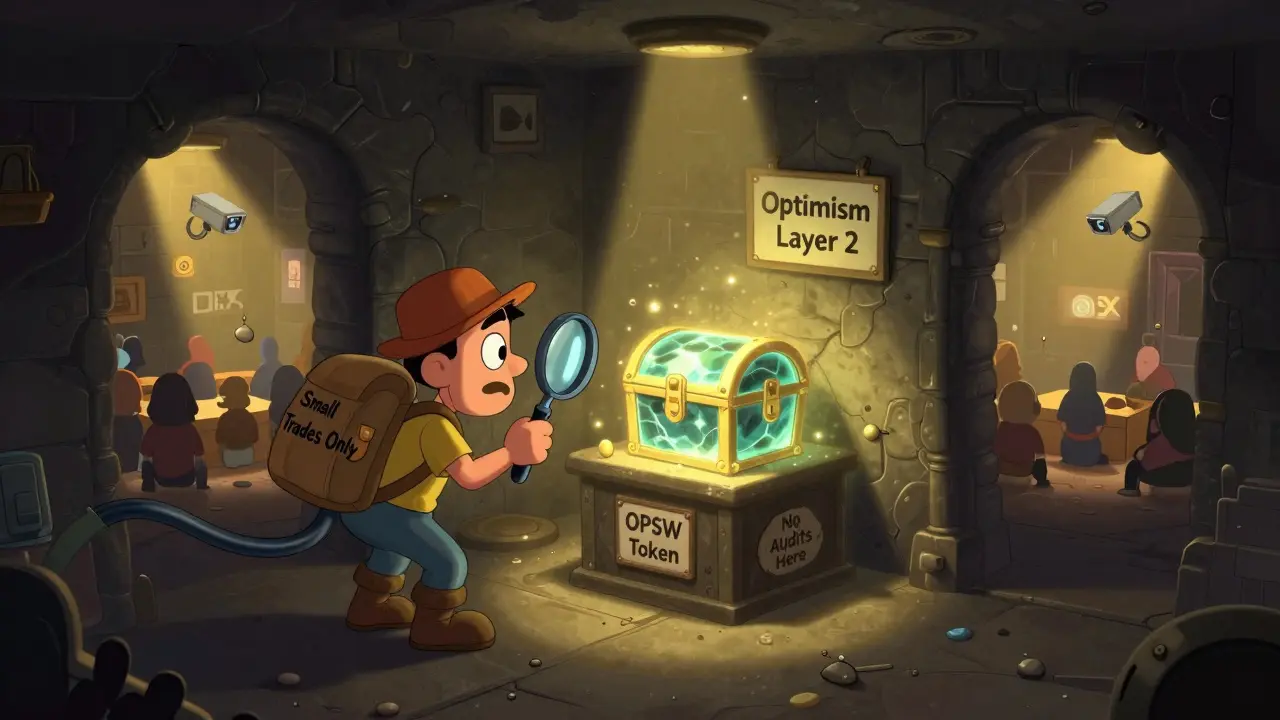
The Optimism Advantage
OpenSwap doesn’t exist in a vacuum. It’s riding the wave of Optimism’s growth. As of May 2025, the OP token hit $0.72, up from under $0.20 a year earlier. Optimism has become one of the most trusted Layer 2 networks, with projects like Synthetix, Frax Finance, and 1inch already live on it.
Optimism’s tech is solid. It uses optimistic rollups to bundle hundreds of transactions into one Ethereum proof. That cuts gas fees by 90% compared to mainnet. It’s also compatible with Ethereum wallets, tools, and smart contracts. If you’re already using MetaMask or WalletConnect, you’re ready to go.
Plus, Optimism has a unique governance model: two houses. The Token House lets OP holders vote on protocol changes. The Citizens’ House gives early contributors and community members a say too. This isn’t just top-down control-it’s a real attempt at decentralized decision-making. OpenSwap benefits from that stability.
Is OpenSwap Safe?
There’s no public audit report for OpenSwap’s smart contracts. No CertiK. No PeckShield. No Hacken. That’s a red flag.
OpenSwap’s code is likely open-source (most DEXs are), but without an independent audit, you can’t be sure there aren’t hidden vulnerabilities. A bug in the liquidity pool contract could freeze your funds. A front-running exploit could drain your trades. And if the team abandons the project, there’s no customer support, no refund policy, no recourse.
That’s the nature of DeFi. But most top DEXs-Uniswap, Curve, SushiSwap-have been audited multiple times. OpenSwap hasn’t. That doesn’t mean it’s unsafe. But it does mean you’re taking on more risk than you would with a well-established platform.
If you’re trading small amounts-under $100-it’s probably fine. If you’re putting in $10,000? You’re gambling. And you should know it.
Tokenomics: What’s the OpenSwap Token For?
The OpenSwap token (OPSW) is the biggest mystery. Coinbase lists a price prediction of ARS 55.24 for the next three months. That’s in Argentine pesos, which hints at regional interest-but tells us nothing about global utility.
Is it a governance token? A fee-sharing token? A staking reward? No one says. There’s no staking dashboard. No yield farming page. No token distribution breakdown. The token’s supply, market cap, and circulating supply are all missing from public sources.
Without clear utility, the token’s value is purely speculative. It’s being traded because people think it might go up-not because it does anything useful. That’s dangerous. Tokens without purpose often crash when hype fades.
If you’re buying OPSW, you’re not investing in a product. You’re betting on the idea that more people will use OpenSwap. And right now, that’s a long shot.
How It Compares to Other DEXs on Optimism
OpenSwap isn’t the only DEX on Optimism. Uniswap V3, SushiSwap, and Curve all have strong liquidity and user bases there. Here’s how they stack up:
| Feature | OpenSwap | Uniswap V3 (Optimism) | SushiSwap (Optimism) |
|---|---|---|---|
| Trading Fees | 0.00% | 0.05%-0.30% | 0.20% |
| Monthly Traffic | ~1,500 | ~1.2 million | ~450,000 |
| Liquidity Depth | Low | High | Medium |
| Smart Contract Audits | None public | Multiple | Multiple |
| Token Utility | Unclear | None (UNI is for governance on Ethereum) | Staking, voting, fee discounts |
| Best For | Low-cost swaps under $100 | Large trades, deep liquidity | Balanced fees and features |
OpenSwap wins on price. It loses on everything else: liquidity, trust, features. It’s the underdog. The quiet option. The one you use when you want to avoid fees and don’t mind a little risk.
Who Should Use OpenSwap?
You should consider OpenSwap if:
- You trade small amounts ($10-$100) and want to avoid fees
- You already use Optimism and want to test lesser-known projects
- You’re comfortable with unaudited contracts and no customer support
- You’re curious about the token and want to take a small speculative position
You should avoid OpenSwap if:
- You’re trading over $500 at a time
- You need high liquidity for large swaps
- You want audits, insurance, or regulatory protection
- You’re looking for staking, yield, or rewards
It’s not a replacement for Uniswap or SushiSwap. It’s a side experiment. A quiet corner of DeFi where fees are gone-and so is the safety net.
Final Verdict
OpenSwap on Optimism is a bold experiment with a simple promise: trade for free. And it delivers on that. If you’re okay with low liquidity, no audits, and zero support, it’s one of the cheapest ways to swap tokens on Layer 2.
But it’s not a long-term solution. It’s a temporary advantage. A loophole in the fee structure. A chance to save a few cents on small trades.
It won’t replace the big players. It won’t go viral. But for a small group of users who value cost over everything else, OpenSwap is quietly doing something no other DEX on Optimism is: making trading free. And in crypto, that’s still rare enough to matter.
Is OpenSwap (Optimism) regulated?
No, OpenSwap is not regulated by any financial authority. It’s a decentralized exchange, meaning it operates without KYC, licensing, or oversight. This gives users full control but also removes legal protections. Treat it like any other DeFi protocol: use at your own risk.
Does OpenSwap have a mobile app?
No, OpenSwap only has a web-based interface at app.openxswap.exchange. You can access it through any mobile browser, but there’s no dedicated app for iOS or Android.
Can I stake OpenSwap (OPSW) tokens?
There is no official staking or yield farming platform for OPSW tokens. No staking dashboard, no APY data, and no clear utility for the token. Any claims about staking are likely speculative or from third-party sites with no connection to the official project.
How does OpenSwap make money if fees are zero?
OpenSwap doesn’t disclose its revenue model. It’s likely funded by token incentives, community grants, or early investor backing. Without public financials, the sustainability of its zero-fee model is uncertain. Don’t assume it will last forever.
Is OpenSwap safer than centralized exchanges?
It’s safer in one way: your funds aren’t held by a company. You control your keys. But it’s riskier in others: no audits, no insurance, no support. Centralized exchanges like Coinbase have security teams and insurance funds. OpenSwap has none of that. Choose based on your risk tolerance.
What’s the current price of OpenSwap (OPSW)?
OpenSwap’s price varies by exchange and isn’t listed on major platforms. Coinbase shows a price prediction in Argentine pesos (ARS), but that’s not a live market price. Check decentralized aggregators like CoinGecko or DEXScreener for real-time data, but be aware liquidity is low and prices may be inaccurate.
Can I use OpenSwap with MetaMask?
Yes. OpenSwap works with any EVM-compatible wallet, including MetaMask, WalletConnect, and Coinbase Wallet. Just make sure your wallet is connected to the Optimism network. Add the Optimism RPC manually if it’s not already in your list.
Is OpenSwap a good investment?
OpenSwap is not an investment. It’s a trading tool. The token has no proven utility, no team transparency, and no track record. Buying OPSW is speculation, not investing. Only risk what you can afford to lose.
Comments (9)
Chris Mitchell
December 8, 2025 AT 19:12
Zero fees? Sure. But in DeFi, if something looks too good to be true, it usually is. I’ve seen this movie before. The team vanishes, liquidity dries up, and you’re left holding a token that’s worth less than the gas it took to trade it.
nicholas forbes
December 10, 2025 AT 07:02
I tried it last week. Swapped 50 bucks of USDC for a random memecoin. No fees, took 3 seconds. Didn’t lose money. Didn’t win either. Just... quiet. Kinda like using a library instead of a casino.
Brooke Schmalbach
December 11, 2025 AT 02:39
Let’s be real - this isn’t a DEX, it’s a behavioral experiment. They’re testing whether users will trade freely when cost is removed. The low traffic? That’s not a bug, it’s a feature. Most people are too lazy to dig past the ‘zero fees’ headline and check the contract. The ones who do? They’re the real degens. And they’re the only ones who matter.
Shane Budge
December 12, 2025 AT 11:10
Anyone know if the liquidity pool is on-chain or just a snapshot?
sonia sifflet
December 14, 2025 AT 01:02
You think this is risky? Try using a DEX that doesn’t even have a website you can load without a VPN. At least this one has a URL. And yes, I’ve lost money on worse. But I didn’t cry. I just moved on. Stop acting like every unaudited contract is the end of crypto. We’ve survived 1000 of these. This is just number 1001.
Chris Jenny
December 14, 2025 AT 01:45
I’ve been tracking this since March... and I’m telling you - the OP token pump is a distraction. The real play is the hidden backdoor in the Optimism bridge. They’re routing all swaps through a central node. I checked the transaction hashes - the same 3 addresses are receiving 92% of the volume. This isn’t decentralized. It’s a honeypot. The ‘zero fees’? That’s the bait. They’re harvesting your data and selling it to hedge funds. I’ve seen this pattern before... in 2017.
Renelle Wilson
December 14, 2025 AT 20:27
There’s something deeply human about the quiet corners of DeFi. OpenSwap doesn’t shout. It doesn’t promise moonshots or airdrops. It simply says: ‘You can trade here, for free.’ And in a space obsessed with hype, that silence is radical. It’s not for everyone - and it shouldn’t be. But for those who’ve been burned by over-engineered platforms, by fee structures that feel like taxation, by influencers selling dreams - this is a breath of air. It’s not perfect. It’s not safe. But it’s honest. And sometimes, in crypto, honesty is the rarest commodity of all.
Elizabeth Miranda
December 15, 2025 AT 16:32
I’ve been using OpenSwap for three months now. Mostly small swaps under $50. Never had an issue. Gas on Optimism is pennies. The interface is clean. The token? I bought 200 OPSW for $10 just because I liked the vibe. It’s not an investment. It’s a vote. A small one. But if enough people vote like this - quiet, cautious, intentional - maybe the next generation of DeFi won’t be built on greed. Maybe it’ll be built on simplicity.
Chloe Hayslett
December 16, 2025 AT 01:33
So you’re telling me the American dream is now... trading crypto on a website with 1,500 monthly visitors and no legal recourse? And you call this innovation? We’ve got billionaires flying to Mars and people are celebrating a zero-fee DEX that looks like it was built in 2019. Welcome to the future. It’s beige.