NUX Airdrop Value Calculator
Calculate how the value of NUX tokens you received in the Peanut.Trade airdrop has changed over time. The airdrop distributed 35.50 tokens per winner in August 2021 when the token price was $0.31. Today, NUX trades at $0.0042.
Back in 2021, if you were active in crypto communities, you probably saw ads for the Peanut.Trade airdrop. It promised free tokens-no purchase needed. All you had to do was follow a few simple steps: join their Telegram group, follow them on Twitter, and add NUX to your CoinMarketCap watchlist. Thousands signed up. But what happened after the tokens landed in wallets? And why does no one talk about it anymore?
How the Peanut.Trade Airdrop Actually Worked
The Peanut.Trade airdrop wasn’t some hidden gem. It was a straightforward, well-documented campaign run through CoinMarketCap’s official airdrop platform. The goal? Build a user base. The method? Distribute 71,000 NUX tokens across 2,000 winners. That’s 35.50 tokens per person-maximum. No one got more. No one got less unless they didn’t complete the steps. To qualify, you had to:- Follow @peanuttrade on Telegram
- Join the official announcement channel @peanutann
- Follow @PeanutTrade on Twitter
- Add NUX to your CoinMarketCap watchlist
- Fill out the registration form on CoinMarketCap’s site
When Did the Tokens Get Distributed?
Winners were announced on August 27, 2021. The tokens started arriving in wallets between August 27 and August 31, 2021. At the time, NUX was trading around $0.31 per token. That meant the average winner got about $11 worth of NUX. Not life-changing, but free money in a booming market. The timing wasn’t random. May 2021 had seen Bitcoin hit $64,000. By August, prices were already dropping. Crypto was cooling off. The airdrop happened during a market correction. That’s important. It meant the tokens were already down from their peak. People weren’t getting them at the top. They were getting them as the hype faded.What Was Peanut.Trade Even Supposed to Do?
Peanut.Trade wasn’t just another token. It was a DeFi protocol built to fix a real problem: slippage on decentralized exchanges. Most DEXs like Uniswap suffer from price gaps between themselves and centralized exchanges like Coinbase or Binance. Big traders exploit this. They buy low on one exchange, sell high on another. Regular users get stuck with bad prices. Peanut.Trade tried to fix that. Here’s how it worked:- 90% of its assets went to Uniswap (a DEX)
- 10% went to a smart contract that monitored prices on centralized exchanges
- The system automatically adjusted prices on Uniswap to match CEX rates
- This reduced slippage for traders using Peanut’s liquidity pools

What Happened to the NUX Token?
The token launched on February 15, 2021. At the time, it raised $7.96 million across five funding rounds. The team had backing. The tech made sense. But adoption never came. The all-time high for NUX was $31.69. That was in early 2021, right after launch. By the time the airdrop happened in August, it was already down to $0.31. And then it kept falling. As of October 2025, NUX trades at $0.0042. That’s a 99.99% drop from its peak. If you got the full 35.50 NUX in the airdrop, your tokens were worth $11.22 back then. Today, they’re worth $0.15. You lost 98.7% of your paper value. The market cap? Around $210,000. That’s less than the cost of a decent used car. The token is ranked #6594 on CoinGecko. You won’t find it on Coinbase or Binance. The only real exchange where it’s traded is Gate.io, and even there, daily volume is under $100,000.Why Did Peanut.Trade Fail?
There are three big reasons:- No real users. The protocol solved a problem most people didn’t feel. Traders didn’t switch from Uniswap to Peanut. Why? Because Uniswap was already easy, deep, and trusted. Peanut added complexity without clear benefit.
- Bad timing. The airdrop happened during a bear market. People were cashing out, not experimenting with new DeFi tools.
- Weak incentives. The token had no staking, no yield, no governance. Holding NUX gave you nothing but the hope it might go up. That’s not enough.
Are There Any Predictions Left?
Some sites still publish wild forecasts. CoinLore says NUX could hit $28.52 by 2041. That’s 6,800 times its current price. CoinCodex says it might reach $0.003 by November 2025. That’s a 20% increase from today’s price. Here’s the truth: no one is trading NUX based on these predictions. The volume is too low. The liquidity is too thin. If you bought NUX today, you’d struggle to sell it without crashing the price. The optimistic forecasts are fantasy. They’re based on past bull markets, not current demand. If you’re looking for a token with real utility, NUX isn’t it.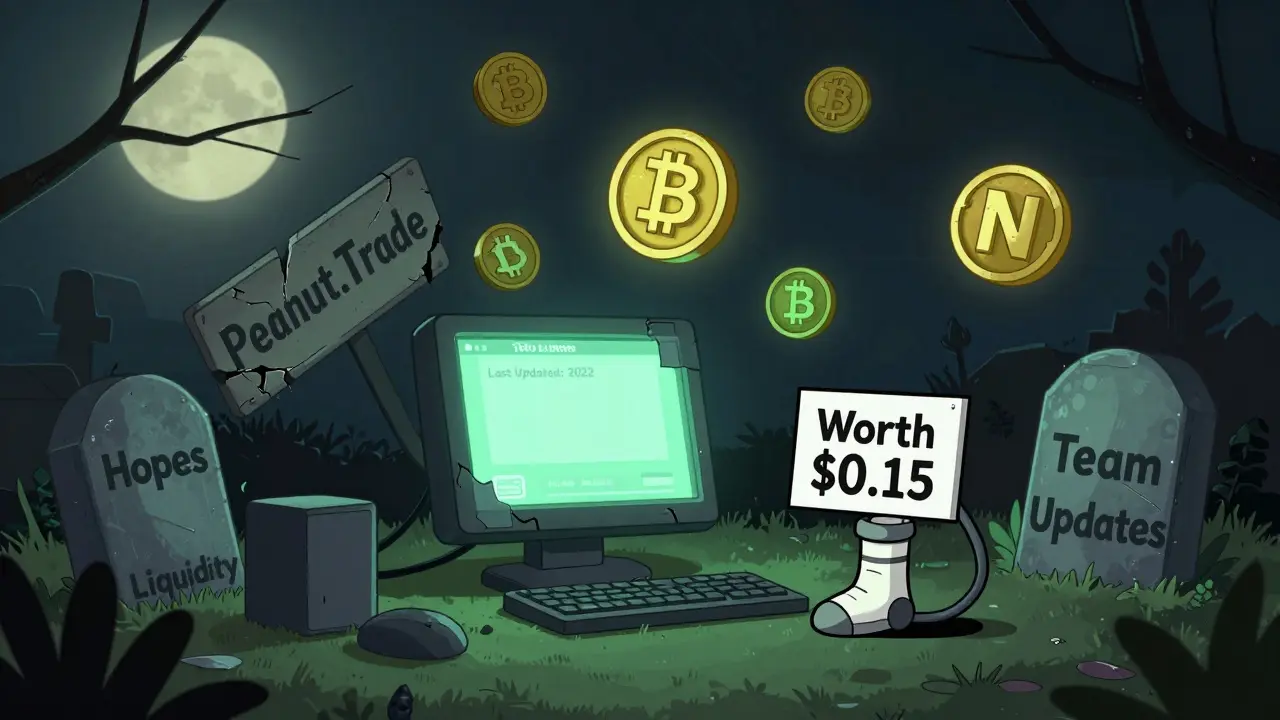
What Can You Learn From the Peanut.Trade Airdrop?
This isn’t a story about a failed project. It’s a lesson about how airdrops work-and how rarely they lead to real value. Most airdrops are marketing tools. They’re not investments. They’re ways to get attention, build a community, and create the illusion of momentum. If the product doesn’t deliver, the token dies. That’s what happened here. If you’re considering future airdrops:- Check the project’s actual usage. Is anyone using the product? Or is it just a whitepaper?
- Look at token distribution. Are most tokens locked up? Or are they being released daily?
- Check the exchange listings. Is it on major platforms? Or only on obscure ones?
- Don’t assume free tokens = free money. The real cost is the time you spend chasing them.
Comments (12)
Jon Visotzky
December 8, 2025 AT 21:20
i remember signing up for this like it was yesterday
thought i was getting free money
turned out i got a digital ghost
still laugh about it
Joe West
December 10, 2025 AT 18:01
this is such a perfect case study for new crypto folks. airdrops aren't gifts, they're marketing funnels. peanut.trade had decent tech but zero community buy-in. if no one's trading it, the token's just a spreadsheet entry. always check volume before you even think about holding.
Brooke Schmalbach
December 12, 2025 AT 12:48
the real tragedy isn't the token crash it's that people still believe in free crypto. you didn't lose $11 you lost 45 minutes of your life clicking links. and now you're here crying about it like it was a funeral. wake up. the market doesn't owe you anything. not even a free token.
Tom Van bergen
December 14, 2025 AT 03:21
they built a solution to a problem that didn't exist
people don't care about slippage
they care about mooning
the protocol was elegant
the market was barbaric
Nina Meretoile
December 15, 2025 AT 05:11
this whole thing reminds me of how we treat tech like it's magic. peanut.trade wasn't broken - it was just too quiet. no hype, no influencers, no drama. in crypto, if you're not screaming, you're invisible. the tech was solid but the soul? dead on arrival. we need more projects that feel human, not just smart contracts with a logo.
Adam Bosworth
December 16, 2025 AT 18:03
i got 35.5 NUX and sold it for 9 bucks because i was scared
now i see people still talking about it like it's a tragedy
bro i lost nothing
you didn't lose money you lost hope
and that's on you for believing in a free lunch
Renelle Wilson
December 18, 2025 AT 04:41
It's important to recognize that the Peanut.Trade airdrop, while ultimately unsuccessful, did serve a legitimate purpose in its design phase. The team attempted to address a tangible issue in decentralized finance - slippage - which affects countless retail traders daily. The failure was not in the concept, but in the execution of user education and ecosystem integration. Many users simply did not understand how the protocol functioned, nor were they incentivized to engage beyond the initial airdrop. Sustainable adoption requires not just innovation, but also clarity, accessibility, and ongoing community nurturing. This case underscores the necessity of holistic development, not just technical brilliance.
Madison Agado
December 18, 2025 AT 08:25
the real lesson here is that crypto doesn't reward effort. it rewards attention. peanut.trade did everything right technically but forgot one thing - people don't care about your protocol unless you make them feel something. no drama, no memes, no influencers. just a whitepaper and a bot. of course it died.
Tisha Berg
December 19, 2025 AT 09:05
i appreciate this breakdown. i signed up for the airdrop too and just forgot about it. seeing the numbers now makes me realize how easy it is to get swept up in the hype. thanks for reminding us to look beyond the free tokens and ask what's actually being built.
Billye Nipper
December 20, 2025 AT 01:24
please, please, please don't chase airdrops like they're lottery tickets. every time you fill out a form, you're trading your time for a chance at nothing. the real wealth is in learning, not in claiming tokens. invest in yourself. learn how to read a whitepaper. understand liquidity. that's the real airdrop.
Roseline Stephen
December 20, 2025 AT 16:55
the token's value dropped because no one needed it. simple as that. the market doesn't care about your tech if it doesn't solve a problem people are willing to pay for. this wasn't a scam. it was just irrelevant.
Isha Kaur
December 21, 2025 AT 04:36
i was in india when this happened and i thought it was too good to be true but i did it anyway because everyone was talking about it. i got my tokens and then nothing. no updates, no news, no one on telegram. it made me realize how much of crypto is just noise. now i only look at projects with real daily users, not just airdrop signups. this post helped me understand why so many projects die. thank you for writing this, it saved me from making the same mistake again.