Privacy Verification Quiz
Imagine proving you’re over 21 without showing your ID. Or verifying you’re a U.S. citizen without handing over your passport number. That’s not science fiction-it’s privacy-preserving identity verification, and it’s already changing how we prove who we are online.
Traditional identity systems are broken. You give your Social Security number, driver’s license, and face scan to a bank, a landlord, or a ride-share app. They store it all. Then, one breach happens-your data is leaked, sold, or misused. And you have zero control over it. Privacy-preserving identity verification flips that model. Instead of handing over your entire life story, you prove only what’s needed-and nothing more.
How It Works: Proving Without Revealing
This isn’t about hiding your identity. It’s about proving it without exposing it. The magic happens through three core technologies: Zero-Knowledge Proofs (ZKPs), Decentralized Identifiers (DIDs), and Selective Disclosure.
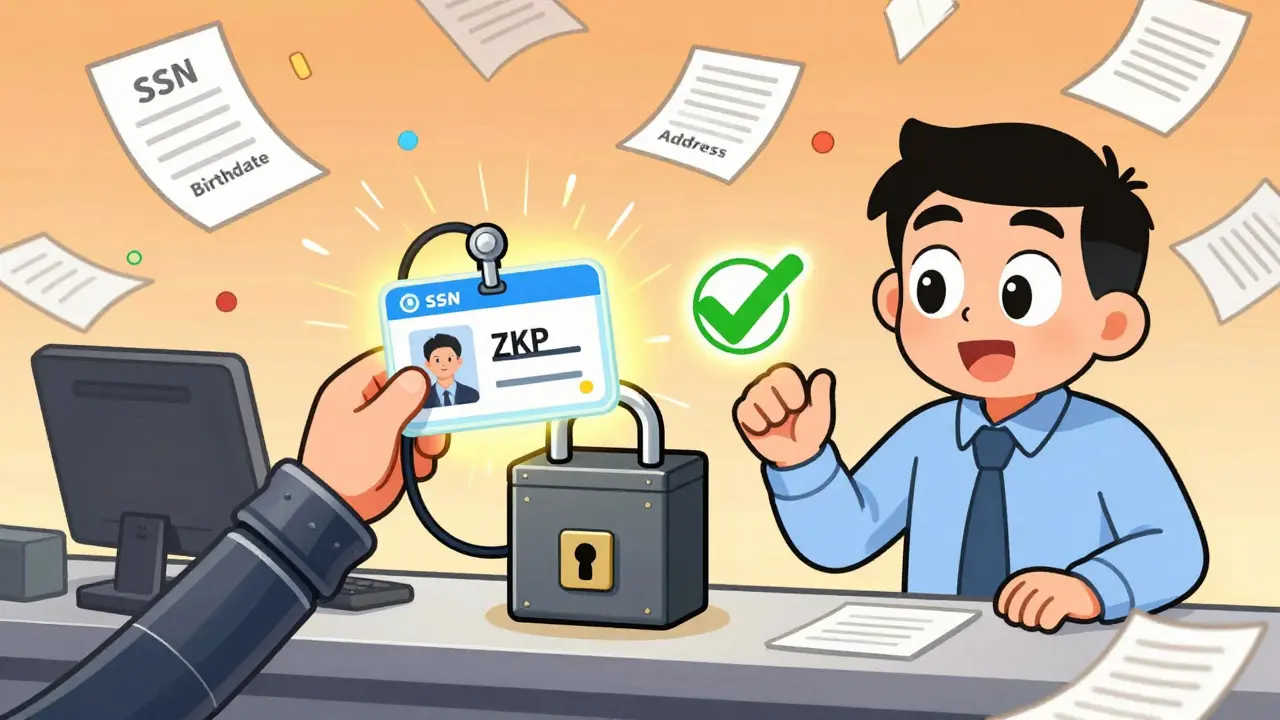
Zero-Knowledge Proofs let you show that you know something-like your age or citizenship-without saying what it is. For example, a ZKP can confirm you’re over 18 without revealing your birthdate. It’s like showing a lockbox that only opens if you have the right key, but no one sees what’s inside.
Decentralized Identifiers (DIDs) give you ownership of your identity. Instead of relying on a government or company to issue and store your ID, you generate your own unique digital ID on a blockchain. It’s yours. You control it. No central database to hack.
Selective Disclosure means you pick what to share. Need to prove you have a valid driver’s license? You don’t send the whole document. You send a cryptographic proof that the license is real, issued by the DMV, and not expired. Your name, address, and photo stay private unless you choose to reveal them.
Why Blockchain Is the Backbone
Blockchain isn’t just for crypto. It’s the trust layer that makes privacy-preserving identity possible. DIDs are stored on public, tamper-proof ledgers. When you verify your identity, the proof is cryptographically signed and recorded-without storing your personal data.
Unlike traditional systems where your data sits in a server owned by a bank or tech giant, blockchain lets you keep your data on your phone or secure device. The verification happens off-chain, but the proof is anchored on-chain. That means no one can alter or delete your identity record. And no single company controls your access.
Companies like Microsoft and the European Union are already testing blockchain-based digital wallets for citizen IDs. In Estonia, citizens use blockchain-backed digital IDs to vote, sign contracts, and access healthcare-all without handing over personal files.
Real-World Use Cases You Can See Today
This isn’t theoretical. Banks are using it for KYC (Know Your Customer) checks. Instead of asking you to upload a photo of your ID and wait days for manual review, you use a privacy-preserving app. You prove you’re not a fraudster, your identity is valid, and you’re not on a watchlist-all without sharing your name, address, or ID number.
In healthcare, patients can prove they’re eligible for a prescription or insurance coverage without exposing their full medical history. Telemedicine platforms use ZKPs to confirm a patient’s identity before a video consultation, keeping their diagnosis and treatment records private.
Airports in the U.S. and Europe are piloting blockchain-based identity systems. You walk through security using your phone. A ZKP confirms you have a valid passport, are cleared for travel, and match your biometric data-without the airline or TSA ever seeing your passport number or full face scan.
Ride-sharing apps like Uber and Lyft are testing this too. Drivers prove they have a clean record and valid license without giving the company access to their criminal history or full DMV file.

Regulations Are Pushing This Forward
GDPR in Europe and CCPA in California don’t just encourage privacy-they enforce it. Fines for mishandling personal data can hit millions. Traditional identity systems, which collect and store everything, are now legal liabilities.
Privacy-preserving verification is one of the few approaches that naturally align with these laws. It follows the principle of data minimization: collect only what’s necessary. It gives users control. It deletes data after verification. It doesn’t create giant honeypots of personal info.
Organizations that adopt this tech aren’t just being ethical-they’re reducing legal risk, cutting compliance costs, and building customer trust. People are more likely to sign up for a service that doesn’t ask for their entire life history.
The Trade-Offs: Complexity vs. Control
This isn’t magic. It’s math. And math is hard.
Zero-Knowledge Proofs require serious computing power. Generating a proof on your phone can take a few seconds-longer if you’re on a weak network. That’s why early adopters are focusing on high-value use cases: banking, healthcare, government services.
Not every app needs this level of privacy. For a newsletter signup, your email is enough. But for anything involving financial data, health records, or legal identity-this is the new standard.
There’s also a learning curve. Developers need to understand cryptography, not just frontend frameworks. Users need to trust apps that don’t ask for their ID photo. That’s why user experience matters as much as the tech. The best system fails if people don’t use it.

What’s Next: Smarter, Faster, More Private
Researchers are making ZKPs faster. New protocols like zk-SNARKs and zk-STARKs are reducing proof size and verification time. Homomorphic encryption lets computers process encrypted data without decrypting it-meaning you could verify income or credit score without revealing your bank statements.
Differential privacy is being added to prevent inference attacks. Even if someone knows your age and location, they can’t guess your name or SSN from the data you share.
By 2026, we’ll see more mobile wallets that act as your universal digital ID. You’ll use one app to verify your age at a bar, your license for a rental car, and your eligibility for a government benefit-all without logging in, uploading files, or trusting a third party.
The future of identity isn’t more data collection. It’s less data, more control. And it’s built on the same tech that powers Bitcoin and Ethereum: decentralized, cryptographic, and user-owned.
Why This Matters for Everyone
You don’t need to be a tech expert to benefit from privacy-preserving identity verification. You just need to care about your data.
Every time you hand over your ID, you’re gambling. The company says they’ll protect it. But breaches happen. Insiders leak. Systems get hacked. With privacy-preserving systems, that gamble disappears. You’re not giving away your keys-you’re showing a lock that only opens with your private code.
This isn’t just about avoiding hackers. It’s about reclaiming your right to privacy in a world that’s obsessed with collecting you. Your identity shouldn’t be a product. It should be yours.
Privacy-preserving identity verification isn’t the end of digital identity. It’s the beginning of a better one.
Comments (10)
Jess Bothun-Berg
December 3, 2025 AT 12:17
This is great... until some gov't or corp decides to mandate it. Then it's not privacy-it's surveillance with extra steps. I'll believe it when I stop seeing 'decentralized' used as a marketing buzzword.
Joe B.
December 3, 2025 AT 19:22
Look, I get the theory-ZKPs, DIDs, all that crypto mumbo-jumbo-but have you tried actually using one of these wallets? My phone overheats, the app crashes twice, and then I have to reboot my entire digital identity because I forgot to back up my recovery phrase. It's like having a Ferrari that runs on gasoline made of regret. And don't even get me started on the UX-why does every privacy app look like it was designed by a grad student who hates humans? 🤦♂️
Rod Filoteo
December 5, 2025 AT 16:22
They're lying. This isn't about privacy. It's about control. Who owns the blockchain? Who validates the proofs? The same banks. The same tech giants. They just moved the data from one server to another and called it 'decentralized.' You think they're not logging your proof attempts? You think they're not selling anonymized metadata to advertisers? Wake up. They're not giving you power-they're giving you a shiny new cage with a better lock.
Greer Dauphin
December 5, 2025 AT 16:40
Okay but honestly? I tried the Estonian digital ID thing last year and it was kinda magical. No forms. No uploads. Just a tap and boom-I’m verified. Took 12 seconds. My grandma used it to renew her prescription. She didn’t even know what a blockchain was. But she knew it didn’t ask for her SSN. So maybe... maybe this actually works? 🤔 (also typo: 'verifcation' lol)
Mark Stoehr
December 6, 2025 AT 22:45
Too much hype zero real world impact
Reggie Herbert
December 7, 2025 AT 06:13
You're conflating decentralization with privacy. ZKPs are cryptographic primitives, not policy solutions. The architecture doesn't solve social trust issues-it just shifts the attack surface. And let's be clear: if your identity is stored on a blockchain, you're not owning it-you're just renting it from a consensus mechanism that can be forked, governed, or regulated out of existence. This isn't liberation. It's rebranding.
Sarah Locke
December 8, 2025 AT 20:50
I just want to say-this is the future we’ve been waiting for. 🌟 No more handing over our entire lives to corporations that treat our data like a free snack. I work in healthcare and I’ve seen patients cry because their medical records got leaked. This tech? It’s not just smart-it’s sacred. We need to push for it everywhere. Not because it’s trendy. Because it’s right.
justin allen
December 9, 2025 AT 11:16
This is how they get us to give up our passports. First they say 'you don’t need to show your ID,' then they say 'you need to prove it with this app.' Next thing you know, the government has a digital fingerprint of your entire life. And you’re the one who volunteered. Welcome to the New America, folks. 🇺🇸
Ivanna Faith
December 9, 2025 AT 23:23
Honestly? I'm just here for the tech. The rest is just noise. ZKPs are elegant. DIDs are revolutionary. The rest? Political theater. 🧠
Christy Whitaker
December 10, 2025 AT 06:49
I don't trust any of this. What if someone hacks my phone and steals my private key? Then I'm locked out forever. And who's gonna help me? No one. You think they'll call you? Nah. You're on your own. And that's terrifying.