
Raydium Transaction Cost Calculator
Total Cost
Ethereum Comparison - Average fee: $2.50
That's over 10,000% cheaper than Ethereum at typical trade sizes.
Raydium isn’t just another crypto exchange. It’s a high-speed, low-cost trading platform built on Solana that blends two trading models you usually see separated: automated market making (AMM) and order books. If you’ve used Uniswap and thought, “I wish this was faster and cheaper,” Raydium is what that dream looks like today. But it’s not perfect. It doesn’t solve every problem - and some of its biggest strengths come with serious trade-offs.
How Raydium Works: AMM Meets Order Book
Raydium runs on Solana, which means trades settle in under a second. Most of the time, you’ll be using its Constant Product Market Maker (CPMM) pools. These are the standard AMM pools where liquidity is spread evenly across price ranges - like Uniswap. But Raydium’s real edge? It connects those pools directly to OpenBook, Solana’s decentralized order book. That means you can place limit orders, get better fills, and tap into deeper liquidity than any pure AMM can offer.Here’s what that looks like in practice: You want to swap SOL for RAY. Instead of just pulling from one pool, Raydium’s smart routing checks both its own AMM pools and OpenBook’s order book. It finds the best price across both, often splitting your trade between them. The result? Less slippage, better rates, and faster execution - especially for large orders.
Fees: Almost Nothing, But Not Free
Trading fees on Raydium are flat: 0.25% per swap. That’s standard for DEXs. But here’s the kicker - Solana’s base transaction fee is around $0.00025. So your total cost for a swap? Usually under a penny. Compare that to Ethereum-based DEXs where gas fees can hit $3-$10 on busy days. Raydium wins on cost, hands down.There’s also a hidden layer: CPMM pool creators can earn 0.05% of swap fees (5 basis points) from trades in pools they launch through Raydium’s LaunchLab. That’s a small incentive for early liquidity providers, and it’s helped grow over 6,100 token pairs on the platform.
Minimum trade size? There isn’t one. As long as you have enough SOL to cover the network fee, you can swap even $1 worth of tokens. That’s rare in DeFi.
Performance: Blazing Fast - Until It Isn’t
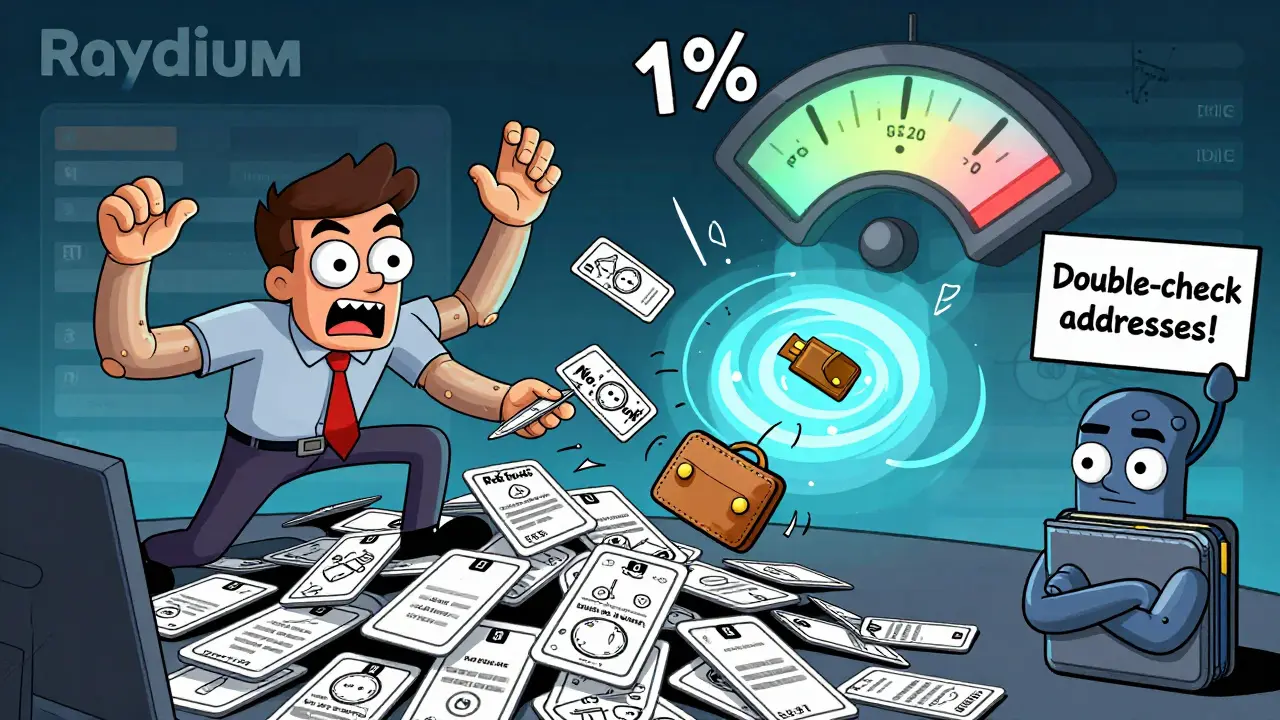
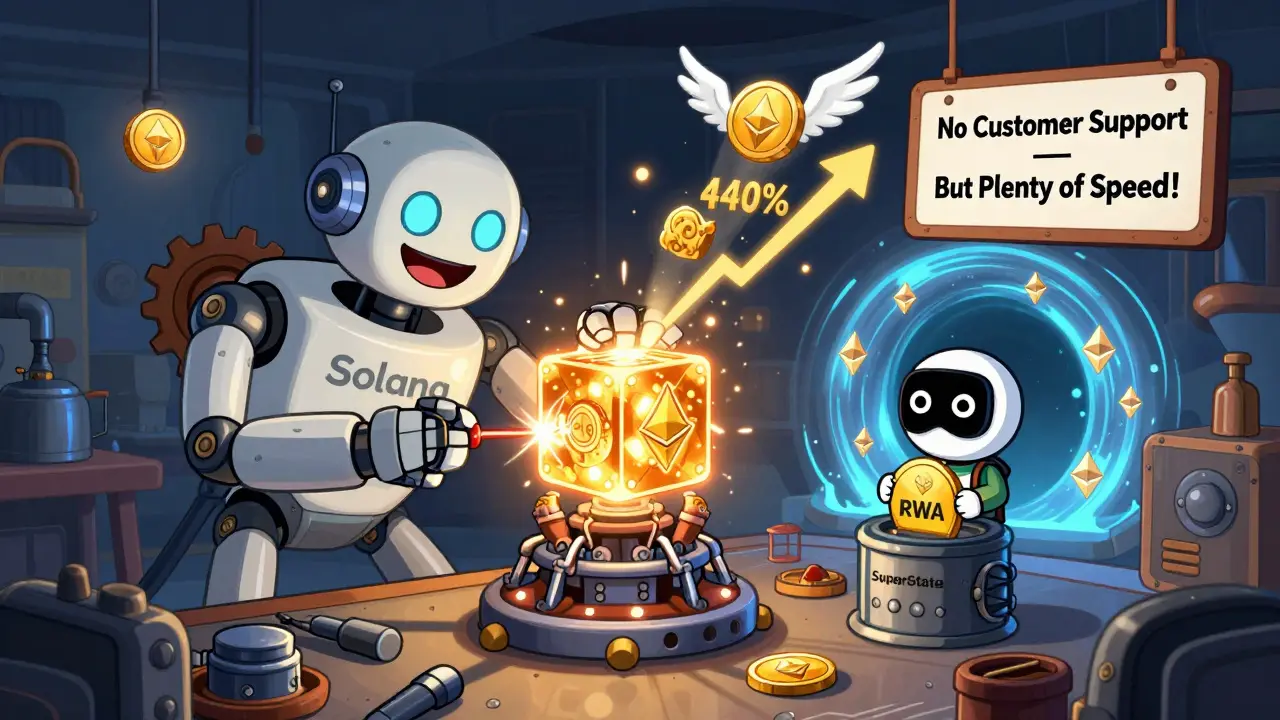
Raydium processes 5,000-6,500 transactions per second during peak times. That’s not a guess - it’s measured by SolanaMetrics. Swaps typically complete in 400-600 milliseconds. Users report swapping 2.5 SOL for RAY in under a second with fees under $0.00022. That’s why it’s the go-to for meme coin traders and high-frequency users.But here’s the dark side: when Solana goes down, Raydium goes down with it. In August 2025, a network outage caused 12-15% of transactions to fail. One Reddit user lost $287 because their swap didn’t go through - and the funds were stuck. There’s no customer support team to call. No refund policy. You’re on your own. That’s the price of decentralization.
What You Can and Can’t Do
Raydium is a pure DeFi platform. That means:- Yes: Swap any SPL token, stake RAY, provide liquidity, farm yields, trade NFTs.
- No: Buy crypto with USD or EUR. No fiat on-ramps. No credit card deposits.
- No: Margin trading. No leverage. No shorting.
- No: KYC. No identity verification. Anonymous trading is built-in.
- No: Mobile app. You use a wallet like Phantom or Solflare, then connect to the web interface.
If you’re looking for a simple, quick way to trade Solana tokens without leaving your wallet - Raydium nails it. But if you need to deposit dollars, trade with leverage, or get help when something goes wrong - you’ll need another platform.
Compared to Jupiter and Uniswap
Raydium’s biggest rival on Solana is Jupiter. Jupiter is an aggregator - it scans dozens of DEXs and liquidity sources to find the best price. Raydium doesn’t do that. It only uses its own pools and OpenBook. That makes Jupiter better for complex swaps and finding hidden liquidity. But Raydium’s direct integration with OpenBook gives it deeper order book depth for major pairs like SOL/RAY or BTC/SOL.On Ethereum, Uniswap is king. But Uniswap’s average transaction fee? Around $2.50. Trade time? 10-30 seconds. Raydium is faster, cheaper, and handles more tokens - 6,100 vs Uniswap’s ~1,500. But Uniswap has more regulatory compliance features, a larger user base, and more institutional backing.
Raydium doesn’t try to beat Uniswap at its own game. It wins by being the best tool for Solana’s ecosystem - fast, cheap, and deeply integrated.
Security and Risks
Raydium’s code has been audited multiple times by reputable firms. The protocol hasn’t been hacked. But that doesn’t mean you’re safe. The biggest risks aren’t technical - they’re user errors.- Scam tokens: Over 6,000 tokens are listed. Many are fake or rug pulls. Always verify token contracts before swapping.
- Slippage: On low-liquidity pairs, slippage can hit 2% or more. Set your tolerance to 1-2% for volatile tokens.
- Network congestion: During Solana outages, your transaction may fail and your SOL will still be spent. No refunds.
- Wallet mistakes: Sending tokens to the wrong address? Gone forever. No recovery.
Use Phantom or Solflare wallets. Enable transaction previews. Double-check token addresses. Don’t trust the interface’s auto-fill.
Getting Started
You need three things:- A Solana wallet (Phantom is the most popular)
- SOL in your wallet (at least $0.50 to cover fees)
- Access to app.raydium.io
Connect your wallet, pick a token pair, set your slippage (start at 1%), and click swap. That’s it. Advanced features like concentrated liquidity (CLMM) or permissioned assets (SuperState) require more setup - but you don’t need them to trade.
First-time users often get stuck on wallet connection issues. If your wallet won’t connect, try reloading the page, switching networks in your wallet, or using a different browser. Chrome and Brave work best.
Who Is Raydium For?
Raydium isn’t for everyone. It’s built for:- Traders who want speed and low fees
- Users already in the Solana ecosystem
- People comfortable with self-custody and DeFi risks
- Liquidity providers earning yield from pool fees
It’s not for:
- Beginners who want to buy crypto with a credit card
- Investors who need customer support or KYC
- Those who trade infrequently and hate learning new tools
Raydium’s user base is 68% retail traders. Most are active during market volatility. When crypto prices spike, Raydium’s daily users jump from 32,000 to 85,000. When things calm down, usage drops. That’s normal for a DEX built on speculative chains.
The Future: What’s Next for Raydium
In Q4 2025, Raydium is rolling out two major upgrades:- Firedancer integration: Solana’s new validator client, expected in Q1 2026, will make the network more stable and reduce outages.
- SuperState expansion: The KYC-enabled CLMM module is being used to bring real-world assets (RWAs) like tokenized bonds onto Raydium - potentially attracting institutional capital.
- Cross-chain bridge: A wormhole-powered bridge to Ethereum is in development. That could let users move assets between chains without leaving Raydium.
The RAY token is up 140% since January 2025, fueled by rising trading volume and staking rewards. But its price still moves with Solana. If Solana crashes, RAY crashes. That’s the risk.
Analysts at 21Shares Research say Raydium is “well-positioned to remain a cornerstone of Solana DeFi.” Others, like Traders Union, give it a low trust score (1.86/10) because of its lack of regulatory safeguards. Both are right. Raydium is powerful - but it’s not safe. It’s fast, cheap, and open. And that’s exactly why it works.
Is Raydium a good exchange for beginners?
Not really. Raydium assumes you already understand wallets, SOL fees, and how to verify token contracts. If you’ve never used a DeFi platform before, start with a centralized exchange like Coinbase or Kraken to buy your first crypto. Then move to Raydium once you’re comfortable with self-custody.
Can I buy crypto with USD on Raydium?
No. Raydium is a decentralized exchange and doesn’t support fiat deposits. You need to buy SOL or another crypto on a centralized exchange first, then transfer it to your Solana wallet before using Raydium.
How safe is Raydium from hacks?
Raydium’s smart contracts have been audited and haven’t been compromised. But the biggest risk isn’t the code - it’s you. Scam tokens, wrong addresses, and Solana network outages can cause real losses. Always check token addresses, set slippage properly, and never send funds to unknown contracts.
What’s the difference between CPMM and CLMM pools on Raydium?
CPMM (Constant Product Market Maker) pools spread liquidity evenly across all price ranges - good for general trading. CLMM (Concentrated Liquidity Market Maker) pools let you place liquidity only in specific price ranges, which increases capital efficiency but requires more active management. CLMM pools also support permissioned assets via the SuperState module, which requires KYC.
Why does Raydium have low customer support ratings?
Because it’s decentralized. There’s no customer service team. If your transaction fails or you lose funds, there’s no one to call. Support comes from community channels like Discord and Telegram, where responses can take 4-6 hours. You’re responsible for your own security and troubleshooting.
Does Raydium support margin trading or leverage?
No. Raydium only supports 1:1 trading - meaning you can only swap tokens you already own. There’s no borrowing, no shorting, and no leverage. If you need margin trading, look at centralized platforms like Bybit or Binance.
How do I avoid losing money on low-liquidity tokens?
Check the liquidity depth before trading. If a token pair has less than $100,000 in liquidity, avoid it unless you’re speculating. Set your slippage tolerance to 1-2% (not the default 0.5%). Never invest more than you can afford to lose. And always verify the token contract address on Solana Explorer before confirming the trade.
Comments (12)
Murray Dejarnette
December 4, 2025 AT 19:11
Bro this is the most insane DEX I’ve ever used. Swapped 5 SOL for a meme coin in 0.3 seconds and paid $0.00018 in fees. My wallet literally didn’t even load before the trade confirmed. Solana is the future and anyone who says otherwise is just mad they missed the train.
Reggie Herbert
December 6, 2025 AT 16:13
Speed and low fees are nice, but you’re ignoring the systemic fragility. Raydium’s entire value proposition is built on a single-chain stack that’s proven to collapse under load. If Solana goes down, your ‘fast trades’ become $287 paper losses with zero recourse. This isn’t innovation - it’s gambling with infrastructure.
Sarah Locke
December 8, 2025 AT 00:16
Y’all are missing the bigger picture! 🌟 Raydium isn’t just a tool - it’s a movement. It’s giving everyday people power to trade without gatekeepers. Yes, there are risks, but so was using a bank in 1929. You learn, you adapt, you protect yourself. And hey - if you’re scared of slippage, start small. Baby steps! 💪 You got this!
Mani Kumar
December 8, 2025 AT 23:40
The CPMM-Order Book hybrid architecture is a non-trivial technical achievement. However, the absence of MEV protection mechanisms and the reliance on OpenBook’s centralized liquidity aggregation introduce non-obvious counterparty risks. Institutional adoption remains implausible without audit transparency beyond the surface-level smart contract reviews.
Philip Mirchin
December 10, 2025 AT 00:18
Hey newbies - if you’re reading this and thinking ‘I wanna try Raydium’ - first, get a Phantom wallet. Second, buy like $0.50 worth of SOL. Third, go to app.raydium.io and swap $1 of some random token just to see how it feels. Don’t overthink it. You’ll figure it out. And if you mess up? Welcome to DeFi. We all did. 😊
Britney Power
December 10, 2025 AT 21:27
Let’s be brutally honest: Raydium is a high-risk, low-regulation playground for retail speculators who mistake volatility for opportunity. The fact that 6,100 tokens are listed - most of which are rug pulls disguised as memes - speaks volumes. The ‘no KYC’ model isn’t freedom; it’s a regulatory time bomb. And when the SEC comes knocking, they won’t care that you ‘didn’t know.’ You’ll be left holding worthless tokens and a ruined credit score.
Maggie Harrison
December 12, 2025 AT 17:02
Raydium = 🚀💸🔥 I traded my first $5 of ETH for a Solana meme coin and made 12x in 45 mins. No bank. No forms. No waiting. Just pure, unfiltered crypto magic. 🤯 If you’re not using Raydium, you’re not living in 2025. Let’s gooooooo!!!
Lawal Ayomide
December 13, 2025 AT 21:25
Why are Americans acting like this is revolutionary? We’ve had faster, cheaper DEXs in Africa for years. Raydium is just Solana’s version of what we’ve been doing on BSC and Polygon. Stop acting like you invented something.
justin allen
December 15, 2025 AT 01:26
Anyone who says Raydium is dangerous is just a crypto-coward. Real men trade on Solana. Real men don’t need KYC. Real men don’t cry when their swap fails. If you can’t handle it, go back to Coinbase and cry into your Starbucks. USA > EVERYTHING.
ashi chopra
December 16, 2025 AT 16:43
I really appreciate how detailed this breakdown is. I’m just starting out and was terrified of DeFi, but now I feel like I understand the trade-offs. The part about verifying token contracts? That’s something I’d never have thought of. Thank you for writing this with care.
Darlene Johnson
December 17, 2025 AT 13:07
Did you know Raydium is secretly funded by the same group that ran the 2021 Terra collapse? They’re using Solana as a Trojan horse to drain retail wallets. The ‘audits’? Fabricated. The ‘speed’? A distraction. The ‘low fees’? A trap. They want you to trade fast so you don’t notice your tokens disappearing. I’ve seen the emails. I’m not paranoid - I’m informed.
Ivanna Faith
December 18, 2025 AT 08:40
Raydium is fire but why is everyone acting like it's the only option? Jupiter does the same thing better and has more liquidity. Also the RAY token is garbage. 140% gain? So what. It's still tied to Solana which is basically a meme coin with a blockchain. Also why is the interface so ugly? Someone needs to hire a designer. 😒