SSI Implementation Cost-Benefit Calculator
Calculate potential time and cost savings of implementing self-sovereign identity for your organization. Based on data from real-world implementations like JPMorgan's KYC verification process and healthcare pilots.
Imagine logging into a bank, applying for a job, or signing up for a healthcare service-without handing over your Social Security number, driver’s license, or passport. No more uploading scans. No more waiting days for verification. No more companies storing your personal data in databases that get hacked. This isn’t science fiction. It’s self-sovereign identity on blockchain-and it’s already happening.
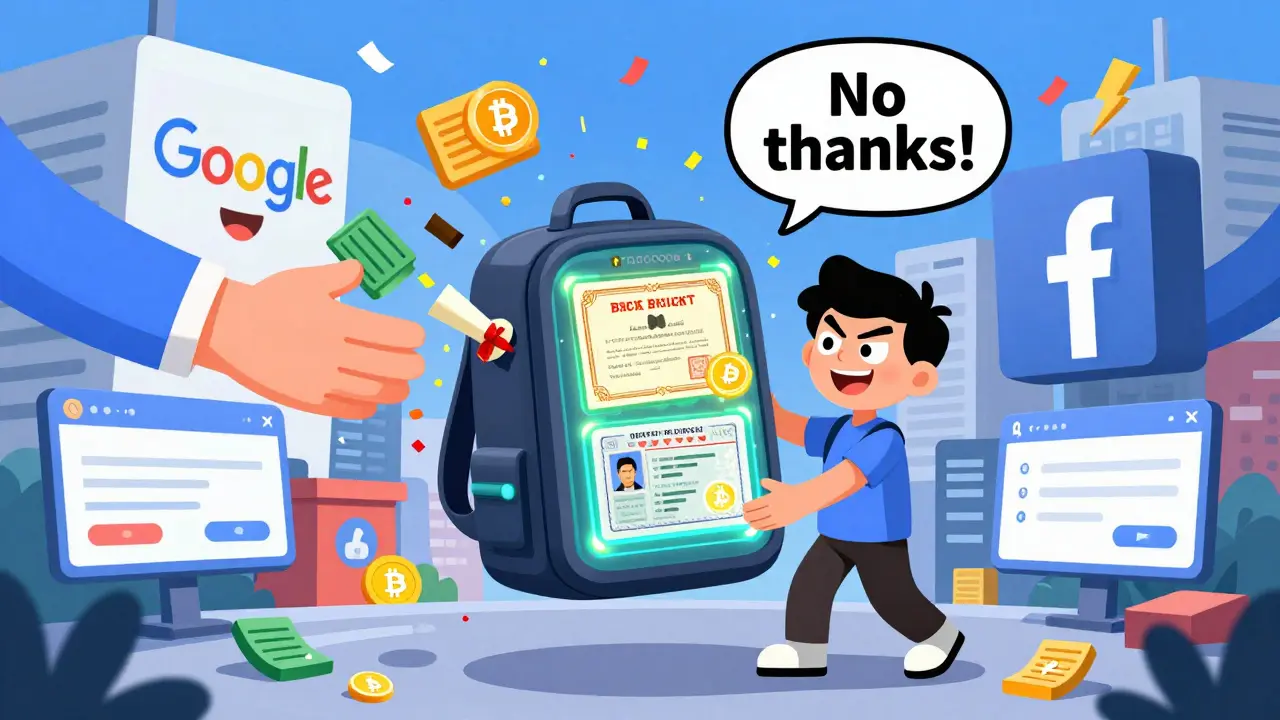
Right now, your digital identity is scattered across hundreds of accounts. Google knows your email, Facebook knows your friends, Amazon knows your purchases, and your bank knows your balance. None of them own your identity. But they all control it. And if one gets breached? Your data leaks. The 2023 Facebook breach exposed 419 million profiles. The average person has over 100 online accounts. That’s 100 chances for someone to steal your identity.
Self-sovereign identity (SSI) flips that model. Instead of trusting companies to hold your data, you hold it yourself. You decide what to share, when, and with whom. And blockchain? It’s the backbone that makes this possible-secure, tamper-proof, and decentralized.
How Self-Sovereign Identity Works
SSI isn’t just a buzzword. It’s built on three core pieces: Decentralized Identifiers (DIDs), Verifiable Credentials (VCs), and blockchain.
DIDs are unique digital addresses you own-like a username, but without a company behind it. You create them. You control them. They don’t rely on Facebook, Google, or any central server. Think of them as your digital fingerprint, but one you can change anytime. The W3C standardized DIDs in 2022, and now they’re used by governments and startups alike.
Verifiable Credentials are your digital documents-birth certificates, diplomas, driver’s licenses, even proof of address. But unlike scanned PDFs, they’re cryptographically signed. If someone tries to fake one, the system knows instantly. You don’t send the whole document. You prove you have it. For example, you can prove you’re over 21 without showing your birth date. That’s called a zero-knowledge proof, and it’s built into modern SSI systems.
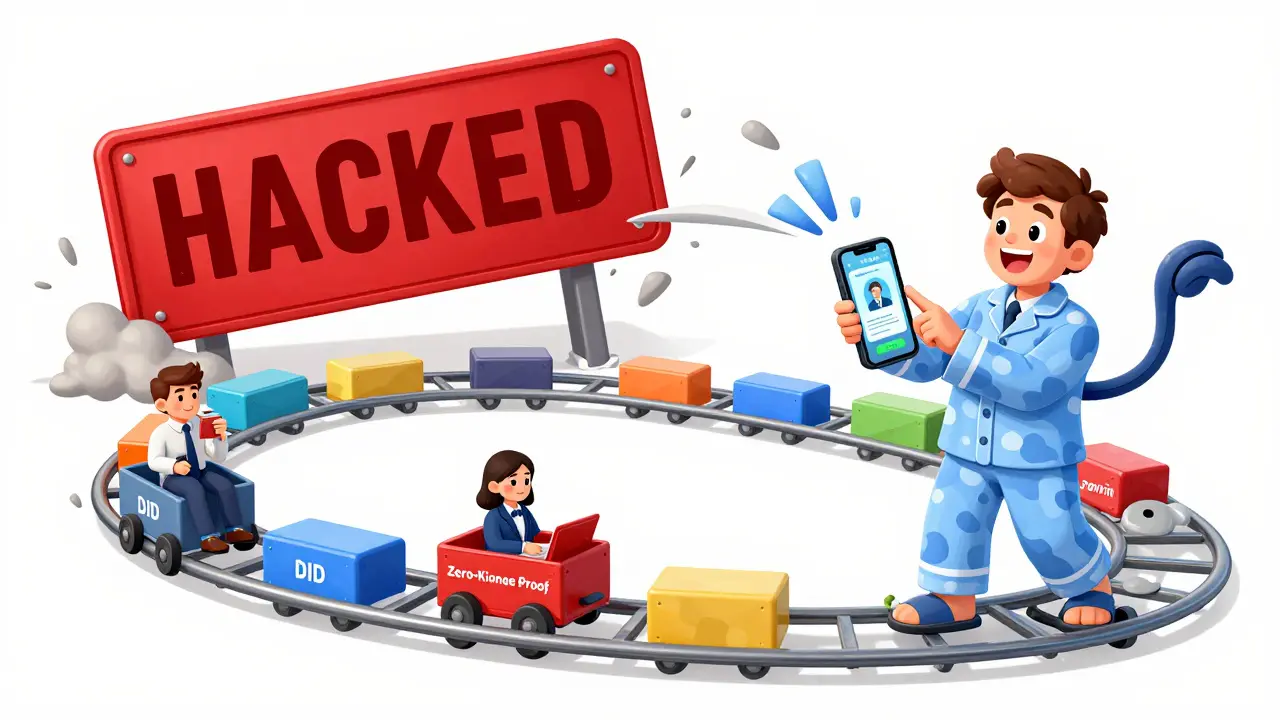
Blockchain doesn’t store your personal data. It stores the cryptographic fingerprints of your DIDs and credentials. This makes them tamper-proof. If you issue a credential from a university, the university signs it. You hold it. A potential employer checks the signature against the blockchain. No middleman. No database to hack. Ethereum, Sovrin, and ION are the most common blockchains used for this. Ethereum costs about $0.45 per transaction. Sovrin handles 1,000 transactions per second. Both are live and in use today.
Why It’s Better Than Google Sign-In
Google Sign-In is convenient. But it’s also a honeypot. Google knows where you are, what you search, who you talk to, and what you buy. They use that data to sell ads. And if Google gets hacked? Millions of identities go with it.
SSI removes that risk. You don’t need Google to log in. You don’t need to trust anyone. You carry your credentials in a wallet app-like a digital backpack. When a service asks for proof of age, you open your wallet, tap ‘share,’ and send only what’s needed. The service never sees your full name, address, or ID number. Just the proof.
Real-world results? JPMorgan’s SSI pilot cut KYC verification from 3-5 days to under 2 hours. The European Union’s EHN network, serving 450 million citizens, uses SSI to let patients control who sees their medical records. British Columbia’s Verified.Me system processed 1.2 million verifications in 2023-with zero data breaches.
Compare that to traditional systems. SAML 2.0, used by enterprises, processes 1.2 trillion logins a year. But every login still depends on a central provider. One breach, and everything collapses.
The Real Problems With SSI
It’s not perfect. And that’s the part most people skip.
First: key management. If you lose your private key? You lose your identity. No reset button. No customer service. A 2023 IEEE study found 68% of non-tech users struggle with this. On Reddit, users say things like, “Lost my entire identity after upgrading my phone.” Product Hunt reviews for SSI wallets show 87% of complaints are about key recovery.
Second: user experience. Onboarding is clunky. Civic’s consumer wallet app had a 72% abandonment rate during setup. People don’t want to learn cryptographic concepts just to prove they’re human.
Third: centralization creep. Dr. Lorrie Cranor from Carnegie Mellon found that 83% of users would accept identity wallets from Apple or Google-even though that defeats the whole point of decentralization. If you’re using an Apple wallet to prove your identity, you’re still trusting Big Tech. The promise of SSI is freedom. But most people will trade freedom for convenience.
And then there’s bias. A 2024 Electronic Frontier Foundation audit found facial recognition tools in some SSI wallets had 34.7% higher error rates for darker-skinned women. If your identity system can’t recognize you, you’re locked out. That’s not just inconvenient. It’s dangerous.
Who’s Using It-and Where
Adoption isn’t everywhere. But it’s growing fast in specific areas.
Government: 42% of SSI deployments are public sector. The EU’s eIDAS 2.0 regulation, effective September 2024, requires all member states to use SSI-compatible systems. Estonia, Finland, and Sweden are ahead. The U.S.? Only 17 states have pilot programs.
Finance: 29% of use cases. Major banks like HSBC, BNP Paribas, and Deutsche Bank are piloting SSI for KYC. Deloitte found a 47% drop in verification costs for one European bank. That’s millions saved per year.
Healthcare: 18%. The U.S. lags here because of HIPAA complexity. But Kaiser Permanente’s pilot showed SSI could reduce administrative costs by 30%. Patients control who sees their records-doctors, insurers, researchers-without exposing everything.
Enterprise adoption is still low. Only 8% of companies use pure SSI frameworks. But 37% of Fortune 500s use Microsoft Entra Verified ID, which blends SSI with legacy systems. It’s not pure decentralization. But it’s a step.
The Tech Behind the Promise
Building SSI isn’t simple. Developers need to learn:
- DID methods (like did:ion, did:ethr)
- VC schemas (how to structure credentials)
- Key management (HD wallets, multi-sig, social recovery)
- Zero-knowledge proofs
- Interoperability standards from the Decentralized Identity Foundation
Consensys Academy says it takes 8-12 weeks for a developer to become proficient. Enterprise deployments take 6-9 months. Setup costs average $287,500 for healthcare systems.
Choosing the right blockchain matters. Public chains like Ethereum are open but expensive. Permissioned chains like Hyperledger Indy are faster and cheaper but controlled by a consortium. Transaction costs vary from $0.02 to $2.50 per verification. Most companies pick based on compliance needs, not tech preference.
And standardization? Still messy. 78% of organizations spend 3-4 months aligning with the W3C Verifiable Credentials Data Model 2.0. Sovrin’s documentation scores 4.5/5. Newer tools like KILT score 3.1/5. That gap slows adoption.
What’s Next in 2025 and Beyond
SSI is at the “Peak of Inflated Expectations,” according to Gartner. That means hype is high, but real-world use is still limited. Mainstream adoption? Not until 2028-2030.
But 2024-2025 are turning points:
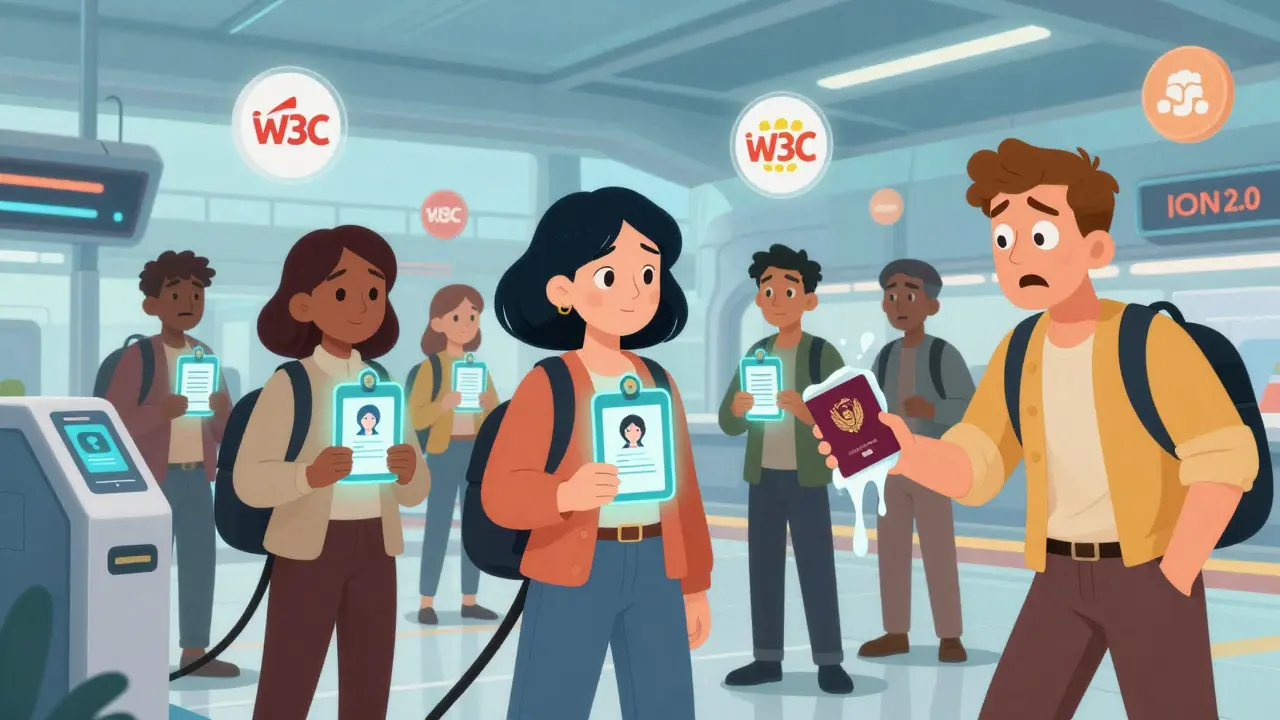
- W3C released Verifiable Credentials Data Model 2.0 in June 2024-better privacy, better structure.
- ION 2.0 launched in September 2024-10x faster, cheaper, and more scalable.
- The European Blockchain Services Infrastructure now handles 1.2 million cross-border verifications daily.
- FIDO Alliance plans to integrate passkeys with SSI by Q4 2025. That means you could use your iPhone’s Face ID to prove your identity on a blockchain wallet.
- The Internet Identity Working Group is building a “Universal Wallet” by Q2 2025-aiming to make wallets work across platforms.
Forrester predicts SSI will dominate Web3 by 2027. 85% of DeFi platforms will use it. But for average users? It’ll take longer. The real test isn’t tech. It’s whether people will trade convenience for control.
Should You Care?
If you’re a developer, entrepreneur, or privacy-conscious user-yes. SSI is the future of digital trust.
If you’re a regular person using apps every day? You might not notice it yet. But you’ll feel it. When you apply for a loan and don’t have to email your pay stubs. When you fly and don’t need to show your passport. When your medical records follow you across hospitals without you ever uploading them.
SSI isn’t about replacing passwords. It’s about replacing trust. Instead of trusting companies to protect your data, you trust math. Cryptography. Provable facts. Not policies. Not terms of service. Not corporate promises.
It’s not perfect. It’s not easy. But it’s the only system that gives you back what was stolen: your identity.
What is self-sovereign identity?
Self-sovereign identity (SSI) is a digital identity system where individuals own and control their personal data without relying on central authorities like Google or Facebook. Users store credentials like diplomas or licenses in digital wallets and share only what’s needed, using cryptographic proofs to verify authenticity.
How does blockchain make SSI secure?
Blockchain doesn’t store your personal data. It stores cryptographic hashes of your Decentralized Identifiers (DIDs) and Verifiable Credentials. This creates an immutable, tamper-proof record. If someone tries to alter a credential, the system detects the mismatch instantly. Public blockchains like Ethereum and Sovrin provide transparency and resilience against hacking.
Can I lose my self-sovereign identity?
Yes-if you lose your private key and don’t have a recovery method. Unlike traditional logins, there’s no “forgot password?” button. SSI requires users to manage their own keys. Solutions like social recovery (trusting friends to help restore access) and hardware wallets are emerging, but 68% of non-tech users still struggle with this concept.
Is SSI better than two-factor authentication?
It’s not a replacement-it’s a different model. Two-factor authentication still relies on centralized systems. SSI removes the middleman entirely. Instead of sending a code from your phone to Google, you present a cryptographically signed credential directly to the service. It’s more secure, private, and portable across platforms.
What are the biggest barriers to SSI adoption?
The top three are: 1) Poor user experience-onboarding is confusing; 2) Key management-users fear losing access; and 3) Centralization risk-most people will use Apple or Google wallets, undermining decentralization. Regulatory fragmentation and algorithmic bias in verification tools are also major hurdles.
Which industries are adopting SSI the fastest?
Governments lead with 42% of deployments, followed by financial services (29%) and healthcare (18%). The EU mandates SSI under eIDAS 2.0. Major banks use it for KYC, cutting verification from days to hours. Healthcare adoption is slower due to HIPAA compliance, but pilots show promise in patient-controlled data sharing.
Will Apple or Google kill SSI?
They might. If Apple or Google become the default identity wallets, users gain convenience but lose true decentralization. Carnegie Mellon’s research shows 83% of users would accept this trade-off. SSI’s goal is user control-but if Big Tech controls the wallet, they control the access. The future depends on whether open wallets can match the ease of Apple’s ecosystem.
Is SSI legal?
Yes, and increasingly required. The EU’s eIDAS 2.0 regulation, effective September 2024, mandates SSI-compatible systems for all member states. In the U.S., 17 states have pilot programs. While no country bans SSI, some, like China, are building competing systems that don’t interoperate with Western standards.
Comments (17)
Joe B.
December 5, 2025 AT 11:25
Let’s be real - this whole SSI thing is just blockchain fetishism wrapped in crypto-bro jargon. You think losing your private key is bad? Try being a refugee without a government-issued ID and then telling them to ‘use your wallet.’ Meanwhile, 80% of the world still can’t afford a smartphone that doesn’t lag. This isn’t liberation - it’s a luxury feature for Silicon Valley elites who think everyone else should just upgrade their life.
Rod Filoteo
December 5, 2025 AT 16:10
They say ‘you control your identity’ but what they really mean is ‘you’re now responsible for everything that goes wrong.’ No customer service. No reset button. No ‘oops I deleted my key’ lifeline. And don’t get me started on the facial recognition bias - they’re building a system that fails harder for Black women and calling it ‘decentralized freedom.’ Sounds like a dystopian TED Talk with a blockchain logo.
Layla Hu
December 6, 2025 AT 13:05
I like the idea in theory. But I’m not ready to be my own IT department.
Nora Colombie
December 7, 2025 AT 11:52
Why are we letting Europeans dictate our digital future? eIDAS 2.0? That’s just EU bureaucracy with a blockchain sticker. America doesn’t need to follow some foreign mandate to ‘verify’ who we are. We’ve got the best tech in the world - why are we outsourcing our identity to a system built by academics who think ‘zero-knowledge proof’ is a dating app feature?
Bhoomika Agarwal
December 8, 2025 AT 12:02
Oh wow, another American white knight saving the world with blockchain? 🤡 We’ve got Aadhaar, biometric IDs for 1.3 billion people - no blockchain needed. You think your fancy DID is revolutionary? We’ve been verifying identities with fingerprints since 2010. Your ‘decentralized future’ is just our 2015 tech with more buzzwords.
Murray Dejarnette
December 9, 2025 AT 07:28
Guys. I’ve been using a self-sovereign wallet for 6 months. It’s not perfect. But when I flew to Berlin last month and used my VC to prove I was over 18 at a bar - no passport, no ID, just my phone - I cried. Like, actually cried. This is the future. And yes, losing your key sucks. But so does having your data sold to 47 advertisers every time you blink. Choose your poison.
Sarah Locke
December 9, 2025 AT 07:41
THIS. IS. HUGE. 🌟
Imagine a world where your child’s birth certificate isn’t stored in some county clerk’s basement - it’s yours. Forever. Portable. Verifiable. And if you’re a survivor of domestic abuse? You can erase your old identity and create a new one - legally, securely, without begging for permission. This isn’t tech. This is liberation. We need to fund this like it’s a civil rights movement. Because it is.
Mani Kumar
December 9, 2025 AT 10:56
SSI adoption is not a technical challenge. It is a behavioral one. Humans prefer convenience over control. This is not a flaw in the system. It is a flaw in human nature.
Philip Mirchin
December 9, 2025 AT 19:19
As someone who’s helped onboard elderly folks to digital ID systems - I get why this feels scary. But here’s the thing: if we don’t fix this, the next breach won’t just leak your email. It’ll leak your Social Security, your medical history, your tax info - all at once. SSI isn’t about being a tech wizard. It’s about being a responsible adult. Start with a hardware wallet. Ask a friend. Take the 20 minutes. You won’t regret it.
Maggie Harrison
December 10, 2025 AT 19:16
Imagine if your identity was like your Spotify profile - you control the data, you share what you want, and no one can sell it without you saying yes. 🎧 That’s SSI. And yeah, it’s clunky now. But so was the first iPhone. We didn’t give up on smartphones because they were expensive and weird in 2007. We stuck with it because it changed everything. This is that moment.
Lawal Ayomide
December 11, 2025 AT 03:50
Why are we even talking about this? In Nigeria, we don’t need blockchain to prove we exist. We have our mothers’ voices. Our village elders. Our names passed down. Your ‘decentralized identity’ is just another way for the West to ignore that identity isn’t data - it’s community.
justin allen
December 12, 2025 AT 14:08
Oh please. You think the blockchain is immune to manipulation? The same people pushing SSI are the ones who sold you NFT monkeys for $500K. You’re not ‘taking back control’ - you’re just handing your keys to another cult. And don’t even get me started on ‘zero-knowledge proofs’ - that’s just math magic for ‘trust me bro.’
ashi chopra
December 13, 2025 AT 10:30
I work with survivors of trafficking. For them, identity isn’t about tech - it’s about safety. If SSI lets them erase a past they didn’t choose and rebuild without fear… then yes. This matters. Not because it’s cool. But because it’s kind.
Darlene Johnson
December 15, 2025 AT 07:17
Of course it’s a government backdoor. You think they’d let you own your identity without a backdoor? The EU’s ‘eIDAS 2.0’? That’s just a fancy name for centralized surveillance with a blockchain skin. They’ll control the root keys. They’ll decide who gets verified. This isn’t freedom. It’s compliance with more crypto buzzwords.
Ivanna Faith
December 16, 2025 AT 18:42
Blockchain doesn't store your data 🤓 but it stores the hash which is basically your fingerprint in a public ledger so if someone knows your pattern they can link you across services… and the 'zero knowledge' proofs? Lol. They still need to trust the verifier's software. It's not magic. It's math. And math can be hacked. Or bought. Or subpoenaed. Wake up.
alex bolduin
December 17, 2025 AT 19:02
What if identity isn’t something to be owned but something to be shared? What if the problem isn’t who holds your data but how we’ve been taught to see ourselves as products to be verified? SSI tries to fix the tool but ignores the wound. Maybe we don’t need better keys. Maybe we need better stories.
Jess Bothun-Berg
December 19, 2025 AT 11:14
This is the most overhyped, under-specified, technically naive piece of nonsense I’ve read this year. You cite ‘1.2 million verifications’ - but not one of them was a real-world test against fraud. You mention ‘zero breaches’ - but you don’t say if the wallets were hardware or software. You throw around ‘blockchain’ like it’s a cure-all - but you never explain how you recover from a lost key. This isn’t innovation. It’s vaporware dressed in academic robes.