Bitcoin in China: How It Works, Why It's Restricted, and What’s Really Happening
When people talk about Bitcoin in China, the world's largest cryptocurrency by market cap operating under one of the strictest state-controlled financial systems. Also known as digital gold in a closed economy, it’s a story of defiance, adaptation, and state power. Bitcoin wasn’t banned outright in China—it was slowly strangled. Starting in 2013, the government began warning banks against handling Bitcoin transactions. By 2017, exchanges like OKCoin and Huobi were forced to shut down local trading platforms. Then came the real blow: in 2021, China outlawed all cryptocurrency mining and trading activities, declaring them illegal under financial stability laws. The goal? Keep control over the yuan, prevent capital flight, and push its own digital currency, the digital yuan.
But Bitcoin didn’t disappear. It just went underground. Bitcoin mining China, once home to over 70% of global Bitcoin hash power. Also known as the powerhouse of Proof of Work, miners didn’t vanish—they moved. Thousands fled to Kazakhstan, Russia, and the U.S., taking their hardware with them. Those who stayed? They switched to hidden farms in rural provinces, used off-grid power, and paid bribes. Meanwhile, crypto regulations China, now focus on surveillance, blockchain tracing, and punishing P2P traders. Also known as financial censorship by algorithm, these rules make it risky to even hold Bitcoin without being flagged. People still use it—not for speculation, but survival. With the yuan losing value and capital controls tightening, Bitcoin became a silent escape hatch. Telegram groups, local cash trades, and wrapped tokens on Layer 2 networks like Polygon became the new normal. Even state-owned banks quietly allow employees to hold Bitcoin in personal wallets, as long as it’s not reported.
What’s left today isn’t a thriving market—it’s a ghost network with heartbeat. You won’t find Bitcoin ATMs in Beijing. You won’t see ads for crypto wallets on WeChat. But if you know where to look, you’ll find people trading Bitcoin for groceries, using it to pay freelancers overseas, or stashing it in hardware wallets buried in drawers. The Chinese crypto ban, isn’t about technology—it’s about control. Also known as the state’s fear of decentralized money, it’s why China pushed so hard to replace Bitcoin with its own centrally managed digital currency. And yet, the more they try to erase it, the more Bitcoin becomes a symbol of resistance.
Below, you’ll find deep dives into how miners survived the crackdown, what tools Chinese users rely on today, how the digital yuan compares to Bitcoin, and why even banned crypto still moves billions in hidden flows. This isn’t about hype. It’s about what happens when a government tries to kill money—and fails.
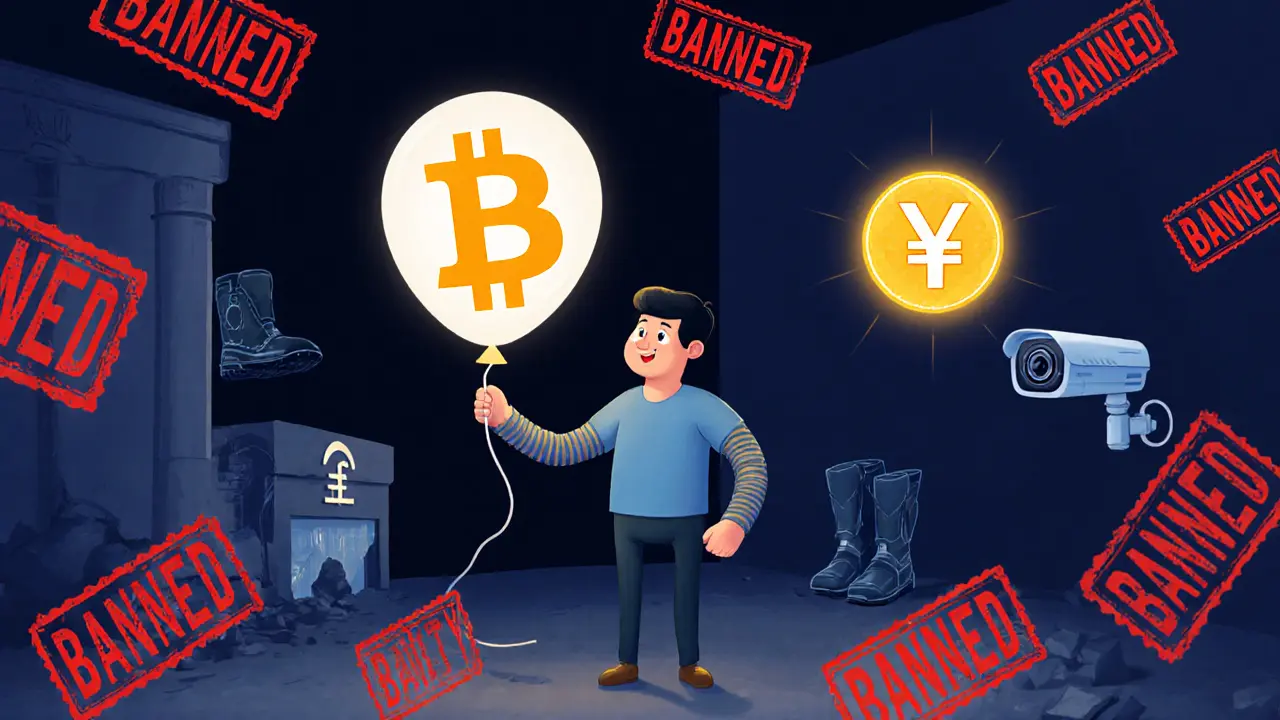
China's crypto ban blocks all trading, mining, and exchange of Bitcoin. Holders can own it, but can't use it legally. Banks freeze accounts, mining is shut down, and the digital yuan is the government's real focus.