
The United Arab Emirates isn't just tolerating cryptocurrency-it's building its entire financial future around it. While many countries struggle with how to regulate Bitcoin and altcoins, the UAE has created one of the most detailed, business-friendly frameworks in the world. If you're thinking about trading, investing, or running a crypto business, understanding how the UAE handles this space isn't optional-it's essential.
How the UAE Regulates Crypto: Five Authorities, One Goal
The UAE doesn’t have one single crypto regulator. Instead, it uses five different authorities, each with their own turf. This isn’t confusion-it’s strategy. It lets businesses pick the best fit for their model.
- VARA (Virtual Assets Regulatory Authority) runs Dubai’s crypto scene outside the DIFC. It’s the most crypto-specific body, covering exchanges, custody, wallet services, and token sales.
- DFSA (Dubai Financial Services Authority) handles crypto activities inside the Dubai International Financial Centre, treating them like traditional financial products.
- FSRA (Financial Services Regulatory Authority) does the same for Abu Dhabi Global Market, focusing on institutional players like fund managers and custodians.
- SCA (Securities and Commodities Authority) oversees investment-linked crypto assets at the federal level.
- CBUAE (Central Bank of the UAE) regulates payment tokens and digital currencies used for transactions.
This split means a company can choose to operate under VARA if it wants pure crypto rules, or under DFSA if it wants to blend crypto with banking-style oversight. There’s no one-size-fits-all. That’s why over 400 crypto firms have set up shop in the UAE since 2023.
Licensing Requirements: What It Takes to Operate Legally
If you want to run a crypto exchange, custody service, or token issuance business in the UAE, you need a license. And the rules are clear.
Under VARA, there are six licensed service categories:
- Exchange services (fiat to crypto, crypto to crypto)
- Broker services
- Transfer services
- Custody services
- Wallet provision
- Token issuance
Each has different capital requirements. For example:
- Basic exchange or custody: AED 100,000-AED 500,000 ($27,000-$136,000 USD)
- Full-service exchange with high volume: Up to AED 1.5 million ($408,000 USD)
Application fees range from AED 40,000 to AED 100,000. Annual supervision fees? Between AED 80,000 and AED 200,000. It’s not cheap-but it’s transparent. No guessing. No hidden costs.
Token issuance is split into two levels. Category 1 tokens (like utility or security tokens) need both a license and direct approval from VARA. Category 2 tokens (like loyalty points or closed-loop tokens) only need a licensed distributor, but still fall under VARA’s watch.
And you can’t just show up with a website. You need:
- A registered business in Dubai (for VARA)
- Proof of capital and insurance
- A full AML/CFT compliance system
- Secure tech infrastructure
- Fit-and-proper checks on all key staff
This isn’t a paperwork exercise. It’s a real barrier to entry-and that’s exactly why reputable firms are choosing the UAE over places with looser rules.
Tax Rules: No VAT, But Reporting Is Coming
Here’s one of the biggest advantages: Most crypto transactions are exempt from VAT. Since November 15, 2024, buying Bitcoin, selling Ethereum, or swapping altcoins doesn’t trigger the 5% sales tax that applies to most goods and services.
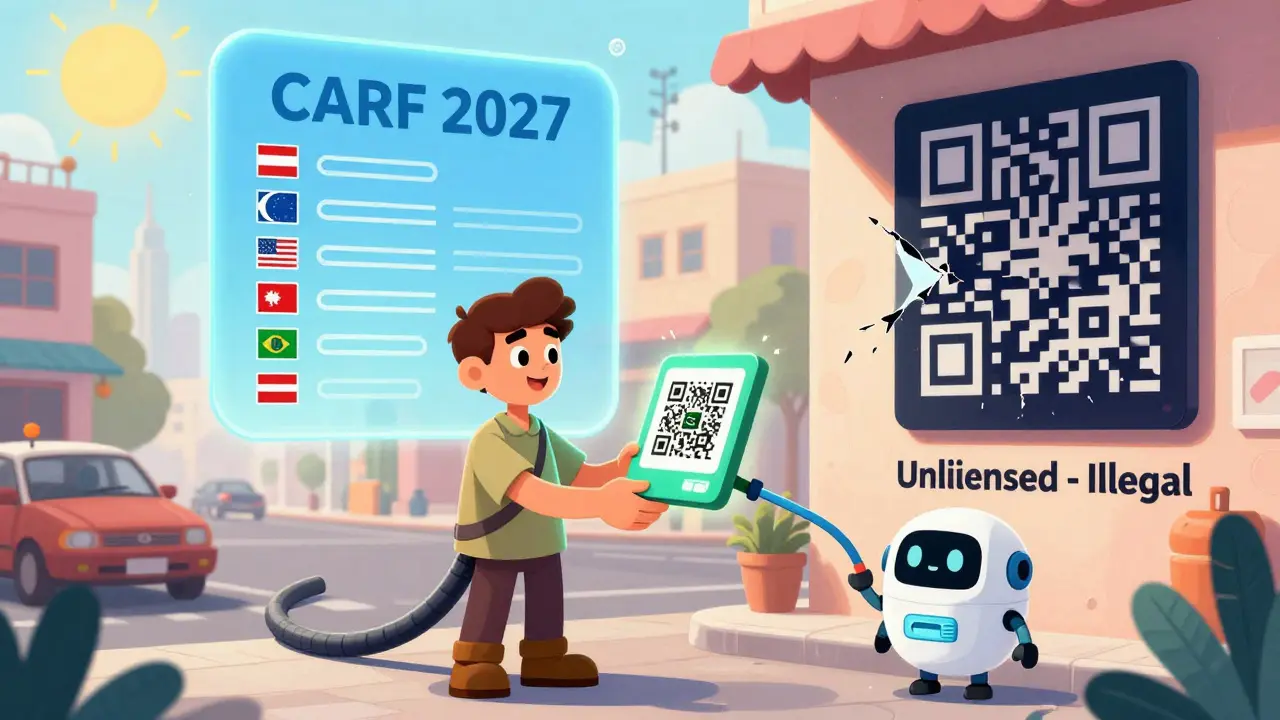
But don’t get too comfortable. The UAE is aligning with global standards. On September 20, 2025, it launched the Crypto-Asset Reporting Framework (CARF). This isn’t a tax-it’s a reporting rule.
Under CARF, every crypto exchange, broker, custodian, and wallet provider must collect and report:
- Customer identity and residency
- Transaction history (buys, sells, swaps)
- Account balances
- Details on NFTs and tokenized assets
The data gets shared automatically with tax authorities in over 100 countries by 2028. The timeline:
- November 2025: Final public consultation ends
- 2026: Final rules published
- January 1, 2027: Reporting begins
- 2028: First automatic data exchange with other countries
This means if you’re a UAE resident trading crypto, your activity will eventually be visible to your home country’s tax agency. The UAE isn’t taxing you-but it’s making sure your home country knows what you’re doing.
What’s Covered? Bitcoin, Altcoins, NFTs, DeFi, and More
The UAE doesn’t pick favorites. Its rules cover everything:
- Bitcoin and altcoins-all are treated as virtual assets
- NFTs-classified as digital assets, subject to the same licensing rules if traded or issued commercially
- DeFi protocols-if they offer services like lending or staking to users in the UAE, they need a VARA license
- Tokenized real estate and commodities-actively encouraged. The government even supports pilot programs for asset-backed tokens
This is different from places like the U.S. or EU, where regulators often argue over whether a token is a security, commodity, or currency. In the UAE, if it’s a digital asset and you’re offering services around it, you need a license. Period.
Even decentralized platforms aren’t off the hook. If a DeFi app has users in Dubai, and it’s facilitating trades or custody, VARA can require it to register. It’s not about decentralization-it’s about who’s serving customers in UAE territory.
Merchant Acceptance: Crypto Payments Are Legal-But Only Through Licensed Providers
Want to accept Bitcoin as payment in your Abu Dhabi store? You can. But since August 2025, all merchants outside free zones must use licensed providers to process crypto payments.
That means you can’t just install a QR code that sends funds directly to your personal wallet. You need a partner-like a VARA-licensed payment processor-that handles compliance, AML checks, and reporting on your behalf.
This rule protects consumers and ensures traceability. It also prevents fraud. If someone pays you in Bitcoin and later claims they didn’t, the licensed provider has the records to prove the transaction.
Free zones like DIFC and ADGM are exempt from this rule, giving them flexibility for high-volume crypto businesses. But for regular shops, restaurants, or service providers? Licensed gateways are mandatory.

Why This Matters: The UAE Is Becoming the Crypto Hub
Compare this to other countries:
- The U.S. has a patchwork of state and federal rules.
- The EU has MiCA, which is comprehensive but slow to implement.
- India taxes crypto at 30% and deducts TDS.
- China bans it outright.
The UAE? It’s the only place with:
- Clear licensing paths
- No VAT on crypto trades
- Multi-jurisdictional flexibility
- Real-time regulatory updates
- Strong institutional support
That’s why Binance, Crypto.com, and Bybit all moved key operations here. That’s why BitGo and Laser Digital chose the UAE for their institutional custody services. That’s why startups from Nigeria, Indonesia, and Argentina are relocating teams to Dubai.
This isn’t hype. It’s infrastructure. The UAE isn’t just letting crypto happen-it’s building the roads, traffic lights, and gas stations for it.
What’s Next? The Road to 2028
The framework isn’t finished. CARF will fully roll out by 2028. More DeFi protocols will be brought under license. Tokenized government bonds are expected to launch. And as global regulators look for models, the UAE’s approach is becoming the blueprint.
One thing is certain: if you’re serious about crypto in 2026, you ignore the UAE at your own risk.
Is Bitcoin legal in the UAE?
Yes, Bitcoin is fully legal in the UAE. You can buy, sell, hold, and trade it without restrictions. The only requirement is that if you’re running a business around Bitcoin-like an exchange or custody service-you need a license from VARA, DFSA, or FSRA, depending on your location.
Do I have to pay tax on crypto gains in the UAE?
No, the UAE does not impose capital gains tax on cryptocurrency. Personal trading, holding, or selling Bitcoin and altcoins is not taxed. However, if you’re running a crypto business, corporate income tax may apply. Also, under CARF, your transaction data will be shared with your home country’s tax authority starting in 2028.
Can I use crypto to pay for goods and services in the UAE?
Yes, but only through licensed payment processors. Since August 2025, all merchants outside free zones must use VARA-licensed providers to accept crypto payments. This ensures compliance with AML rules and protects both buyers and sellers.
What’s the difference between VARA and DFSA?
VARA regulates crypto activities across Dubai (outside the DIFC) with rules designed specifically for digital assets. DFSA regulates crypto within the Dubai International Financial Centre and treats it like traditional finance-applying banking-style rules. VARA is more crypto-native; DFSA is more finance-integrated.
Do I need a license if I’m just holding Bitcoin?
No. If you’re an individual buying and holding Bitcoin for personal use, you don’t need a license. The rules only apply to businesses offering services like trading, custody, or token issuance. Personal wallets are completely unregulated.
Are NFTs regulated in the UAE?
Yes. If you’re selling NFTs to the public, issuing them commercially, or operating an NFT marketplace, you need a license from VARA. Personal NFT ownership isn’t regulated-but commercial activity is treated like any other virtual asset service.
What happens if I don’t get a license to run a crypto business?
Operating without a license is illegal and can lead to fines, asset freezes, or criminal charges. VARA and other regulators actively monitor unlicensed platforms. If your business serves UAE customers, even from abroad, you’re still subject to their rules.
How long does it take to get a crypto license in the UAE?
The process typically takes 3 to 6 months. It depends on how complete your application is. You need business documentation, compliance plans, tech audits, capital proof, and fit-and-proper checks. Rushing it increases the chance of rejection. Most successful applicants work with legal advisors familiar with VARA or DFSA requirements.
Can foreign companies get a crypto license in the UAE?
Yes, but they must incorporate a legal entity in the UAE-usually in Dubai or Abu Dhabi. Foreign-owned companies can own 100% of the business. The license is tied to the local entity, not the parent company abroad. Many international firms set up a UAE subsidiary just to get licensed.
Is the UAE’s crypto regulation stable, or could it change?
The framework is designed to be adaptable. Regulations have evolved since 2020, and updates like CARF show the government is responsive to global trends. But unlike many countries, the UAE doesn’t flip-flop. Changes are announced well in advance, with long transition periods. Stability is part of what attracts institutional investors.
Comments (17)
Austin King
March 4, 2026 AT 00:00
This is actually one of the clearest crypto frameworks I've seen. No guesswork, no regulatory whiplash. Just straight-up rules that make sense for businesses. The UAE is building something real here.
Bryanna Barnett
March 5, 2026 AT 09:10
Lmao look at all these ‘licenses’ they need. Someone’s got a whole team just filing paperwork. Crypto’s supposed to be decentralized, not a corporate HR nightmare.
Rachel Rowland
March 6, 2026 AT 19:23
If you’re serious about crypto in 2026 you’re in Dubai. Period. The tax exemption alone is a game changer and the fact they’re not trying to crush innovation is why so many teams are moving here. This isn’t luck - it’s strategy.
Bonnie Jenkins-Hodges
March 7, 2026 AT 19:53
Why are we letting foreign governments dictate our money? 🤦♀️ Crypto is freedom! Now the UAE is snitching on us to every country? That’s not freedom - that’s just another surveillance state with better sun.
Cerissa Kimball
March 8, 2026 AT 23:29
The CARF framework is a critical step toward global compliance and transparency in digital asset markets. Entities must ensure they are prepared for data collection protocols and reporting obligations under international standards. Failure to comply may result in significant operational disruption.
Jeffrey Dean
March 9, 2026 AT 01:56
They say ‘no VAT’ but then they track everything. So it’s not about taxes - it’s about control. The real goal isn’t innovation. It’s about making crypto predictable enough for banks to absorb it. This isn’t freedom. It’s assimilation.
Olivia Parsons
March 9, 2026 AT 06:00
So if I’m just holding Bitcoin and not running a business, I’m totally fine? That’s actually refreshing. Most places treat you like a criminal just for owning it.
Nick Greening
March 9, 2026 AT 20:19
Oh wow five regulators? That’s not structure - that’s chaos with a fancy name. If you need five different approvals just to run a wallet, you’re not building a crypto hub. You’re building a bureaucracy museum.
Jackson Dambz
March 10, 2026 AT 21:52
The fact that this post is 1500 words long and still doesn’t answer whether you can legally mine Bitcoin in Abu Dhabi is why people don’t trust these ‘comprehensive’ guides.
Jesse VanDerPol
March 12, 2026 AT 05:42
VARA vs DFSA is like choosing between a hammer and a scalpel. One’s for builders. The other’s for accountants. Both work. Depends what you’re trying to fix.
jonathan swift
March 13, 2026 AT 01:17
CARF? More like CAF - Controlled Asset Framework. They’re just building a global ledger to track your every move. Next they’ll require biometrics to send Dogecoin. 👁️🗨️
Datta Yadav
March 13, 2026 AT 07:06
You think this is good? Let me tell you what real crypto looks like. In India we pay 30% tax and still outpace you in adoption. You build rules. We build communities. The UAE is a theme park. We’re the real thing. You don’t need licenses when you have millions of people who just believe in it.
Lydia Meier
March 13, 2026 AT 18:51
The article lists six licensing categories under VARA but doesn’t clarify whether non-residents can apply. That’s a critical omission for international operators.
Basil Bacor
March 15, 2026 AT 17:37
So the UAE lets you trade crypto but makes you register like you’re opening a bank account? Sounds like they just renamed the IRS and painted it gold.
Leah Dallaire
March 17, 2026 AT 14:52
They say ‘no taxes’ but then hand your data to every tax authority on Earth. That’s not freedom. That’s a trap. You think you’re getting an advantage? You’re just being prepped for a global crypto audit. They’re not welcoming you. They’re harvesting you.
prasanna tripathy
March 18, 2026 AT 03:14
Honestly? This is the most balanced take I’ve seen. The UAE gets that crypto isn’t just tech - it’s infrastructure. They’re not banning it. They’re not overregulating it. They’re building the rails so everyone can ride. Respect.
Issack Vaid
March 18, 2026 AT 03:33
Let’s be honest - this isn’t about crypto. It’s about positioning Dubai as the next global financial capital. The rules are clean. The infrastructure is world-class. The sun? Bonus. This is capitalism with a view.