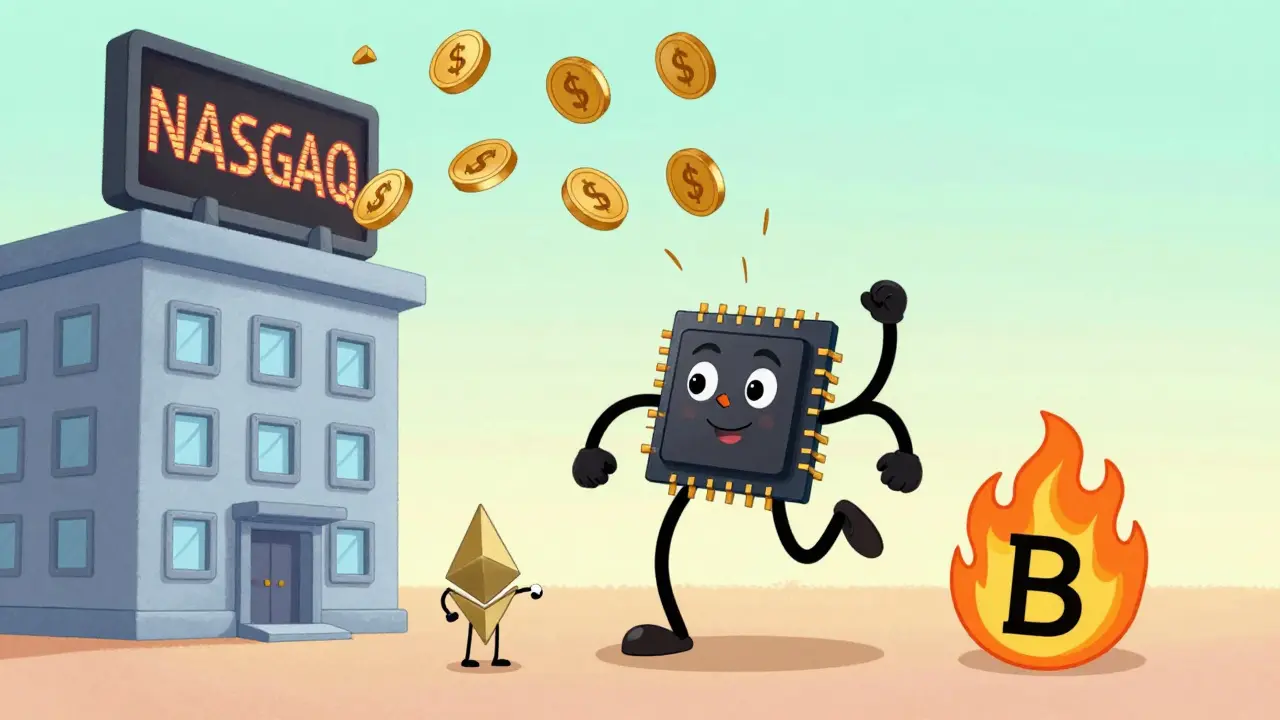
AVGOon isn’t another meme coin. It’s not a speculative token with no backing. It’s a blockchain-based version of Broadcom Inc. (AVGO), one of the world’s leading semiconductor companies. If you’ve ever wanted to own a piece of Broadcom without opening a brokerage account, AVGOon lets you do that-using crypto wallets, decentralized exchanges, and smart contracts. But it’s not stocks. It’s not shares. It’s something in between.
What Exactly Is AVGOon?
AVGOon is an ERC-20 token issued by Ondo Finance that mirrors the economic performance of Broadcom stock. Every AVGOon token is designed to track the price of one share of Broadcom (AVGO) on the NASDAQ. When Broadcom pays a dividend, those payments are automatically reinvested into more AVGOon tokens-no manual action needed. That’s the core promise: crypto access to real-world company equity.
Unlike buying AVGO stock through Fidelity or Charles Schwab, you don’t need a Social Security number, proof of address, or to wait for market hours. You just need a crypto wallet and access to an exchange like Gate.io or MEXC. You can buy as little as $10 worth of AVGOon. At current prices around $325 per token, that’s about 0.03 AVGOon. You own a fraction of the token, not a fraction of a share. And that’s the key distinction.
How Does It Work?
AVGOon runs on two blockchains: Ethereum and BNB Chain. On Ethereum, there are roughly 3,988 AVGOon tokens in circulation, held by 176 wallets. On BNB Chain, it’s smaller-248 tokens held by 73 wallets. Both versions are ERC-20 compliant, meaning they work with most wallets like MetaMask, Trust Wallet, or Coinbase Wallet.
The Ondo Finance protocol holds the actual Broadcom shares in a legal entity. Each AVGOon token represents a claim on a portion of those shares-not ownership, but economic exposure. Think of it like a derivative: when Broadcom’s stock goes up, AVGOon goes up. When it pays dividends, the protocol uses the cash to buy more AVGOon tokens and distribute them to holders. No paperwork. No brokerage fees. No waiting for settlement.
There’s no voting power. You can’t attend shareholder meetings. You can’t influence company decisions. You’re not a shareholder-you’re a token holder with exposure to Broadcom’s financial performance. That’s the trade-off.
Price and Market Data (As of March 2026)
AVGOon has been unusually stable for a crypto asset. In late February 2026, it traded between $325.83 and $326.13-a range of less than $0.30. That’s tighter than most stablecoins. The all-time high was $326.43. As of now, it’s hovering near $340, up 0.41% over the past 30 days.
The total market cap is around $1.44 million. Sounds small? Compare that to Bitcoin’s $1.2 trillion. But consider this: the number of holders on Ethereum jumped 91% in just 30 days. Monthly trading volume on Ethereum hit $1.5 million. On BNB Chain, it was $258,000. That’s not a flash in the pan. People are actively trading it.
Price predictions vary. LiteFinance expects AVGOon to average $338.62 by the end of 2026. Wallet Investor predicts $330.91 by 2027. By 2030, models suggest a range between $300 and $350. These aren’t wild guesses-they’re based on historical stock performance, dividend trends, and crypto market behavior. But remember: these are forecasts, not guarantees.
Where Can You Buy AVGOon?
You can’t buy AVGOon on Coinbase or Kraken. It’s not listed on centralized exchanges that handle U.S. stocks. Instead, you need decentralized exchanges (DEXs). The two main platforms are:
- Gate.io - Supports AVGOon/USDT and AVGOon/BTC pairs
- MEXC - Also offers AVGOon/USDT and AVGOon/BTC
To buy, you’ll need to first get USDT or BTC. If you’re starting with fiat, you can buy Bitcoin on Binance or Kraken, then send it to Gate.io or MEXC to trade for AVGOon. Direct credit card purchases aren’t available on these platforms. You’ll need to move crypto between exchanges.
Minimum purchase is $10. You can set limit orders to buy at a specific price, or use market orders to grab it instantly. The liquidity is decent-orders usually fill within seconds.
Why Does This Exist?
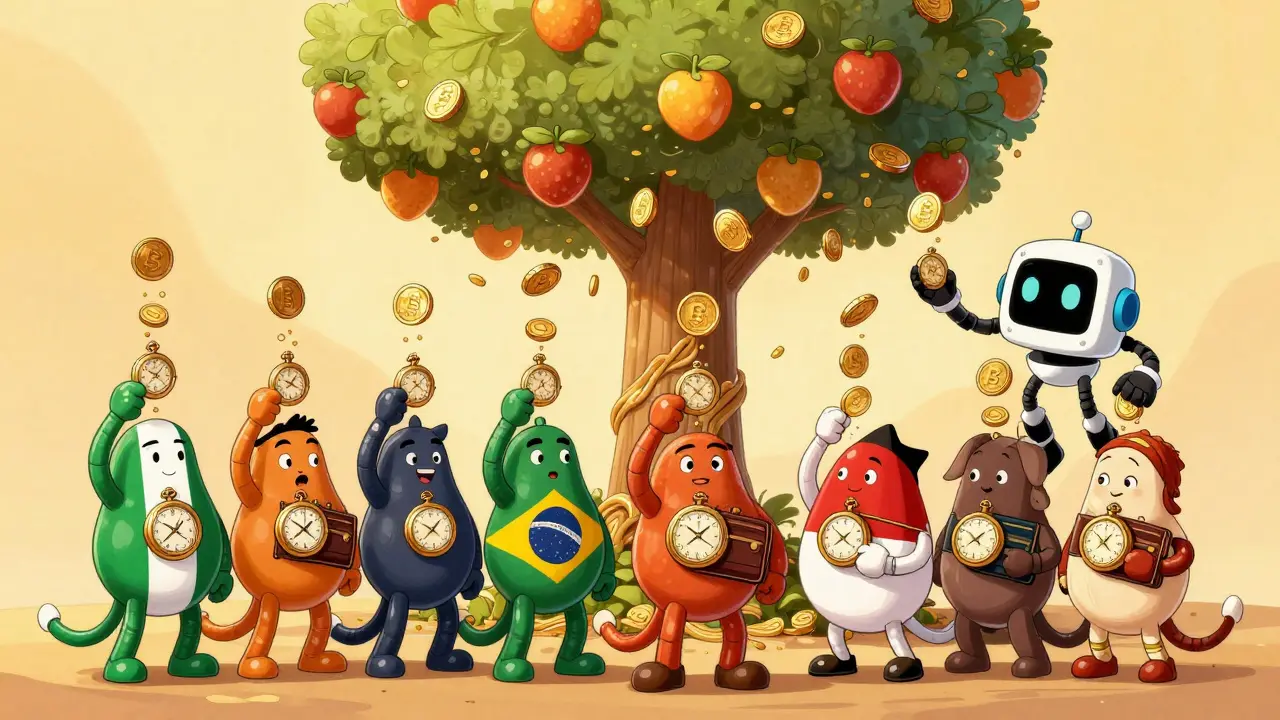
AVGOon is part of a bigger trend: real-world asset (RWA) tokenization. Companies like Ondo Finance, Maple Finance, and Centrifuge are turning stocks, bonds, and real estate into blockchain tokens. Why? Because it opens access. Someone in Nigeria, Brazil, or Indonesia can own a piece of Broadcom without jumping through regulatory hoops. No KYC. No residency requirements. Just a wallet and internet.
It also automates dividends. Traditional investors have to manually reinvest dividends or cash them out. With AVGOon, it’s built-in. The protocol collects Broadcom’s dividends, converts them to stablecoins, and buys more AVGOon to distribute. That’s compounding without the effort.
For crypto-native investors, it’s a bridge. You don’t have to choose between DeFi and traditional markets. You can hold AVGOon alongside ETH, SOL, or BTC. It’s equity exposure in a crypto portfolio.
Risks and Downsides
It’s not all smooth sailing. Here’s what you should know:
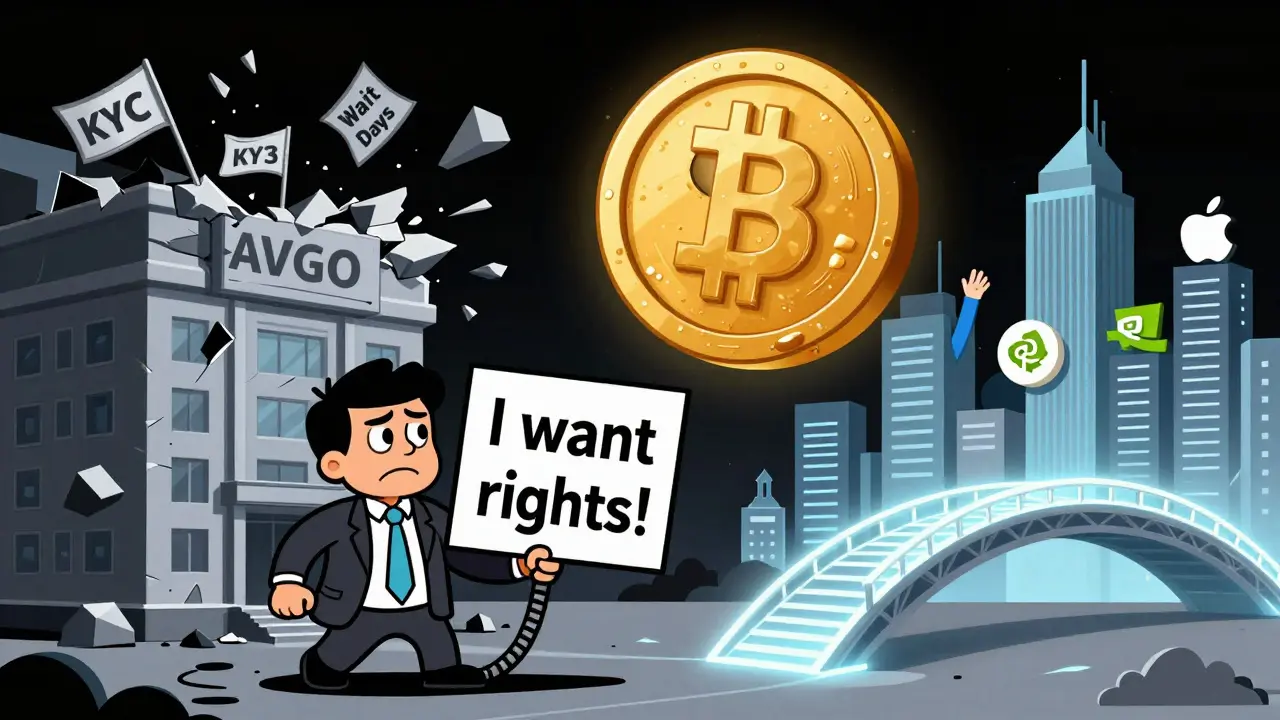
- No legal ownership - You don’t own Broadcom stock. You own a token that tracks it. If Ondo Finance collapses, the link could break.
- Regulatory uncertainty - The SEC hasn’t clearly defined whether tokenized equities are securities. If regulators crack down, AVGOon could be delisted or frozen.
- Custody risk - If you lose your private key, you lose your AVGOon. There’s no password reset. No customer support.
- Liquidity risk - While trading volume is growing, it’s still tiny compared to major tokens. A large sell-off could crash the price.
- Smart contract risk - Bugs, exploits, or failed upgrades could disrupt dividend distribution or token transfers.
These aren’t dealbreakers for everyone-but they’re real. If you’re comfortable with crypto risks and believe in the long-term value of Broadcom, AVGOon makes sense. If you’re looking for guaranteed returns or legal protections, stick with a brokerage.
Who Is This For?
AVGOon isn’t for everyone. It’s for:
- Investors outside the U.S. who can’t access U.S. stocks easily
- Crypto users who want stable, dividend-paying assets in their portfolio
- People who believe in RWA tokenization as the future of finance
- Those who want automatic dividend reinvestment without brokerage fees
It’s not for:
- People who want voting rights or shareholder communications
- Those who prefer regulated, insured investment platforms
- Traders looking for high volatility and quick flips
If you’re curious, start small. Buy $20 worth. See how it behaves. Watch how it moves with Broadcom’s stock price. Check the dividend history. Compare it to holding actual AVGO stock. You’ll learn more in a month than reading a dozen articles.
What’s Next?
AVGOon is still early. The holder count is growing. The trading volume is rising. More tokens like this are coming-Apple, Microsoft, NVIDIA. The infrastructure is being built. Ondo Finance is working with institutional investors to bring more real-world assets on-chain.
The question isn’t whether tokenized stocks will grow. It’s whether you’ll be ready when they do. AVGOon is one of the first real tests. It’s not perfect. But it’s real. And it’s working.
Is AVGOon the same as Broadcom stock?
No. AVGOon is a blockchain token that tracks the price of Broadcom stock (AVGO). You don’t own actual shares. You own a derivative that gives you economic exposure-meaning you benefit from price changes and dividends, but you can’t vote, receive shareholder letters, or hold physical shares.
Can I cash out AVGOon for U.S. dollars?
Not directly. You can sell AVGOon for USDT or BTC on exchanges like Gate.io or MEXC, then convert those to USD on platforms like Kraken or Coinbase. There’s no direct path from AVGOon to bank transfer.
Are dividends automatically reinvested with AVGOon?
Yes. Whenever Broadcom pays a dividend, the Ondo Finance protocol collects the cash, buys more AVGOon tokens, and distributes them proportionally to all token holders. No action is required on your part.
Is AVGOon regulated by the SEC?
It’s unclear. Tokenized securities like AVGOon exist in a gray area. The SEC has not officially classified them, but they may be considered securities under U.S. law. Always check your local regulations before investing.
What happens if Ondo Finance shuts down?
If Ondo Finance ceases operations, the link between AVGOon and Broadcom stock could break. The tokens might still trade, but dividend payments and price tracking could stop. This is a key risk-AVGOon depends on the protocol’s continued operation.
Comments (14)
Graham Smith
March 20, 2026 AT 16:59
AVGOon represents a paradigmatic shift in the tokenization of real-world assets - not merely a crypto derivative, but a financial instrument that abstracts equity into on-chain liquidity primitives. The Ondo protocol’s use of ERC-20 standards enables atomic settlement, eliminating counterparty risk inherent in traditional custodial models. Dividend reinvestment is algorithmically optimized via smart contract arbitrage, effectively creating a self-compounding yield engine unbound by brokerage latency or fractional share constraints. This is not speculation - it’s structural innovation in capital formation.
One must recognize that the 91% increase in Ethereum holders isn’t noise - it’s a signal of institutional-grade demand from non-US retail investors who’ve been systematically excluded from U.S. equity markets. The market cap may be microcap by Bitcoin standards, but its velocity and composability within DeFi protocols suggest it’s a canary in the coal mine for RWA adoption.
Regulatory ambiguity is not a flaw - it’s a feature. The SEC’s inability to classify AVGOon as a security is precisely what allows it to operate as a global, permissionless asset class. If they attempt to regulate it, they’ll only accelerate its migration to non-U.S. jurisdictions with clearer legal frameworks - think Singapore, Dubai, or Switzerland. This is the future of finance: borderless, automated, and disintermediated.
Jerry Panson
March 21, 2026 AT 00:37
Thank you for the detailed breakdown. I appreciate the clarity with which you’ve outlined the mechanics of AVGOon and its distinction from traditional equity ownership. The absence of voting rights is indeed a significant trade-off, and I believe it is critical for investors to fully comprehend this before allocating capital.
The automation of dividend reinvestment is a compelling advantage, particularly for those who may not have the time or resources to manage portfolio rebalancing manually. The reduction in friction - no SSN, no proof of address, no market hours - is a substantial improvement over legacy systems.
I would only caution against overestimating the stability of the token’s price. While its narrow trading range suggests low volatility, this may also indicate thin liquidity. A sudden large sell-off could trigger a cascade effect, especially given the relatively small number of wallets holding the asset. Due diligence remains paramount, even in seemingly stable instruments.
Katrina Smith
March 21, 2026 AT 13:24
so avgoon is just… stock but on blockchain? lol. i thought we were done with this "crypto does everything better" nonsense. 🙄
Anastasia Danavath
March 21, 2026 AT 19:39
i just bought $20 of it and now i’m obsessed 😍 like imagine if apple did this next?? 🤯 i’m gonna cry if it goes to 400 lol
anshika garg
March 22, 2026 AT 13:02
There is something deeply poetic about this - a semiconductor company, a pillar of modern technology, now represented as a digital token accessible to a farmer in Kerala or a student in Lagos. It feels like the internet finally delivered on its promise: equity without borders.
But I wonder… does this not also deepen the divide? Those who understand blockchain, who can navigate wallets and DEXs, will inherit the future. Those who cannot - the elderly, the unconnected, the skeptical - will remain outside the gates, watching as wealth flows through digital channels they cannot touch.
AVGOon is not just finance. It is philosophy. It is power. It is inclusion… and exclusion, all at once. We must not celebrate the innovation without mourning the silence it leaves behind.
Bruce Doucette
March 24, 2026 AT 07:45
Ugh. Another crypto bro trying to rebrand Wall Street as Web3. Let’s be real - you’re just gambling with a ticker symbol and calling it "financial innovation." You don’t own anything. You’re trusting a private company to not disappear tomorrow. And if Ondo gets shut down? Poof. Your "equity exposure" is now a ghost token. 🤡
Marie Vernon
March 24, 2026 AT 10:15
I love how this opens doors for people who’ve been locked out of traditional investing. I’m from a small town in Mississippi - my grandma couldn’t even open a brokerage account because she didn’t have a credit card. But she has a phone. And a wallet. And now? She bought 0.05 AVGOon for my cousin’s college fund.
It’s not perfect. But it’s *something*. And in finance, something is better than nothing.
Also - dividend auto-reinvestment? Yes please. I’ve been manually reinvesting since 2018. This is the upgrade I didn’t know I needed.
rajan gupta
March 25, 2026 AT 08:44
AVGOon… it’s beautiful. A digital echo of capitalism’s soul. We are no longer buying stocks - we are buying *hope* encoded in bytecode. The blockchain doesn’t care about borders, about SEC filings, about your social security number. It only cares about balance.
And yet… I feel it. The loneliness of owning something that no government recognizes. You hold a piece of Broadcom - but not its voice. Not its legacy. Not its boardroom. You are a ghost in the machine, watching dividends appear like magic.
Is this progress? Or are we becoming digital serfs - serving the algorithm, while the real power remains hidden behind corporate firewalls?
Billy Karna
March 25, 2026 AT 20:40
Let me clarify a few misconceptions here. AVGOon is not a security under U.S. law - at least not yet. The SEC’s Howey Test hinges on investment of money in a common enterprise with expectation of profit from the efforts of others. Ondo doesn’t manage the Broadcom shares directly - they’re held by a special purpose vehicle (SPV) in a Cayman Islands entity. Ondo merely administers the token issuance and dividend distribution via smart contract. That’s critical.
Also, the 3,988 tokens on Ethereum? That’s not the total supply. That’s the circulating supply. There’s a larger reserve held by Ondo for future issuance. The market cap of $1.44M is misleading because it doesn’t account for the underlying $1.3B in Broadcom shares backing it. The leverage ratio is insane - roughly 1:900. That’s why liquidity is thin. One whale selling 100 tokens could tank the price. But that’s also why arbitrageurs are watching it like hawks.
And yes - if you’re outside the U.S., this is the most efficient way to gain exposure. But if you’re in the U.S., you’re still better off with a brokerage unless you’re specifically seeking DeFi composability or automated reinvestment.
Cheri Farnsworth
March 26, 2026 AT 17:37
While the concept is innovative, I remain concerned about the legal and fiduciary implications for holders. The absence of shareholder rights, combined with the reliance on a third-party protocol, introduces an unacceptable level of counterparty risk. Furthermore, the lack of regulatory clarity may expose investors to unintended tax consequences or reporting obligations under FATCA or CRS.
I would advise caution. This is not a substitute for direct equity ownership. It is an experimental instrument - intriguing, but not yet mature enough for core portfolio allocation.
Gene Inoue
March 27, 2026 AT 14:04
You people are so gullible. AVGOon is just a pump-and-dump waiting to happen. Ondo Finance is probably a shell company. I’ve seen their whitepaper - it’s got more buzzwords than a Web3 conference. They’re not even registered with FINRA. If this thing crashes, you’ll be the ones begging for help. And guess what? No one’s coming. 🤡
Ricky Fairlamb
March 27, 2026 AT 22:40
Let me remind you all: the U.S. Constitution does not recognize blockchain as legal tender. The SEC has been clear - any asset that mirrors the performance of a publicly traded stock is a security. AVGOon is a violation of Section 5 of the Securities Act of 1933. This isn’t innovation - it’s civil disobedience dressed up as finance.
And you’re all fine with that? You’re fine with bypassing KYC, AML, and investor protections? You’re fine with a system where your only recourse if Ondo vanishes is a Twitter thread?
This isn’t progress. It’s anarchy. And anarchists don’t build wealth - they burn it.
Tony Weaver
March 29, 2026 AT 07:20
AVGOon is the perfect metaphor for late-stage capitalism: a beautiful, complex machine that works flawlessly - until it doesn’t. You’ve got a token that tracks a $500B company, backed by real dividends, automated compounding, and global access. But underneath? A single smart contract. A single company. A single point of failure.
It’s like building a skyscraper out of Jenga blocks and calling it architecture.
The holders are doubling down because they’ve convinced themselves this is the future. But the future doesn’t care about your conviction. It cares about resilience. And right now, AVGOon is the most fragile asset I’ve ever seen that claims to be "stable."
It’s not a stock. It’s not a coin. It’s a vibe. And vibes don’t pay dividends - real systems do.
Graham Smith
March 30, 2026 AT 19:36
Responding to @2138 - you’re conflating fragility with innovation. The fact that AVGOon relies on a single protocol is precisely why it’s so elegant. Traditional finance is a labyrinth of custodians, clearinghouses, and intermediaries. Here, one smart contract replaces an entire ecosystem. Yes, it’s a single point of failure - but it’s also a single point of truth.
And that truth is verifiable on-chain. Anyone can audit the dividend distribution. Anyone can verify the SPV’s holdings. That’s transparency. That’s accountability. That’s what legacy finance refuses to offer.
It’s not a Jenga tower. It’s a blockchain. And blockchains are designed to fail gracefully - not with a crash, but with a fork. If Ondo vanishes, the community can fork the contract. The shares still exist. The dividends still flow. The token just needs a new steward. That’s the power of decentralization - not perfection, but resilience.