Maxcoin (MAX) isn’t a household name like Bitcoin or Ethereum. In fact, if you’re checking it out in 2026, you’re probably digging through the relics of early crypto experiments. But here’s the thing: Maxcoin was never meant to be just another altcoin. It was built with real technical ambition - and then mostly forgotten.
How Maxcoin started
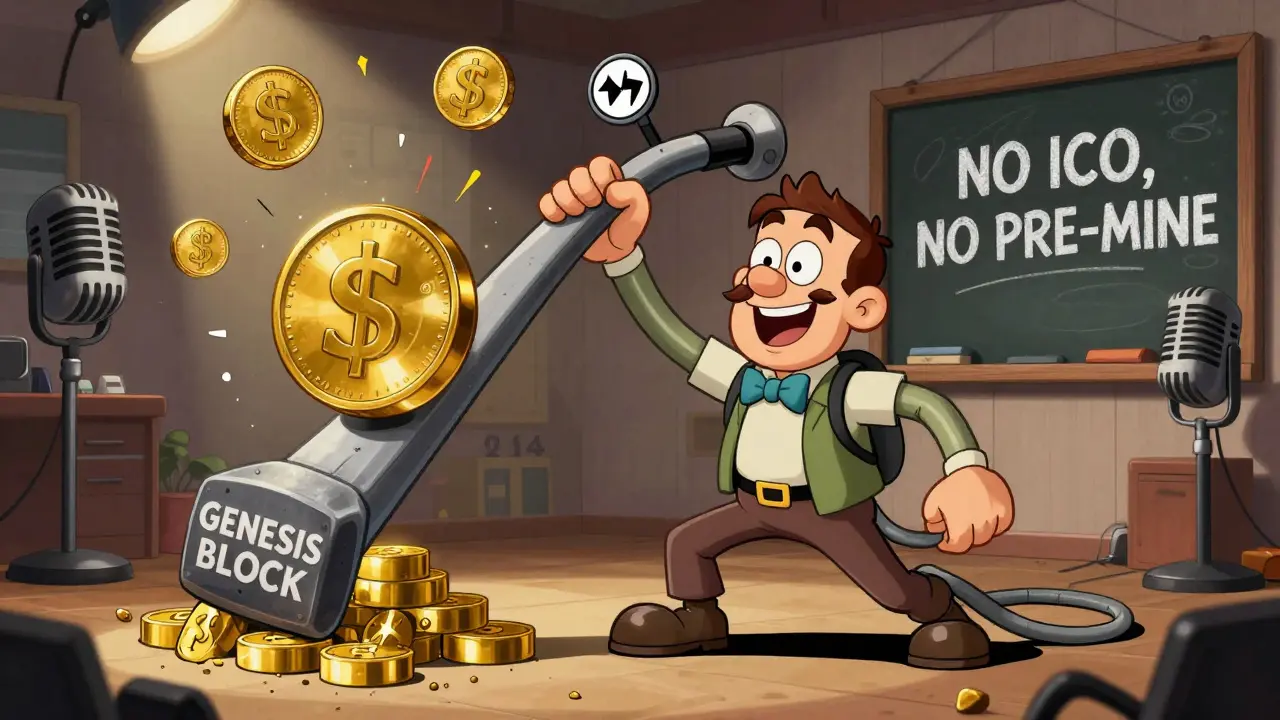
Maxcoin launched on February 6, 2014, during episode 555 of the Keiser Report, a popular cryptocurrency podcast hosted by Max Keiser. Unlike most coins that raise money through ICOs or pre-mining, Maxcoin had none of that. No fundraising. No marketing campaign. Just a clean, community-driven launch. The team behind it claimed they wanted to create a cryptocurrency that prioritized real-world payments over speculation.
Keiser himself mined the first block. That’s not just symbolic - it’s rare. Most founders don’t touch the genesis block. He did. And that gave Maxcoin a weird kind of credibility early on. But credibility doesn’t pay bills. And as time passed, Maxcoin started to fade.
What made Maxcoin different
Maxcoin wasn’t just a Bitcoin clone with a new name. It had two major technical upgrades that were bold for 2014:
- SHA-3 (Keccak) hashing instead of Bitcoin’s SHA-256
- Schnorr signatures for faster, more private transactions
SHA-3 was a newer, more secure algorithm at the time. Bitcoin stuck with SHA-256. Maxcoin switched. That alone made it stand out.
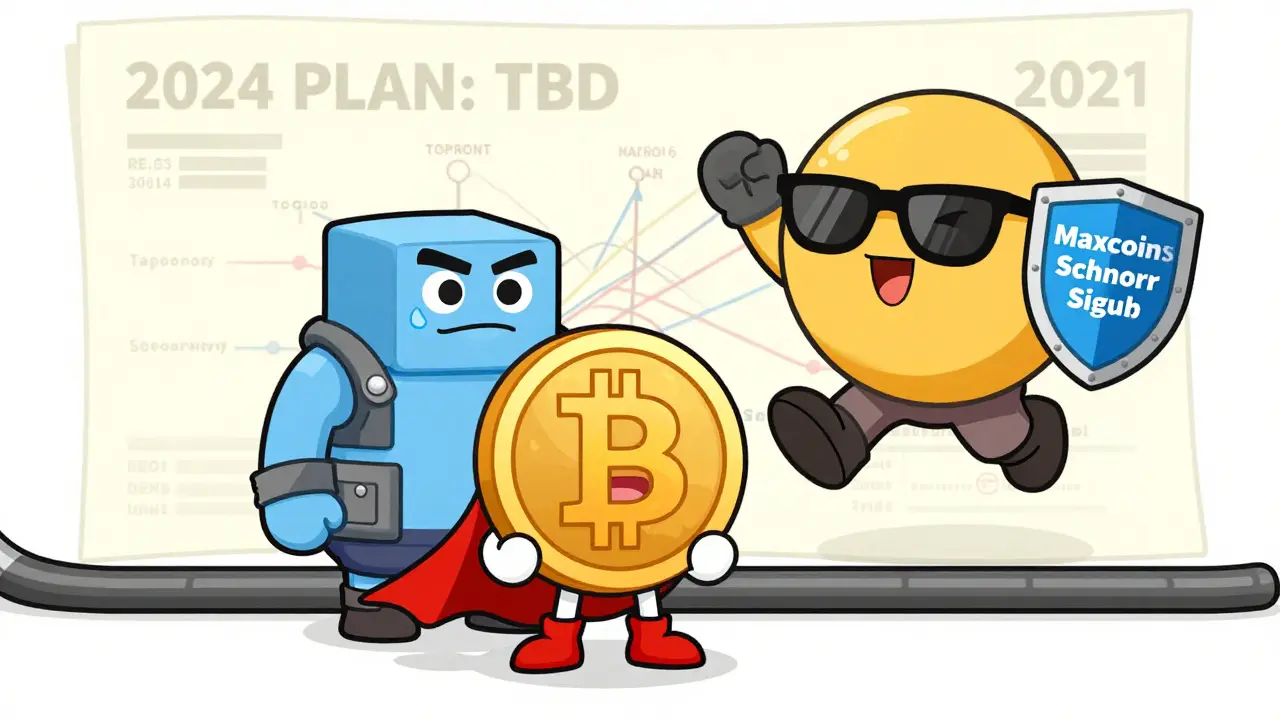
Schnorr signatures? That’s even more interesting. They let multiple signatures be combined into one, cutting down transaction size and improving privacy. It’s a big deal for scalability. But here’s the kicker: Bitcoin didn’t adopt Schnorr until late 2021 - with its Taproot upgrade. Maxcoin had it eight years earlier.
Maxcoin also used the Secp256r1 elliptic curve for key generation, not Bitcoin’s Secp256k1. Some cryptographers argue Secp256r1 is more resistant to certain attacks. Whether that’s true in practice is still debated - but it was a deliberate choice.
And then there’s the blockchain. Maxcoin adjusted mining difficulty after every block. Bitcoin waits two weeks. That meant Maxcoin could react faster to changes in mining power. In theory, that made it more stable. In practice? It didn’t matter enough to attract miners.
Where Maxcoin stands today
As of February 2026, Maxcoin has a circulating supply of exactly 61,445,805 MAX tokens. That’s the total supply - no more will ever be created. The market cap? Around $75,660. Each MAX token is worth about $0.0037. That’s down from its all-time high of $52 million - a figure that almost certainly reflects a data glitch. No coin with a $52 million ATH should trade at $0.0037. That’s not a correction. That’s a mistake in reporting.
Trading volume? About $30 per day. On two exchanges. For comparison, Bitcoin trades over $30 billion daily. Maxcoin’s liquidity is so low that buying or selling more than a few hundred tokens could crash the price.
It’s ranked #4,872 by market cap out of over 5,000 cryptocurrencies. That’s not just niche. It’s invisible.
Why Maxcoin failed to take off
Maxcoin had the tech. It had the early hype. So why did it die?
- No developer activity: GitHub shows only three contributors in the last year. The last meaningful code commit was in September 2025. That’s not a project. That’s a zombie.
- Outdated tools: The official wallet hasn’t been updated since 2019. The blockchain explorer is slow. The website looks like it was built in 2015 and never touched.
- No community: The Telegram group has 127 members. The last active discussion was in 2020. Reddit has zero threads about Maxcoin in 2025. There’s no Reddit community. No Twitter buzz. No YouTube tutorials.
- Bitcoin stole its best feature: Schnorr signatures were Maxcoin’s big selling point. But Bitcoin implemented them in 2021. Now, Maxcoin’s innovation feels like a footnote.
- No merchant adoption: You can’t buy coffee with Maxcoin. You can’t pay for a subscription. You can’t send it to a friend using PayPal or Cash App. It doesn’t integrate anywhere.
The project’s 2024 roadmap talks about "enhancing transaction speed" and "introducing decentralized governance." But there are no timelines. No updates. No proof. Just words on a page.
Can you mine Maxcoin?
Technically, yes. Maxcoin is still a Proof-of-Work coin. You can mine it with a CPU or GPU using the Keccak algorithm. But here’s the reality:
- Electricity costs more than the MAX you’d earn
- Mining pools are dead - you’re solo mining
- Even if you mine 100 MAX, you can’t sell them without a huge price drop
WhatToMine.com shows negative profitability. That’s not a coincidence. It’s a death sentence for miners.
Is Maxcoin worth anything?
If you’re asking whether Maxcoin has future value - the answer is no. Not as a payment system. Not as an investment. Not even as a technical experiment anymore.
It’s not a scam. It wasn’t a rug pull. It was a real project with real code. But it failed because it had no ecosystem, no users, and no momentum. The crypto world moved on. Maxcoin didn’t.
The only people still holding MAX are collectors - the kind who keep old floppy disks or VHS tapes. They believe in the history. Not the future.
What you can do with Maxcoin today
Not much.
- You can download the wallet from maxcoinproject.org - but it’s outdated and may not sync properly.
- You can buy MAX on two obscure exchanges - but don’t expect to sell it easily.
- You can try to mine it - but you’ll lose money.
- You can study its code - it’s open source, and the early design choices are still interesting.
There’s no app. No API. No developer docs. No tutorials. No support.
If you’re looking to use a cryptocurrency for payments, Maxcoin is not it. If you’re looking for a coin with growth potential, Maxcoin is not it. If you’re looking for something that might be valuable in five years? Maxcoin is not it.
But if you’re curious about how early crypto projects tried to innovate - and why most of them failed - Maxcoin is a perfect case study.
Is Maxcoin still being developed?
No, not meaningfully. The last significant code update was in 2025. The GitHub repo has only three contributors, and none have pushed new code since September 2025. The official website and wallets haven’t been updated since 2019. While the project claims to have a roadmap, there’s no public progress, no announcements, and no community activity to suggest active development.
Can I buy Maxcoin on major exchanges like Coinbase or Binance?
No. Maxcoin is not listed on any major exchange. It trades only on two tiny, low-volume platforms. You won’t find it on Coinbase, Binance, Kraken, or any other well-known exchange. Buying it requires using obscure, often risky platforms with little to no security.
Why does Maxcoin use SHA-3 and Schnorr signatures?
SHA-3 (Keccak) was chosen as a more secure and modern alternative to Bitcoin’s SHA-256. Schnorr signatures were meant to improve privacy and reduce transaction size by allowing multiple signatures to be combined into one. These were advanced ideas in 2014. But Bitcoin later adopted Schnorr in 2021 via Taproot, making Maxcoin’s innovation less unique.
Is Maxcoin a good investment?
No. With a market cap under $80,000 and daily trading volume under $30, Maxcoin has no liquidity. There’s no institutional interest, no merchant adoption, and no developer activity. The price is extremely volatile and likely manipulated. It’s not an investment - it’s a relic.
Can I mine Maxcoin profitably?
No. Mining Maxcoin requires specialized hardware for the Keccak algorithm, but the electricity cost far exceeds the value of the MAX coins you’d earn. Mining pools are inactive, and solo mining yields almost nothing. Profitability calculators show negative returns. It’s not worth the effort.
Comments (16)
Jordan Axtell
February 7, 2026 AT 13:01
This is the kind of crypto graveyard I love. Maxcoin didn't fail because it was bad tech-it failed because it was too smart for its own good. The world doesn't reward innovation. It rewards hype, liquidity, and memes. Maxcoin was a surgical scalpel in a world that wanted a chainsaw. And now? It's a museum piece. I keep a few MAX just to remind myself how quickly everything gets erased.
People think crypto is about disruption. Nah. It's about who shouts loudest.
James Harris
February 8, 2026 AT 08:06
I love this post. It's like finding an old VHS tape of a movie no one remembers but you still watch every year. Maxcoin had heart. It had real ideas. And now? It's just a quiet ghost in the blockchain graveyard. I still mine it once a month just to say I did. Not for profit. For respect.
Some things aren't meant to be big. They're meant to be remembered.
Alex Garnett
February 9, 2026 AT 12:27
This is why American crypto failed. Too many people chasing novelty instead of substance. Maxcoin had legitimate technical superiority-SHA-3, Schnorr, custom curve-but Americans couldn't handle discipline. They wanted quick flips. This coin was built for engineers. Not degens. And now it's worth less than your morning coffee. Predictable.
aryan danial
February 10, 2026 AT 09:15
The real tragedy here is not that Maxcoin died-it's that nobody noticed it was dying. The entire crypto ecosystem is built on performative innovation. Everyone claims to be building the future but no one has the patience to maintain the past. Maxcoin’s code was cleaner than Bitcoin’s. Its architecture more elegant. And yet it vanished because it didn’t have a Discord server with 50k members screaming about mooning. The system is broken.
Ryan Chandler
February 11, 2026 AT 21:59
I JUST FOUND OUT ABOUT THIS AND I’M CRYING. I mean-Schnorr signatures in 2014? That’s like inventing the smartphone in 1995 and then letting it rot in a drawer. Maxcoin was a goddamn prophet. And we ignored it. We were too busy buying Dogecoin with our tax refunds. The crypto world is a tragedy wrapped in a meme. I’m going to buy 10,000 MAX today. Not because I think it’ll rise. But because someone has to remember.
Rest in peace, Maxcoin. You deserved better.
Ajay Singh
February 13, 2026 AT 07:55
Maxcoin was ahead. Simple as that. No drama. No hype. Just better tech. Now it's dead. The system rewards noise not genius. Move on.
Oliver James Scarth
February 14, 2026 AT 12:54
One cannot help but observe with profound regret the manner in which this project-technically superior, architecturally bold, and philosophically grounded-was allowed to wither under the weight of collective apathy. The absence of institutional recognition, the lack of developer continuity, and the utter disregard for cryptographic integrity represent not merely a failure of marketing, but a systemic collapse of intellectual stewardship. Maxcoin was not merely a coin. It was an ethos. And we let it die.
Kieren Hagan
February 15, 2026 AT 15:18
The technical merits of Maxcoin are undeniable. SHA-3 adoption in 2014 was forward-thinking. Schnorr signatures predated Bitcoin’s Taproot by years. The real issue lies in ecosystem neglect. No wallet updates, no documentation, no community engagement. A project with strong fundamentals can still fail without operational discipline. This is a textbook case of technical excellence without execution.
sachin bunny
February 16, 2026 AT 03:35
LMAO they didn't want Maxcoin to succeed 😂 The government and Big Crypto teamed up to bury it. Why? Because if everyone used MAX, they couldn't track your money. SHA-3 + Schnorr = untraceable. That's why they let it die. They're scared. And now you're all just sitting there like sheep. Wake up. 🕵️♂️💰
Olivette Petersen
February 17, 2026 AT 22:42
I just read this whole thing and I’m so inspired. Maxcoin didn’t win because it was too quiet. But that doesn’t mean it didn’t matter. Sometimes the quietest ideas are the ones that change the world later. I’m downloading the wallet right now. Not to invest. Just to honor it. We need more projects like this-real, honest, unsexy tech. Keep going, Maxcoin. You’re not forgotten.
Michelle Anderson
February 19, 2026 AT 02:33
This is why you don’t trust crypto projects without VC backing. Maxcoin had ‘good ideas’ but zero hustle. No marketing. No influencers. No community managers. Just code. And in 2026? Code doesn’t pay bills. It’s a dead end. You want to be taken seriously? Build hype. Build a brand. Build a cult. Otherwise you’re just a footnote in a GitHub repo.
Danica Cheney
February 20, 2026 AT 10:21
maxcoin was so ahead of its time like imagine if bitcoin had schnorr in 2010 instead of 2021 but no one cared so now its just a ghost lol
Kyle Pearce-O'Brien
February 21, 2026 AT 12:16
Maxcoin wasn’t just a cryptocurrency-it was a *philosophical statement* against the degenerate, meme-driven, FOMO-fueled hellscape we call blockchain today. The fact that it utilized Secp256r1? That’s not a technical choice. That’s a *statement*. A middle finger to the cult of Bitcoin maximalism. And now? It’s a $75k ghost. The irony is so thick you could spread it on toast. 🖕💎
Matthew Ryan
February 22, 2026 AT 17:40
Interesting breakdown. I’ve been following Maxcoin since 2015. It’s sad to see how much potential was lost. But honestly? I’m not surprised. Most crypto projects don’t survive 3 years. The fact that it lasted over a decade with active code until 2025 is actually impressive. I still run a node.
Nathaniel Okubule
February 24, 2026 AT 05:33
Thanks for this thoughtful overview. You’ve highlighted the key reasons why even technically superior projects fail: lack of maintenance, community, and adoption. Maxcoin’s story is a lesson for any developer thinking they can build something great and assume the world will follow. You need more than code-you need care.
Shruti Sharma
February 26, 2026 AT 01:21
maxcoin was the real deal but nobody cared 😭 i mined it for 2 years and got 12 max and now its worth less than a candy bar lmao the world is stupid