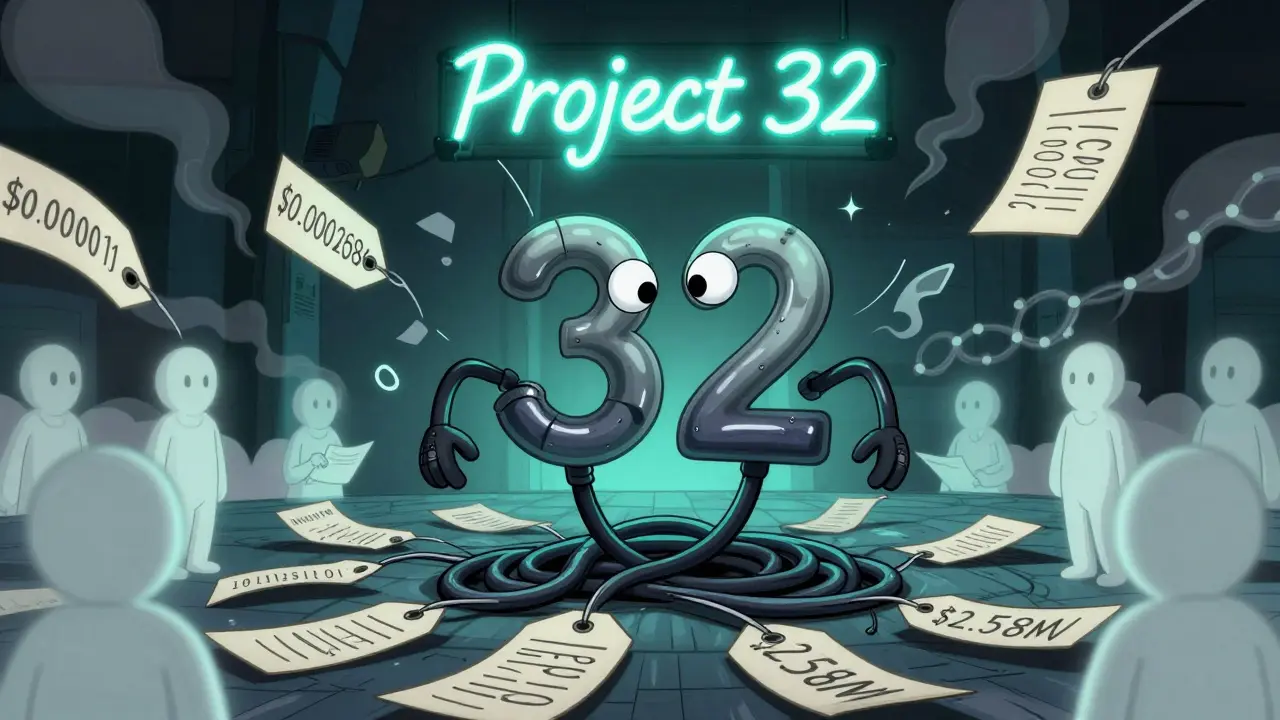
Project 32 (32) sounds like it could be the next big thing in crypto - a simple name, a clean symbol, maybe even a story behind it. But if you dig even a little deeper, you’ll find almost nothing. No team. No whitepaper. No clear blockchain. No real trading volume. Just conflicting numbers on different websites and a whole lot of silence.
There’s no official story behind Project 32
Most legitimate cryptocurrencies have a clear origin. Bitcoin had a whitepaper. Ethereum had Vitalik Buterin. Even small tokens usually have a GitHub repo, a Discord server, or at least a Twitter account. Project 32? Nothing. No founders listed. No roadmap. No development updates since at least 2023. You won’t find a single reliable source explaining what the token is for, who made it, or why it exists.That’s not just unusual - it’s a red flag. The Securities and Exchange Commission (SEC) lists missing team information and no clear utility as top warning signs of a scam. Project 32 checks both boxes.
The price data doesn’t add up
Look at the price numbers from different sites and you’ll think there’s a glitch in the matrix.- Crypto.com says it’s worth $0.00001568
- CoinCodex says it’s $0.052084 - over 3,000 times higher
- CoinGecko shows a trading volume of just $4.44 in 24 hours
- But Crypto.com claims $2.58 million in volume
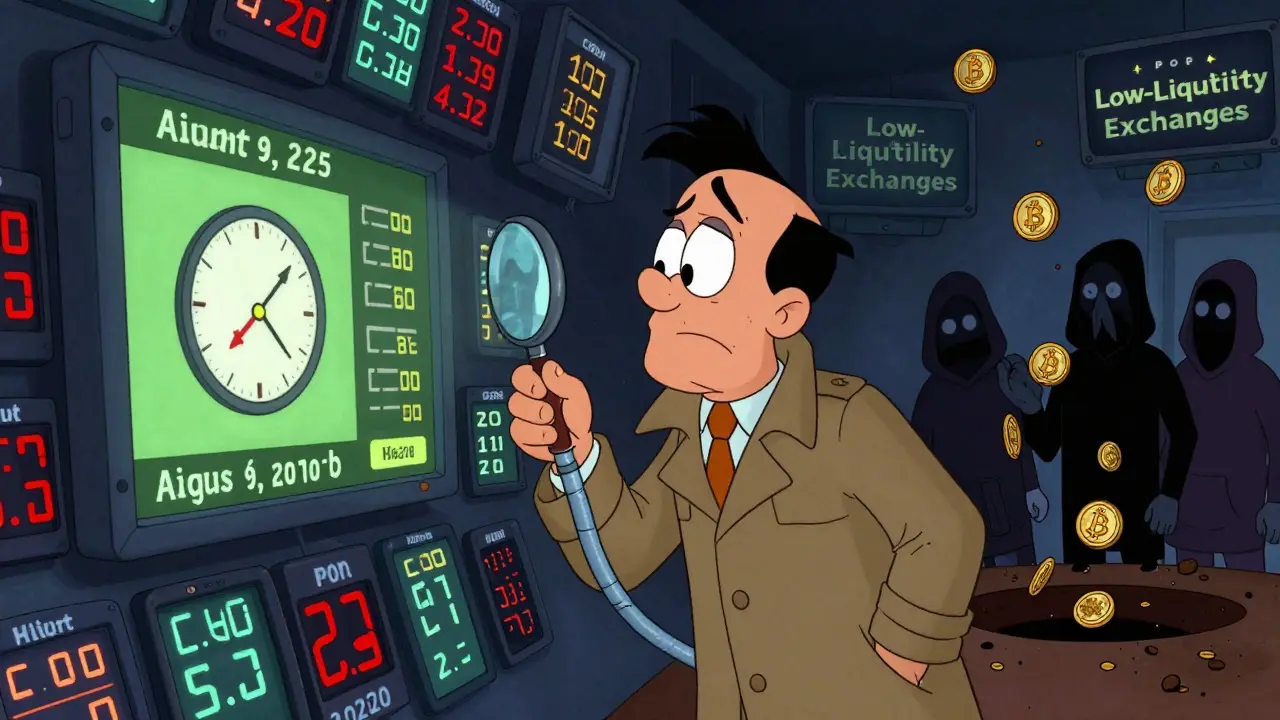
That kind of inconsistency doesn’t happen with real projects. It happens when a token is either being manipulated, misreported, or - more likely - isn’t even a real asset with active trading. Some platforms might be tracking a different token with the same name. Others might be pulling data from low-liquidity exchanges that don’t reflect actual market behavior.
Even weirder? CoinGecko once listed Project 32’s value in Bitcoin as of August 9, 2025 - a date that hadn’t happened yet when the data was supposedly collected. That’s not a typo. That’s a sign the data is either auto-generated, outdated, or fake.
No one’s talking about it
Real crypto projects have communities. Reddit threads. Twitter debates. Telegram groups full of people sharing updates, memes, and trading tips. Search for “Project 32” on any of those platforms. You’ll find almost nothing. No meaningful discussions. No influencers mentioning it. No warnings from experienced traders.Compare that to even obscure tokens like Shiba Inu or Dogecoin in their early days - they had fans, memes, and at least a few developers posting updates. Project 32 has silence. That’s not a quiet success. That’s a dead project.
It doesn’t run on any known blockchain
Every cryptocurrency lives on a blockchain. Bitcoin on Bitcoin’s chain. Ethereum on Ethereum. Most altcoins are built on Ethereum (ERC-20), Binance Smart Chain (BEP-20), or Solana. But no one knows where Project 32 lives. No contract address is publicly verified. No explorer shows its transactions. No wallet supports it officially.If you can’t find the blockchain address, you can’t verify ownership. And if you can’t verify ownership, it’s not really cryptocurrency - it’s just a number on a website.
It breaks basic crypto naming rules
The token’s symbol is just “32.” That’s not a name. It’s a number. All major tokens use letters: BTC, ETH, SOL, ADA, DOGE. Even the most niche tokens have names like $PEPE or $SHIB. “32” is confusing, unbranded, and looks like a placeholder - not a real asset. It’s the kind of thing you’d see on a fake exchange or a bot-generated token list.Why does it even show up on price trackers?
You might wonder: if it’s so questionable, why do sites like Crypto.com and CoinCodex list it at all?Because many price aggregators pull data from dozens of small, unregulated exchanges - some of which are run by anonymous teams. These exchanges list hundreds of fake or low-value tokens to attract traders looking for “the next big thing.” The platforms then scrape those prices and display them as if they’re real. It’s a feedback loop: low volume → inflated prices → more listings → more confusion.
It’s not fraud - at least not always. But it’s not transparency either. It’s noise.
What does this mean for you?
If you’re thinking of buying Project 32, here’s the truth: you’re not investing. You’re gambling. There’s no underlying value. No team to build on it. No community to support it. And no way to know if the price you see today will be the same tomorrow - because the data itself is unreliable.Even if you make a quick profit, you won’t be able to cash out easily. Most major exchanges - Coinbase, Binance, Kraken - don’t list it. You’d have to trade on obscure platforms that could vanish overnight. And if you lose money? There’s no customer support. No recourse. No one to blame but yourself.
Is Project 32 a scam?
It’s not proven to be a scam. But it has every hallmark of one: no transparency, no utility, no team, no community, and wildly inconsistent data. The Bank for International Settlements warned in 2018 about cryptocurrencies that lack stability, security, and accountability. Project 32 fits that description perfectly.Legitimate crypto projects don’t hide. They publish whitepapers. They update GitHub. They answer questions. Project 32 does none of that. And that’s not negligence - it’s a choice.
What should you do instead?
If you’re looking for new crypto opportunities, focus on tokens with:- A clear team with real names and LinkedIn profiles
- A published whitepaper explaining the use case
- Active development on GitHub
- Listing on at least one major exchange (Coinbase, Binance, Kraken)
- Consistent trading volume across multiple platforms
- A community that talks about the tech - not just the price
There are thousands of legitimate small-cap tokens that meet these standards. You don’t need to chase ghosts like Project 32.
Final takeaway
Project 32 (32) isn’t a cryptocurrency. At least, not in any meaningful sense of the word. It’s a data anomaly. A ghost in the machine. A number on a screen with no real world behind it.If you see it pop up on a price tracker, don’t get excited. Don’t buy in. Just close the tab. There’s nothing there worth your time - or your money.
Comments (19)
Tyler Porter
December 24, 2025 AT 00:40
I saw this token pop up on my watchlist and thought, 'Hmm, maybe it's the next big thing?'... Nope. Just a ghost. Closed the tab. Saved my sanity. 😅
Steve B
December 25, 2025 AT 02:49
One must ask, is the absence of information not itself a form of information? The silence surrounding Project 32 speaks volumes, does it not? A metaphysical void masquerading as an asset.
Jake Mepham
December 25, 2025 AT 18:21
Honestly? This is textbook 'don't touch with a 10-foot pole.' I've seen dozens of these ghost tokens. They all start with a clean name and a suspiciously clean chart. Then you dig - and there's nothing. No team, no code, no future. Don't let FOMO trick you into gambling on a spreadsheet.
Jordan Renaud
December 27, 2025 AT 12:37
It's funny how we treat numbers like they have soul. $0.00001568 vs $0.052084 - same symbol, different dreams. But if no one's building, no one's talking, and no one's accountable... it's not a coin. It's a mirage.
Luke Steven
December 27, 2025 AT 13:46
I used to chase these. Thought I’d find the next DOGE in the shadows. Turns out, the shadows are just where scams hide. Now I only look for projects with GitHub commits, real names, and people arguing about tech - not price charts. 🤷♂️
Janet Combs
December 27, 2025 AT 23:41
okay but why does crypto.com even list this?? i thought they were kinda legit?? like i clicked on it by accident and now i feel dirty. why do these sites even exist??
Dan Dellechiaie
December 28, 2025 AT 22:59
The entire crypto data aggregation ecosystem is a Ponzi scheme of metadata. These platforms profit from volume, not truth. Project 32 is just a symptom - the disease is the lack of regulation. You're not being scammed; you're being monetized.
Radha Reddy
December 29, 2025 AT 13:53
This is why I only invest in tokens listed on Binance or Coinbase. No exceptions. If it's not on a major exchange, it's not real. The fact that this token has conflicting prices across platforms says everything you need to know.
Sarah Glaser
December 30, 2025 AT 16:42
The absence of a whitepaper is not negligence - it's a declaration of intent. Legitimate projects publish. Scams vanish. The fact that no one can point to a single developer, contract, or roadmap means this was never meant to be real. It was always meant to be extracted.
roxanne nott
January 1, 2026 AT 04:55
32? Really? That's not a ticker. That's a placeholder for a bot-generated token. I've seen this exact pattern 17 times this year. All vanish within 3 months. Don't waste your time.
Rachel McDonald
January 2, 2026 AT 14:32
I lost $800 on this last year. Thought I was smart. Turned out I was the sucker. Now I just laugh when I see it pop up. You think you're getting in early? Nah. You're just the last one holding the bag. 😭
Collin Crawford
January 3, 2026 AT 03:38
It is imperative to note that the absence of verifiable blockchain infrastructure negates the very ontological classification of Project 32 as a cryptocurrency. One cannot possess what cannot be transacted on a decentralized ledger. Ergo, it is not a currency - it is a statistical artifact.
Jayakanth Kesan
January 4, 2026 AT 02:01
I live in India and I've seen a lot of these fake tokens. People here get excited over anything with a cool symbol. But if you check the contract address? Blank. No one's home. Stick to the big ones - they're boring, but they don't vanish overnight.
Aaron Heaps
January 4, 2026 AT 04:52
The fact that CoinGecko listed a future date? That's not a bug. That's a feature. They're using AI to auto-generate data for low-volume tokens to make their platform look 'comprehensive.' It's a lie dressed as data. Don't trust the numbers.
Tristan Bertles
January 4, 2026 AT 04:54
If you're new to crypto, here's my rule: if you can't find the team's LinkedIn, skip it. If there's no GitHub activity in 6 months, skip it. If the symbol is a number? Run. I've saved myself thousands by just saying no to anything that feels off.
Earlene Dollie
January 5, 2026 AT 16:26
I saw someone post about Project 32 on TikTok saying it's gonna hit $1... I cried. Not because I bought it. Because I knew they were gonna lose everything. This isn't investing. It's a horror movie and we're all the extras.
Dusty Rogers
January 7, 2026 AT 12:32
I used to be the guy who dug into every weird token. Now I just scroll past. The market's full of ghosts. You don't need to chase them. Just hold BTC, ETH, and wait for real projects to emerge. Patience > paranoia.
Melissa Black
January 8, 2026 AT 02:15
The real scandal isn't Project 32. It's that price aggregators are allowed to display unverified, auto-generated data without disclaimers. That's not market transparency - that's systemic deception. Regulators need to shut this down.
Mmathapelo Ndlovu
January 8, 2026 AT 07:07
I'm from South Africa and I've seen this happen over and over. People think crypto is magic. But it's just code. And if there's no code? Then there's nothing. 🌍💔 Don't let hope blind you.