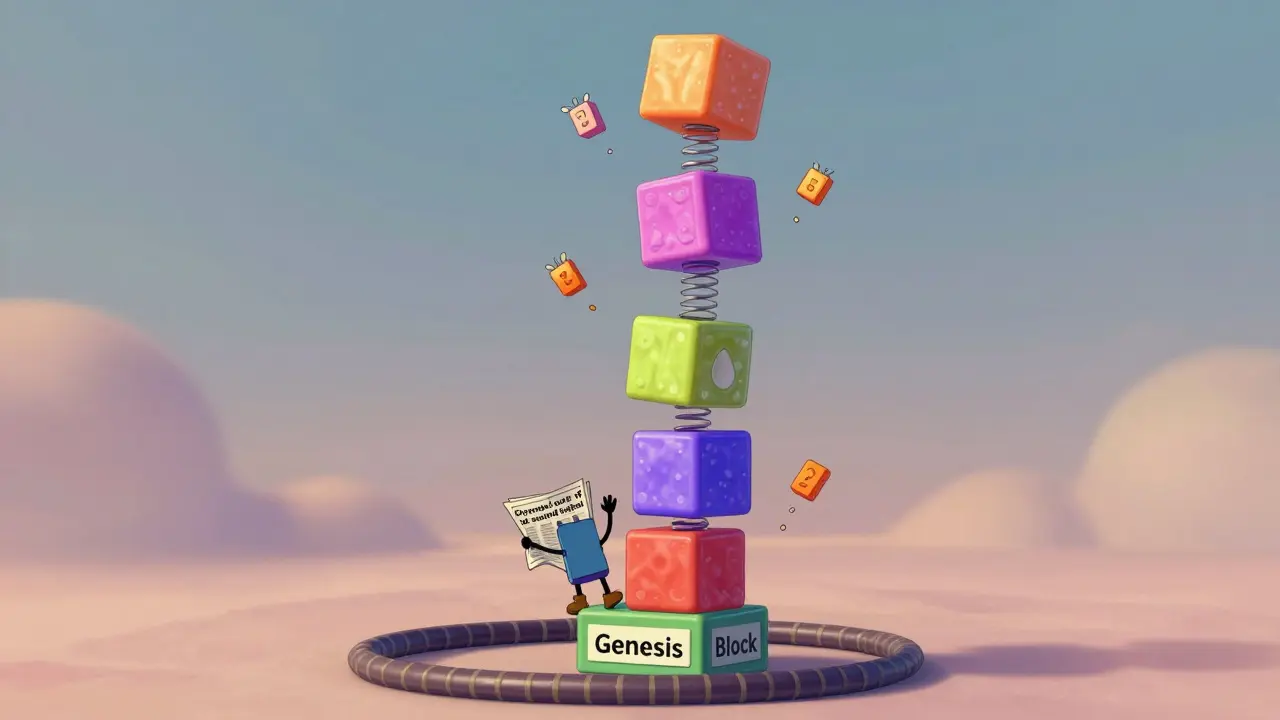
The genesis block is the very first block in any blockchain. Think of it as the foundation of a building - without it, nothing else can stand. It’s not just another block in the chain. It’s the starting point. Every transaction, every subsequent block, every coin ever mined traces its origin back to this one block. In Bitcoin, it was created on January 3, 2009, by Satoshi Nakamoto. That’s when the whole system came to life.
What Makes the Genesis Block Different?
All other blocks in a blockchain link back to the one before them. That’s how the chain stays secure - each block holds a cryptographic fingerprint of the previous one. But the genesis block? It doesn’t point to anything. It has no predecessor. That’s because there was nothing before it. It’s the original. This makes it unique. It’s hardcoded into the software of every node on the network. You can’t change it. You can’t delete it. You can’t rewrite it. It’s permanent.
The Bitcoin genesis block has a hash: 000000000019d6689c085ae165831e934ff763ae46a2a6c172b3f1b60a8ce26f. That’s its fingerprint. It’s been the same since day one. If anyone tried to alter even one byte of data in that block, every single block after it would break. The whole chain would be invalid. That’s the power of this one block.
What’s Inside the Genesis Block?
The genesis block isn’t just empty space. It carries real data. In Bitcoin’s case, it included the first ever Bitcoin transaction - a reward of 50 BTC. But here’s the twist: that 50 BTC was never spendable. It’s locked forever. Why? Because the network rules didn’t allow it. That’s intentional. It wasn’t about making money. It was about proving the system worked.
It also contains the timestamp: January 3, 2009. That’s not just a date. It’s a statement. Right above it, in the coinbase transaction, was a headline from The Times: "The Times 03/Jan/2009 Chancellor on brink of second bailout for banks." That message wasn’t random. It was a protest. A declaration that Bitcoin was built to fix a broken financial system.
The genesis block also sets the network’s rules. It defines the difficulty level for mining. It sets the maximum block size. It tells the network how transactions should be validated. Everything else follows from this block. It’s like the constitution of a country - everything else is built on top of it.
Why Does It Matter?
Without the genesis block, there’s no blockchain. No trust. No history. No way to verify that a transaction is real. Every time you send Bitcoin or check your balance, your wallet is checking that every block in the chain leads back to this one. That’s how you know you’re not being lied to. That’s how decentralization works. No bank. No government. Just math and code.
It also stops fraud. If someone tried to fake a transaction from 2010, they’d have to rewrite every block after that - all the way back to the genesis block. And because each block is chained with cryptographic hashes, that would take more computing power than the entire Bitcoin network combined. It’s impossible. That’s why the genesis block is the ultimate anchor.

Other Blockchains, Other Genesis Blocks
Bitcoin wasn’t the only one. Every blockchain has its own genesis block. Ethereum’s was created in 2015. It didn’t just start with a message - it launched with a public sale. People bought Ether before the network even went live. Those early buyers got their tokens from the genesis block’s allocation. That’s how Ethereum began - not with mining, but with community funding.
Some blockchains embed jokes, quotes, or even memes. Litecoin’s genesis block has a message from its creator: "The Bitcoin network is not dead. It’s evolving." Monero’s genesis block includes a timestamp from 2014, right after its launch. Each one tells a story.
Even enterprise blockchains like those built by IBM or Walmart have their own genesis blocks. They’re not public like Bitcoin’s, but they still exist. They define the rules for internal supply chains, inventory tracking, or payment logs. The structure is the same - just customized.
How Is It Created?
The genesis block isn’t mined like other blocks. It’s written by the creator before the network launches. It’s baked into the software. When the first node starts up, it checks: "Is this the right genesis block?" If the hash matches what’s hardcoded, the network accepts it. If not, it rejects the chain. This is how nodes agree on the truth - they all start from the same origin.
That’s why you can’t just create a new blockchain by copying code. You need to define your own genesis block. You need to set your own rules. You need to choose your own timestamp and your own message. That’s why every blockchain is different. Even if they’re built from the same codebase, their genesis blocks make them unique.
What Happens If the Genesis Block Is Lost?
You can’t lose it. It’s not stored on a server. It’s not in a cloud. It’s copied onto every single node that runs the software. There are millions of them. Even if every copy vanished tomorrow, the code would still be out there. Someone would just restart the network with the original genesis block. It’s designed to survive.
That’s the beauty of decentralization. No single point of failure. No central authority. Just a shared truth, anchored in one unchangeable block.
The Future of the Genesis Block
As blockchain tech grows, so does the genesis block’s role. New blockchains are being built with quantum-resistant cryptography in mind. That means future genesis blocks might include math that’s safe even if quantum computers break today’s encryption. It’s not needed yet - but it’s being planned.
Some developers are even experimenting with multi-chain genesis blocks - where one block can serve as the root for several parallel chains. That’s still experimental, but it shows how foundational this idea is. The genesis block isn’t just history. It’s the blueprint for what’s next.
Why You Should Care
You don’t need to be a coder to understand the genesis block. But if you use crypto, you’re living with its legacy. Every time you send money, check your balance, or trade a coin, you’re relying on that first block from 2009. It’s what makes crypto trustless. It’s what makes it secure. It’s what makes it possible.
The genesis block is more than code. It’s a promise. A promise that a system can exist without middlemen. That value can be transferred without permission. That history can’t be erased. And it all started with one block - silent, unchangeable, and unforgettable.
Is the genesis block the same for every blockchain?
No. Every blockchain has its own unique genesis block. Bitcoin’s is different from Ethereum’s, Litecoin’s, or any private enterprise chain. Each one has its own hash, timestamp, and embedded data. The structure is similar, but the content is always customized to the network’s purpose.
Can the genesis block be changed after creation?
No. The genesis block is hardcoded into the software of every node on the network. If you change it, the network rejects it. That’s why it’s immutable. Even if you had control of 99% of the nodes, you still couldn’t alter the genesis block without breaking the entire chain. It’s designed to be permanent.
Why is the Bitcoin genesis block’s message important?
The message - "The Times 03/Jan/2009 Chancellor on brink of second bailout for banks" - was a political statement. It showed that Bitcoin was created as a response to financial instability. It wasn’t just a technical experiment. It was a rebellion. That message is why Bitcoin isn’t just currency. It’s a movement.
Do all genesis blocks contain transactions?
Most do, but not all. Bitcoin’s genesis block had a coinbase transaction with 50 BTC, but those coins can’t be spent. Ethereum’s genesis block allocated Ether to early contributors. Some newer blockchains start with empty blocks - no transactions at all - just the network’s rules. It depends on the design.
What happens if the genesis block hash doesn’t match?
If a node detects that the genesis block hash doesn’t match what’s hardcoded in its software, it refuses to connect to the network. It assumes the chain is fake or corrupted. This is how nodes verify authenticity from the very first step. No genesis block match = no network access.
Can a blockchain exist without a genesis block?
No. A blockchain must have a starting point. Without a genesis block, there’s no origin, no chain, and no way to verify history. Even private or permissioned blockchains - like those used by banks or corporations - still require a genesis block. It’s not optional. It’s fundamental.
Comments (11)
Tracy Peterson
March 2, 2026 AT 20:19
This isn't just code. It's a revolution wrapped in cryptography. The genesis block is the first act of defiance against a system that rigged itself. They printed money while people starved. Satoshi didn't just build a ledger - they built a middle finger to Wall Street. And that message? The Times headline? That's the soul of Bitcoin. No bank. No bailouts. Just math and morality.
People talk about decentralization like it's a feature. It's not. It's a revolution. And it started with one block that said: 'We're done waiting.'
KingDesigners &Co
March 4, 2026 AT 14:43
lol. genesis block = hardcoded truth. you can't change it. you can't fake it. it's the only thing in crypto that actually works. everything else is just noise. blockchain is just a fancy database. but the genesis block? that's the one thing that makes it real. no one can touch it. no one can rewrite it. that's power.
Felicia Eriksson
March 4, 2026 AT 21:18
I love how something so simple - one block - holds the whole thing together. No drama. No hype. Just a timestamp and a message. It’s quiet. But it’s everything.
aaron marp
March 5, 2026 AT 10:43
What’s wild is how many people think blockchain is about transactions. Nah. It’s about trust. And trust starts with the genesis block. Every node, every miner, every wallet - they all agree on that one unchangeable truth. That’s not tech. That’s philosophy. And it’s beautiful. If you want to understand crypto, stop chasing the next coin. Go back to block 0. That’s where the soul is.
Patrick Streeb
March 6, 2026 AT 15:54
The genesis block constitutes the foundational ontological anchor of the blockchain protocol. Its immutability is not merely a technical constraint but a socio-technical covenant between distributed agents. The embedded timestamp serves as both a historical marker and a performative utterance, establishing temporal sovereignty independent of centralized institutions. One might argue that its cryptographic integrity represents the first instance of verifiable consensus in human history.
Alyssa Herndon
March 7, 2026 AT 15:03
I think about how quiet that block was. No fanfare. No press release. Just code. And now look at it. It’s the reason we can even have this conversation. No one asked for permission. They just started. That’s all it took.
Ifeanyi Uche
March 8, 2026 AT 08:39
fr tho the genesis block is just a joke. satoshi was a bot. the times headline? that was a meme. the 50btc? never spent. so its not even real money. its all just a psyop. they want you to believe in a digital ghost. but its just code. no one owns it. no one controls it. so why care? its a ghost story with a blockchain.
Jeff French
March 10, 2026 AT 06:47
The genesis block’s coinbase transaction is a null output with a fixed nonce and a zero merkle root. It’s a genesis UTXO with a hardcoded scriptPubKey. The timestamp is embedded in the block header’s nTime field. The message is a coinbase input script with a 76-byte payload. It’s not symbolic - it’s protocol. The fact that it’s unspendable is a consensus rule, not a design flaw. This is how the network bootstraps - through deterministic initialization.
Elana Vorspan
March 10, 2026 AT 19:26
i just cried a little reading this. 🥹 it’s wild to think that one quiet block started a whole new way of thinking about money. no one asked permission. no one got a grant. just code. a message. and a belief. we’re all standing on that block. thank you, satoshi.
Kenneth Genodiala
March 10, 2026 AT 21:51
Ah, the genesis block. The sacred relic of the crypto cult. How quaint. You all worship a timestamp and a headline from 2009 like it’s scripture. Meanwhile, the real innovation is in Layer 2 solutions, ZK-Rollups, and cross-chain bridges. But no - you’re all too busy genuflecting before a hash to notice the future is already here.
Michael Rozputniy
March 11, 2026 AT 13:14
what if the genesis block was planted by the feds? the times headline? too perfect. the 50btc never spent? too convenient. the timestamp? aligned with the bailout. this is a psyop. they want us to think we’re free. but the chain is still controlled. the nodes are monitored. the code is written by insiders. they built the myth so we’d stop fighting the system. we’re still in the matrix.