Singapore Crypto Tax Calculator
Calculate your potential capital gains tax savings when trading crypto in Singapore compared to other countries. Singapore offers zero capital gains tax on crypto transactions, unlike most other jurisdictions.
Your Tax Savings
| Jurisdiction | Tax Rate | Estimated Tax | Annual Savings |
|---|---|---|---|
| Singapore | 0% | $0 | $0 |
| United States | 37% | $0 | $0 |
Why Singapore Wins: Singapore's government doesn't tax capital gains from crypto trading, staking, or mining. This policy has attracted major institutions like BlackRock and Coinbase to establish operations here.
Compare with US (capital gains tax up to 37%) or Germany (45% tax on profits over €1,000).
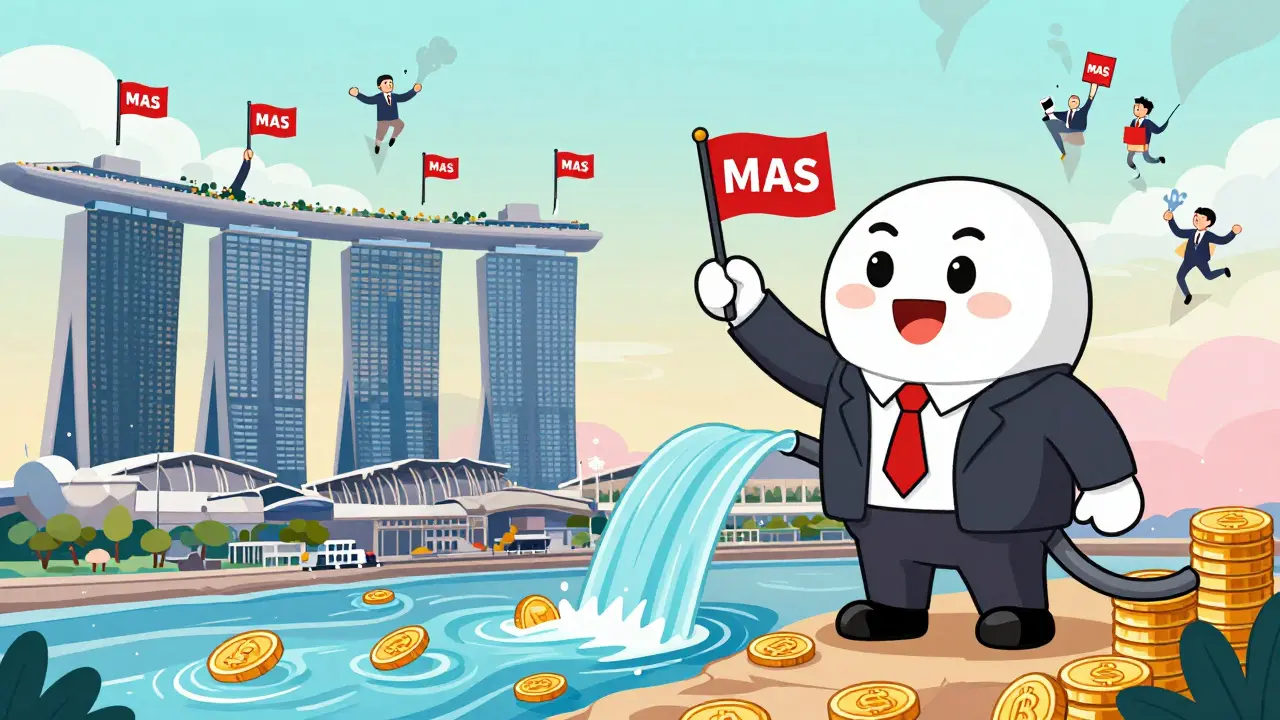
When you think of crypto hubs, you might picture San Francisco startups or Dubai’s free zones. But the real powerhouse in Asia isn’t where you’d expect. Singapore isn’t just open to crypto-it’s built an entire financial ecosystem around it, even while enforcing some of the strictest rules in the world. How? Because it didn’t try to ban crypto. It decided to control it-better than anyone else.
Regulation That Works
Singapore’s Monetary Authority (MAS) doesn’t say ‘no’ to crypto. It says ‘here’s how to do it right.’ Unlike places that shut down unlicensed firms overnight, Singapore gave companies a clear path: get licensed, follow the rules, or leave. By June 30, 2025, every crypto business operating in Singapore had to be licensed-or shut down. Over 120 firms complied. Others vanished. That’s not chaos. That’s cleanup.The result? 83% of Fortune 500 companies running blockchain pilots in Asia do so under MAS-approved frameworks. That’s not luck. That’s trust. Institutions don’t gamble with billions unless they know exactly what’s allowed. MAS gives them that clarity. Tokenized assets? Allowed. Stablecoin issuance? Regulated. Custody services? Licensed. No gray areas. No surprises.
The Stablecoin Powerhouse
Singapore isn’t just a place where people trade Bitcoin. It’s where trillions move in digital dollars. Between June 2024 and June 2025, $2.4 trillion in stablecoin activity flowed through Asia-and over half of it touched Singapore. That’s more than any other Asian country. More than Hong Kong. More than South Korea.The top route? Singapore to China. Businesses use stablecoins to pay suppliers, settle invoices, and move money across borders without waiting days for bank transfers. Wetrip, a Singapore travel agency, now lets customers pay for luxury tours in USDC. Capella Hotels accept DAI for bookings. Ginza Xiaoma, a high-end reseller, uses stablecoins to buy rare watches from Japan. These aren’t fringe experiments. They’re daily operations.
Corporate stablecoin use jumped from under $100 million in early 2023 to over $3 billion by early 2025. That’s a 30x increase in two years. And it’s not just small players. Circle, the company behind USDC, opened its first Asian office in Singapore in May 2025. Why? Because MAS gave them a clear license to operate-and a stable legal environment to scale.
Taxes That Attract Millionaires
If you make money trading crypto in Singapore, you pay zero tax on it. No capital gains tax. No tax on staking rewards. No tax on mining. Not even on crypto-to-crypto trades. Compare that to the U.S., where the IRS treats crypto like property, or to Germany, where holding for over a year still triggers tax on profits over €1,000.This isn’t a loophole. It’s policy. Singapore’s government doesn’t tax speculative gains. It taxes income. If you’re running a crypto business and earning salaries or dividends, you pay corporate tax. If you’re just holding and trading? You keep it all. That’s why top crypto founders moved here. Gary Or and Bobby Bao from Crypto.com. Changpeng Zhao from Binance. Rafael Melo. They didn’t just open offices-they relocated families. Why? Because their wealth grows faster here.

Institutional Trust on Steroids
BlackRock didn’t pick Singapore by accident. The world’s largest asset manager chose it as its Asian tokenization hub. Why? Because Singapore’s infrastructure lets them turn real estate, bonds, and private equity into digital tokens-and sell them to investors globally, legally and securely.SWIFT, the global banking network, is testing CBDC bridges with Singaporean banks. That means central bank money from Singapore, China, and other countries could one day move instantly between each other-no intermediaries. That’s not science fiction. It’s being tested in labs right now.
Sky Wee, managing partner at Sky Ventures, put it simply: “Singapore has achieved what no other crypto hub has: institutional trust at scale.” Other places talk about being crypto-friendly. Singapore proves it. Banks, hedge funds, and sovereign wealth funds don’t just visit. They build headquarters here.
The World’s Biggest Crypto Event
TOKEN2049 Singapore 2025 wasn’t just another conference. It sold out. 25,000 people from 160 countries. 500+ exhibitors. 300+ speakers. The event filled all five floors of Marina Bay Sands. Sponsors included Coinbase, OKX, Bitget, TRON, and DWF Labs-every major name in crypto.This isn’t a marketing stunt. It’s a signal. When the entire industry shows up in one place, it’s because that place matters. Tokyo? Too strict. Dubai? Too flashy. Seoul? Too volatile. Singapore? It’s the only place where a founder can walk into a bank, explain their tokenized bond project, and get a meeting with a senior executive-not a lawyer.

What’s Next? Tokenizing Everything
Singapore isn’t stopping at payments. It’s building the future of finance. Tokenized real-world assets-like real estate, art, and even carbon credits-are expected to unlock $2 trillion in value by 2030. Goldman Sachs and BlackRock are already testing how to turn office buildings into digital shares. A Singaporean startup just tokenized a 10-story commercial tower and sold 5% of it to 1,200 investors via blockchain.Public services are getting in on it too. The government is piloting digital IDs tied to crypto wallets for healthcare access and tax filings. Imagine logging into your medical records with your wallet instead of a password. It’s not sci-fi. It’s coming by 2027.
Who’s Left Behind?
The flip side? Singapore’s rules aren’t for everyone. If you’re a decentralized exchange that doesn’t want KYC, you’re out. If you’re a meme coin project with no whitepaper, you’re banned. If you’re trying to run a peer-to-peer crypto exchange without a license? You’ll get fined-or shut down.That’s the trade-off. Singapore doesn’t want chaos. It doesn’t want pump-and-dump schemes. It wants institutions to feel safe. And for that, it’s willing to turn away the noise. The result? A crypto ecosystem that’s smaller than Dubai’s, but 10x more valuable.
Why This Matters
Most countries treat crypto like a problem to solve. Singapore treats it like infrastructure to build. It didn’t wait for the world to catch up. It built the roads, the traffic lights, and the toll booths first. And now, the world’s biggest players drive on them.Millennials and Gen Z in Singapore are adopting crypto at three times the rate of older generations. They’re not just buying Bitcoin. They’re using DeFi to earn interest, trading NFTs as digital collectibles, and holding tokenized stocks. This isn’t speculation-it’s a new way of managing money.
By 2030, Singapore won’t just be Asia’s crypto hub. It’ll be the model for how a country balances innovation and control. Other nations will look at its licensing system, its tax rules, its institutional partnerships-and try to copy them. But they won’t have the same clarity. Or the same trust.
Singapore didn’t become the top crypto hub by being the most permissive. It became the top hub by being the most predictable.
Is crypto legal in Singapore?
Yes, crypto is fully legal in Singapore. The Monetary Authority of Singapore (MAS) regulates it under the Payment Services Act. You can buy, sell, trade, and hold crypto without restrictions. However, all businesses offering crypto services-exchanges, custodians, payment providers-must be licensed by MAS. Individuals face no legal barriers.
Does Singapore tax crypto gains?
No, Singapore does not tax capital gains from crypto trading, staking, or mining. The government only taxes income-like salaries, business profits, or dividends. If you’re an individual buying and selling Bitcoin, you keep 100% of your profits. This makes Singapore one of the most tax-friendly jurisdictions in the world for crypto investors.
Why are so many crypto companies moving to Singapore?
Because Singapore offers regulatory clarity, zero capital gains tax, and access to institutional capital. Unlike places with vague rules or sudden crackdowns, MAS provides clear licensing paths. Companies like Crypto.com, Circle, and Binance relocated leadership teams here because they can operate without fear of sudden policy shifts. Plus, Singapore’s location connects them to China, Southeast Asia, and global markets.
Can I open a crypto business in Singapore?
Yes, but you need a license from MAS. The process requires proof of financial stability, anti-money laundering controls, cybersecurity measures, and a local operational presence. The application takes 6-12 months. Many startups fail because they underestimate the compliance burden. But once licensed, you gain access to banks, institutional clients, and global partners that won’t touch unlicensed firms.
What’s the difference between Singapore and Dubai as crypto hubs?
Dubai is more open to speculative activity and attracts retail traders with flashy marketing. Singapore targets institutions with strict rules. Dubai has lower licensing costs but less banking access. Singapore has higher entry barriers but connects you to global banks, BlackRock, SWIFT, and Fortune 500 companies. If you want scale and credibility, Singapore wins. If you want speed and hype, Dubai might suit you better.
Is Singapore’s crypto dominance sustainable?
Yes. Singapore isn’t relying on hype. It’s building infrastructure: tokenized assets, CBDC bridges, digital IDs, and institutional-grade custody. The $2 trillion real-world asset tokenization opportunity by 2030 is backed by Goldman Sachs and BlackRock. Even if crypto prices drop, the underlying systems-secure, regulated, and bank-integrated-will keep growing. Singapore’s edge isn’t price. It’s permanence.
Comments (13)
Elvis Lam
December 16, 2025 AT 07:35
Singapore didn't win because it's permissive-it won because it's precise. MAS didn't just create rules; they built a legal architecture that institutions can bank on. No guesswork. No regulatory whiplash. When BlackRock and SWIFT choose your country as their tokenization hub, you're not a hotspot-you're the standard. Other nations are still debating whether crypto is real. Singapore already built the highway and painted the lanes.
Amy Copeland
December 17, 2025 AT 15:07
Oh please. You're telling me a place that bans meme coins and demands KYC on every crypto transaction is "innovative"? That's not a hub-it's a financial zoo where only the tamest animals get fed. Real innovation thrives in chaos, not compliance checklists. You call this leadership? I call it corporate babysitting.
Rebecca Kotnik
December 19, 2025 AT 14:27
While the article paints a compelling picture of institutional dominance, it omits the human cost of this model: the thousands of independent developers, DeFi pioneers, and small DAOs who simply cannot afford the 12-month licensing process or the six-figure compliance overhead. Singapore's success is not a universal blueprint-it's a gated community for capital, not creativity. The $2 trillion in tokenized assets? Likely owned by fewer than 200 entities. Meanwhile, the grassroots builders who first believed in blockchain are being priced out by the very system that now claims to champion it.
Regulation without inclusion is not progress-it's consolidation. And history shows us that when innovation becomes the exclusive domain of institutions, it eventually stagnates. The real question isn't whether Singapore is the most predictable hub-it's whether predictability is the highest value we should be optimizing for in a decentralized world.
Jonny Cena
December 20, 2025 AT 22:39
Let’s not forget the people behind all this. The engineers in Singapore who coded the stablecoin bridges. The compliance officers who stayed up till 3 a.m. to meet MAS deadlines. The small fintechs that pivoted from unlicensed chaos to licensed legitimacy. This isn’t just about policy-it’s about grit. Singapore didn’t get here by accident. It got here because people showed up, did the work, and played by the rules-even when it was hard. That’s the real story.
Patricia Amarante
December 21, 2025 AT 10:37
Stablecoins for hotel bookings? Yes please. I paid for my Bali trip in USDC last month-no fees, instant. Singapore’s actually doing it right.
Samantha West
December 21, 2025 AT 15:38
It’s fascinating how everyone praises Singapore’s control yet ignores the elephant in the room-the fact that this entire ecosystem is built on the backs of Chinese capital and cross-border regulatory arbitrage. The $2.4 trillion in stablecoin activity? Most of it isn’t Singaporean-it’s Chinese businesses using Singapore as a laundering conduit to bypass capital controls. MAS isn’t regulating crypto-it’s enabling a shadow financial system under the guise of legitimacy
And don’t get me started on the zero capital gains tax. That’s not policy-it’s a tax haven dressed in a suit. The government pretends it’s about attracting innovation when really it’s about attracting oligarchs who want to hide wealth without the hassle of audits
The truth? Singapore is the most sophisticated tax evasion platform in Asia and everyone’s too polite to say it out loud
Timothy Slazyk
December 22, 2025 AT 09:40
There’s a deeper philosophical tension here that the article sidesteps: Is decentralization compatible with state control? Singapore didn’t tame crypto-it domesticated it. It took a technology born from distrust of institutions and turned it into another instrument of institutional power. The result is not freedom-it’s order. And while order is efficient, it is also sterile. The original promise of blockchain was to remove intermediaries. Singapore didn’t remove intermediaries-it replaced them with a better-regulated one. Is that progress? Or just a more elegant cage?
Perhaps the real innovation isn’t tokenized real estate or CBDC bridges-it’s the quiet, systemic betrayal of crypto’s founding ethos. We wanted permissionless finance. What we got was permissioned finance with better branding.
Donna Goines
December 24, 2025 AT 03:56
Wait a minute-MAS is "regulating" crypto but the U.S. IRS treats it like property? That’s not regulation-that’s a trap. And don’t tell me about "trust" when the same government that gave us the SEC’s crypto crackdown is now cozying up to BlackRock. This whole thing is a psyop. Singapore is being used as a front for global financial elites to launder crypto into the traditional system. They’re not building infrastructure-they’re building a bridge to the old world so they can burn it down from the inside
And the zero tax? That’s a trap for retail investors. They think they’re getting rich, but they’re just fueling a system that will collapse when the CBDCs go live. You think they’re letting you keep your gains? You’re just the sheep being fattened for the slaughter
They’re tokenizing everything because soon, everything will be monitored. Your digital ID tied to your wallet? That’s not convenience-that’s surveillance. And you’re celebrating it
Wake up. This isn’t the future of finance. It’s the final stage of financial colonization.
Sean Kerr
December 24, 2025 AT 13:08
bro i just used DAI to pay for my coffee in sg last week and it was smoother than apple pay 😍 no fees no wait no bs. this is the future and you haters are still stuck in 2017 thinking crypto = gambling. grow up. 🚀💸
Kelsey Stephens
December 25, 2025 AT 16:48
I love how Singapore proves you don’t need to be wild to be innovative. It’s not about being the loudest-it’s about being the most reliable. I’ve seen too many crypto projects crash because they couldn’t get a bank account. Singapore gives them a seat at the table. That’s not boring-that’s brilliant.
Abby Daguindal
December 26, 2025 AT 06:56
Interesting how the article ignores the fact that Singapore’s entire crypto dominance is built on the assumption that the U.S. dollar will remain the global reserve currency. What happens when that collapses? All these stablecoins and tokenized assets become digital ghosts. This isn’t a model-it’s a bet on American hegemony.
Mark Cook
December 27, 2025 AT 09:59
Wait… so Singapore is the crypto hub because it bans memes and forces KYC? That’s not a hub-that’s a bank branch with a blockchain sticker on it. Dubai at least lets you have fun. Singapore just lets you file forms. 🤡
Jack Daniels
December 27, 2025 AT 22:03
I read this whole thing and I just feel… empty. Like I’ve been sold a dream that’s already been packaged and sold to hedge funds. I miss when crypto felt like a rebellion. Now it just feels like another corporate conference with better Wi-Fi.