
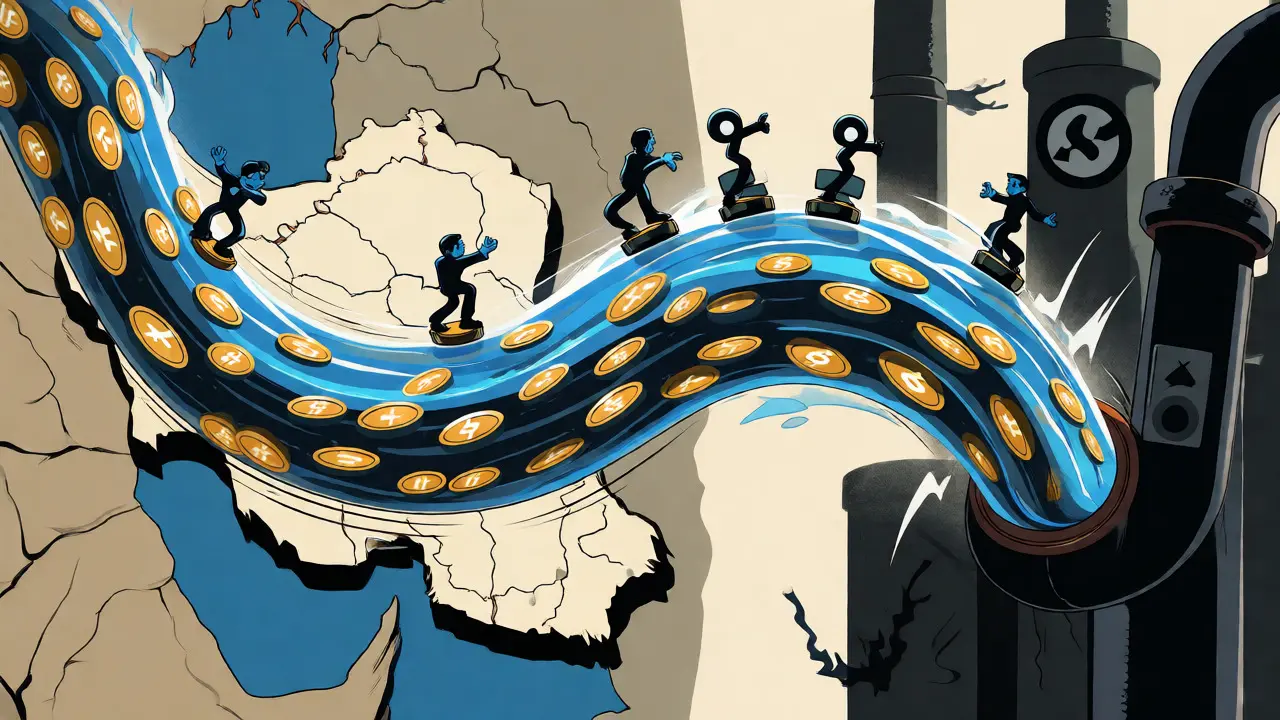
Imagine watching your life savings evaporate by nearly 90% in just a few years. That is the reality for millions of Iranians since U.S. sanctions intensified in 2018. But they didn't just watch it happen. In 2024 alone, they moved $4.18 billion into cryptocurrency. This wasn't some shadowy government plot to fund missiles. It was ordinary people-teachers, shop owners, students-scrambling to save what they could. The data comes from Chainalysis, a blockchain analytics firm that tracks digital money flows globally. Their report reveals a staggering 70% year-over-year increase in capital flight. This surge tells us something profound about trust, technology, and survival.
Why Regular Iranians Are Choosing Bitcoin Over Banks
You might assume this massive movement of funds was driven by state actors trying to dodge sanctions. Think again. Chainalysis researchers found that the bulk of these transactions came from everyday citizens. They were reacting to two crushing pressures: hyperinflation and geopolitical fear. With inflation rates hovering between 40-50%, holding the Iranian rial felt like holding an ice cube in a sauna. It melts fast. So, when tensions with Israel spiked in April and October 2024, people didn't wait for banks to open. They used mobile apps to convert rials into Bitcoin and stablecoins within hours.
This behavior mirrors what we saw in Venezuela during its economic crisis, but on a larger scale. Iran's outflows exceeded Venezuela's peak periods significantly. Why? Because the infrastructure was there. Domestic exchanges like Nobitex, Wallex, and Ramzinex had already built a user base. When the panic hit, these platforms became lifelines. Users reported using Telegram channels with over 100,000 members to share tips on how to access international exchanges via VPNs. It’s a grassroots financial revolution born out of necessity.
The Technical Reality Behind the $4.18 Billion Move
How do you track billions in digital assets moving across borders? You look at the patterns. Chainalysis identified specific spikes in transaction volumes that correlated perfectly with real-world events. For instance, on April 9th and 14th, 2024, right after the Israeli bombing of the Iranian Embassy in Damascus, crypto activity surged. Google Trends data confirmed this, showing global search peaks for 'Iran Israel' on those exact dates. People were buying Bitcoin as a hedge against immediate conflict.
Interestingly, smaller transactions under $1,000 saw the steepest decline in platform access later in the year. This indicates that retail investors were being squeezed out first. Large institutional movements continued, but the average person faced increasing friction. Compliance measures tightened, and direct access to international exchanges dropped. Yet, the total volume remained high because users got creative. They used decentralized platforms and sophisticated routing techniques to keep their money flowing. It’s a cat-and-mouse game where the mice are getting faster.
Sanctions Evasion or Financial Survival?
Traditional narratives often paint sanctioned countries as hubs for illicit finance. North Korea, for example, uses crypto largely for state-sponsored hacking and theft. Russia has used it for broader sanctions circumvention. But Iran’s case is different. The primary driver here is wealth preservation. Kim Grauer, Director of Research at Chainalysis, noted that this activity reflects "deepening distrust in government" rather than coordinated evasion. Citizens aren't trying to help the regime bypass rules; they're trying to escape them.
This distinction matters for policymakers. If the goal of sanctions is to pressure the government, does citizen-led crypto adoption undermine that? Or does it simply highlight the human cost? The Treasury Department’s Office of Foreign Assets Control (OFAC) documented evolving techniques in their 2025 enforcement actions. They noted that detecting Iranian transactions is harder now due to privacy-focused tools. But blocking every small transfer is practically impossible. The system is too big, too distributed, and too motivated by basic survival instincts.
Comparing Iran’s Crypto Strategy to Other Sanctioned Nations
To understand the scale, let’s look at the numbers side-by-side. While Russia also increased crypto usage, Iran’s outflows were proportionally higher relative to its GDP. Venezuela offers the closest parallel in terms of citizen-driven adoption, but Iran’s ecosystem is more mature. Let’s break down the key differences:
| Country | Primary Driver | Key Asset Type | Infrastructure Status |
|---|---|---|---|
| Iran | Wealth preservation & inflation hedge | Bitcoin & Stablecoins | Mature domestic exchanges (Nobitex, Wallex) |
| Russia | Sanctions circumvention & trade | Stablecoins & BTC | Growing regulatory framework |
| Venezuela | Hyperinflation survival | USDT (Tether) | Fragmented, informal networks |
| North Korea | State revenue & illicit activities | Mixed (often stolen funds) | Limited public access |
Notice the infrastructure column. Iran developed centralized exchanges that operated domestically until late 2024. This allowed for smoother onboarding compared to Venezuela’s peer-to-peer chaos. However, the Iranian Central Bank imposed strict licensing requirements, mandating user data submission. This created a privacy paradox: users needed crypto for freedom but had to surrender personal details to use local platforms. Many opted for international exchanges via VPNs to avoid this surveillance.

The Human Cost of Digital Migration
Data points are cold, but stories are warm. On Persian-language Reddit forums, you’ll find threads titled "Should I sell my house for Bitcoin?" These aren't speculators chasing moonshots. They are families trying to keep up with grocery prices that double every few months. One user described converting life savings to Bitcoin during a spike where inflation hit 50%. Another mentioned using crypto to pay tuition abroad when wire transfers were blocked for weeks.
Small business owners face similar hurdles. Importing goods requires hard currency. Traditional banking channels are clogged or non-existent. So, merchants use crypto to settle payments through intermediary countries. It’s messy, risky, and involves learning new tech quickly. Community feedback suggests it takes 2-4 weeks to master basic transactions, but months to feel confident in advanced strategies. The learning curve is steep, but the alternative-losing everything-is worse.
What Comes Next for Iran’s Digital Economy?
The trend isn’t slowing down. Chainalysis predicts continued growth in outflows through 2025-2026. Why? Because the root causes remain. Sanctions show no sign of lifting soon. Inflation remains stubbornly high. And the government’s contradictory stance-restricting citizen access while promoting state digital currencies-creates confusion. Meanwhile, the global crypto market cap exceeded $2.3 trillion during peak outflow periods, providing ample liquidity for these moves.
Regulators are scrambling. The G7 and FATF frameworks aim to close loopholes, but decentralized technology evolves faster than bureaucracy. Privacy coins and mixing services make tracking increasingly difficult. The precedent set by Iran suggests that traditional sanctions have diminishing returns in the digital age. Money finds a way, especially when people believe their bank account is sinking.
Who was primarily responsible for the $4.18 billion crypto outflows from Iran?
According to Chainalysis reports, the outflows were primarily driven by ordinary Iranian citizens seeking to preserve their wealth against hyperinflation and geopolitical instability, rather than state-sponsored illicit activities. This represents a grassroots effort at financial survival.
Which cryptocurrencies did Iranians prefer during the 2024 outflows?
Bitcoin dominated the outflow composition, particularly during crisis periods. Stablecoins were also popular for their stability against the volatile Iranian rial, serving as a digital dollar equivalent for many users.
How did geopolitical events influence crypto transaction volumes in Iran?
Transaction volumes spiked sharply during periods of heightened military tension, such as the April 2024 embassy bombing and the October 2024 escalations. These events triggered immediate reactive capital flight as citizens sought safe-haven assets.
What challenges did Iranian users face when accessing international exchanges?
Users faced declining direct access due to tightening compliance measures. Many relied on VPN services and proxy connections to reach global platforms. Additionally, domestic exchanges imposed strict data submission requirements, raising privacy concerns.
How does Iran's crypto adoption compare to other sanctioned nations?
While Russia and Venezuela also utilize crypto, Iran's outflows were proportionally higher relative to GDP and featured a more mature domestic exchange infrastructure. Unlike North Korea's state-centric model, Iran's adoption was largely citizen-driven.