
Imagine walking into a busy stock market floor where brokers shout prices and match buyers with sellers. Now imagine walking into a vending machine where you insert cash and get a snack at a fixed price determined by how many snacks are left. These two scenarios perfectly illustrate the battle between Order Book and Automated Market Maker (AMM) trading models. One relies on human interaction and matching; the other relies on code and math. In 2026, understanding which model serves your needs is not just academic-it determines whether you keep your money or lose it to slippage.
The crypto world has evolved from a niche experiment into a multi-trillion-dollar industry. With daily decentralized exchange volumes hitting billions, the way we trade matters more than ever. You might be wondering why some platforms feel instant while others require patience. The answer lies in the engine under the hood. Let’s break down exactly how these systems work, who benefits from each, and why hybrid models are starting to emerge.
How Order Books Work: The Traditional Auction House
An order book is a list of buy and sell orders for a specific asset, organized by price level. Think of it like eBay. If you want to buy Bitcoin, you place a bid saying, "I will pay $60,000." If someone wants to sell, they place an ask saying, "I want $60,500." When a buyer and seller agree on a price-say, $60,250-the trade executes. This system has been used in traditional finance for centuries because it provides precise price discovery.
In cryptocurrency, order books can exist on-chain or off-chain. Centralized exchanges like Binance use off-chain order books. They are fast, cheap, and efficient because the matching happens on private servers, not on the blockchain. However, this means you trust the exchange with your funds. Decentralized exchanges that use order books, such as dYdX, try to bring this efficiency on-chain using layer-2 solutions. On-chain order books offer transparency but suffer from high gas fees and slower execution times.
The biggest advantage of order books is control. You can set limit orders, stop-losses, and take-profit targets. If you believe Ethereum will hit $3,500, you can place an order now and walk away. The system waits until the market reaches your price. This precision attracts professional traders and institutions who need to execute large trades without moving the market price drastically.
However, order books have a fatal flaw in low-liquidity markets. If there are no sellers near your desired price, your order sits there indefinitely. This is known as "thin liquidity." It makes order books inefficient for new tokens or smaller assets where few people are trading. Additionally, order books are vulnerable to manipulation tactics like spoofing, where bad actors place large fake orders to influence price perception before canceling them.
How AMMs Work: The Algorithmic Vending Machine
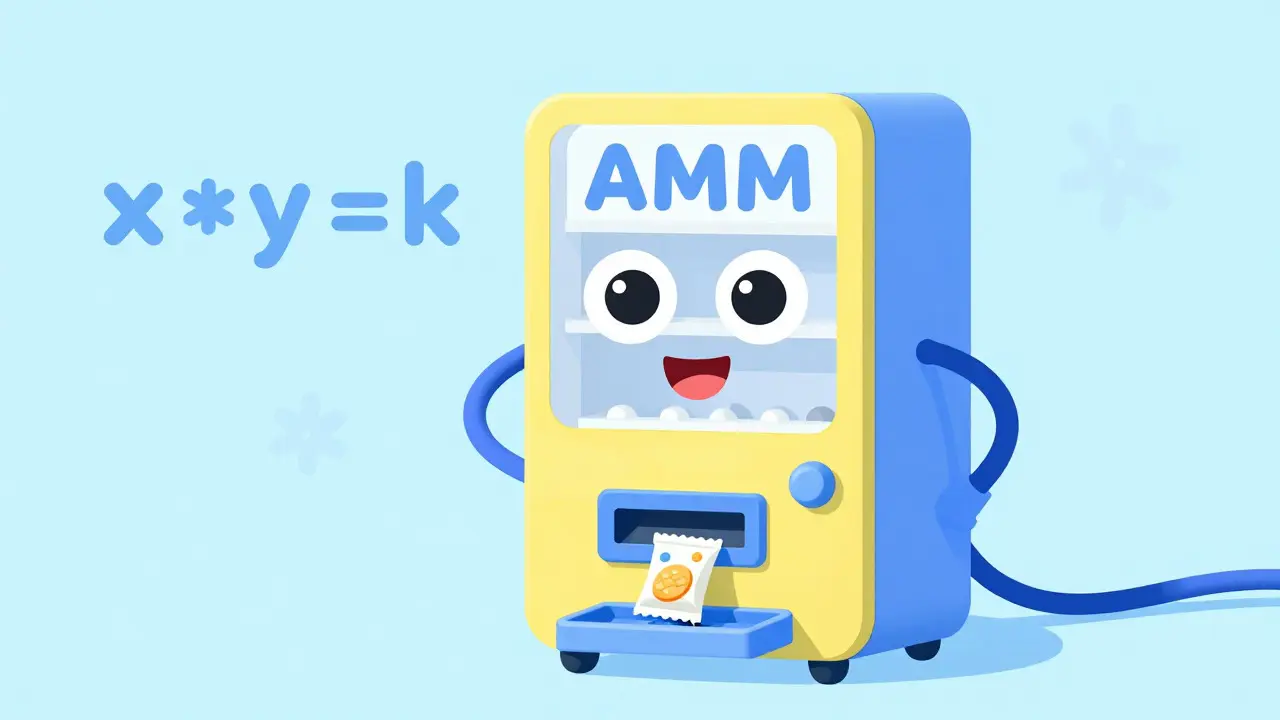
Automated Market Makers (AMMs) are smart contracts that facilitate trading through liquidity pools rather than matching individual orders. Instead of waiting for a counterparty, you trade against a pool of funds provided by other users. The price is determined by a mathematical formula, most commonly the constant product formula: x * y = k. Here, x and y represent the amounts of two tokens in the pool, and k is a constant. As you buy one token, its amount decreases, causing the price of the other token to increase automatically.
This model was pioneered by Bancor in 2017 and popularized by Uniswap in 2018. Today, Uniswap dominates the DEX landscape with over 44% market share. Other major players include Curve Finance, optimized for stablecoins, and Balancer, which allows multi-asset pools.
The beauty of AMMs is accessibility. Anyone can provide liquidity by depositing pairs of tokens into a pool. In return, they earn a share of the trading fees. This democratizes market making, allowing retail investors to participate in revenue generation previously reserved for institutional market makers. For traders, AMMs mean 24/7 availability. You never have to worry about finding a counterparty. If there is liquidity in the pool, you can trade instantly.
But convenience comes with a cost: slippage. Because the price adjusts automatically based on pool balance, large trades significantly impact the price. If you try to buy $1 million worth of a token in a small pool, you might end up paying much more per token than the current market rate. This makes AMMs less suitable for large institutional trades unless the pool is massive.
Key Differences: Control vs. Convenience
To help you decide which model fits your style, let’s compare them across critical dimensions. The choice isn’t just about technology; it’s about your trading goals, risk tolerance, and experience level.
| Feature | Order Book | AMM |
|---|---|---|
| Price Discovery | Based on supply/demand matching | Based on algorithmic formulas |
| Liquidity Source | Market makers and traders | Liquidity providers (LPs) |
| Trade Execution | Matches buy/sell orders | Swaps against pool reserves |
| Slippage | Low for large orders (if deep) | High for large orders |
| User Control | High (limit orders, stops) | Low (market price only) |
| Accessibility | Requires knowledge | Simple, beginner-friendly |
| Best For | Professionals, large trades | Retail, long-tail assets |
Notice how order books excel in precision. If you are a day trader looking to scalp small profits, you need the ability to set exact entry and exit points. AMMs force you to accept the current price, which can eat into thin margins. On the flip side, AMMs shine in simplicity. A newcomer to crypto can swap tokens on Uniswap in three clicks without understanding candlestick charts or order depth.
Who Should Use Which Model?
Your choice depends heavily on your profile. Are you a casual investor holding Bitcoin for years? Or are you a DeFi degens farming yield on obscure tokens? Let’s look at specific scenarios.
Choose Order Books if:
- You trade large volumes ($10k+ per trade). The reduced slippage saves significant capital.
- You prefer strategic trading with limit orders. You want to wait for specific price levels.
- You value transparency in market depth. Seeing the full order book helps you gauge sentiment.
- You trade established assets like BTC, ETH, or SOL where liquidity is deep and consistent.
Choose AMMs if:
- You are new to crypto trading. The interface is intuitive and requires less learning.
- You trade smaller amounts. Slippage impact is minimal for trades under $1k.
- You want to provide liquidity. Earning passive income from fees is easier via AMMs.
- You trade long-tail or new tokens. Many altcoins only have liquidity on AMMs like Uniswap or PancakeSwap.
The Rise of Hybrid Models
As the market matures, the lines between AMMs and order books are blurring. Why choose one when you can have the best of both? Hybrid models are emerging to solve the limitations of pure approaches.
Projects like Kyber Network and newer iterations of dYdX combine elements of both. They might use an order book for price discovery and matching but settle trades on-chain via smart contracts. Others use AMMs as a backstop liquidity source for order books, ensuring trades always execute even if the order book is thin.
This evolution addresses key pain points. Hybrid systems reduce slippage for large orders by tapping into multiple liquidity sources. They also mitigate front-running risks inherent in transparent on-chain order books. By 2026, expect more DEXs to adopt these hybrid architectures, offering users seamless switching between models based on their immediate needs.

Common Pitfalls to Avoid
Regardless of the model, mistakes happen. Here are practical tips to protect your capital.
For AMM Users:
- Check Pool Depth: Before swapping, look at the total value locked (TVL) in the pool. Small pools mean high slippage.
- Set Slippage Tolerance: Don’t leave it at default. Adjust it based on volatility to avoid failed transactions or overpaying.
- Beware Impermanent Loss: If providing liquidity, understand that price divergence between assets can lead to losses compared to holding.
For Order Book Users:
- Watch for Spoofing: Large walls of orders might disappear before hitting your price. Don’t rely solely on visible depth.
- Use Limit Orders: Market orders can suffer from slippage in volatile conditions. Limit orders give you control.
- Verify Counterparties: In decentralized order books, ensure the exchange is reputable to avoid rug pulls or hacks.
Future Outlook: Coexistence, Not Replacement
Will AMMs replace order books? Unlikely. Each model solves different problems. Order books remain superior for professional trading, derivatives, and high-frequency strategies. AMMs dominate in decentralized finance, offering permissionless access and continuous liquidity for niche assets.
The future lies in integration. Layer-2 scaling solutions will make on-chain order books faster and cheaper. Meanwhile, AMMs will become more sophisticated with concentrated liquidity and dynamic fee structures. As a trader, your edge comes from knowing which tool to pick for each job. Don’t force a square peg into a round hole. Match the model to your strategy, and you’ll navigate the crypto markets with confidence.
What is the main difference between AMM and order book?
The core difference is price determination. Order books match buyers and sellers at agreed prices, creating a dynamic market driven by human activity. AMMs use algorithms to set prices based on the ratio of assets in a liquidity pool, removing the need for direct counterparties.
Which model is better for beginners?
AMMs are generally better for beginners due to their simplicity. You don’t need to understand order types or market depth. Just connect your wallet, select the tokens, and swap. Order books require more knowledge to avoid costly mistakes like slippage or missed entries.
Can I use limit orders on an AMM?
Traditionally, no. AMMs execute trades at the current algorithmic price. However, some advanced protocols and interfaces now offer limit order functionality by routing trades through specialized bots or integrating with order book layers, bridging the gap between models.
Why do AMMs cause slippage?
Slippage occurs because AMM prices adjust continuously based on pool balance. Large trades deplete one side of the pool faster, causing the price to shift significantly during execution. The deeper the pool, the lower the slippage.
Is Uniswap an AMM or order book?
Uniswap is an AMM. It uses liquidity pools and the constant product formula to facilitate swaps. It does not maintain a traditional order book where users post bids and asks.
Are order books safer than AMMs?
Safety depends on implementation. Centralized order books carry custodial risk (exchange hack). On-chain order books face smart contract risks and front-running. AMMs also have smart contract risks and impermanent loss for providers. Neither is inherently safer; diligence is key.