Have you ever stumbled upon a crypto project that promises the world but feels... quiet? That’s exactly where BitBall-DEX sits in the current landscape. Launched back in February 2020 as part of the broader BitBall ecosystem, this decentralized exchange (DEX) was supposed to be a game-changer for cross-border bartering and digital payments. But it is now June 2026. The crypto market has evolved drastically since then. So, does BitBall-DEX still hold any value, or is it just another relic from the early days of DeFi?
If you are looking for high-frequency trading with deep liquidity, you might want to keep scrolling. However, if you are curious about niche ecosystems, multi-token structures, or how older projects survive in today's saturated market, this review breaks down everything you need to know. We will look at the technology, the tokens, the risks, and whether there is any real utility left in the BitBall universe.
What Exactly Is BitBall-DEX?
To understand the exchange, you first have to understand the parent project. BitBall is a multipurpose cryptocurrency project that originated in August 2018 with the mission to bridge the gap between digital currencies, exchanges, and real-world customers. It wasn't just built to trade; it was built to be spent. The vision included an online barter system for goods and services, accepting both crypto and fiat currencies like PayPal.
BitBall-DEX itself launched on February 3, 2020. It operates as the decentralized arm of this ecosystem. Unlike centralized exchanges where a company holds your funds, a DEX uses smart contracts to facilitate trades directly between users. BitBall-DEX is based in Australia, which adds a layer of regulatory context compared to many offshore anonymous projects. Its primary role is to serve as an Automated Market Maker (AMM), allowing users to swap tokens without needing an order book.
The Token Ecosystem: More Than Just One Coin
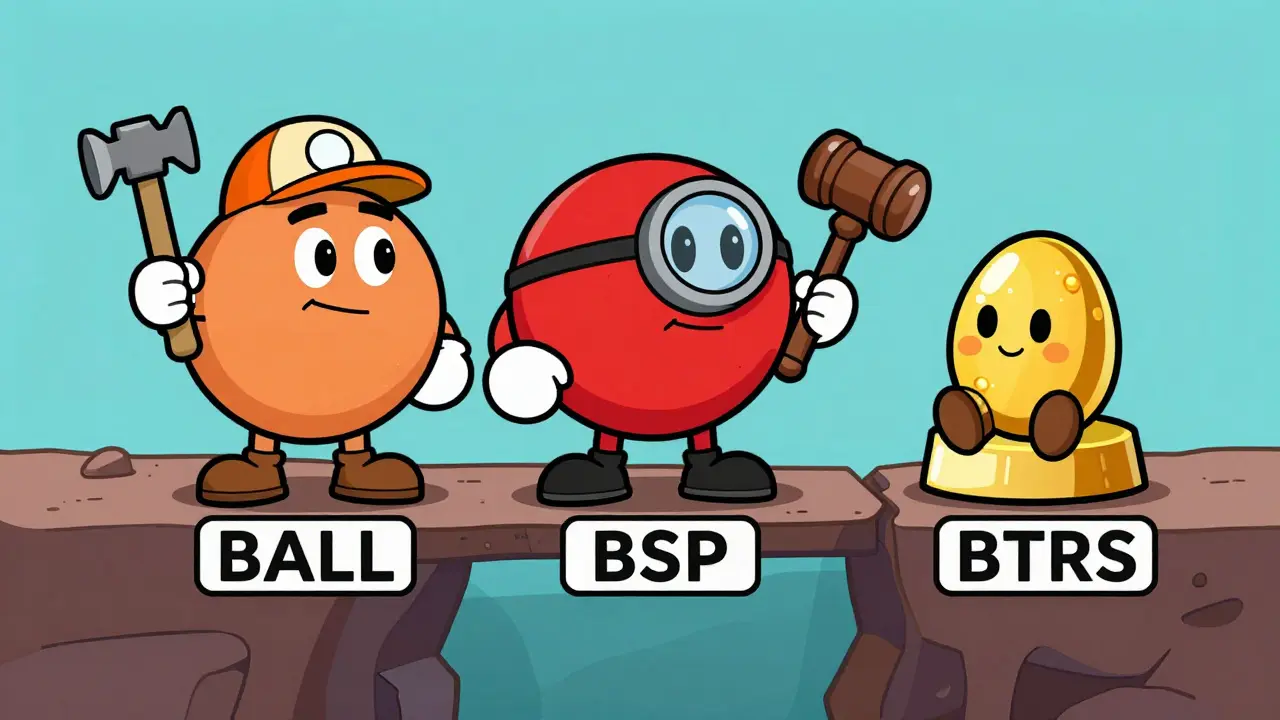
One thing that stands out about BitBall is its complexity. Most simple DEXs rely on one native token. BitBall, however, introduced a trio of assets, each with a specific job. This structure can be confusing for new users, so let’s break it down.
| Token Name | Ticker | Primary Function | Network |
|---|---|---|---|
| BitBall | BALL / BTB | Main utility token for transactions and payments | Multi-chain |
| BallSwap | BSP | Governance token for the Ballswapper DeFi protocol | Ethereum |
| BitBall Treasure | BTRS | Limited edition store of value (10x lower supply than BTB) | Multi-chain |
BALL (sometimes referred to as BTB) is the workhorse. It’s used for the e-barter platform and general transactions. BallSwap (BSP) is interesting because it functions as a governance token. If you hold BSP, you theoretically have a say in how the Ballswapper DeFi protocol evolves. This protocol was built on Ethereum and launched via Uniswap, integrating standard DeFi mechanics like liquidity provision. Then there is BitBall Treasure (BTRS), which positions itself as a scarce asset. With a supply ten times lower than the main token, it aims to act as a digital gold within the ecosystem.
Trading Liquidity and Market Reality
Here is where things get tricky. In the world of DEXs, liquidity is king. Without enough money in the pools, you cannot make large trades without slipping the price significantly. When we look at the data for BitBall tokens, the picture is mixed.
According to recent data, the most active trading pair for BALL is against USDT on Gate.io, a centralized exchange. The 24-hour volume fluctuates, with figures ranging from roughly $9,900 to over $76,000 depending on the day. While $76k sounds decent, it is tiny compared to major exchanges like Binance or Coinbase, which handle billions daily. For a DEX specifically, the liquidity is often thinner. You might find some activity on Uniswap V2 (Base chain), but don’t expect instant execution for large orders.
This low liquidity means two things: higher risk of slippage and potential difficulty exiting your position quickly. If you are planning to park a significant amount of capital here, you need to ask yourself: who is on the other side of my trade? In niche ecosystems, that answer isn't always reassuring.
Price History: A Cautionary Tale
We need to talk about the numbers. Crypto investors love charts, but they also hide stories. BitBall had an all-time high (ATH) of $647.60 on January 5, 2019. That was during the peak of the initial coin offering (ICO) hype cycle. As of mid-2026, the price hovers around $0.0000008686.
Yes, you read that right. A decline of nearly 100% from its peak. This isn't unique to BitBall-many projects from the 2017-2019 era suffered similar fates-but it is crucial context. If you bought at the top, you are likely not getting your money back anytime soon. If you are buying now, you are betting on a revival of the ecosystem rather than past glory. The volatility has settled into a flatline, which suggests very little speculative interest remains.
Safety and Security Considerations
Is BitBall-DEX safe? Like any DeFi platform, it depends on how you define safe. The code itself is open-source, which allows for audits, but we must consider the age of the project. Smart contract vulnerabilities change over time. A contract written in 2020 might not meet the security standards of 2026.
Since it is a DEX, you retain custody of your funds until the moment of swap. This eliminates the risk of the exchange going bankrupt and stealing your assets (the "not your keys, not your coins" principle). However, you face different risks:
- Smart Contract Risk: Bugs in the AMM logic could lead to loss of funds.
- Rug Pull Potential: While less likely for a project this old, low liquidity makes pools vulnerable to manipulation.
- Regulatory Uncertainty: Being based in Australia helps, but the global nature of crypto means regulations shift constantly.
Always use a hardware wallet when interacting with lesser-known DEXs. Never connect your main holding wallet to unfamiliar interfaces. Use a burner wallet with only the funds you intend to trade.

Who Is BitBall-DEX For?
Let’s be honest. BitBall-DEX is not for the day trader looking for quick profits. The spreads are too wide, and the volume is too low. It is also not for the passive investor seeking steady yield, given the lack of robust staking rewards information in recent updates.
So, who is it for? It might appeal to:
- Ecosystem Believers: People who genuinely believe in the original vision of a crypto-based barter system and want to support the infrastructure.
- NFT Collectors: Since the ecosystem includes NFT functionality, collectors interested in BitBall-specific digital assets might use the DEX to acquire tokens needed for minting or trading.
- Cross-Border Experimenters: Users in regions with limited banking access who want to try the peer-to-peer cross-chain features for small-value transactions.
For everyone else, established DEXs like Uniswap, PancakeSwap, or Curve offer better liquidity, more transparent governance, and stronger security track records.
Final Verdict: Proceed with Caution
BitBall-DEX represents an ambitious attempt from 2020 to create a holistic financial ecosystem. It has the components: a DEX, governance tokens, a store of value, and a barter platform. However, execution matters more than ambition. With prices down 99.99% from highs and minimal public communication in recent years, the momentum has clearly stalled.
If you decide to interact with BitBall-DEX, treat it as a high-risk experimental play. Allocate only what you can afford to lose entirely. Verify the contract addresses yourself, check the latest audit reports if available, and start with micro-transactions. The dream of a seamless crypto-barternet is still alive in some circles, but BitBall-DEX alone may not be the vehicle to get you there in 2026.
Is BitBall-DEX a centralized or decentralized exchange?
BitBall-DEX is a decentralized exchange (DEX). It uses smart contracts to facilitate trades without a central intermediary holding user funds.
Where is BitBall-DEX based?
The platform is based in Australia, according to CoinMarketCap data.
What is the current price of BitBall (BTB)?
As of mid-2026, the price is approximately $0.0000008686, representing a massive decline from its all-time high of $647.60 in 2019.
Can I trade BitBall tokens on centralized exchanges?
Yes, BALL/USDT pairs are available on centralized exchanges like Gate.io, BingX, and others, though volumes vary significantly.
What is the purpose of the BSP token?
BSP (BallSwap) is a governance token for the Ballswapper DeFi protocol on Ethereum, allowing holders to participate in decision-making processes.
Is BitBall-DEX suitable for beginners?
Not really. Due to low liquidity, complex tokenomics, and high risk, it is better suited for experienced users familiar with DeFi risks.
Does BitBall support fiat currency integration?
The broader BitBall ecosystem aims to integrate fiat options like PayPal for its barter platform, bridging traditional and digital finance.
When was BitBall-DEX launched?
BitBall-DEX was launched on February 3, 2020, as part of Phase 4 of the BitBall project roadmap.
Comments (18)
Maurice Flynn
July 1, 2026 AT 00:49
it's funny how we look back at these early projects and see them as relics when they were actually just ahead of the curve in terms of vision but behind in execution. the barter concept was cool i guess but nobody really wanted to trade their crypto for physical goods through a sketchy middleman. feels like a time capsule.
Trent Erman1
July 1, 2026 AT 16:11
Great breakdown here! It is always interesting to see how the landscape has shifted since 2020. The multi-token structure with BALL, BSP, and BTRS is definitely complex, maybe too complex for what it offered. I think the governance aspect of BSP on Ethereum was a smart move technically, but without active community participation, it’s just code sitting there. Good luck if you decide to experiment!
Fiona Ellis
July 3, 2026 AT 08:42
I must say, this review is quite thorough, though I find the notion of 'digital gold' via BTRS rather quaint 🤔. The supply dynamics are theoretically sound, yet practically irrelevant given the lack of demand. One wonders if the developers ever intended for this to scale or if it was merely an exercise in tokenomics for its own sake. The Australian regulatory angle is intriguing, certainly, but does not seem to have provided the safety net many hoped for. 📉
Nicole Woessner
July 4, 2026 AT 21:35
honestly i remember when this launched everyone was talking about the paypal integration which was supposed to be huge for bridging fiat and crypto but that never really took off. now looking at the price chart it is just a flatline. sometimes the simplest solutions win out and bitball tried to do too much at once. good read though thanks for sharing the details
Jon Milton
July 6, 2026 AT 02:31
You people are missing the bigger picture. This isn't just about liquidity; it's about sovereignty. BitBall was trying to build a system outside the traditional banking rails, and sure, it failed in the short term because the market wasn't ready. But don't let these centralised exchange shills tell you it's worthless. The tech is there, the vision was solid. We need more projects like this, even if they stumble. Stop crying about slippage and start supporting decentralisation.
Sajjad Ghorbani Moghaddam
July 7, 2026 AT 07:36
hey jon calm down a bit man. no one is saying the vision was bad but let's be real the execution matters. if you can't swap your tokens easily then the sovereignty argument falls apart. i get the passion for de-fi but we have to acknowledge that most users just want easy access to their money. bitball dex is basically a ghost town now so it's hard to argue it's serving any purpose right now.
Rebecca Shoniker
July 8, 2026 AT 16:59
Oh, please. Do not conflate 'sovereignty' with incompetence. The project is a graveyard of abandoned promises. The smart contracts are likely riddled with vulnerabilities that have gone unpatched since 2020. To suggest otherwise is not only naive but dangerous. You are essentially encouraging retail investors to walk into a den of thieves. The 'vision' you speak of is merely a veneer for a rug pull that happened slowly over six years. Stay away. Seriously. 💀
Jay Sharma
July 8, 2026 AT 18:15
you guys are all sheep following the herd to binance and coinbase. bitball is probably being suppressed by the same banks that killed bitcoin in 2013. the low volume is artificial manipulation by cexs to keep the price down. wake up sheeple. the government doesn't want you trading freely on australian dexs. it's all part of the great reset. don't believe the fud.
Scott Miller
July 10, 2026 AT 13:23
COME ON EVERYONE! Just because it's quiet doesn't mean it's dead! There's always potential in these old gems if you dig deep enough. Maybe the team is working on something big in stealth mode? Don't give up hope! Crypto is about believing in the dream before the reality hits. Grab some BALL while it's cheap and hold tight! TO THE MOON! 🚀🚀🚀
Abby Martin
July 11, 2026 AT 04:01
Scott you are literally giving financial advice based on zero evidence. that is insane. the chart shows a 99% drop. that is not a dip that is a collapse. people who buy this are either idiots or scammers trying to exit on latecomers. stop spreading this toxic positivity. it is harmful. read the article properly. it says high risk experimental play. take the hint.
Mélanie Boulay
July 12, 2026 AT 00:43
While I appreciate the enthusiasm displayed by some commenters here, it is imperative to consider the historical context of cryptocurrency projects from the 2018-2020 era, which were often characterized by speculative fervor rather than sustainable utility, and consequently, many such projects have failed to maintain relevance due to a lack of continuous development and community engagement, leading to a situation where the assets become illiquid and effectively worthless, thus serving as a cautionary tale for future investors who might be tempted by low entry prices without understanding the underlying fundamentals.
nancy jarecki
July 13, 2026 AT 01:28
The sheer banality of this discussion is exhausting. Of course BitBall is irrelevant. It lacks the sophisticated AMM mechanics of modern protocols like Uniswap V3 or Curve's convexity optimizations. The tokenomics are archaic. The governance is a joke. Only amateurs would waste their time analyzing a zombie protocol. If you cannot discern between a viable DeFi primitive and a relic, perhaps you should stick to savings accounts.
Robert Hundley
July 14, 2026 AT 03:44
lol nancy chill out queen. not everyone is a quant trader. some of us just like exploring old projects for fun. besides the barter idea was kinda unique for its time. yeah it flopped but that's crypto. up and down. i still check it occasionally just to see if anything changed. haven't seen much movement though. stay positive folks! :)
Melissa L
July 15, 2026 AT 21:20
i dont get why ppl care so much about old coins. just buy btc or eth and forget about the rest. this bitball thing looks sus af. why would u trust a site from 2020 with ur money? sounds like a scam to me. glad i didnt invest.
Rob Morton
July 16, 2026 AT 14:33
It is interesting to consider the philosophical implications of a 'barter' system in a digital age. Does the reintroduction of direct exchange remove the abstraction of value that fiat provides? Or does it simply complicate the transaction layer unnecessarily? BitBall attempted to solve a problem that perhaps didn't exist in the way they envisioned. The friction of swapping tokens for goods is high, and without a massive network effect, it remains a niche curiosity rather than a practical tool.
Routh Middaugh
July 17, 2026 AT 17:25
I think we can all agree that the project had ambitious goals! However, the reality of market adoption is harsh. The multi-chain approach for BALL and BTRS was forward-thinking, yet the lack of clear utility differentiation between the tokens created confusion. It is a classic case of feature creep overwhelming core functionality. Let us hope future projects learn from these structural mistakes! 🌟
Ryan Peters
July 19, 2026 AT 03:54
Australian DEX? Please. Give me a US-based compliant platform any day. This offshore-style operation with vague governance is exactly why crypto gets a bad reputation. The SEC should have shut this down years ago. It's a playground for tax evaders and fraudsters. Real innovation happens where regulations are clear, not in these shadowy ecosystems pretending to be decentralized.
ross harris
July 19, 2026 AT 21:00
BitBall is a beautiful corpse. A skeletal reminder of the ICO winter that froze our dreams. The liquidity pools are dry as the sahara, and the smart contracts are dusty tombs holding the bones of forgotten alpha. To trade here is to dance with ghosts. The slippage will eat your soul, and the gas fees will break your heart. It is art, really. Tragic, useless art. Do not touch it unless you enjoy pain.