
You’ve probably seen the buzz around CAKEBANK. Maybe it was a tweet promising free tokens, a Discord message claiming an exclusive drop, or a headline shouting about "guaranteed returns." It’s easy to get excited. Who doesn’t want free money? But here is the hard truth you need to hear right now: there is almost zero credible information about a legitimate CAKEBANK airdrop by an entity called Cake Bank.
In the world of cryptocurrency, silence from official sources is loud. When major projects like PancakeSwap (the actual project behind the CAKE token) or Binance run airdrops, they publish whitepapers, announce dates on verified social media channels, and list mechanics on their main websites. For CAKEBANK, none of that exists. Instead, we have a token trading at fractions of a penny and a vacuum of official documentation. This isn’t just a missed opportunity; it might be a trap.
The Reality Check: What Is CAKEBANK?
Before you connect your wallet to any site claiming to distribute these tokens, let’s look at the data. As of mid-2026, the CAKEBANK token has shown extremely low market activity. Reports indicate a price hovering around $0.00000207 USD. To put that in perspective, you would need millions of these tokens to equal a single dollar. This valuation suggests one of two things: either this is a brand-new micro-cap project with no liquidity, or it is a failed experiment abandoned by its creators.
There is a critical distinction many newcomers miss. You might be confusing CAKEBANK with PancakeSwap. PancakeSwap is a massive decentralized exchange on the BNB Chain. They use the CAKE token. They have run legitimate airdrops before. But Cake Bank-the specific entity associated with the CAKEBANK ticker-is not PancakeSwap. Mixing them up is dangerous. Scammers often use similar names to confuse users into sending funds to the wrong address or connecting to malicious smart contracts.
Why There Are No Official Details
If a legitimate financial institution or a reputable DeFi protocol were launching an airdrop, you wouldn’t find out through rumors. You would see:
- Official Announcements: Posts on verified Twitter/X accounts, Discord servers, and Telegram groups linked directly from the project’s homepage.
- Clear Mechanics: A step-by-step guide on how to qualify. Do you need to hold a certain amount of another token? Do you need to bridge assets? Do you need to complete quests?
- Snapshots: A specific block number where eligibility is calculated.
- Tax & Legal Disclosures: Especially for US-based users, who face strict regulatory scrutiny regarding unregistered securities.
For CAKEBANK, none of these pillars exist. The absence of a whitepaper, a team reveal, or a roadmap is a massive red flag. In 2025 and 2026, the industry standard shifted toward transparency. Projects like Hyperliquid and Monad built huge communities by being open about their development stages. Hiding in the shadows is no longer a viable strategy for legitimate growth-it’s usually a sign of a "rug pull" waiting to happen.
The Danger of Fake Airdrop Sites
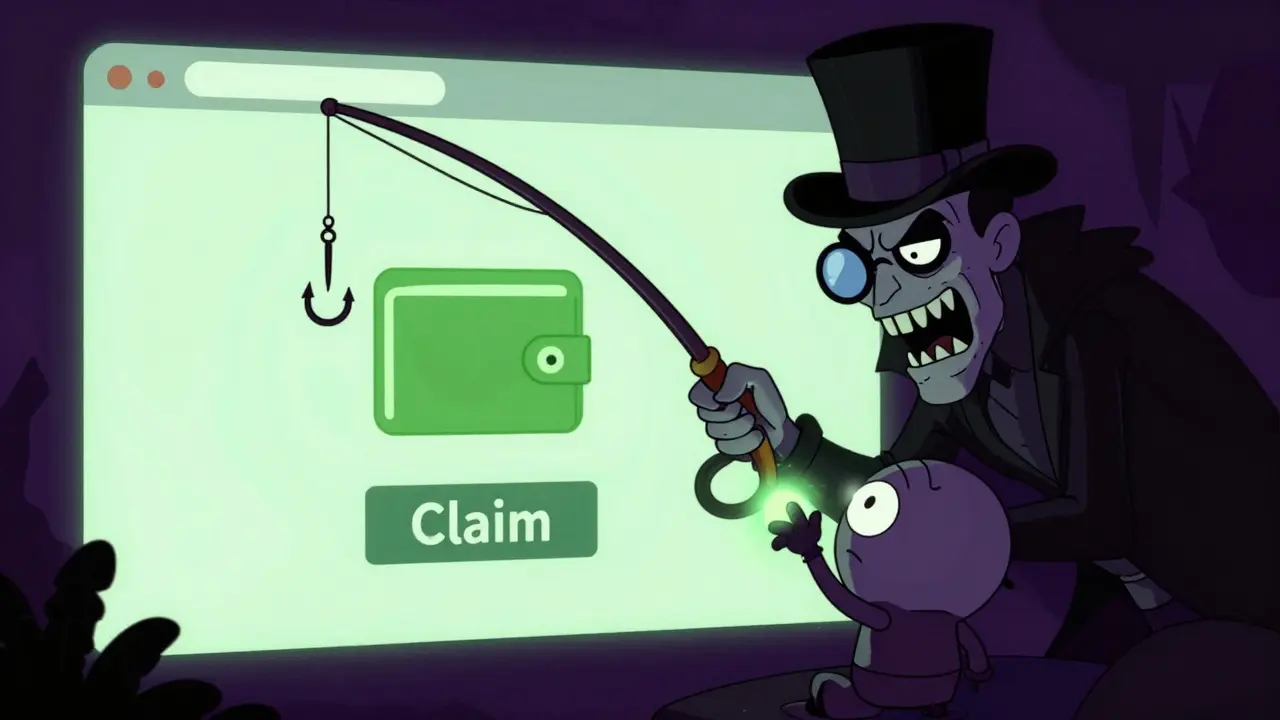
Because there is no official source for CAKEBANK details, the internet is filled with fake sites. These are designed to look professional. They mimic the design of popular exchanges. They promise that if you connect your MetaMask or Phantom wallet, you’ll receive thousands of dollars worth of CAKEBANK tokens.
Here is how the scam works:
- The Hook: You visit a site claiming to be the "Official CAKEBANK Airdrop Portal."
- The Connection: You click "Connect Wallet" to claim your reward.
- The Approval: The site asks you to approve a transaction. This isn’t just a gas fee. It’s an
approvefunction call that gives the scammer permission to move your existing assets (like ETH, SOL, or USDT). - The Drain: Within seconds, your wallet is empty. The CAKEBANK tokens never existed, or they were worthless dust sent to make the interface look real.
This is not hypothetical. Thousands of users lose money monthly to these exact schemes. If a site asks you to pay a "gas fee" or "verification tax" to receive an airdrop, it is 100% a scam. Legitimate airdrops are free to claim.
How to Verify Any Crypto Airdrop
Since you can’t rely on hype, you need a verification checklist. Use this every time you hear about a new drop, whether it’s CAKEBANK or the next big thing.
| Check Point | Legitimate Project Signs | Scam Red Flags |
|---|---|---|
| Source Origin | Announced on official website and verified social handles (@ symbol) | Found via DMs, random tweets, or SEO-spam blogs |
| Cost to Claim | Free (only network gas fees apply) | Requires sending crypto, buying NFTs, or paying "taxes" |
| Smart Contract | Audited by firms like CertiK or OpenZeppelin | No audit, or code is obfuscated/hideable |
| Community | Active Discord/Telegram with real devs answering questions | Bots flooding chat, links only, no human interaction |
| Tokenomics | Clear supply cap, vesting schedules, and utility | Infinite supply, unknown team, no whitepaper |
Comparing CAKEBANK to Real Airdrop Models
To understand why CAKEBANK feels off, compare it to how established protocols operate. Take PancakeSwap, for example. Their recent campaigns offered rewards to users who maintained trading volume on supported chains like BNB Chain or Arbitrum. The rules were clear: trade $100+ worth of assets, stay active for two weeks, get CAKE tokens. The total budget was public ($25,000 war chest). The timeline was fixed.
Now look at Binance Megadrop. They partnered with projects like KernelDAO. Users had to lock BNB or FDUSD to earn points. The distribution was handled by Binance’s secure infrastructure. There was no ambiguity.
CAKEBANK offers neither clarity nor security. It lacks the infrastructure of a centralized exchange and the community trust of a decentralized protocol. Without these, there is no mechanism to ensure fair distribution. If you can’t verify who controls the tokens, you don’t own them-they do.

Regulatory Risks for US Users
If you are in the United States, the stakes are even higher. The SEC has been aggressive in labeling unregistered token distributions as illegal securities offerings. In 2025, reports highlighted that US users missed out on billions in airdrops because projects geofenced them to avoid legal trouble.
Participating in an obscure airdrop like CAKEBANK could expose you to:
- Tax Liabilities: Even if the tokens are worthless, the IRS may view receipt of property as taxable income. However, current proposals suggest treating small promotional drops like gift cards, taxed only upon sale. The law is still evolving.
- Legal Scrutiny: If CAKEBANK is deemed an unregistered security, holding it could complicate future financial audits.
- Account Bans: Major exchanges like Coinbase or Kraken may delist the token or freeze accounts associated with high-risk, unverified projects.
Always check if a project explicitly excludes US residents. If they don’t mention it, assume they might be operating in a legal gray area.
What Should You Do Now?
Stop looking for the "claim button." It likely doesn’t exist, or it leads to a drain. Instead, focus on protecting your capital.
First, audit your connected wallets. Go to Revoke.cash or DeBank and check for any approvals given to unknown contracts. If you see anything related to CAKEBANK or suspicious domains, revoke access immediately.
Second, shift your attention to verified opportunities. If you want exposure to DeFi airdrops, look at protocols with strong fundamentals. Interact with layer-2 networks like Base or Arbitrum. Provide liquidity on audited DEXs. Bridge assets using trusted bridges. These actions build a history of participation that might qualify you for future, legitimate drops from established players.
Third, ignore the noise. FOMO (Fear Of Missing Out) is the primary tool scammers use. They create urgency: "Claim ends in 24 hours!" "Only 100 spots left!" Real projects give you months to prepare. They don’t panic-buy you into action.
Final Thoughts on CAKEBANK
The CAKEBANK airdrop appears to be a myth or a scam. There is no official documentation, no credible team, and no transparent tokenomics. The token’s near-zero value indicates a lack of market confidence. In the crypto space, if something sounds too good to be true and lacks proof, it is false.
Don’t risk your savings for a ghost. Stick to verified platforms, read the terms, and remember: if you aren’t paying for the product with money, you are the product-and your private keys are the target.
Is the CAKEBANK airdrop real?
There is no credible evidence that a legitimate CAKEBANK airdrop exists. The lack of official announcements, whitepapers, or verified social media presence strongly suggests it is either a rumor or a scam designed to steal wallet funds.
What is the difference between CAKEBANK and PancakeSwap (CAKE)?
PancakeSwap is a well-known decentralized exchange on the BNB Chain that uses the CAKE token. CAKEBANK is a separate, obscure token with no clear connection to PancakeSwap. Confusing the two can lead to interacting with fraudulent sites.
Can I lose money participating in a fake airdrop?
Yes. Fake airdrop sites often ask you to connect your wallet and approve transactions. Once approved, scammers can drain your existing crypto holdings (ETH, USDT, etc.). Never pay fees to claim an airdrop.
How can I verify if an airdrop is legitimate?
Check for official announcements on the project’s verified website and social media. Look for smart contract audits, clear tokenomics, and active community management. If the source is unclear or demands payment, it is likely a scam.
Are airdrops taxable in the US?
Currently, the IRS considers received tokens as taxable income at fair market value. However, regulations are evolving. Some proposals suggest treating small promotional drops like gift cards, taxed only upon sale. Consult a tax professional for advice.
Comments (14)
Erik Kirana
June 7, 2026 AT 13:23
It is absolutely imperative that one understands the gravity of this situation. The lack of documentation is not merely an oversight; it is a deliberate obfuscation designed to prey on the uneducated masses. 🚨📉 You are being led by the nose into a digital slaughterhouse, and you thank them for the privilege. How utterly pathetic.
aaliyah zahid
June 7, 2026 AT 14:21
Oh wow, thanks for the reality check. I was actually about to click on some random link in my DMs because free money sounds nice, but yeah, maybe I should use my brain first. 🙃
Caitlin Donahue
June 7, 2026 AT 19:33
i mean its pretty obvious right? if it was real they would just tell us. no need for all the shady stuff. i feel like ppl forget basic safety online sometimes tho. its kinda scary how easy it is to get tricked these days. hope everyone stays safe out there!
Sylvia Mossman
June 9, 2026 AT 09:25
You guys are all sheep. Just because there's no whitepaper doesn't mean it's a scam. Early adopters make millions while you sit here reading articles telling you to be 'safe'. I'm connecting my wallet and seeing what happens. If I lose $50, whatever. If I win, I laugh at you. 🤡
Steven Jacobowitz
June 11, 2026 AT 05:19
The smart contract approval mechanism is where the actual vulnerability lies. Most users do not understand that signing a transaction grants infinite allowance to the spender address. This is not just about the token itself; it is about the underlying protocol permissions. You are handing over the keys to your house and hoping the burglar is polite. It is aggressive negligence on the part of the user base.
JEVON HALL
June 12, 2026 AT 06:09
hey guys just wanted to say check revoke.cash like the post said. i found like 3 old approvals from projects i forgot about. good thing i checked before anything happened lol. stay safe everyone! 👍
Dinesh Pattigilli
June 13, 2026 AT 04:31
Look at these normies panicking over a micro-cap. The elites already know how the game works. Liquidity pools are manipulated by insiders who dump on retail. You think you're getting an airdrop? You're the liquidity. Typical韭菜 behavior. 🤮
Alexander DeVries
June 14, 2026 AT 23:40
LISTEN TO ME. Stop looking for shortcuts. There are no shortcuts in DeFi. Build your reputation. Trade volume. Provide liquidity on established chains like Arbitrum or Base. That is how you build wealth, not by gambling on ghost tokens. Wake up and take control of your financial destiny! 💪
Lee Paige
June 16, 2026 AT 11:09
This is exactly what the globalist agenda wants. They want you distracted by crypto scams so you don't notice the real theft happening through inflation and regulatory overreach. CAKEBANK is a distraction tactic. Keep your eyes on the real enemy, which is the erosion of national sovereignty through digital currency controls.
Alexis Abster
June 16, 2026 AT 13:57
I am literally shaking reading this. 😱 It is terrifying to think how many people have lost their life savings to things like this. We have to protect each other. Please share this with anyone you know who is new to crypto. We cannot let greed destroy our community. ❤️
Yogendra Dwivedi
June 18, 2026 AT 05:24
Interesting perspective on the verification checklist. In India, we see similar patterns with Ponzi schemes disguised as investment platforms. The key is always patience and verification. Never rush. Always verify the team behind the project. Transparency is the only way forward for sustainable growth in blockchain technology.
Karthikeyan S
June 18, 2026 AT 19:06
u r all so naive. the real scam is the tax man taking ur profits. why bother with legit projects when u can just rug pull urself? just kidding... unless? 😈😈😈
Caralee Robertson
June 19, 2026 AT 14:47
omg i had no idea about the tax implications for US users. that sounds super complicated and stressful. i guess i'll stick to just watching from the sidelines for now. thanks for breaking it down though, really helpful info!
Mark Corpuz
June 20, 2026 AT 21:32
The distinction between PancakeSwap and CAKEBANK is critical. Many newcomers conflate the two due to similar naming conventions, which is a common social engineering tactic. One must exercise due diligence and verify the official channels of any project before engaging. The absence of a whitepaper is a definitive indicator of illegitimacy in the current market landscape.