
Buying Bitcoin or Ethereum in Canada doesn't make you a tax rebel, but selling it might. The Canada Revenue Agency (CRA) is the federal body responsible for administering and enforcing tax laws in Canada treats digital assets strictly as commodities, not currency. This distinction changes everything about how you calculate what you owe. If you hold crypto long-term, you likely pay less than if you trade it daily. But get the classification wrong, and you could face a surprise bill that eats into your profits.
As of 2025, roughly 3.2 million Canadians own some form of cryptocurrency. That’s about 8% of the adult population. With so many people involved, the CRA has tightened its grip on compliance. Audits related to crypto rose by 37% between 2023 and 2024. Whether you are a casual investor or an active trader, understanding these rules is no longer optional-it’s essential for keeping your money where it belongs: in your pocket.
Capital Gains vs. Business Income: The Core Distinction
The most critical decision you will face is determining whether your crypto activity counts as capital gains or business income. This isn’t just semantics; it determines your effective tax rate. The CRA looks at intent and frequency. Did you buy and hold? Or did you buy low and sell high repeatedly?
| Feature | Capital Gains | Business Income |
|---|---|---|
| Taxable Portion | 50% of profit (inclusion rate) | 100% of profit |
| Typical Activity | Long-term holding, occasional trades | Frequent trading, day trading, mining as a business |
| Deductible Expenses | Limited (mostly carrying costs) | Full deduction (software, internet, home office) |
| Reporting Form | Schedule 3 (T1 General) | Form T2125 (Statement of Business Activities) |
If you are classified under capital gains, only half of your profit is added to your taxable income. For example, if you made $10,000 profit, only $5,000 is taxed. If you are classified as a business, the full $10,000 is taxed. Furthermore, businesses can deduct expenses like trading software subscriptions, internet bills, and even a portion of your home office rent. Investors cannot. Tax lawyer Kim Kirton warns that the CRA is aggressive in reclassifying frequent traders as businesses, which can double their tax liability overnight.
Calculating Your Actual Tax Liability
Once you know your category, you need to apply the correct rates. Canada uses a progressive tax system, meaning higher income levels are taxed at higher percentages. These rates apply federally, but provinces add their own layers. Ontario, Quebec, and British Columbia all have different brackets.
For the 2025 tax year, the federal base rates start at 15% for income up to $55,867 and climb to 33% for income over $246,752. Let’s look at a concrete scenario. Imagine you live in British Columbia and earn $100,000 in capital gains from crypto sales. Because of the 50% inclusion rule, only $50,000 is added to your taxable income. After applying federal and provincial rates, you might pay around $20,300 in taxes. Now, imagine that same $100,000 was classified as business income. You would be paying approximately $40,600. That $20,000 difference highlights why proper classification matters more than picking the right coin.
Transactions That Are Not Taxable
Not every click triggers a tax bill. Many beginners panic when they move funds or buy new coins, fearing immediate taxation. The CRA clarifies several non-taxable events in its guidance. Knowing these helps you manage your portfolio without creating unnecessary paperwork.
- Buying with Fiat: Using Canadian Dollars (CAD) to buy Bitcoin is not a taxable event. You are simply exchanging one asset for another.
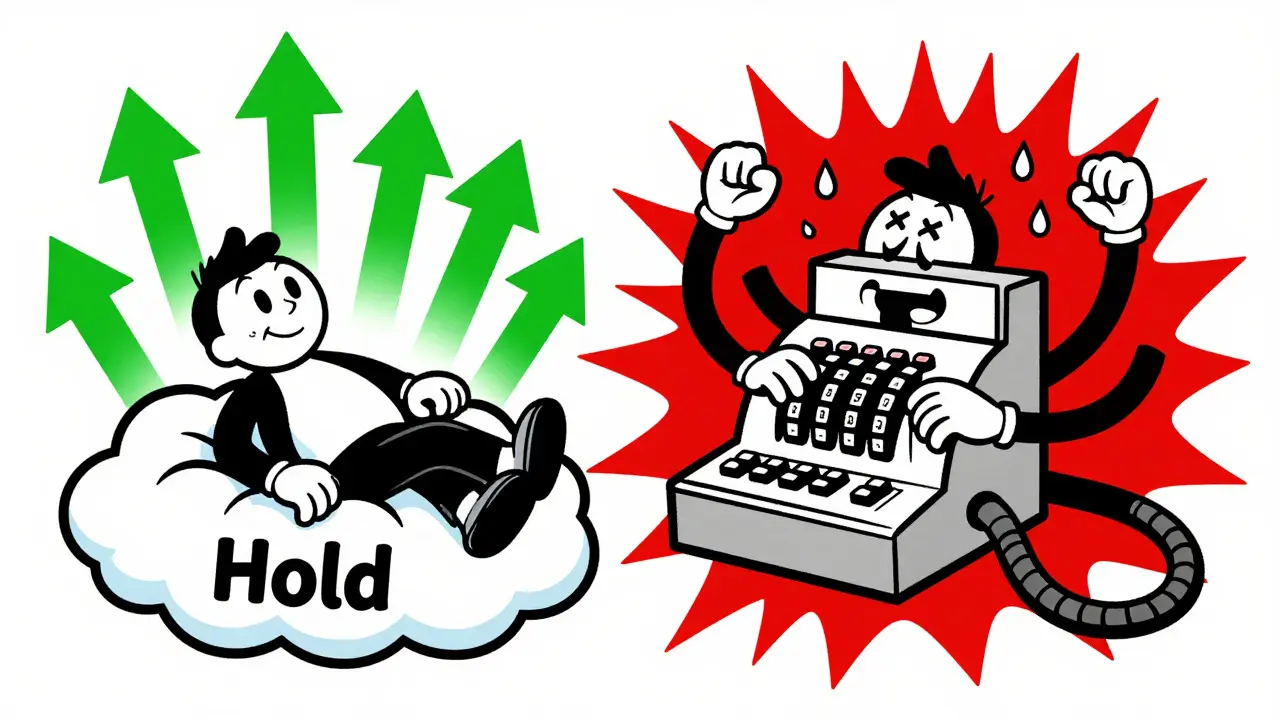
- Holding (HODLing): Simply owning crypto does not create tax liability. You only pay when you dispose of it.
- Transfers Between Personal Wallets: Moving BTC from your Coinbase wallet to your Ledger hardware wallet is not a sale. It is still your property.
- Receiving Gifts: If someone sends you crypto as a gift, it is generally not taxable income for you at that moment. However, the cost basis transfers to you, affecting future gains.
- Creating a DAO: Setting up a Decentralized Autonomous Organization structure itself is not a taxable event, though subsequent earnings may be.
However, spending crypto is different. If you use Bitcoin to buy a coffee or pay for services, the CRA views this as a disposal. You must calculate the gain or loss based on the value of the Bitcoin at the time of purchase versus the time of the transaction. Keep records of every spend, no matter how small.
Tax Loss Harvesting and Superficial Losses
You don’t always win. When you sell crypto for less than you bought it, you have a capital loss. You can use this loss to offset other capital gains, reducing your overall tax bill. This strategy is called tax loss harvesting. But there is a trap: the superficial loss rule.
Under CRA Guide T4037, if you sell a crypto asset at a loss and buy back the same or identical property within 30 days before or after the sale, the loss is disallowed. The CRA assumes you didn’t actually realize the loss; you just shuffled it around. To claim the loss, you must wait at least 31 days before repurchasing the same asset. Alternatively, you could switch to a similar but distinct asset, like swapping Ethereum for Polygon, to avoid the rule entirely.
Remember that only 50% of capital losses are deductible against capital gains. If you have $15,000 in gains and $10,000 in losses, you can only deduct $5,000 from your gains. You would then be taxed on the remaining $10,000 in gains. Unused losses can be carried forward indefinitely to offset future gains, so don’t panic if you can’t use them all this year.

Reporting Requirements and Penalties
The deadline for filing your personal tax return is April 30 of the following year. Self-employed individuals have until June 15 to file, but any balance owing is still due by April 30. Late filings incur penalties: 5% of the tax owing plus 1% for each full month the return is late, up to 12 months. If the CRA determines you were grossly negligent-meaning you knew about the transactions but ignored them-the penalty jumps to 10% of the tax owing.
In 2025, draft legislation proposed enhanced reporting for transactions over $10,000, mirroring US measures. While not yet fully enacted, the trend is clear: transparency is increasing. Major Canadian exchanges like Wealthsimple, Coinsquare, and Bitbuy now provide CRA-compliant tax statements. In fact, 87% of major exchanges offer these tools, up from 62% in 2022. Use these statements, but verify them. A 2025 CRA compliance review found that 73% of audited crypto returns contained material errors, mostly due to incorrect cost basis calculations.
Tools and Professional Help
Manual tracking is nearly impossible if you trade across multiple platforms. One user on Reddit reported spending 47 hours preparing their 2024 return after trading on five different exchanges. Software solutions like Koinly and CoinLedger automate this process by connecting to your exchange APIs and generating CRA-specific reports. Koinly, for instance, averages 4.6 stars on Trustpilot for its accurate templates, while TurboTax Canada receives mixed reviews for its crypto features.
If your situation involves complex staking rewards, mining operations, or cross-border transfers, consider hiring a tax professional specializing in digital assets. The CPA Canada survey noted that 68% of tax professionals find the current system too complex for average taxpayers. Paying for expertise can save you thousands in potential penalties and missed deductions.
Is cryptocurrency considered legal tender in Canada?
No. The CRA explicitly states that cryptocurrency is not legal tender nor foreign currency. It is treated as a commodity or property. This means you do not pay tax on mere ownership, but you do pay tax on disposals (sales, trades, or spending).
How are staking rewards taxed in Canada?
Staking rewards are typically treated as ordinary income. You must report 100% of the fair market value of the tokens at the time you receive them. Later, when you sell those specific tokens, you calculate capital gains based on that initial income value as your cost basis.
What happens if I forget to report crypto gains?
The CRA can reassess your return for up to three years after the original assessment date, or indefinitely if fraud or gross negligence is suspected. Penalties include 5% of the unpaid tax plus monthly interest. Voluntary disclosure programs exist but require full honesty and payment of owed amounts.
Can I deduct my crypto trading losses against regular job income?
Generally, no. Capital losses can only offset capital gains. If you have excess capital losses, they carry forward to future years. However, if your crypto trading is classified as a business, business losses can offset other sources of income, such as employment wages.
Do I need to pay tax on crypto gifts I receive?
Receiving crypto as a gift is not a taxable event for the recipient. However, you inherit the giver's adjusted cost base. When you eventually sell the gifted crypto, you will pay capital gains tax on the difference between the sale price and that inherited cost basis.