
Imagine trying to run a marathon while carrying all the equipment needed to build a house. That is essentially what traditional blockchains like Bitcoin and early Ethereum were forced to do. They handled everything-processing transactions, agreeing on the order of those transactions, storing the data, and securing the network-all on one single layer. As more people joined, the system slowed down, fees skyrocketed, and users got frustrated. Now, in 2026, we are seeing a fundamental shift away from this "do-it-all" model toward something much smarter: modular blockchain architecture. At the center of this revolution is Celestia, a protocol that does just one thing incredibly well: it makes sure data is available and secure, letting other networks handle the heavy lifting of execution.
If you have been following crypto news, you have likely heard terms like "rollups," "Layer 2," and "data availability." These aren't just buzzwords; they represent the new building blocks of the internet. Celestia was built specifically to solve the bottleneck that has plagued blockchain since day one. By separating the functions of a blockchain into distinct layers, projects can now scale without sacrificing security or decentralization. This article breaks down exactly how Celestia works, why it matters for developers and investors, and how it fits into the broader ecosystem of modular projects.
The Problem with Monolithic Blockchains
To understand why Celestia exists, you first need to understand what it replaced. For years, the industry relied on monolithic blockchains. Think of Bitcoin or Ethereum before its major upgrades. In these systems, every node (computer) on the network had to download, verify, and store every single transaction. If ten million people used the network, every node had to process ten million transactions. This created a hard limit on scalability. You could make the blocks bigger, but then only a few powerful servers could run nodes, leading to centralization. Or you could keep blocks small, but then the network became slow and expensive to use.
This dilemma is often called the "Blockchain Trilemma," a concept popularized by Vitalik Buterin. It suggests that you can only pick two out of three: Security, Decentralization, and Scalability. Monolithic chains struggled to balance all three. Celestia’s team, led by CEO Mustafa Al-Bassam and co-founders Ismail Khoffi, John Adler, and Nick White, decided to break the trilemma by splitting the work. Instead of one chain doing everything, they created a specialized network dedicated solely to consensus and data availability. This allows execution layers to grow independently, solving the scalability issue without compromising on security.
How Celestia Works: The Modular Approach
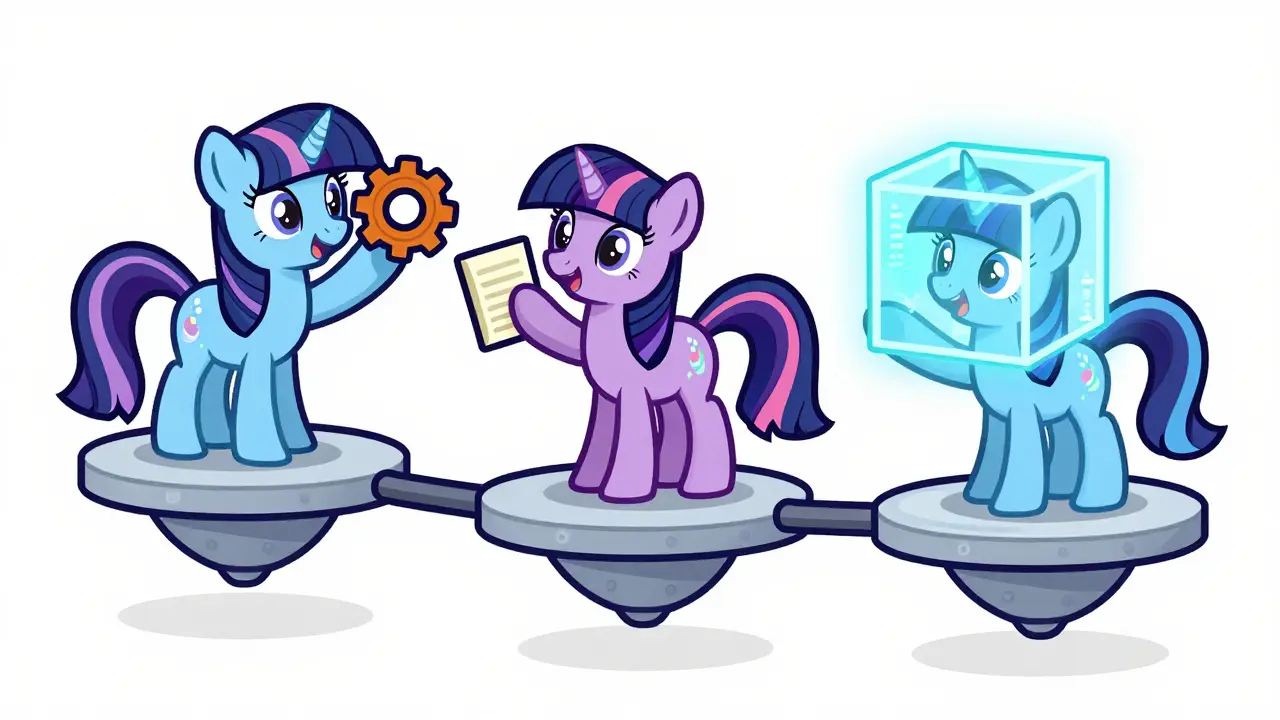
Celestia operates on a simple but powerful principle: separation of concerns. In a modular blockchain ecosystem, there are typically three layers:
- Execution Layer: Where transactions are processed and smart contracts run. This is where apps live.
- Settlement Layer: Where disputes are resolved and finality is achieved.
- Data Availability (DA) Layer: Where transaction data is published so anyone can verify it later.
Celestia focuses entirely on the DA layer. When a rollup (a type of execution layer) processes thousands of transactions, it doesn’t need to worry about storing them permanently or proving they exist to the world. It simply posts the data to Celestia. Celestia ensures that this data is available to anyone who wants to check it. This offloads the burden from the execution layer, allowing it to focus purely on speed and efficiency.
| Feature | Monolithic (e.g., Early Ethereum) | Modular (e.g., Celestia + Rollups) |
|---|---|---|
| Responsibility | One chain handles execution, consensus, and data storage. | Separate chains handle specific tasks (execution vs. data availability). |
| Scalability | Limited by node hardware constraints. | Highly scalable as execution and data layers scale independently. |
| Node Requirements | High bandwidth and storage needed for full nodes. | Lightweight nodes can verify data availability using sampling. |
| Flexibility | Hard to upgrade without hard forks. | Developers can build custom execution environments easily. |
Key Technologies: DAS and NMT
Celestia isn’t just a theoretical idea; it relies on two groundbreaking technologies to function efficiently: Data Availability Sampling (DAS) and Namespace Merkle Trees (NMT). Let’s break these down into plain English.
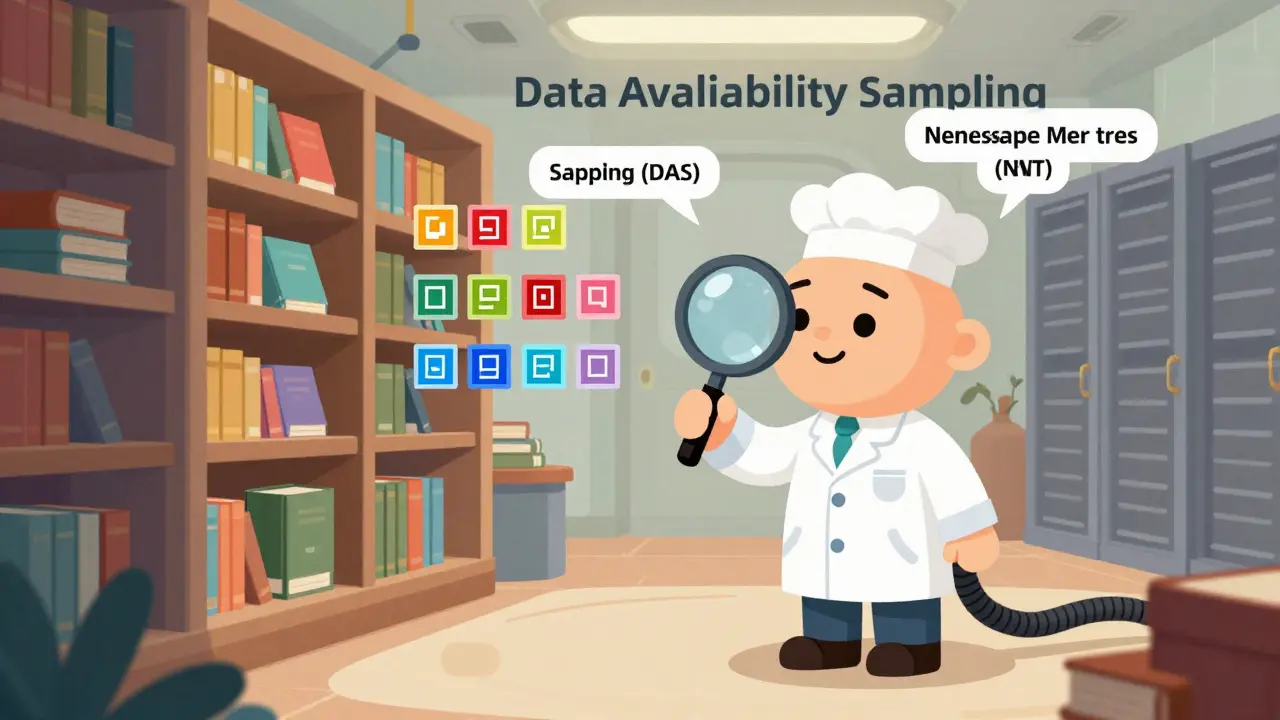
Data Availability Sampling (DAS) solves the problem of verifying data without downloading it all. In a traditional blockchain, if you want to ensure no data is missing, you must download the entire block. On Celestia, lightweight nodes don’t need to do that. Instead, they take random samples of the data. If the data is truly available, these random checks will confirm it. If someone tries to hide or delete data, the probability of catching them increases exponentially with each sample. For instance, seven random requests can give a node over 99% confidence that the data is available. This means anyone with a standard laptop can participate in securing the network, keeping it decentralized.
Namespace Merkle Trees (NMT) organize the data so that different applications don’t interfere with each other. Imagine a library where books are sorted not just by author, but by genre, language, and topic. NMTs divide block data into namespaces. If you are running a gaming dApp, you only need to download the data relevant to your game’s namespace. You don’t care about the financial transactions happening in another namespace. This reduces the load on individual applications and allows for parallel processing of data across the network.
Celestia in the Ecosystem: Rollups and Developers
So, who actually uses Celestia? The primary users are developers building rollups. A rollup is a solution that bundles many transactions together and posts them to a main chain for security. Previously, most rollups posted their data back to Ethereum. While Ethereum is secure, it is also expensive and congested. By posting data to Celestia instead, rollups can achieve lower costs and higher throughput.
Celestia supports multiple programming languages and virtual machines. Whether you are coding in Solidity for EVM compatibility, Rust for Cosmos SDK integration, or Go, you can build on top of Celestia. This flexibility is crucial. It means that a developer creating a high-frequency trading platform can build a custom execution layer optimized for speed, while another developer creating a social media app can build a layer optimized for storage. Both rely on Celestia for the underlying data integrity.
The network uses a Proof-of-Stake consensus mechanism, secured by validators who stake the TIA token. Validators agree on the order of transactions and ensure data is published correctly. Users pay fees in TIA to post data to the network. This economic model aligns incentives: validators are rewarded for keeping the network secure, and users get reliable, low-cost data availability.
Market Position and Future Outlook
Since its launch in October 2023, Celestia has quickly become a cornerstone of the modular blockchain narrative. Backed by major venture capitalists like Coinbase Ventures, Jump Crypto, and Galaxy Digital, the project raised $55 million and achieved unicorn status with a valuation over $1 billion. This level of funding signals strong institutional confidence in the modular thesis.
One of the key indicators of Celestia’s health is its adoption rate. As of mid-2026, numerous rollups and Layer 2 solutions have chosen Celestia as their data availability provider. This includes both established projects experimenting with hybrid models and new startups building from scratch. The Ginger upgrade, which reduced block times from 12 seconds to 6 seconds, further cemented its position as a high-performance infrastructure layer.
However, competition is fierce. Other projects like EigenDA and Avail are also vying for the data availability market. Celestia’s advantage lies in its first-mover status, robust developer tooling, and active community. Its ability to support any virtual machine gives it a broader appeal than solutions tied to specific ecosystems.
Challenges and Considerations
While the modular approach offers significant benefits, it is not without challenges. One concern is complexity. For end-users, interacting with a modular ecosystem can be confusing. You might need to bridge assets between an execution layer and a settlement layer, or manage tokens on different chains. Abstraction layers are being developed to hide this complexity, but it remains a hurdle for mass adoption.
Another consideration is security dependencies. Since execution layers rely on Celestia for data availability, a failure or attack on Celestia could impact all dependent rollups. However, Celestia’s design includes multiple safeguards, including erasure coding and redundant data distribution, making such an attack extremely difficult. Additionally, the diverse validator set helps prevent centralization risks.
Regulatory scrutiny is also increasing for all blockchain projects. As Celestia grows, it may face questions regarding its role in facilitating cross-border transactions and data storage. Compliance frameworks will need to evolve to address these issues, potentially impacting how projects interact with the network.
Conclusion: The Path Forward
Celestia represents a pivotal moment in blockchain history. By decoupling data availability from execution, it has unlocked a new era of scalability and customization. For developers, it offers the freedom to build tailored solutions without being constrained by a one-size-fits-all architecture. For users, it promises faster, cheaper, and more efficient interactions with decentralized applications.
As the ecosystem matures, we can expect to see more innovation in the modular space. Projects will experiment with new combinations of execution, settlement, and data availability layers. Celestia’s success will depend on its ability to maintain high performance, attract quality developers, and adapt to changing market conditions. But one thing is clear: the future of blockchain is modular, and Celestia is leading the charge.
What is Celestia?
Celestia is a modular blockchain network that provides data availability and consensus services. Unlike traditional blockchains that handle all functions, Celestia focuses solely on ensuring transaction data is accessible and secure, allowing other networks (rollups) to handle execution.
How does Data Availability Sampling (DAS) work?
DAS allows lightweight nodes to verify that data is available without downloading the entire block. Nodes take random samples of the data. If the samples are valid, it statistically proves the rest of the data is likely available. This reduces the hardware requirements for running a node, promoting decentralization.
Why do rollups use Celestia?
Rollups use Celestia to post their transaction data because it is cheaper and faster than posting to monolithic chains like Ethereum. Celestia’s modular design allows rollups to scale independently while still benefiting from robust security and data integrity guarantees.
What is the TIA token used for?
The TIA token is used for staking by validators to secure the network and for paying transaction fees when posting data to the Celestia network. It serves as the economic backbone of the ecosystem, aligning incentives between users and validators.
Is Celestia compatible with Ethereum?
Yes, Celestia is compatible with various virtual machines, including the Ethereum Virtual Machine (EVM). Developers can build rollups using Solidity and other languages, making it easy to integrate existing Ethereum-based projects into the Celestia ecosystem.