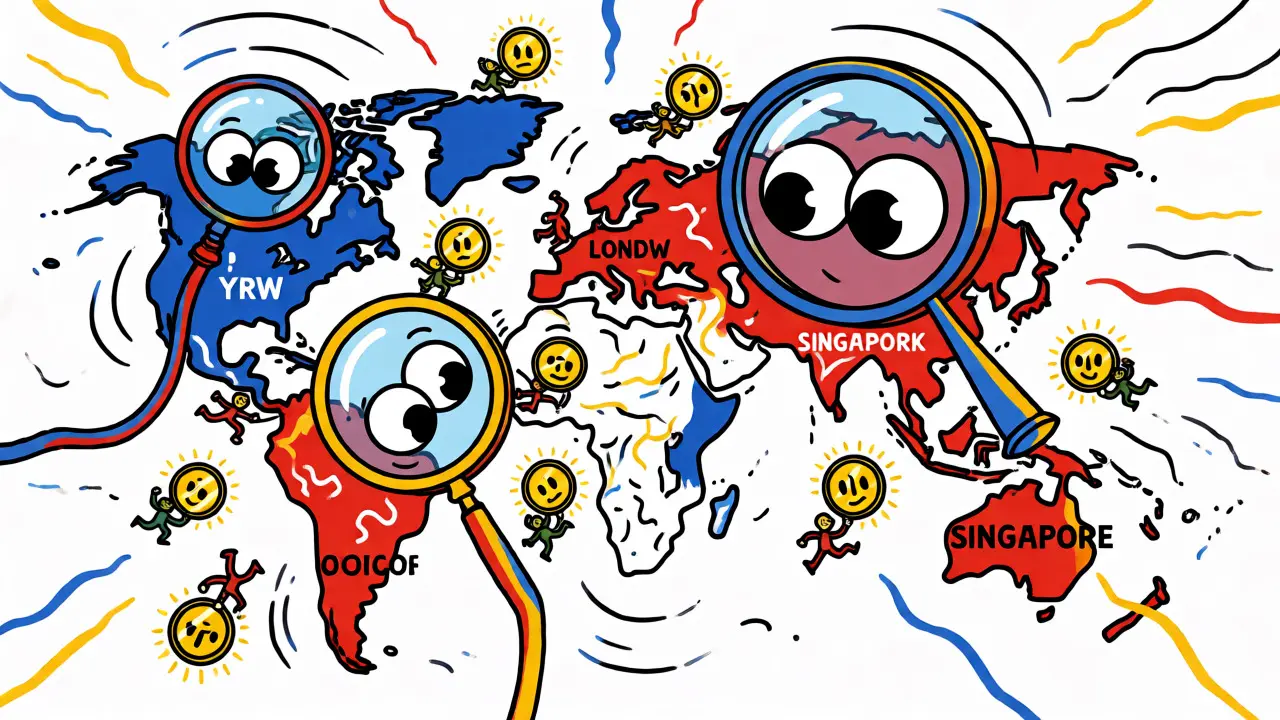
Imagine sending money from New York to London. In the traditional banking world, that transaction leaves a paper trail so thick you could build a house with it. Every hop, every intermediary, and every fee is logged. Now, imagine doing the same thing with Bitcoin or Ethereum. For years, the narrative was that crypto was anonymous, untraceable, and outside the reach of regulators. That narrative is dead.
Today, Cross-border crypto monitoring is a sophisticated, data-heavy operation orchestrated by international authorities. It’s no longer about whether regulators can see your transactions; it’s about how fast they can connect the dots between a wallet in Singapore, an exchange in Dubai, and a user in Texas. If you’re moving digital assets across borders, you are operating within a web of surveillance designed to catch money laundering, terrorism financing, and sanctions evasion. This isn't just bureaucracy-it's the new reality of global finance.
The Global Watchdogs: Who Is Actually Watching?
You might think your local bank regulator is the only one looking over your shoulder. They aren't. The primary architect of this global surveillance network is the Financial Action Task Force (FATF). While not a law enforcement agency itself, the FATF sets the standards that countries adopt into their own laws. Think of them as the UN of financial crime. Their most critical tool for crypto is the "Travel Rule," which requires Virtual Asset Service Providers (VASPs) to share personal data when transferring funds above certain thresholds.
In the United States, the Financial Crimes Enforcement Network (FinCEN) acts as the enforcer. Under the Bank Secrecy Act, crypto exchanges and custodians are classified as financial institutions. This means they have the same obligations as banks: report suspicious activity, keep records, and verify who you are. But the scope has widened. The Securities and Exchange Commission (SEC) and the Commodity Futures Trading Commission (CFTC) also monitor specific types of crypto assets, treating some tokens as securities and others as commodities. This multi-agency approach creates a complex compliance landscape where a single transaction might trigger reporting requirements in three different regulatory domains.
Across the Atlantic, the European Union has taken a more unified stance with the Markets in Crypto-Assets (MiCA) regulation. Unlike the fragmented US approach, MiCA provides a comprehensive framework for all EU member states. Licensed crypto asset service providers must maintain rigorous financial crime controls. The UK, meanwhile, works closely with the US through the Transatlantic Task Force, aiming to align licensing, custody, and stablecoin standards. This bilateral cooperation suggests a future where major economic powers set the rules, and smaller jurisdictions follow suit to avoid being cut off from global liquidity.
The Travel Rule: Your Data Moves With Your Money
The cornerstone of cross-border monitoring is the Travel Rule. Originally designed for wire transfers, it now applies to crypto. Here is the hard fact: if you send $3,000 or more in convertible virtual currency (like Bitcoin or Ether) across borders, your VASP must collect and transmit your personally identifiable information (PII). This includes your name, address, account number, and the details of the recipient.
This isn't optional. It’s baked into the infrastructure of compliant exchanges. When you initiate a withdrawal, the platform checks if the destination is another VASP. If it is, they attempt to send your data along with the coins using protocols like TRISA or OpenVASP. If the receiving exchange doesn’t support these protocols, or if you’re sending to a private wallet, things get messy. You might face delays, additional verification requests, or even frozen funds until the originator and beneficiary identities are confirmed.
| Regulatory Framework | Jurisdiction | Primary Focus | Key Requirement |
|---|---|---|---|
| FATF Standards | Global | AML/CFT Coordination | Travel Rule implementation ($1,000-$3,000 threshold varies) |
| Bank Secrecy Act (BSA) | United States | Money Laundering Prevention | Reporting for transactions >$3,000 involving CVC/LTDA |
| MiCA Regulation | European Union | Market Integrity & Consumer Protection | Licensing for CASPs; strict disclosure rules |
| OFSI Sanctions | United Kingdom | Sanctions Compliance | Screening against designated persons and entities |
It’s crucial to understand that this rule applies to both domestic and international transfers in many jurisdictions. However, the cross-border aspect adds complexity because data privacy laws differ. Sending your home address from the EU to a US exchange involves navigating GDPR restrictions alongside AML requirements. Regulators are pushing for standardized data formats to make this seamless, but we aren't there yet.

How Authorities Trace the Untraceable
Crypto enthusiasts often point to blockchain analytics firms like Chainalysis or Elliptic as proof that anonymity is a myth. They’re right. These tools allow investigators to visualize the flow of funds. If a hacker steals $50 million in ETH and moves it through five different wallets, analysts can tag those addresses. If one of those addresses interacts with a KYC-compliant exchange, the pseudonymity collapses. The wallet is linked to a real person.
But bad actors don't stand still. They use techniques to break these chains. Layering involves moving assets through multiple platforms to obscure the source. Mixing services pool users' coins together to sever the link between sender and receiver. Privacy coins like Monero or Zcash offer stronger obfuscation, though many major exchanges delist them due to compliance difficulties. Even more sophisticated is the use of VPNs. By masking their IP address, a user in a sanctioned country can appear to be trading from a friendly jurisdiction. This complicates Know Your Customer (KYC) efforts, forcing authorities to rely on behavioral analysis rather than just location data.
A significant challenge remains centralized exchanges with hidden links. Some platforms may share infrastructure or ownership with sanctioned entities. Intermediary wallets can disguise these connections, separating incoming deposits from withdrawals. Instant exchange services that skip KYC entirely are particularly vulnerable. They act as gateways for sanctioned individuals to convert fiat into crypto, bypassing traditional banking screens. International authorities are increasingly targeting these high-risk, non-KYC services, recognizing them as weak points in the global defense against illicit finance.
The Rise of CBDCs and Stablecoins
The urgency for better monitoring is fueled by institutional adoption. As of late 2026, 91% of central banks are exploring digital currencies or stablecoins. When governments issue their own digital dollars or euros, the line between traditional banking and crypto blurs further. Central Bank Digital Currencies (CBDCs) offer programmable money, allowing authorities to embed compliance rules directly into the token. Imagine a dollar that automatically rejects payments from sanctioned wallets. That’s not science fiction; it’s in development.
Stablecoins, pegged to assets like the US Dollar, serve as the bridge between fiat and crypto. Because they are often issued by private companies like Circle or Tether, they fall under intense scrutiny. Regulators want to ensure that the reserves backing these coins are legitimate and that issuers comply with anti-money laundering laws. The UK-US Transatlantic Task Force is specifically working on stablecoin standards, aiming to create a safe harbor for innovation while preventing systemic risks. If you hold stablecoins, expect stricter reporting requirements as these frameworks mature.
Practical Implications for Users and Businesses
So, what does this mean for you? If you’re an individual trader, the days of casual, unmonitored cross-border swaps are fading. You need to expect friction. Withdrawals to unknown wallets may trigger manual reviews. Using privacy-enhancing tools might raise red flags, leading to account freezes until you provide proof of source of funds. Always check the compliance status of the exchange you’re using. A platform licensed in the EU under MiCA will have different data-sharing practices than an offshore exchange with loose oversight.
For businesses accepting crypto payments, the stakes are higher. Working with licensed crypto asset service providers allows you to leverage payment rails without obtaining your own license. However, you must perform due diligence on your partners. Ensure they have robust AML programs. Non-compliance can result in penalties, legal action, or loss of banking relationships. Banks are wary of fintechs that touch crypto; demonstrating strong compliance protects your operational stability.
Technology is evolving to meet these demands. Regulatory technology (RegTech) solutions now automate much of the monitoring. Tools can screen transactions against sanctions lists in real-time, flagging potential issues before they become violations. Integration of blockchain analytics with traditional financial systems is becoming standard. The goal is balance: fostering innovation while maintaining the integrity of the international financial system.
What’s Next for Global Oversight?
The trajectory is clear: harmonization. We are moving toward a world where crypto regulations look more like traditional finance regulations. The lack of coordinated oversight has historically led to inconsistent enforcement and confusion. Market participants suffered from conflicting rules. Now, initiatives like the UK-US partnership aim to set a template for other nations. China and the EU are advancing their own frameworks, creating a multipolar regulatory environment. Yet, the core principles remain consistent: customer protection, market stability, and integrity.
Expect increased scrutiny on decentralized finance (DeFi) protocols. As smart contracts handle billions in value, authorities are figuring out how to apply identity requirements to code. Will DeFi require KYC? Probably, at least for fiat on-ramps. The borderless nature of blockchain makes isolation impossible. A protocol deployed globally faces global rules. Adaptability is key. Those who view compliance as a feature, not a bug, will thrive in this maturing market.
What is the Travel Rule in crypto?
The Travel Rule is an anti-money laundering requirement that mandates Virtual Asset Service Providers (VASPs) to collect and share personal information (such as names and addresses) for cryptocurrency transactions above a certain threshold, typically $3,000 in the US. This ensures that financial institutions know who is sending and receiving funds across borders.
Do I need to declare my crypto holdings internationally?
Yes, in many jurisdictions. Tax authorities and financial regulators require reporting of foreign-held assets. Additionally, if you move large sums across borders, compliance with AML laws may require documentation of the source of funds and intended use, regardless of tax implications.
How do authorities track anonymous crypto transactions?
They use blockchain analytics tools provided by firms like Chainalysis or Elliptic. These tools analyze patterns, cluster addresses, and identify interactions with known entities (like exchanges). When an anonymous wallet interacts with a KYC-verified account, its history can be de-anonymized and traced back to a real-world identity.
What is MiCA regulation?
Markets in Crypto-Assets (MiCA) is a comprehensive regulatory framework adopted by the European Union. It establishes uniform rules for crypto asset service providers (CASPs) across all EU member states, focusing on consumer protection, market integrity, and anti-money laundering compliance.
Can I use privacy coins like Monero to avoid monitoring?
While privacy coins offer stronger anonymity, they are difficult to use within regulated environments. Many major exchanges delist them due to compliance challenges. Using them may limit your ability to cash out through regulated platforms and can attract heightened scrutiny from authorities attempting to trace fund flows.