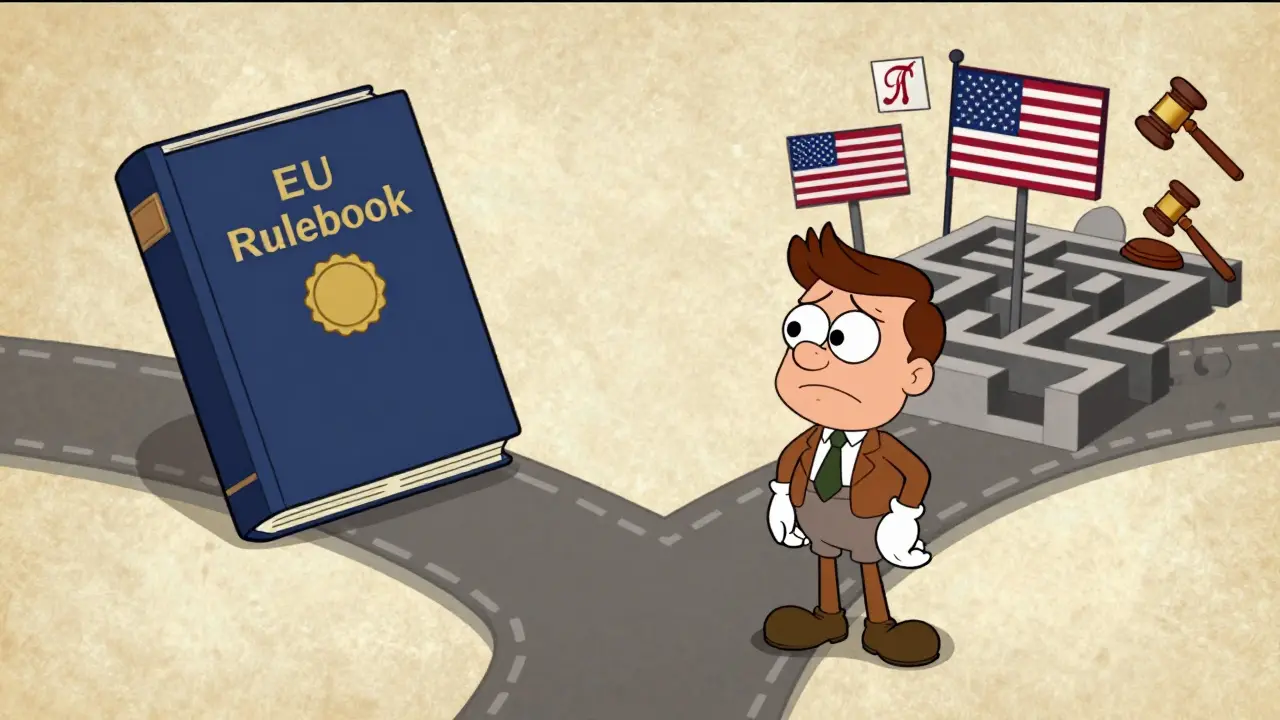
Trying to trade digital assets globally today feels like navigating a minefield where the rules change the moment you cross a digital border. Depending on where your exchange is based or where you live, a single token could be viewed as a currency, a commodity, or a security. This isn't just a legal headache for lawyers; it's a practical reality that determines which coins you can buy, how much you pay in fees, and whether your favorite platform suddenly disappears from your region.
The Big Picture: Two Different Philosophies
When we look at the global map, the Regulatory Differences for Crypto Trading essentially boil down to a clash between two styles: the "Rulebook" approach and the "Case-by-Case" approach. The European Union decided to write the entire rulebook upfront, while the United States has spent years fighting over who gets to hold the pen.
In the EU, the goal was clarity. They wanted a single set of rules that applied to every member state, removing the guesswork for businesses. In the US, the approach has been much more reactive. Instead of one big law, regulators use existing laws from the 1930s to decide if a new token fits an old definition. This creates a massive gap in how traders and businesses operate on either side of the Atlantic.
The EU Approach: MiCA and the Era of Certainty
The European Union changed the game with MiCA (Markets in Crypto-Assets Regulation). After becoming fully applicable in December 2024, MiCA established a comprehensive framework for issuing and trading crypto-assets across the EU. It doesn't matter if you're in France or Poland; the rules are the same.
Under MiCA, the EU focuses heavily on specific categories of tokens. For instance, if a company wants to issue Electronic Money Tokens (EMTs) or Asset-Referenced Tokens (ARTs), they can't just launch a website and start selling. They need a proper e-money or banking license. This gives traditional banks a huge advantage because they already have the infrastructure to meet these requirements, making the transition into crypto trading much smoother for established financial institutions.
One unique twist in the EU is the focus on sustainability. The European Commission is linking crypto-asset mining to EU taxonomy regulations. This means if a bank wants to partner with a crypto platform, they have to check if that platform's energy use clashes with their environmental goals. You won't find this level of "green" scrutiny in the US framework.
The US Approach: A Patchwork of Power Struggles
The US situation is... messy. There is no single "Crypto Law." Instead, you have a tug-of-war between two main agencies: the SEC (Securities and Exchange Commission) and the CFTC (Commodity Futures Trading Commission).
The SEC handles securities (like stocks), and the CFTC handles commodities (like gold or corn). The problem? Many crypto assets look like both. For years, these two agencies have disagreed on where the line is drawn. For example, in the case of XRP, courts had to step in to decide that institutional sales were securities, but retail sales on exchanges were not. This "regulation by enforcement" means businesses often find out they've broken a rule only after they get sued.
However, things shifted in July 2025 with the passage of the GENIUS Act. This landmark stablecoin law finally gave some much-needed clarity to the markets. It's the first real sign that the US is moving away from purely case-by-case battles and toward actual legislation. Along with the Digital Trading Clarity Act, the US is trying to give exchanges a "grace period"-usually about two years-to comply once a token is officially labeled a security, rather than hitting them with immediate fines.
The Hidden Layer: US State Laws
If you think federal agencies are complicated, wait until you look at the state level. In the US, you don't just deal with Washington D.C.; you might deal with 50 different state governments. Take Louisiana, for example. Their Virtual Currency Business Act requires businesses to get specific licenses to operate in the state, unless they are already governed by federal acts like the Securities Exchange Act of 1934.
This creates a nightmare for a crypto startup. To operate legally across the whole US, they might need to navigate a dozen different state licensing regimes on top of the federal SEC and CFTC requirements. In contrast, a company licensed under MiCA in one EU country can "passport" its services across the entire union.
| Feature | European Union (EU) | United States (US) |
|---|---|---|
| Primary Regulation | MiCA (Comprehensive) | Patchwork (SEC, CFTC, State Laws) |
| Asset Classification | Pre-defined categories (ARTs, EMTs) | Case-by-case / Judicial rulings |
| Licensing | Unified "Passporting" system | State-by-state + Federal registration |
| Focus Areas | Consumer protection & Sustainability | Market integrity & Anti-money laundering |
| Recent Milestone | Full MiCA implementation (Dec 2024) | GENIUS Act (July 2025) |
The Compliance Grind: KYC and the Travel Rule
Regardless of whether you're in New York or Berlin, regulators are obsessed with one thing: stopping money laundering. This is where the Financial Action Task Force (FATF) standards come in. Both the US and EU follow the "Travel Rule," but the operational side differs.
In the US, FinCEN (Financial Crimes Enforcement Network) treats crypto businesses as financial institutions under the Bank Secrecy Act. If a transaction hits $3,000 or more, the Virtual Asset Service Provider (VASP) must collect and transmit a mountain of data: names, addresses, and wallet hashes of both the sender and receiver. If you miss a single detail, the penalties are severe.
While the EU also enforces strict Know Your Customer (KYC) rules, they've integrated these requirements into the broader MiCA framework, making the process more standardized for the provider. The US approach remains a bit more fragmented, as different agencies may have slightly different reporting expectations.
Which System Actually Works?
If you're a big bank, you probably love the EU. The rules are clear, and once you have your license, you're set. If you're a scrappy innovator, the US might actually be more appealing despite the chaos. The lack of a rigid, pre-emptive rulebook allows for some "regulatory breathing room" at the state level, and the recent GENIUS Act shows that the US can pivot quickly when the political will is there.
The real danger for traders is "regulatory arbitrage." This happens when companies move their headquarters to the jurisdiction with the easiest rules. For a while, the EU was the gold standard for clarity, but as the US streamlines its stablecoin and securities laws, the competitive edge is shifting. The ultimate winner will be whichever region can protect users without killing the technology that makes crypto valuable in the first place.
What is the main difference between MiCA and US regulation?
The EU uses MiCA, a single comprehensive law that covers all member states. The US uses a fragmented system where different agencies (SEC and CFTC) apply existing securities and commodities laws to crypto on a case-by-case basis, supplemented by individual state laws.
Does the GENIUS Act replace SEC oversight in the US?
No, the GENIUS Act specifically focuses on providing regulatory clarity for stablecoins. It doesn't remove the SEC's authority over other digital assets that are deemed securities, but it does reduce the overall uncertainty for the stablecoin market.
What happens if a crypto token is classified as a security in the US?
Under the Digital Trading Clarity Act, if a token is officially deemed a security, intermediaries typically enter a two-year compliance window. This allows them to register as broker-dealers or exchanges without facing immediate enforcement actions for the listing.
How does the Travel Rule affect my trades?
The Travel Rule requires exchanges (VASPs) to share identifying information about the sender and receiver for transactions over a certain threshold (e.g., $3,000 in the US). This means your trades are no longer anonymous, as the platform must verify and transmit your personal data to the receiving institution.
Can I use an EU-licensed exchange in the US?
Not necessarily. While MiCA allows "passporting" within the EU, it does not grant automatic legality in the US. An exchange must still comply with US federal laws (SEC/CFTC) and potentially state-level licenses (like those in Louisiana) to legally serve US customers.
Comments (18)
Susan Wright
April 7, 2026 AT 04:40
Just a heads up for anyone looking at the US side, definitely keep an eye on those state-level licenses because some states are way more aggressive than others with their enforcement even if federal laws are leaning toward clarity
Emma Pease-Byron
April 8, 2026 AT 04:53
How quaint that some actually believe the GENIUS Act provides 'clarity' when it merely rearranges the deck chairs on the Titanic of American regulatory incompetence. The notion that a two-year grace period is a benefit rather than a prolonged execution is truly adorable.
Earnest Mudzengi
April 8, 2026 AT 19:25
Wake up people the Travel Rule is just a front for the globalist surveillance state to map every single wallet hash to a biometric ID so they can freeze your assets the second you stop complying with the narrative
This isn't about money laundering it's about total financial panopticon control via the VASP gateway and the SEC is just the muscle for the central banks
Bruce Micciulla Agency
April 9, 2026 AT 19:52
the sheer inefficiency of the sec vs cftc battle is a textbook example of regulatory capture where the lack of a unified framework actually serves the legacy institutional players who can afford the legal fees to litigate their way into a favorable ruling while the retail trader just gets dumped on by the volatility caused by these vague judicial outcomes and the genius act is just a band-aid on a bullet hole
Arlen Medina
April 9, 2026 AT 20:48
USA is still the king of the hill here because the chaos is where the money is made! While the EU is busy filling out forms in triplicate and checking if their Bitcoin is 'green' enough we're actually innovating and pushing the boundaries of what's possible in the markets
vijendra pal
April 11, 2026 AT 00:51
Bro the EU is just too slow 🐌 MiCA is okay but US market is where the real action happens always!! 🚀 Just need to follow the right signals and ignore the noise 📈💰
Manisha Sharma
April 11, 2026 AT 11:29
The Wests obsession with these tiny rules is so funny when India is basically leading the way with mass adoption regardless of what some old man in DC thinks
Your frameworks are just failures of imagineation and lack of spiritual alignment with the future of money which is obviously decentralized beyond your silly borders
Patty Levino
April 11, 2026 AT 21:23
It's completely understandable to feel overwhelmed by the different laws. If anyone is struggling with the KYC process, I'd recommend keeping a detailed log of your documentation to make the VASP transitions easier.
Hugo Lopez
April 12, 2026 AT 21:27
I think both systems have their merits and we can find a middle ground where safety meets innovation! 😊 Maybe we can all learn a bit from each other's mistakes to make a better global standard 🌍✨
Arwyn Keast
April 13, 2026 AT 13:41
Typical American arrogance assuming the 'chaos' is a feature. The lack of a cohesive statutory framework is a systemic failure that only benefits the high-frequency trading firms who can exploit the latency in regulatory response times. Absolute shambles.
Sharhonda Walker
April 14, 2026 AT 03:44
I've seen a few peopel try to use the 'passporting' thing in the EU and it's actually way smoother than dealing with the SEC but you still gotta watch out for the local tax laws in each country because that's where they get ya
Krystal Moore
April 14, 2026 AT 17:27
Honestly it's just disgusting that we're letting these regulators ruin the whole point of crypto!
We wanted freedom and now we're just getting 'compliance windows' and 'travel rules' like we're all criminals just for wanting to own our own money!
david head
April 15, 2026 AT 23:48
totally agree with that! lets just hope the tech keeps winning over the red tape 🚀🙌
Alexandra Lance
April 17, 2026 AT 05:18
Oh please, as if 'consumer protection' in the EU isn't just a code word for 'we want to tax you more efficiently' 🙄 The Travel Rule is a joke and we all know the SEC is just playing a game of cat and mouse to see who they can shake down for the biggest settlement check 💸🤡
Deepak Prusty
April 17, 2026 AT 12:05
The comparison fails to mention that the EU's sustainability focus is practically a barrier to entry for non-European miners. It's not about the environment, it's about protectionism disguised as ethics.
Taylor Meadows
April 17, 2026 AT 14:50
You're all just chasing ghosts in the machine. The only way to actually survive this regulatory slaughter is to detach your identity from the asset entirely, but most of you are too emotionally invested in your 'bags' to see the truth of your own fragility.
gladys christine
April 19, 2026 AT 08:40
OMG the stress of this is just too much!!
Just keep breathing everyone and stay strong while we navigate this madness together you got this
Evan Borisoff
April 19, 2026 AT 22:56
The strategic depth of the US state-level layering is actually a sophisticated defense mechanism against federal overreach ensuring that no single agency can completely stifle the liquidity of the domestic market through an overly rigid implementation of the Howey Test which has been misinterpreted for decades by bureaucrats who dont understand the underlying blockchain architecture of smart contracts or the nuances of automated market makers in a decentralized ecosystem