
Imagine waking up to find that your digital wallet is perfectly legal in one country, a gray area in another, and a potential crime in a third-all while your assets are sitting on the same blockchain. That is the reality of the current global financial landscape. As of 2026, there is still no single "world rulebook" for digital assets. Instead, we have a fragmented map where some nations embrace the tech as a tool for financial freedom, while others see it as a threat to their monetary sovereignty.
If you're moving across borders or managing a global portfolio, you need to know where you stand. While the market has grown to a staggering $1.89 trillion, the rules change the moment you cross a border. Whether you're looking for a tax haven, trying to understand the new EU rules, or wondering why some countries are banning exchanges, this guide breaks down the global cryptocurrency legal status into clear, actionable categories.
The Global Breakdown: Where Is It Legal?
To make sense of the chaos, it helps to group countries by their approach. According to data from the Atlantic Council, most nations fall into one of four buckets. Understanding which bucket a country sits in tells you immediately whether you should be cautious or confident.
- Legal and Regulated: These are the "green zones." About 45 countries have embraced crypto, creating specific laws for taxes, licensing, and consumer protection. Examples include the United States, where the digital assets are legal but managed by various agencies like the SEC and CFTC, and Japan.
- Partially Banned: Here, you might be allowed to own crypto, but you can't use it to buy a coffee or run a business. Namibia is a classic example; the central bank prohibits exchanges and using crypto for payments, even if holding the asset isn't explicitly illegal.
- Generally Banned: The "red zones." In these countries, trading, mining, and even owning crypto can lead to legal trouble. China is the most prominent example, having banned all crypto transactions and mining since 2021. Bolivia and Saudi Arabia also maintain strict prohibitions.
- Undecided or Unregulated: These are the gray zones, like Angola. The government might advise against it, but there are no actual laws to enforce a ban. This sounds great for freedom, but it's a nightmare for businesses because there's no legal recourse if a partner scams you.
The Pioneers: Cryptocurrency as Legal Tender
Most countries treat crypto as an asset or a commodity. But a few have gone all-in, declaring it "legal tender." This means businesses are technically required to accept it as payment for goods and services, just like they would with a national currency.
El Salvador led the charge in 2021 by adopting Bitcoin alongside the US dollar. While the rollout had its bumps, it shifted the conversation on how small nations can bypass traditional banking bottlenecks. The Central African Republic followed suit in 2022, adding Bitcoin to its mix with the CFA franc. These moves are often more about attracting investment and financial inclusion than they are about daily retail use, but they represent a radical departure from traditional economics.
Major Regional Regulatory Frameworks
While individual countries have their own quirks, we are seeing the rise of "regional blocks" that standardize rules. This is a huge win for anyone tired of checking 27 different tax codes in Europe.
The European Union and MiCA
The biggest game-changer is the Markets in Crypto-Assets (MiCA) regulation. Launched toward the end of 2024, MiCA is essentially a single passport for crypto businesses. If a company is licensed in one EU member state, they can operate across all 27. It sets strict rules for stablecoin issuers and transparency, which has made the EU one of the most predictable places to do business. However, this clarity comes with a price: medium-sized exchanges often spend around €250,000 just to get set up and compliant.
The United States' Complex Patchwork
Unlike the EU, the US doesn't have one single "Crypto Law." Instead, it's a tug-of-war between agencies. The Securities and Exchange Commission (SEC) often views tokens as securities, the CFTC sees Bitcoin as a commodity, and the IRS treats every trade as a taxable event, as if you were selling a piece of real estate. For an exchange to operate legally here, they have to jump through multiple hoops, including registering as a Money Services Business (MSB) and getting licenses in nearly every state.
| Region/Country | Legal Status | Tax Treatment | Primary Regulator |
|---|---|---|---|
| European Union | Legal (MiCA) | Varies by member | EBA / National Authorities |
| United States | Legal / Regulated | Capital Gains (IRS) | SEC / CFTC / FinCEN |
| China | Banned | N/A | People's Bank of China |
| El Salvador | Legal Tender | Exempt (Bitcoin) | Central Reserve Bank |
| Portugal | Legal | 0% for individuals | CMVM |

The Tax Trap: Where You Can Save (and Where You Can't)
Legal status is one thing, but tax status is what actually affects your wallet. The difference between a "crypto-friendly" country and a "crypto-hostile" one often comes down to the percentage they take from your gains.
Portugal has famously become a magnet for "crypto nomads" because it offers 0% tax on income from Bitcoin transactions for individuals. Similarly, Estonia eliminated much of its crypto taxation in 2024. On the flip side, countries like Brazil have specific thresholds; if you trade more than BRL 35,000 in a month, you're looking at a 15% tax on your gains.
In Australia, the government takes a nuanced approach: if you're just a person holding crypto for the long term, you might avoid certain capital gains taxes, but if you're running a trading business, the taxman expects his share of the income. This distinction between "investor" and "trader" is a critical detail that many people overlook until they get an audit notice.
Why Bans Usually Fail
You might wonder why countries like China or Saudi Arabia bother banning crypto if people just find ways around it. There is a documented "gap" between law and reality. For example, Venezuela has experienced hyperinflation for years, and while its legal status is a gray area, it ranks among the highest in the world for adoption. When the local currency fails, people turn to stablecoins or Bitcoin regardless of what the government says.
Dr. Sheila Warren of the Crypto Council for Innovation has pointed out that bans are largely ineffective. People use peer-to-peer (P2P) networks to trade. In Ukraine, users have navigated strict foreign currency purchase limits (around $3,300) by using P2P exchanges like LocalBitcoins to move funds. The tech is designed to be decentralized, which means as long as you have an internet connection, a government ban is more of a hurdle than a wall.
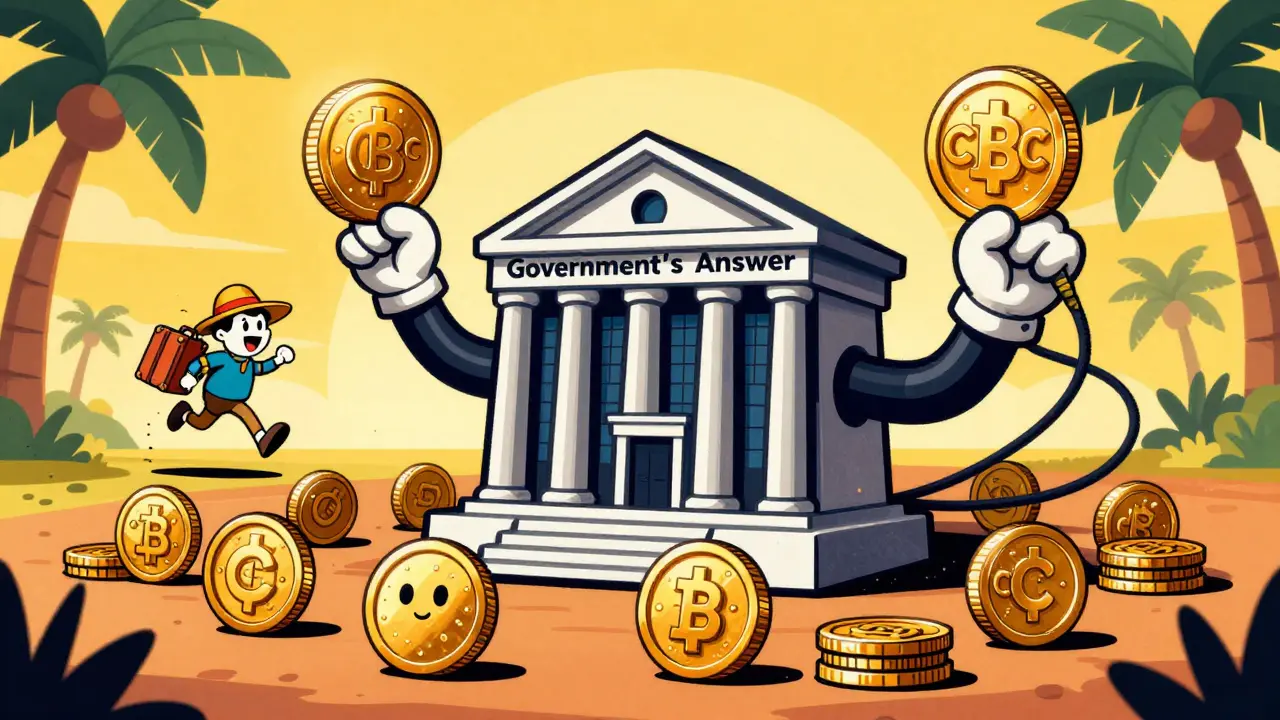
The Rise of CBDCs: The Government's Answer
Governments aren't just trying to stop private crypto; they're trying to build their own versions. Central Bank Digital Currencies (CBDCs) are digital versions of a country's sovereign currency. According to the Bank for International Settlements, about 92% of analyzed countries are working on some form of CBDC.
This creates a strange paradox. A country might ban Bitcoin while simultaneously launching a digital currency project, like Saudi Arabia or Cambodia with "Project Bakong." The goal here is control. CBDCs provide the efficiency of blockchain-instant settlements and lower costs-without giving up the ability to track every single transaction or freeze an account with a keystroke.
Practical Tips for Navigating Global Crypto Laws
If you are operating in multiple jurisdictions, don't wing it. The legal landscape changes fast. Here are a few rules of thumb to keep you out of trouble:
- Check the "Travel Rule": The Financial Action Task Force (FATF) now requires exchanges to share sender and receiver info for transactions over $1,000. If you're using a compliant exchange, expect to provide more KYC (Know Your Customer) data than you did five years ago.
- Separate Personal from Business: As seen in Australia, the tax treatment for an individual holding a "digital gold" asset is very different from someone trading for profit. Keep your records clean.
- Avoid "Banned" Exchanges in Red Zones: Attempting to use a banned exchange in a country like China often leads to poor service and high risk of account freezes, as shown by low user ratings on platforms like Trustpilot.
- Prioritize Clarity Over Laxity: While an unregulated country might seem attractive because "no one is watching," the lack of a framework means you have zero protection if an exchange vanishes with your funds. Regulated markets like Singapore or Switzerland are often safer bets for large sums.
Is it illegal to own Bitcoin in China?
While the Chinese government has banned cryptocurrency trading, mining, and the operation of exchanges since September 2021, the act of simply holding Bitcoin is generally not treated as a criminal offense for individuals. However, attempting to trade or exchange it for yuan through official channels is strictly prohibited and can lead to severe penalties.
Which countries have the most crypto-friendly tax laws?
Portugal is widely considered one of the most friendly, offering 0% tax on income from Bitcoin transactions for individuals. Estonia has also significantly reduced its tax burden on crypto in 2024. Other jurisdictions like the UAE and certain regions of Switzerland offer highly favorable environments for digital asset holders.
What is the MiCA regulation in the EU?
The Markets in Crypto-Assets (MiCA) regulation is a comprehensive framework that standardizes crypto rules across all 27 EU member states. It provides clear requirements for stablecoin issuers and crypto asset service providers, allowing a company licensed in one EU country to operate across the entire union without needing separate licenses for every nation.
Can I use Bitcoin as a legal payment in El Salvador?
Yes. Since June 9, 2021, Bitcoin has been recognized as legal tender in El Salvador. This means businesses are legally required to accept it as payment, although in practice, adoption varies by merchant and the use of the government-backed Chivo wallet is common.
What happens if I trade crypto in a country where it is "Partially Banned"?
In "partially banned" countries, you can usually own the asset, but you cannot use it for commercial transactions. For example, in Namibia, the central bank prohibits banks from facilitating crypto exchanges. This means you might hold Bitcoin in a private wallet, but you'll struggle to move that money into a traditional bank account without triggering red flags.
Comments (16)
debashish sahu
April 20, 2026 AT 04:44
The distinction between legal tender and regulated assets is quite a subtle but important point for those of us in Asia.
Miranda Jamieson
April 21, 2026 AT 23:43
Imagine thinking a 'guide' like this is enough to save you from the SEC. You're all delusional if you think a few bullet points replace actual legal counsel. Most of you are just gambling and calling it investing, which is exactly why the regulatory mess exists. Get a grip on your portfolio before the government does it for you. This is basic stuff that anyone with a brain should already know if they're playing with millions. Stop acting like this is some secret knowledge. It's common sense for anyone who actually understands how global finance operates. You're just begging to get audited with this half-baked approach. Seriously, the arrogance of retail traders is just staggering. Just hire a lawyer and stop pretending a blog post is a strategy. It's pathetic.
Ellie Drews
April 22, 2026 AT 05:53
It's really helpful to see the EU's MiCA explained so simply. It definitely takes some of the stress out of the equation for people wanting to expand their reach.
Jason M
April 22, 2026 AT 18:13
OH MY GOD, the MiCA section is an absolute game-changer!!
For anyone struggling to wrap their head around the EU market, just remember that the 'passport' system is your golden ticket! It is absolutely wild how much efficiency this brings to the table. You have to realize that the cost of compliance is just a small price to pay for the massive scale of the entire European market! Don't let the €250k scare you off, look at the potential for growth! This is the kind of structural shift that defines a decade of finance!
Kyle Bush
April 24, 2026 AT 00:58
USA is still the king regardless of the SEC nonsense! 🇺🇸🦅 We have the best market in the world and we'll always lead the way in innovation! Screw the EU's boring rules 🙄🤡
Eric Raines
April 25, 2026 AT 12:20
I've been saying this for years. The US system is a joke because the agencies don't talk to each other. I tried explaining this to my brother and he just didn't get it. Now I'm the only one in the family who actually knows how the IRS treats these as real estate trades. It's just so draining trying to educate people who refuse to learn.
Benjamin Forg
April 25, 2026 AT 18:50
central banks just want total surveillance through cbdcs its all a trap to freeze your funds the moment you disagree with the narrative’t believe the hype about efficiency they just want to track every cent you spend in real time
Keith Garcia
April 27, 2026 AT 16:33
The juxtaposition of sovereign monetary control and decentralized autonomy is simply delicious 🍷. Most participants in this discourse lack the intellectual fortitude to grasp the sheer absurdity of a 'legal tender' Bitcoin. 🙄 It's quite a quaint notion, really. 💅
Larry Yang
April 28, 2026 AT 17:35
the analysis is okay i guess but feels a bit surface level. a bit too focused on the big names and not enough on the actual flow of capital in gray zones. pretty mid tbh.
Paige Raulerson
April 29, 2026 AT 00:36
I mean, I suppose this is a decent effort for a general audience, though it lacks the nuance I'd expect. It's a bit tedious to read through the basics when the real questions are about the systemic failures of the SEC.
Doc Coyle
April 29, 2026 AT 18:32
It is just wrong to move money to avoid taxes in Portugal. People should pay their fair share for the society they live in. Simple as that.
Guy Bianco
April 30, 2026 AT 20:03
I would suggest focusing on the long-term stability of regulated markets for your primary holdings. 🙂
jill huyo-a
May 1, 2026 AT 16:12
I wonder if there are any other regions besides the EU that are starting to look at a unified passport system for crypto. That would be so helpful for everyone!
Charlie Queen
May 3, 2026 AT 07:14
Love seeing the focus on financial inclusion in places like El Salvador! 🌍✨ It's all about breaking down those old barriers and letting people access the global economy. So inspiring! ❤️
Sara Ellis
May 3, 2026 AT 10:48
laws are just ideas we all agree on until we dont money is just a vibe anyway
Findlay Duncan Lyon
May 4, 2026 AT 09:26
Spot on about the P2P networks. Very common in the UK too.