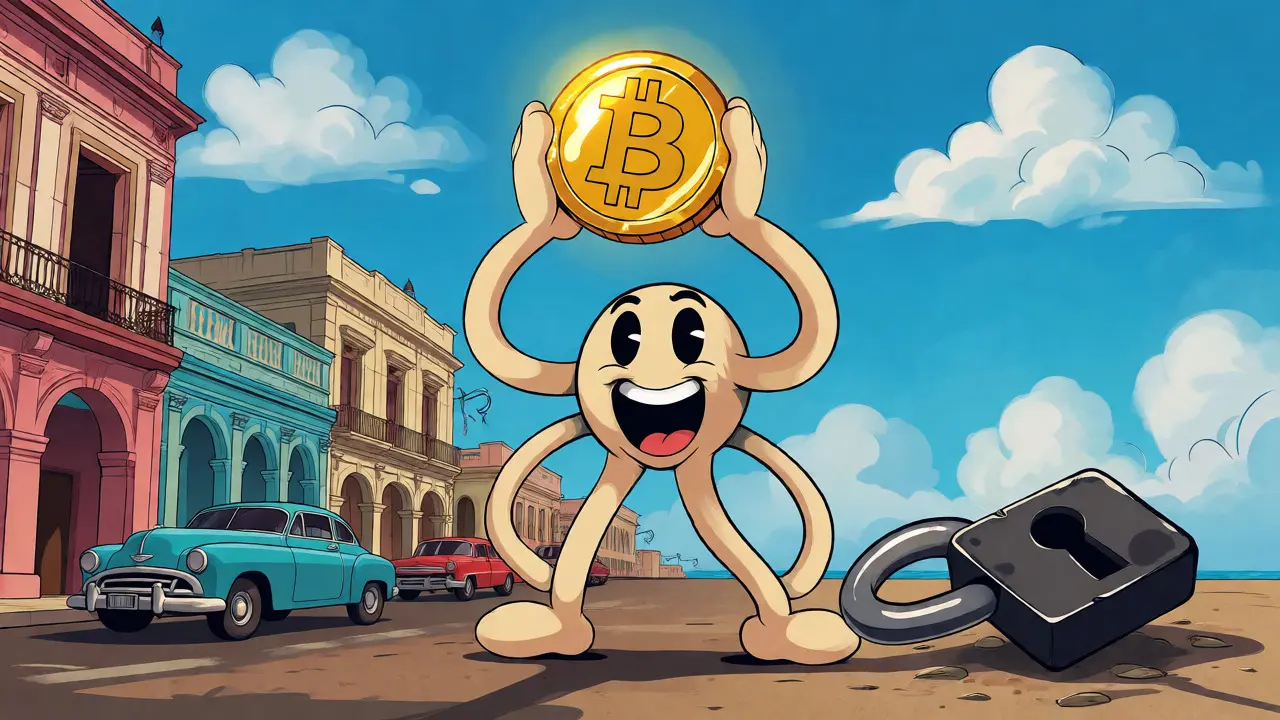
Imagine living on an island where you can’t use PayPal, most credit cards are useless, and Western Union has shut down hundreds of local branches. For millions of Cubans, this isn't a hypothetical scenario-it’s daily life under decades of economic isolation. Yet, while the rest of the world debates whether to ban or embrace digital assets, Cuba did something unexpected. In August 2021, it became only the second nation globally to officially recognize cryptocurrencies as legal tender. This move wasn't driven by tech utopianism but by sheer survival necessity. Today, despite strict government oversight and ongoing U.S. sanctions, Cuban crypto adoption is surging, offering a fascinating case study in how digital currencies can bypass traditional financial blockades.
Why Cuba Embraced Digital Currency
To understand why Havana opened its doors to Bitcoin, you have to look at the financial walls surrounding the country. The U.S. embargo, in place since the early 1960s, has effectively cut Cuba off from the global banking system. Major financial services like Visa and Mastercard don't work there. When Western Union closed over 400 locations in Cuba in 2020, it severed one of the last reliable links for remittances-the money families abroad send home to survive. Suddenly, receiving cash was difficult, expensive, and slow.
Cryptocurrency provided a workaround. It allowed Cubans to receive funds directly into digital wallets without needing a traditional bank account that might be blocked or monitored by sanctioned entities. The Cuban Central Bank (BCC) recognized this shift. By citing "reasons of socio-economic interest," they published Resolution 215, granting themselves the power to regulate digital currencies. This wasn't about deregulation; it was about control. The state wanted to ensure that while people could use crypto, it wouldn't destabilize the peso or escape government oversight entirely.
The Regulatory Framework: Order Out of Chaos
Contrary to the idea of a "wild west" crypto market, Cuba implemented a surprisingly structured regulatory environment. The BCC didn't just say "go ahead." They established specific licensing procedures for Virtual Asset Service Providers (VASPs). If you want to run a crypto exchange or mining operation in Cuba today, you need a license approved directly by the Central Bank. This process evaluates the applicant's probity, experience, and the socioeconomic value of their proposal.
This framework serves two main purposes. First, it combats money laundering and terrorism financing, aligning Cuba with international standards even if they aren't part of the SWIFT network. Second, it allows the government to monitor capital flows. In a country where the official exchange rate often differs wildly from the street rate, knowing who holds Bitcoin and how much helps the state manage inflation and currency devaluation. As of 2025, the rules require all licensed operators to report suspicious activities, ensuring that the digital economy remains visible to regulators.
Mining and Infrastructure Challenges
You might think that in a country known for energy shortages, crypto mining would be impossible. Surprisingly, mining is legal and growing. Since legalization, several mining farms have popped up, particularly in regions rich in renewable energy resources like solar and wind. The government encourages this because it generates foreign currency reserves-something Cuba desperately needs. However, this comes with strict caps on energy consumption. Miners must adhere to rigorous cybersecurity standards and operate within limits set by the state to prevent grid instability.
Infrastructure remains the biggest bottleneck. While mobile internet access has improved significantly in recent years, connection speeds and reliability still lag behind global averages. Accessing international exchanges can be tricky due to IP blocking and payment processing issues linked to sanctions. To mitigate this, the Cuban government has partnered with international tech companies to build better infrastructure and train local workers. These partnerships are crucial for scaling operations beyond small, peer-to-peer transactions.

Who Is Using Crypto in Cuba?
Adoption statistics tell a compelling story. Estimates suggest between 100,000 and 200,000 Cubans actively use cryptocurrencies like Bitcoin, Ethereum, and Avalanche. That represents roughly 1-2% of the population-a significant number for a nation that only recently gained widespread mobile connectivity. But who are these users? They aren't just speculators trying to get rich quick. They are everyday citizens navigating a broken financial system.
- Remittance Recipients: Families receiving money from relatives in Miami or Madrid prefer stablecoins or Bitcoin because they can convert them to pesos at favorable rates or hold them as a hedge against local inflation.
- Online Shoppers: With Amazon and other major retailers inaccessible via traditional cards, many Cubans use crypto to buy goods from international vendors who accept digital payments.
- Small Business Owners: Entrepreneurs involved in tourism and private services use crypto to settle debts with suppliers or partners abroad, bypassing the complex bureaucracy of official currency exchange.
The Role of State-Owned Enterprises
A unique aspect of the Cuban model is the involvement of state-owned enterprises (SOEs). Companies controlled by military-linked groups like GAESA and Gaviota play a massive role in the economy. Because these entities are often subject to OFAC sanctions, international banks are hesitant to deal with them. Cryptocurrency offers a layer of separation. Some SOEs have begun accepting digital assets for services, allowing them to engage in trade without triggering immediate banking freezes. This creates a hybrid economy where state capitalism meets decentralized finance, creating compliance challenges for foreign firms trying to assess risk.
Comparison: Cuba vs. Other Sanctioned Nations
How does Cuba's approach stack up against other nations facing similar restrictions? Unlike Iran, which bans mining during peak energy demand, or Venezuela, where adoption is largely informal and volatile, Cuba has pursued a regulated path. This distinction matters. A regulated market attracts more serious institutional players and reduces the risk of fraud, which has plagued unregulated markets elsewhere.
| Country | Legal Status | Primary Driver | Regulatory Body | Mining Status |
|---|---|---|---|---|
| Cuba | Legal Tender (2021) | Sanctions circumvention & Remittances | Banco Central de Cuba (BCC) | Legal & Licensed |
| Iran | Restricted/Conditional | Energy export monetization | Central Bank of Iran | Banned intermittently |
| Venezuela | Legal (Petro Coin focus) | Inflation hedge | State Oil Company (PDVSA) | Informal/Large scale |
| Russia | Payment restricted | Trade settlement | Bank of Russia | Legalized post-sanctions |

Key Takeaways for Investors and Observers
If you're watching the global crypto landscape, Cuba offers several lessons. First, regulation doesn't always kill innovation; sometimes, it enables it by providing clarity. Second, utility drives adoption more than speculation. People in Cuba aren't buying Bitcoin because they believe in blockchain magic; they're using it because it works when nothing else does. Third, geopolitical pressure accelerates technological adaptation. The harder the sanctions, the more creative the financial solutions become.
However, risks remain. The Cuban peso continues to struggle with inflation, and political shifts could alter the regulatory stance overnight. Additionally, the reliance on imported hardware for mining makes the sector vulnerable to supply chain disruptions caused by trade barriers. Despite these hurdles, the trajectory points toward deeper integration of digital assets into the national economy.
Frequently Asked Questions
Is Bitcoin legal tender in Cuba?
Yes. In August 2021, Cuba became the second country in the world to officially recognize Bitcoin and other cryptocurrencies as legal means of payment through Resolution 215 issued by the Cuban Central Bank.
Can foreigners easily use crypto in Cuba?
It can be challenging. While legally permitted, practical usage is limited by internet infrastructure and the lack of widespread merchant acceptance outside tourist hubs. Foreigners typically rely on peer-to-peer platforms or specific authorized exchanges rather than direct point-of-sale crypto terminals.
Why did Western Union stop operating in Cuba?
Western Union ceased operations in Cuba in November 2020 due to changes in U.S. sanctions policy that complicated its ability to process payments involving certain Cuban state-owned enterprises. This closure pushed many Cubans toward alternative methods like cryptocurrency for receiving remittances.
Is crypto mining profitable in Cuba?
Profitability depends on energy costs and hardware efficiency. While electricity is subsidized, frequent blackouts and strict government caps on consumption pose risks. Mining farms utilizing renewable energy sources like solar and wind have shown better resilience and profitability compared to those relying solely on the national grid.
What are the main risks of holding crypto in Cuba?
The primary risks include regulatory changes, internet connectivity issues preventing access to exchanges, and the volatility of the Cuban peso relative to the USD. Additionally, U.S. secondary sanctions can complicate interactions with international crypto service providers, potentially freezing accounts associated with Cuban IPs.
Next Steps for Understanding Cuban Crypto
If you want to dive deeper, keep an eye on the Banco Central de Cuba's updates regarding VASP licenses. Changes in licensing criteria often signal shifts in government strategy. Also, monitor the performance of stablecoins like USDT, which are increasingly used for everyday transactions due to lower volatility compared to Bitcoin. For travelers or researchers, connecting with local tech communities in Havana can provide real-time insights into how regulations are actually applied on the ground, distinct from what appears in official gazettes.