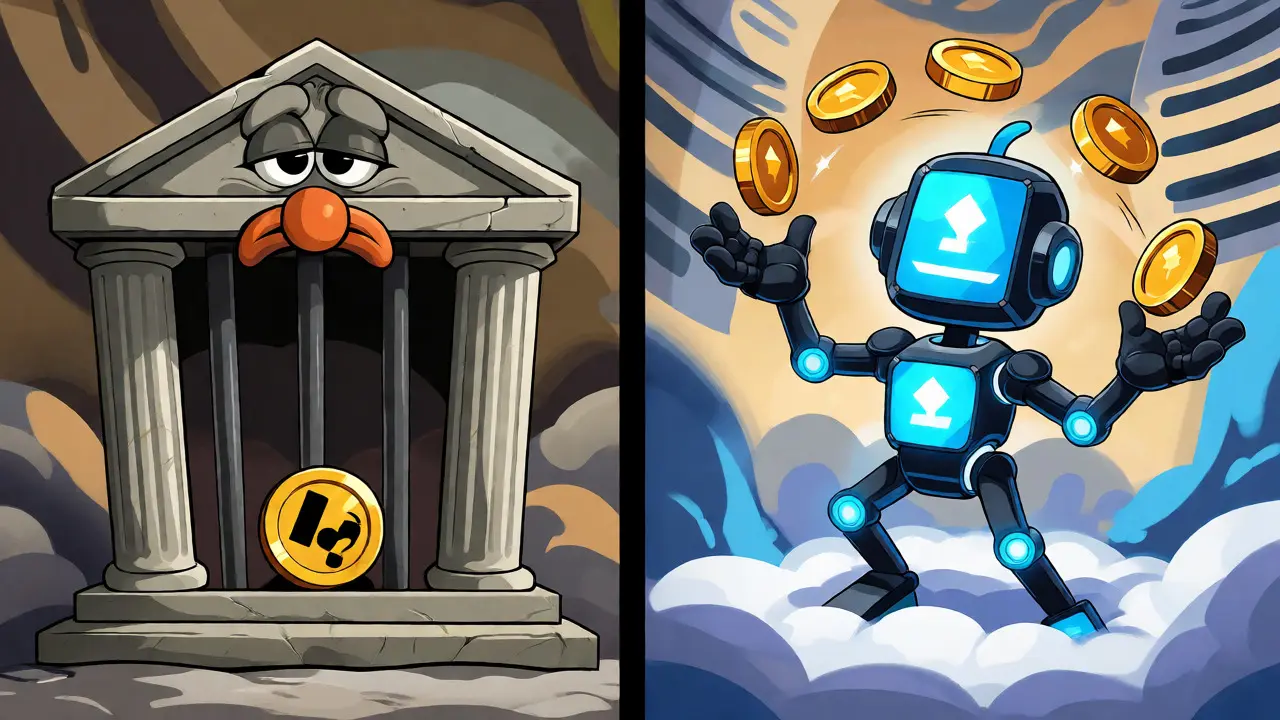
You’ve probably heard the hype. Decentralized Finance (DeFi) is supposedly killing banks, offering double-digit yields with zero paperwork and instant global transfers. But then you read about a $610 million hack or realize you lost your password to your wallet, and suddenly that shiny new tech looks risky. Meanwhile, your local bank charges you $12 a month just for existing, takes three days to send money overseas, and gives you interest so low it’s basically a joke. So, what’s the real deal? Is DeFi actually better for your wallet, or is traditional banking still the safer bet?
This isn’t just a tech debate; it’s a choice about how you control your money. In 2026, the lines are blurring. Traditional banks are trying to act like tech companies, and DeFi protocols are trying to look more like regulated institutions. But the core differences remain stark. Let’s break down exactly where each system wins, loses, and why you might want a piece of both.
The Core Difference: Who Holds the Keys?
The biggest distinction between these two worlds comes down to custody. When you put money in a traditional bank, you don’t really own it in the way you think. The bank holds it. They lend it out, invest it, and manage it for you. You have a claim on their balance sheet, backed by legal frameworks and insurance schemes like the FDIC in the US, which covers up to $250,000 per depositor. If the bank fails, the government steps in. It’s a safety net woven over centuries of financial history.
DeFi, on the other hand, flips this model upside down. It operates on public blockchains like Ethereum or Solana using smart contracts-self-executing code that lives on the network. Here, you hold your own assets in a self-custodial wallet, like MetaMask or Trust Wallet. You control the private keys. No bank manager can freeze your account because they don’t like your name or your location. But here’s the catch: if you lose those keys, or if you click a malicious link and sign a bad transaction, there’s no customer service hotline to call. As of Q2 2025, data shows that 97% of DeFi fraud victims receive no restitution, compared to 97% of traditional banking fraud cases being resolved. That’s a massive difference in risk tolerance.
Yields and Fees: Where Does Your Money Grow Faster?
Let’s talk numbers, because that’s usually what drives people to switch. Traditional savings accounts are notoriously slow growers. According to FDIC reports from mid-2025, the average APY (Annual Percentage Yield) on a standard savings account hovers around 0.45%. Even high-yield online banks rarely push past 4-5% without strict conditions. On top of that, you’re bleeding cash through fees. Bankrate’s 2025 survey found average monthly maintenance fees of $12.50, plus $25-$30 for wire transfers and small fees for every ATM withdrawal.
Now look at DeFi. Because there are no middlemen taking a cut for overhead, salaries, or brick-and-mortar branches, the yields can be significantly higher. Protocols like Aave have offered stablecoin lending rates averaging 8.7% APY in recent months. Yes, these rates fluctuate based on market demand, but they generally dwarf traditional options. However, DeFi isn’t free. You pay "gas fees" to process transactions. These vary wildly depending on network congestion. In early 2026, following Ethereum’s Dencun upgrade, Layer 2 costs dropped dramatically, making small transactions feasible. On Polygon, a typical swap might cost $1.20, while Ethereum mainnet could still run $3.50 during busy periods. For large sums, DeFi’s percentage-based efficiency often beats fixed bank fees, but for small, frequent trades, those gas fees can eat your profits alive.
| Feature | Traditional Banking | DeFi Protocols |
|---|---|---|
| Average Savings Yield | 0.45% - 4.5% APY | 5% - 12%+ APY (Variable) |
| Cross-Border Transfer Time | 3-5 Business Days | Seconds to Minutes |
| Transfer Cost | $25 - $50 + FX Markup | $1 - $10 (Gas Fees) |
| Minimum Deposit | Often $250+ | None (Permissionless) |
| Customer Support | 24/7 Human/Legal Recourse | Community/Discord (Slow) |
| Insurance/Protection | FDIC/RBI Backed | Smart Contract Risk Only |

Speed and Accessibility: Breaking Down Borders
If you’ve ever tried to send money internationally, you know the pain. Traditional systems rely on SWIFT networks, which involve multiple intermediaries, compliance checks, and time zones. A transfer from New York to London can take 72 to 120 hours. It’s archaic. DeFi doesn’t care about borders. Because it runs on a global ledger, sending $10 or $10 million to someone in Nairobi or Tokyo takes seconds to minutes, regardless of weekends or holidays. Stellar, for instance, handles cross-border payments in under 5 seconds.
This speed translates directly into accessibility. There are roughly 5.4 billion unbanked or underbanked people globally, according to World Bank data. Many of them live in regions where opening a bank account requires documents they simply don’t have-like consistent proof of address or land deeds. DeFi removes this barrier. All you need is an internet connection and a smartphone. A farmer in Bihar, India, reported earning 12.3% APY on USDC via Aave with zero paperwork, whereas local banks required documentation he couldn’t provide. This permissionless nature is DeFi’s superpower. It democratizes access to financial services for anyone with a device, bypassing the gatekeepers who decide who is "creditworthy."
Security Risks: Code vs. Regulation
Here is where most people hesitate. Traditional banking feels safe because it’s boring. It’s regulated. If a bank employee steals your money, laws protect you. If the bank goes bust, insurance pays you. DeFi security relies entirely on code. Smart contracts are immutable once deployed. If there’s a bug in the code, hackers can exploit it, and often, the money is gone forever. Remember the Poly Network hack in 2021? That was $610 million. While some funds were returned, many exploits result in permanent losses.
However, DeFi offers something traditional banks cannot: radical transparency. Every transaction on Uniswap or Compound is publicly verifiable on the blockchain. You can audit the reserves yourself. In traditional banking, you trust the bank’s internal ledgers, which are opaque. You only see what they choose to show you. Dr. Garrick Hileman from Blockchain.com notes that while this creates unprecedented auditability, "code is law only when the code is perfect." And code is rarely perfect. Recent stats show 38% of DeFi hacks are mitigated within 24 hours due to community alerts, but that still leaves a lot of room for error. If you aren’t comfortable reading smart contract audits or understanding liquidity pools, traditional banking’s institutional safeguards are much easier to rely on.

Complexity and User Experience
Let’s be honest: DeFi is hard to use. Setting up a wallet, buying crypto on an exchange, bridging assets across chains, and managing gas fees is a steep learning curve. A 2025 study by Openware found that 68% of new users need 2-3 weeks just to become proficient. One wrong click, one forgotten seed phrase, and your assets are inaccessible. Documentation for protocols like Aave scores highly for developers but poorly for beginners (2.3/5).
Traditional banking, conversely, is designed for the masses. Opening an account digitally takes about 15 minutes. The interface is familiar. Customer support is available 24/7 with an average hold time of two minutes. If you make a mistake, you can reverse a transaction or dispute a charge. DeFi lacks this recourse. Once a transaction is confirmed on the blockchain, it’s final. There’s no "undo" button. For many users, especially older generations or those not tech-savvy, this complexity is a major barrier. CoinMetro’s survey revealed that 42% of potential users cite "complexity of wallet management" as the primary reason they stick with banks.
The Future: Convergence, Not Replacement
Are banks going extinct? Probably not. Are DeFi protocols going mainstream? Absolutely. We are seeing a convergence. JPMorgan’s Onyx platform processed $1.2 trillion in blockchain transactions in 2024, showing that big banks are adopting the tech. Regulatory bodies like the OCC have approved national banks for crypto custody. Meanwhile, DeFi is maturing. With Ethereum’s upgrades reducing costs and projects like Project Guardian in Singapore testing DeFi within regulated frameworks, the gap is narrowing.
Gartner predicts DeFi’s Total Value Locked will hit $520 billion by 2027. Goldman Sachs suggests DeFi could capture 15-20% of traditional banking functions by 2030, specifically in cross-border payments and yield generation. But for now, the best strategy isn’t picking a side-it’s diversifying. Keep your emergency fund in a traditional bank for safety and ease of access. Explore DeFi for higher yields and global transfers, but start small. Understand the risks. Use reputable protocols. Check your wallet addresses twice. The future of finance isn’t just digital or traditional; it’s hybrid.
Is DeFi safer than traditional banking?
It depends on your definition of safe. Traditional banking is safer regarding consumer protection and insurance (e.g., FDIC coverage). DeFi is safer regarding censorship resistance and asset ownership, but carries higher risks from smart contract bugs, user error (lost keys), and lack of insurance.
Can I earn more interest in DeFi than in a bank?
Yes, typically. DeFi protocols often offer higher APYs (5-12%+) on stablecoins compared to traditional savings accounts (often under 5%). However, these rates are variable and come with additional risks like smart contract vulnerabilities and market volatility.
Do I need a credit check to use DeFi?
No. DeFi is permissionless. You do not need a credit score, ID verification (KYC), or approval from a loan officer to open a wallet, deposit funds, or borrow against collateral. Anyone with an internet connection can participate.
What happens if I lose my DeFi wallet password?
If you lose your private key or seed phrase, you lose access to your funds permanently. Unlike a bank password, there is no "forgot password" link or customer support team that can reset it for you. Recovery is impossible without the original backup.
Are DeFi transactions faster than bank transfers?
Generally, yes. DeFi transactions settle in seconds to minutes, depending on the blockchain used. Traditional international wire transfers can take 3-5 business days due to intermediary processing and compliance checks.
Comments (15)
Kevin Van Deusen
October 1, 2026 AT 06:56
banks are just legalized theft with a smile and a fee schedule
they take your money lend it out at 15% give you back crumbs and charge you for the privilege of watching them do it
defi is messy sure but at least i know exactly where every satoshi goes and nobody can freeze my account because they woke up on the wrong side of bed or decided my zip code was too risky
the idea that we need these massive inefficient institutions to hold our digital assets is absurd in an age where code is law
i dont care about fdic insurance if the system itself is fundamentally broken by design
regulation usually just means protecting incumbents from competition not protecting the consumer
if you cant read a smart contract audit then maybe defi isnt for you but thats a personal failure not a systemic one
traditional banking is a relic kept alive by inertia and lobbying power
Steve Parshall
October 2, 2026 AT 22:36
Yo this breakdown is solid! 🌍 I've been sending remittances to family in Lagos using stablecoins for like two years now and the difference is night and day compared to Western Union.
It used to cost me 8-10% in fees and take days. Now it's under 1% and instant. That extra cash goes straight into food and school supplies, not some bank's overhead.
The learning curve was real though, took me a few weeks to feel comfortable bridging assets without getting scared of losing everything.
But once you get the hang of it, there's no going back. The financial freedom is addictive. Keep pushing the narrative! 💪🚀
Dana T.
October 3, 2026 AT 02:43
the yield chasing crowd ignores tail risk entirely. 97% unrecovered fraud stats aren't just numbers they're people who lost life savings because they couldn't parse a transaction hash. liquidity fragmentation across L2s creates arbitrage opportunities for insiders while retail gets rekt on slippage. until insurance primitives mature beyond niche protocols defi remains a casino for those with high risk tolerance and low time preference. traditional rails have friction but friction provides safety nets. removing intermediaries removes accountability which is a feature not a bug only if you enjoy being your own compliance officer.
Ana Caroline
October 3, 2026 AT 13:07
One must consider the epistemological crisis inherent in self-custody. When the burden of security falls entirely upon the individual, we are essentially demanding that the layperson possess the technical acumen of a systems engineer. This is not democratization; it is abdication of institutional responsibility.
The romantic notion of 'being your own bank' ignores the cognitive load imposed by constant vigilance against phishing attacks, rug pulls, and protocol upgrades. Traditional banking, despite its inefficiencies, offers a social contract that acknowledges human fallibility. We pay for the luxury of error correction. To dismiss this as mere 'inertia' is to misunderstand the value proposition of stability in an increasingly volatile global economy.
Shawn Jayroe
October 4, 2026 AT 00:57
This is a very balanced perspective. I would add that for most individuals, a hybrid approach is indeed the most prudent strategy.
If you are new to DeFi, start with blue-chip protocols like Aave or Compound rather than experimental farms. Always use hardware wallets for significant holdings. Never share your seed phrase. And please, test transactions with small amounts first. It saves heartache and capital. Education is your best asset here.
Amit Sharma
October 5, 2026 AT 05:58
whatever. both suck in different ways. banks steal slowly defi steals fast. i keep my money in a mattress. zero counterparty risk. zero gas fees. zero interest. perfect system.
Kaitlin Ruiz
October 5, 2026 AT 17:57
Omg YES!! 🙌 The part about cross-border transfers hit home for me. I sent money to my friend in Brazil last week via Solana and it literally took 3 seconds. My bank tried to tell me it would take 3 business days and charge me $35 😱
Also, shoutout to anyone struggling with wallet setup right now – it IS confusing at first but don't give up! Once it clicks, you feel so powerful. Like you actually OWN your money. Which is wild to think wasn't always true lol. 💸✨
KRISHAN LAKHIWAL
October 7, 2026 AT 06:46
DeFi lacks moral grounding. It rewards speculation over production. Banks, flawed as they are, facilitate commerce through credit creation. DeFi facilitates gambling. One builds society, the other enriches whales. Clear distinction.
Aman Kumar Shah
October 8, 2026 AT 07:54
Man, reading this brings back memories of when I first dipped my toes into the crypto waters back in '21. It was like trying to learn quantum physics while juggling flaming swords, honestly! 😅 But seriously, the point about accessibility for the unbanked is HUGE and often overlooked in these debates.
Think about it: in many parts of India, getting a formal loan involves endless paperwork, bribes, and waiting months. With DeFi, if you have collateral (even if it's just some ETH), you can borrow instantly. No gatekeepers. No judgment. Just code executing what you programmed.
Sure, the UX is still clunky, and yeah, one wrong click can ruin your day, but the potential for financial inclusion is staggering. It's not just about earning 10% APY; it's about having access to the global financial system without needing a passport, a utility bill, or a handshake from a local branch manager. That empowerment? That's worth the learning curve. Keep exploring, folks, the future is bright and decentralized! 🌟💡
Tiffany Kee
October 9, 2026 AT 05:10
I appreciate how nuanced this discussion is. For many, especially older generations or those in rural areas, the fear of technology outweighs the benefits of higher yields. Empathy is key here. We shouldn't shame people for preferring the familiar comfort of their local bank branch where they know the teller's name. Transitioning to DeFi requires a shift in mindset that takes time and support. Let's encourage gradual adoption rather than all-or-nothing switches. Every small step towards financial literacy counts. ❤️
Precious Ekwuribe
October 9, 2026 AT 15:47
honestly the ux is still trash imo. i tried setting up metamask again yesterday and almost threw my laptop out the window. why does everything have to be so complicated?? i just want to send money to my mom without becoming a blockchain developer. banks are boring but they work. defi feels like a beta product that hasn't shipped yet. fix the interface before you try to save the world.
Kevin Van Deusen
October 10, 2026 AT 09:36
@Precious Ekwuribe complexity is the price of sovereignty. if you want convenience you accept surveillance and control. you cannot have both. stop complaining about the tool and start learning it.
Mallika Sachdev
October 10, 2026 AT 16:37
Kevin is technically correct but morally bankrupt. Convenience is not surrender. Efficiency allows us to focus on living rather than managing infrastructure. If I hire a driver I am not surrendering my right to travel. Similarly using a custodial service does not mean I cease to own my assets. It is a division of labor. Defi maximalism ignores that specialization drives progress.
sarah lucero baer
October 10, 2026 AT 18:42
respectfully disagree with the 'moral bankruptcy' label mallika. everyone has different risk profiles and values. some prioritize peace of mind others prioritize autonomy. neither is objectively better. let's keep the conversation constructive and avoid labeling people based on their financial preferences. we can all learn from each other's perspectives.
Kerry Sims
October 11, 2026 AT 21:44
at the end of the day money is just information. whether that info lives in a centralized server or a distributed ledger doesn't change its nature as a medium of exchange. what changes is who controls the truth. defi shifts control to the user but also shifts the burden of verification. it's a philosophical trade-off between trust in institutions and trust in mathematics. neither is perfect but math doesn't have bad days.