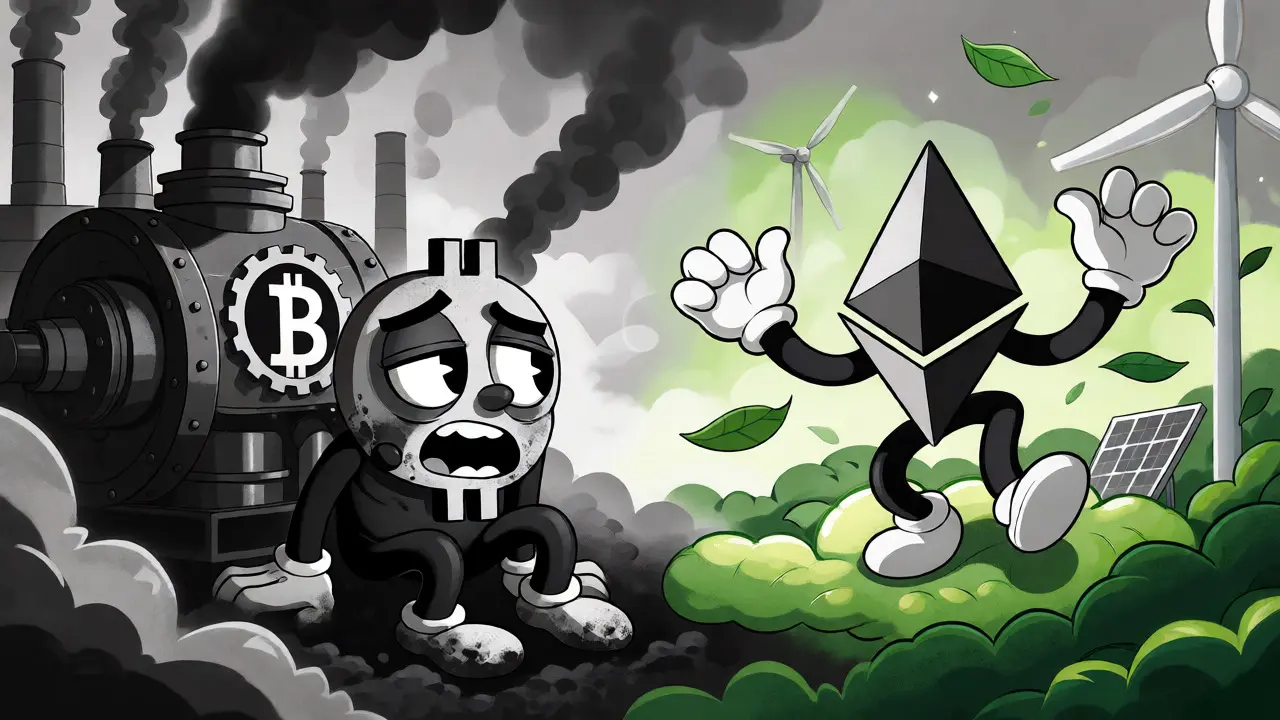
Remember when buying Bitcoin meant you were basically burning coal to power a digital ledger? That image stuck. For years, environmentalists and traditional investors looked at cryptocurrency with suspicion, seeing it as a carbon-heavy outlier in a world trying to go green. But if you're still thinking about crypto through that lens in 2026, you might be missing the bigger picture. The landscape has shifted dramatically. Between regulatory whiplash in Washington and massive technical upgrades on the blockchain itself, ESG concerns for crypto investors have become less about "is this bad for the planet?" and more about "how do I navigate the complex web of sustainability, social impact, and governance in digital assets?"
If you are managing a portfolio or just curious where your money goes, you need to understand three specific jobs you have to complete. First, you need to distinguish between different types of blockchains based on their energy footprint. Second, you must evaluate the social utility of projects beyond just price speculation. Third, you have to keep an eye on the changing regulatory environment, especially after the U.S. Department of Labor's recent moves regarding fiduciary duties. Let’s break down how to handle these tasks without getting lost in jargon.
The Environmental Reality: Proof-of-Work vs. Proof-of-Stake
Let’s start with the 'E' in ESG because it’s usually the first thing people ask about. Is crypto killing the planet? The short answer is: it depends entirely on which coin you buy. Not all blockchains are created equal. The primary driver of environmental impact is the consensus mechanism-the way a network agrees on who owns what.
Bitcoin uses Proof-of-Work (PoW). This requires miners to solve complex mathematical puzzles using powerful computers. It’s secure, but it consumes a lot of electricity. Estimates vary, but Bitcoin mining alone can consume as much energy as medium-sized countries like Argentina or Sweden. However, context matters. If those miners are located in regions with excess hydroelectric power, like parts of Canada or the Pacific Northwest, the carbon footprint drops significantly. But if they’re running on natural gas in Texas, the emissions are real.
Then there is the alternative: Proof-of-Stake (PoS). This is where things get interesting for eco-conscious investors. In PoS systems, validators don’t burn electricity solving puzzles; instead, they lock up ('stake') their coins to validate transactions. The energy difference is staggering. When Ethereum transitioned from PoW to PoS in September 2022, its energy consumption dropped by roughly 99.9%. Suddenly, Ethereum became one of the most energy-efficient major networks available.
Other networks like Cardano and Solana also use PoS or similar low-energy mechanisms. Solana, for instance, claims a per-transaction energy cost comparable to watching a few minutes of video streaming. If environmental impact is your top priority, avoiding pure PoW chains is the simplest heuristic. Look for projects explicitly designed for efficiency or those actively transitioning to greener standards.
| Blockchain | Consensus Mechanism | Relative Energy Use | Primary Energy Source Trend |
|---|---|---|---|
| Bitcoin | Proof-of-Work | High | Mixed (Renewables increasing, but fossil fuels remain significant) |
| Ethereum | Proof-of-Stake | Very Low | Grid-dependent (low absolute draw) |
| Solana | Proof-of-History/Stake | Low | Grid-dependent (high throughput efficiency) |
| Algorand | Pure Proof-of-Stake | Negative Carbon Footprint (claims offset) | Renewable-focused initiatives |
Governance: Who Actually Runs the Show?
Now let’s talk about the 'G'. In traditional finance, governance means looking at board independence, executive pay, and shareholder rights. In crypto, it’s wilder. Governance here refers to how decisions are made about protocol upgrades, treasury spending, and rule changes. Ideally, crypto is democratic. In practice, it’s often messy.
You need to look at token distribution. If 1% of wallets hold 50% of the tokens, you don’t have a democracy; you have a plutocracy. Check tools like Dune Analytics or Nansen to see whale concentration. High concentration risks centralization, which defeats the purpose of decentralized finance. Also, examine the voting mechanisms. Are they transparent? Can regular users participate, or is it gated behind high staking requirements?
Consider Uniswap. Its governance token, UNI, allows holders to vote on proposals. But voter turnout has historically been low, meaning a small group of large holders often decides the outcome. Compare this to older projects where developers held unilateral control. Good governance isn't just about having a vote; it's about active participation and clear communication channels. Look for projects with public forums, documented decision-making processes, and a track record of handling conflicts without hard forks or community splits.

Social Impact: Beyond Price Action
The 'S' in ESG stands for Social, and in crypto, this is often overlooked. Traditional ESG looks at labor practices and community engagement. For crypto, you should ask: Does this project actually help people? Or does it just extract value?
Financial inclusion is a big one. Projects targeting unbanked populations in Southeast Asia or Latin America can have genuine social merit. Stablecoins, for example, allow people in countries with hyperinflation (like Venezuela or Nigeria) to save in USD equivalents. That’s a tangible social benefit. On the flip side, some meme coins offer zero utility, serving only as gambling vehicles. They create little social value and often exploit retail investors with poor information access.
Also, consider the development team. Diversity in tech teams correlates with better problem-solving and broader product appeal. While hard data on crypto dev diversity is scarce, look for projects publishing annual reports or community grants that support diverse contributors. Ethical working conditions within DAOs (Decentralized Autonomous Organizations) are also emerging topics. Are contributors paid fairly? Is there transparency in how treasury funds are spent?
The Regulatory Shift: What Changed in 2025?
If you read news from 2023 or 2024, you might remember the SEC being aggressive against crypto companies. Fast forward to 2026, and the vibe has changed. The political winds shifted, bringing a more crypto-friendly administration to the White House. This has direct implications for ESG investing, particularly for retirement accounts.
In May 2025, the U.S. Department of Labor (DOL) issued Compliance Assistance Release No. 2025. This was a big deal. It effectively rescinded Biden-era rules that had complicated how fiduciaries could consider ESG factors. The new stance suggests that applying individual ESG investment factors might be inconsistent with ERISA fiduciary duty requirements unless they directly affect financial returns. Essentially, regulators are telling plan sponsors: "Focus on money, not morals," unless the moral factor impacts the bottom line.
This creates a tricky situation for crypto investors in 401(k)s. Previously, the DOL warned against offering crypto options due to volatility and custody risks. Now, the tone is neutral. Plan sponsors are less discouraged, but they still need to prove prudence. For you, this means institutional adoption might accelerate, but the explicit "ESG label" might carry less weight in official fiduciary reviews. Don’t rely solely on an ESG rating to justify a crypto purchase; ensure the asset has strong fundamentals.
Furthermore, the classification of assets is shifting. There is growing momentum to classify many cryptocurrencies as commodities rather than securities. This would move oversight from the SEC to the Commodity Futures Trading Commission (CFTC). Why does this matter for ESG? Because commodity regulations often focus more on market integrity and physical supply chains (like mining sources) rather than investor disclosure. Keep an eye on whether your holdings fall under CFTC or SEC jurisdiction, as compliance costs and transparency requirements differ.

How to Build an ESG-Conscious Crypto Portfolio
So, how do you actually put this into practice? You don’t need to sell all your Bitcoin, but you should diversify with intention. Here is a simple checklist to run through before adding a new asset:
- Check the Consensus Mechanism: Is it Proof-of-Stake? If yes, the environmental risk is low. If Proof-of-Work, investigate the energy mix of major mining hubs.
- Analyze Token Distribution: Use on-chain data to see if whales dominate. Decentralized ownership equals better governance potential.
- Evaluate Real-World Utility: Does the project solve a problem? Financial inclusion, supply chain tracking, or cross-border payments count as social positives.
- Review Governance Activity: Are votes happening? Is the community engaged? Passive governance is a red flag.
- Monitor Regulatory Status: Is the asset likely to be classified as a security or commodity? This affects long-term liquidity and institutional acceptance.
Don’t ignore green bonds and sustainable finance instruments either. Some newer projects issue tokens backed by renewable energy credits or carbon offsets. These hybrid models attempt to bridge the gap between traditional ESG metrics and blockchain technology. For example, a platform might tokenize solar farm output, allowing investors to earn yield while supporting clean energy. These are worth exploring if you want direct alignment with environmental goals.
Common Pitfalls to Avoid
One major mistake is assuming "green" branding equals actual sustainability. Greenwashing exists in crypto just like in fashion. A project might claim to be eco-friendly but lack third-party verification of its energy sources. Always look for audits or independent assessments of energy consumption.
Another pitfall is ignoring the social cost of rapid innovation. Blockchain projects often move fast, sometimes breaking things-and people. Poorly managed token launches can wipe out retail investors. Look for projects with clear vesting schedules for insiders to prevent dumping on early adopters. That’s a governance and social fairness issue rolled into one.
Finally, don’t treat ESG as a static filter. Technology evolves. A chain that was energy-intensive five years ago might have upgraded. Regulations change every election cycle. Stay flexible. Re-evaluate your holdings annually, not just when prices spike.
Is Bitcoin inherently bad for ESG scores?
Not necessarily. While Bitcoin uses energy-intensive Proof-of-Work, its environmental impact varies by location. Mining operations increasingly use stranded renewable energy (like hydro in rainy seasons) or flare gas from oil fields, turning waste into power. Additionally, Bitcoin's fixed supply and decentralization score well on governance aspects of ESG. It’s a trade-off: high environmental cost, but high governance robustness.
Do ESG ratings exist for cryptocurrencies?
Yes, several firms now provide ESG ratings for digital assets, such as Sustainalytics and MSCI. However, methodologies vary widely. Some focus heavily on energy use, while others weigh governance and social utility. Be careful relying on a single score; always check the underlying criteria used by the rating agency.
How did the 2025 DOL guidance affect crypto in 401(k)s?
The DOL’s 2025 release signaled a return to a neutral approach, removing previous explicit warnings against crypto in retirement plans. It suggested that ESG factors shouldn’t override pecuniary (financial) interests. This makes it easier for plan sponsors to include crypto options, provided they demonstrate prudent selection and adequate custody solutions, potentially boosting institutional demand.
Which cryptocurrencies are best for ESG-focused investors?
Generally, Proof-of-Stake networks like Ethereum, Cardano, and Algorand rank higher on environmental metrics. Projects with strong social missions, such as those providing banking services to the unbanked or improving supply chain transparency, also score well. Look for assets with transparent governance and low whale concentration.
What is the risk of greenwashing in crypto?
Greenwashing is common. Projects may claim carbon neutrality without verifiable offsets or overstate the efficiency of their consensus mechanism. Always seek third-party audits of energy usage and carbon offset purchases. Skepticism is healthy; verify claims with on-chain data and independent reports rather than marketing materials.
Comments (17)
Bhanu Rokkam
September 11, 2026 AT 00:57
Stop pretending this is a new paradigm. The 'shift' you describe is just the industry pivoting to survive regulation while keeping the same extractive mechanics. Proof-of-Stake isn't a moral victory; it's a technical adjustment that conveniently aligns with institutional demands for lower operational costs without changing the fundamental power dynamics of who holds the assets. You are still buying into a system where early whales dictate the narrative, and now they get to do it with a cleaner conscience and a smaller electricity bill.
Claudio Gatlin
September 12, 2026 AT 03:28
The article fails to address the core issue: retail investors lack the sophistication to evaluate these nuances. Most people cannot distinguish between a genuine consensus mechanism upgrade and a marketing ploy. They see "Green" and buy, ignoring the underlying tokenomics which often remain centralized regardless of energy consumption. This guide assumes an intelligence level among the general public that simply does not exist in the crypto space.
Katherine Rosales Maza
September 14, 2026 AT 03:14
I appreciate the breakdown of the DOL guidance. It is crucial for fiduciaries to understand that ESG factors must directly impact financial returns to be considered under ERISA. However, I would add that the distinction between commodity and security classification remains the most volatile variable here. Until the CFTC provides clearer jurisdictional boundaries, plan sponsors should proceed with extreme caution regarding custody solutions, as the regulatory landscape is far from settled despite the perceived shift in tone.
Sue Long Merrill
September 15, 2026 AT 14:02
One must exercise significant skepticism regarding the claim that governance has improved. In my professional experience reviewing digital asset portfolios, the majority of projects exhibit profound deficiencies in social impact metrics. The focus on energy efficiency is merely a superficial layer masking poor labor practices within development teams and opaque treasury management. Investors who prioritize environmental metrics over social governance are making a fundamentally flawed assessment of risk.
Alvin Sunderland
September 16, 2026 AT 21:33
They're hiding the real data!!! The "green" transition is a smokescreen for centralization!! When Ethereum moved to PoS, did anyone check the validator concentration?? No!! Because the media wants you to feel good about your carbon footprint while the whales consolidate control!!! The DOL change isn't about neutrality; it's about protecting Wall Street's access to retail capital before the bubble bursts!!! Wake up!! The grid dependency is a ticking time bomb for stability!!!
William Newcombe
September 16, 2026 AT 21:50
The philosophical underpinning of this argument rests on a utilitarian framework that may be insufficient for true sustainability. By reducing environmental impact to mere energy consumption per transaction, we ignore the broader ecological externalities of hardware production and disposal. Furthermore, the concept of "social utility" in decentralized networks is inherently subjective. Who defines value? If the network serves only those with capital to stake, can it truly claim social merit? We must consider whether these systems reinforce existing hierarchies rather than disrupting them.
clarence bustos
September 18, 2026 AT 16:57
It feels so wrong to judge crypto solely by its energy use when it gives financial freedom to millions who were ignored by banks! 🌍 We need to look at the human stories behind the tech. Helping someone in Venezuela save their money is worth more than a few kilowatt-hours. Don't let the elitists tell you otherwise. ❤️
Wanda Terral
September 19, 2026 AT 01:00
The sheer magnitude of the regulatory pivot described is nothing short of tectonic. To suggest that the DOL's stance effectively neutralizes previous barriers to entry for retirement plans is to underestimate the lingering inertia of institutional risk aversion. The volatility inherent in these assets creates a psychological barrier that no amount of ESG rebranding can fully dismantle. It is a dramatic, high-stakes gamble masquerading as prudent diversification.
John Failla
September 19, 2026 AT 18:21
We have a moral obligation to support technologies that empower the unbanked. Dismissing stablecoins because they don't fit a traditional ESG mold is short-sighted. The social benefit of providing a store of value in hyperinflationary economies is undeniable. We must champion these tools, not critique them based on Western-centric definitions of sustainability.
Sean Patterson
September 19, 2026 AT 18:26
lol "ESG conscious crypto" is an oxymoron. Youre basically saying "I want to gamble but feel good about it." The greenwashing is insane. Half these projects cant even prove their energy sources. Its all vibes and no data. Typical crypto nonsense. 😂
Ryan Abenoja
September 19, 2026 AT 20:09
This is actually really helpful info for beginners trying to navigate the noise. Great job breaking down the complex parts into simple steps
Tim Soefje
September 20, 2026 AT 21:52
Finally, some clarity. Just remember, if it doesn't make money, the planet doesn't care. Keep it simple.
Sean Russo
September 21, 2026 AT 20:53
I think there is room for both perspectives here. While environmental concerns are valid, the social inclusion aspect shouldn't be dismissed. A balanced portfolio might include both low-energy chains and projects with strong social missions. We can learn from each other's viewpoints rather than dismissing them entirely.
Greeshma Umapathi
September 23, 2026 AT 02:37
This is EXACTLY what the market needed! Stop being afraid and start investing in the future! 🚀 The technology IS evolving and we MUST embrace the change! Look at how fast things are moving! Don't miss out on this revolution! 💪🔥
Alison Cooper
September 23, 2026 AT 05:34
From a global perspective, the emphasis on US regulatory changes ignores the rapid adoption in emerging markets where ESG frameworks are less rigid. These regions prioritize utility and accessibility over strict environmental scoring. Ignoring this cultural difference leads to a biased investment strategy that fails to capture the true global demand for digital assets.
emmanuel ivan
September 25, 2026 AT 00:43
Great post! As someone working in cross-border finance, I see the value in stablecoins daily. But yes, the typo in the table header caught my eye. Otherwise, solid analysis. We need more collaboration on standardizing these metrics globally. 🤝
Samantha Dalton
September 25, 2026 AT 16:52
i think u guys r overcomplicating it. just dont buy stuff that wastes too much power and supports bad bosses. easy.