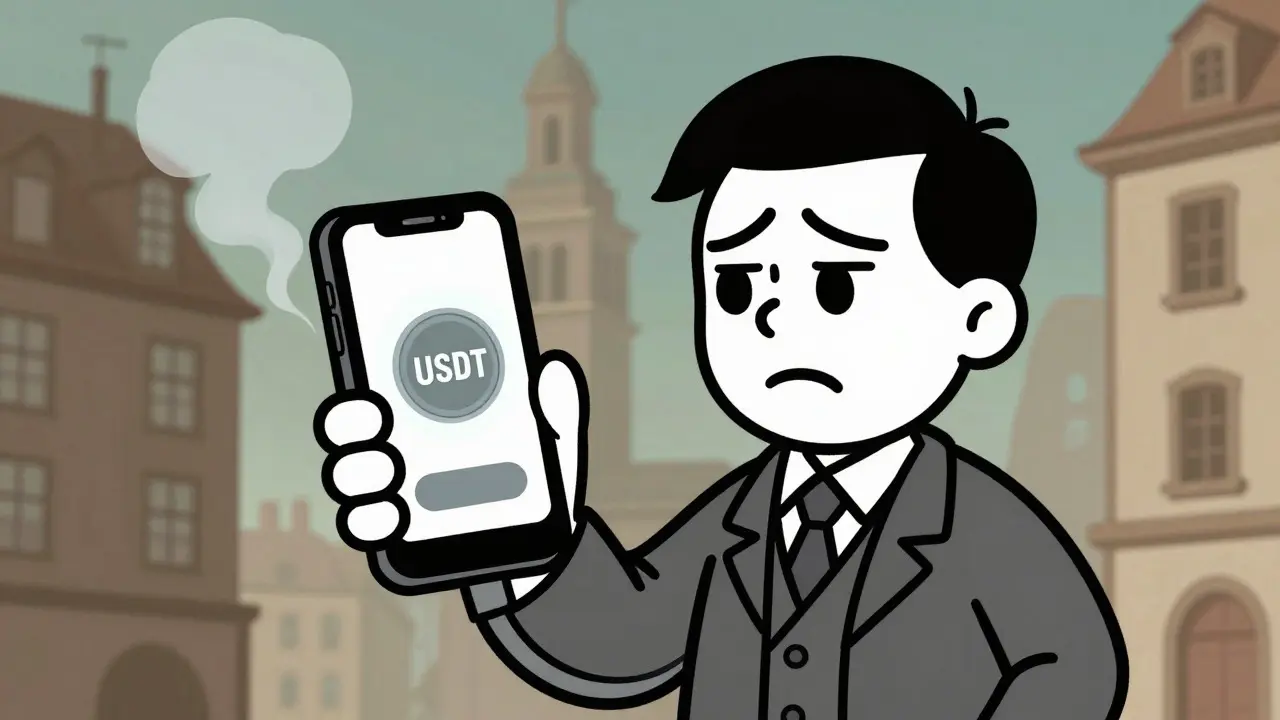
Imagine logging into your favorite crypto exchange in Berlin, Paris, or Amsterdam, only to find that USDT-the digital dollar you’ve used for years-is no longer available for trading. No error message, just a grayed-out button and a notice about new European laws. This isn’t a glitch. It’s the reality of living under the Markets in Crypto-Assets (MiCA) regulation.
If you hold stablecoins in Europe, the rules have changed dramatically. The European Union didn’t just tweak the guidelines; it rebuilt them from the ground up. With MiCA fully enforceable in 2025, the days of unregulated stablecoins operating freely within the EU are over. But what does this actually mean for your wallet? Why is Tether’s USDT facing such strict scrutiny, and what alternatives are left for everyday users?
The End of the Wild West: Understanding MiCA
To understand why your options have shrunk, you first need to look at MiCA, which stands for Markets in Crypto-Assets Regulation. Officially known as Regulation (EU) 2023/1114, this law became the backbone of crypto regulation across all 27 EU member states. Before MiCA, stablecoins operated in a legal gray area. Now, they face strict oversight designed to protect consumers and ensure financial stability.
MiCA divides stablecoins into two specific categories, and understanding this split is crucial:
- E-Money Tokens (EMTs): These are stablecoins pegged 1:1 to a single fiat currency, like the Euro or the US Dollar. They must be backed by highly liquid assets held in segregated accounts.
- Asset-Referenced Tokens (ARTs): These track a basket of currencies or other assets. They face even stricter capital requirements because their value can fluctuate more than simple e-money tokens.
The key takeaway here is transparency. Under MiCA, issuers must prove they have enough reserves to cover every token in circulation. If you hold one euro-worth of an EMT, the issuer must have one euro (or equivalent high-quality liquid assets) sitting in a protected account, ready for you to redeem at any time. This eliminates the mystery surrounding reserve backing that plagued earlier stablecoins.
Why USDT Is Facing Heavy Scrutiny
You might be wondering, "What about USDT?" Tether USD (USDT) has been the market leader for years, but it faces significant hurdles under MiCA. As of early 2025, USDT was not immediately classified as a compliant EMT within the EU framework without meeting specific authorization standards set by national competent authorities.
The core issue is trust and verification. The Bank for International Settlements (BIS) warned in its 2025 Annual Economic Report that many major stablecoins, including USDT, had experienced "substantial deviations from par." In plain English, this means the price sometimes dipped below $1.00, showing fragility in the peg. MiCA aims to prevent this by demanding real-time auditability and bankruptcy-protected reserves.
For Crypto-Asset Service Providers (CASPs)-the exchanges and platforms where you trade-this meant a hard deadline. By the end of January 2025, ESMA (European Securities and Markets Authority) required these platforms to delist non-compliant stablecoins from trading pairs. While you might still be able to hold or transfer existing USDT if you already owned it, buying or selling it on regulated EU platforms became difficult or impossible unless Tether secured full local authorization.
| Feature | Pre-MiCA Era | Post-MiCA (2025+) |
|---|---|---|
| Reserve Backing | Often opaque, mixed assets | 1:1 backing with high-quality liquid assets |
| Redemption Rights | No guaranteed right to redeem | Legal right to redeem at par value |
| Issuer Liability | Limited consumer protection | Strict liability and segregation of funds |
| Market Access | Open to all issuers | Requires EU passporting or national license |
The European Alternative: A New Era of Local Stablecoins
So, if USDT is restricted, what do Europeans use? The answer lies in a massive shift toward indigenous solutions. Nine major European banks-including ING, UniCredit, KBC, and Raiffeisen Bank International-formed a consortium to launch a MiCA-compliant euro-denominated stablecoin. Scheduled for release in the second half of 2026, this project aims to provide a "real European alternative" to US-dominated stablecoins.
This isn’t just about politics; it’s about infrastructure. Floris Lugt, Digital Assets lead at ING, noted that digital payments are key for new euro-denominated financial markets. By creating a stablecoin that settles instantly 24/7 using blockchain technology, Europe hopes to reduce reliance on SWIFT and traditional banking rails for cross-border transactions.
For now, however, users are looking at existing compliant options. Some smaller e-money institutions have already launched Euro-backed EMTs that meet MiCA standards. These tokens are less liquid than USDT but offer the peace of mind that comes with regulatory approval. You’ll see them listed on major EU exchanges like Coinbase Europe, Kraken, and Bitstamp, often labeled clearly as "MiCA Compliant."">
How This Compares to the US Approach
If you’re thinking of moving your operations offshore, you should know how the US handles this. On July 18, 2025, President Trump signed the GENIUS Act (Guiding and Establishing National Innovation for U.S. Stablecoins Act). While both MiCA and the GENIUS Act demand 1:1 reserves and redemption rights, the US approach is notably more flexible.
The GENIUS Act treats regulated stablecoins as "payment stablecoins," granting them status similar to electronic money but with faster implementation timelines. This leniency has sparked a race for "competitive acquisition," where US regulators aim to attract crypto businesses away from stricter jurisdictions like the EU. Major players like Visa and Mastercard are integrating stablecoins into their networks, and retailers like Walmart are exploring them for high-volume transactions.
This creates a divergence. Europe prioritizes consumer protection and monetary sovereignty, while the US focuses on innovation and global competitiveness. For a trader in Boulder, Colorado, this means easier access to a wider range of stablecoins. For a trader in Munich, it means fewer choices but higher security guarantees.
What You Need to Do Right Now
If you live in the EU and hold non-compliant stablecoins, here is your action plan:
- Audit Your Holdings: Check which stablecoins you own. If they are not explicitly marked as MiCA-compliant EMTs or ARTs, they may face liquidity issues on local exchanges.
- Convert Strategically: CASPs are required to offer conversion options. Consider swapping non-compliant tokens for Euro-backed EMTs or Bitcoin/Ethereum if you want to maintain flexibility.
- Verify Exchange Status: Ensure your exchange holds a valid CASP license under MiCA Title V. Unlicensed platforms may shut down operations in the EU, risking your funds.
- Watch for the Bank Consortium Token: Keep an eye on announcements from the ING-led consortium. When their Euro stablecoin launches in late 2026, it could become the primary medium of exchange for EU-based DeFi and payments.
Don’t panic if you still see USDT on some platforms. Some legacy wallets allow transfers, but trading volume will drop significantly. The goal of MiCA is not to ban stablecoins but to force them into the light. If a stablecoin can’t prove its reserves, it shouldn’t be trusted with your savings.
The Bigger Picture: Financial Stability vs. Freedom
Critics argue that MiCA stifles innovation. Proponents say it prevents the next Terra-Luna collapse from happening in Europe. The truth likely sits in the middle. By enforcing strict reserve ratios and redemption rights, MiCA protects retail investors who previously had no recourse if a stablecoin depegged.
The BIS highlighted risks of capital flight and monetary sovereignty undermining in emerging economies, suggesting that global coordination is needed. However, Europe is setting the standard. Other regions may follow suit, making MiCA compliance a global benchmark rather than just a local rule.
As we move through 2026, the landscape will continue to evolve. The gap between US and EU regulations may widen, leading to fragmented markets. But for the average user, the message is clear: choose regulated, transparent stablecoins. Your money deserves better than a promise backed by vague corporate statements.
Is USDT banned in the EU?
USDT is not strictly "banned" in the sense that you cannot hold it in a private wallet. However, under MiCA, regulated Crypto-Asset Service Providers (exchanges) must delist non-compliant stablecoins from trading pairs. Since USDT did not initially meet the strict EMT authorization requirements in all member states, it became difficult to buy or sell on major EU-regulated platforms after January 2025.
What is a MiCA-compliant stablecoin?
A MiCA-compliant stablecoin is either an E-Money Token (EMT) or an Asset-Referenced Token (ART) that has received authorization from an EU national regulator. It must be backed 1:1 by high-quality liquid assets, kept in segregated accounts, and offer users the legal right to redeem tokens at par value.
When will the European bank stablecoin launch?
The consortium led by ING, UniCredit, and eight other major European banks plans to launch its MiCA-compliant euro-denominated stablecoin in the second half of 2026. This token aims to provide a secure, locally regulated alternative to US-dominated stablecoins like USDT and USDC.
How does MiCA differ from the US GENIUS Act?
Both frameworks require 1:1 reserve backing and redemption rights. However, MiCA is stricter regarding enforcement timelines and consumer protections, requiring immediate delisting of non-compliant assets. The US GENIUS Act, signed in July 2025, offers more flexible implementation periods and aims to foster innovation through "rapid onshoring" of crypto businesses.
Can I still use USDT for DeFi in Europe?
You can technically interact with USDT on decentralized protocols if you access them via non-custodial wallets. However, liquidity may decrease as regulated exchanges remove USDT pairs. Additionally, future EU regulations may extend MiCA-like rules to DeFi interfaces accessible to EU residents, potentially restricting usage further.
Comments (19)
Nick Darring
August 4, 2026 AT 02:24
Look, I know everyone is freaking out about MiCA and the whole USDT situation, but let’s take a step back and look at this from a slightly different angle, shall we? It’s almost like we’re being herded into these new, shiny, regulated pens because the old ones were too messy, or so they claim. But really, isn’t it just another way for the big banks to tighten their grip on what used to be our playground? I mean, sure, safety is good, who doesn’t want their money safe, right? But remember when crypto was supposed to be about freedom and decentralization, not filling out forms for some bureaucrat in Brussels? Now we have ING and UniCredit launching their own stablecoins, which sounds less like innovation and more like them just trying to digitize their existing monopoly. It’s funny how 'protection' always seems to come with a side of 'control'. And don’t get me started on the US GENIUS Act, which is basically saying 'we’ll do it faster and looser', inviting all the risk-takers over there while Europe plays it safe. So maybe the Europeans are safer, but are they happier? Probably not. They’re trading liquidity for peace of mind, which is a tough pill to swallow when you’re used to moving millions in seconds without asking permission. Anyway, just my two cents, or rather, my two euros now that we’re talking about EMTs.
Phil Babb
August 5, 2026 AT 02:31
THIS IS EXACTLY WHAT WE NEEDED!!! FINALLY SOME ORDER IN THE CHAOS!! YES TO SAFETY!! YES TO TRANSPARENCY!!
Dominic Greco
August 5, 2026 AT 19:15
They want your data! 🚨👁️ The 'reserves' are fake! Just like everything else! Wake up sheeple! 🐑💸
Sean Rowland
August 6, 2026 AT 12:52
The epistemological framework of MiCA is fundamentally flawed in its assumption that centralized oversight equates to stability. One must consider the ontological shift occurring within the financial paradigm. By enforcing strict liability, they are essentially criminalizing the very essence of decentralized trust mechanisms. It is a draconian measure disguised as consumer protection. The jargon-heavy discourse surrounding 'EMTs' and 'ARTs' serves only to obfuscate the underlying power dynamics at play. We are witnessing the death of digital sovereignty.
Sus Sawyer
August 7, 2026 AT 05:17
Honestly, y’all are making this way more complicated than it needs to be. Look, if you’re in the EU, you gotta adapt. It’s not the end of the world. Just swap your USDT for something compliant, like those Euro-backed tokens mentioned. Yeah, it’s a pain in the butt, but hey, better safe than sorry, right? Plus, once that bank consortium token drops in 2026, things might smooth out. Don’t stress too much, just keep an eye on your exchange status. You got this! 💪✨
Aryan MISHRA
August 8, 2026 AT 13:58
MiCA is necessary. Period. Volatility is bad. Regulation is good. Follow the rules.
Ryan Robinson
August 8, 2026 AT 19:11
i guess its fine? i dont really care that much tbh. just hope i can still trade my shit without too much hassle. regulation is regulation i suppose. lets see how it goes.
Earl Kott65
August 9, 2026 AT 11:52
Oh wow, what a surprise! 😱 Another layer of bureaucracy to slow us down! Can't wait to fill out all those forms! 🙄 So thrilling!
Ethan Yuwono
August 10, 2026 AT 00:52
it is interesting to see how different regions approach this. europe chooses safety. usa chooses speed. neither is perfect. both have tradeoffs. we should observe carefully.
Jack Delasquez
August 11, 2026 AT 15:19
just convert it already stop complaining lol
Harman Singh
August 11, 2026 AT 17:33
my wallet is empty anyway so whatever happens doesnt matter much to me really
Qolbina Islami
August 12, 2026 AT 02:26
AMERICA FIRST!! WHY ARE WE LISTENING TO EUROPEAN RULES?? THEY HATE FREEDOM!! BUY AMERICAN STABLECOINS!! 🇺🇸🇺🇸🇺🇸
SUBHAM CHOUDHURY
August 14, 2026 AT 00:26
It is a good step towards maturity of the market. Let us embrace the change gently.
Joy Kwant
August 15, 2026 AT 05:22
You people are so selfish. Only caring about profits. What about the little guy? This protects them. Stop whining.
amy miranda
August 17, 2026 AT 02:27
This article is completely lazy. It fails to address the systemic issues inherent in fiat-backed stablecoins. The entire premise is flawed. Utterly disappointing.
Pernelia Wahkan
August 17, 2026 AT 11:10
The nuance here is often overlooked. While MiCA restricts certain assets, it opens doors for institutional adoption. Think of it as a filter, removing the weak players. For those willing to navigate the new landscape, opportunities abound in compliant DeFi sectors. It requires patience and strategic thinking, but the long-term viability of regulated assets is significantly higher. Don't just look at the restrictions; look at the infrastructure being built underneath.
Subhash Kashyap Dm
August 17, 2026 AT 15:02
globalist agenda exposed. they want to control every transaction. watch your wallets. resistance is futile but necessary.
Billy Cunningham
August 17, 2026 AT 22:14
😐
Ed Wallace
August 19, 2026 AT 15:42
There is a profound philosophical question here about trust. Do we trust code, or do we trust institutions? MiCA forces us to trust institutions again. Is that progress or regression? Perhaps it is merely evolution. The wild west had its charm, but also its dangers. Now we walk a paved road. It is slower, yes, but perhaps safer. Let us ponder the implications of this shift in our digital consciousness.