Have you heard the buzz about Exchangeist, a new name in the crowded world of digital asset trading? You are not alone. Every week, dozens of new cryptocurrency exchanges pop up, promising lower fees, faster withdrawals, and exclusive token listings. But here is the hard truth: the majority of these platforms do not survive their first year. Many vanish overnight, taking user funds with them.
If you are considering depositing money into Exchangeist, you need to pause and look beyond the shiny website. This review cuts through the marketing hype to examine the real risks, security measures, and operational history of this platform. We will help you decide if it is worth your trust or if you should stick to established giants like Coinbase or Kraken.
The Missing Foundation: Who Owns Exchangeist?
The most critical question when evaluating any financial platform is simple: who is behind it? Established exchanges like Binance (founded by Changpeng Zhao) or Gemini (founded by the Winklevoss twins) have public founders, clear corporate structures, and years of regulatory scrutiny. Their identities are tied to their reputations.
When we look at Exchangeist, the picture is blurry. There is no publicly available information about the founding team, the headquarters location, or the registered legal entity. In the crypto world, anonymity used to be a feature; today, it is a major red flag. Without knowing who owns the platform, you cannot hold anyone accountable if things go wrong. If you lose your savings, there is no CEO to sue and no board to pressure. This lack of transparency is common among short-lived schemes that prioritize quick profits over long-term sustainability.
Regulatory Status: Operating in the Shadows?
Cryptocurrency regulation has tightened significantly since the collapse of FTX in 2022. Legitimate exchanges now operate under strict licenses. For example, Coinbase holds money transmitter licenses in all 50 US states and complies with SEC regulations. Kraken operates globally with adherence to EU's MiCA framework and US compliance standards.
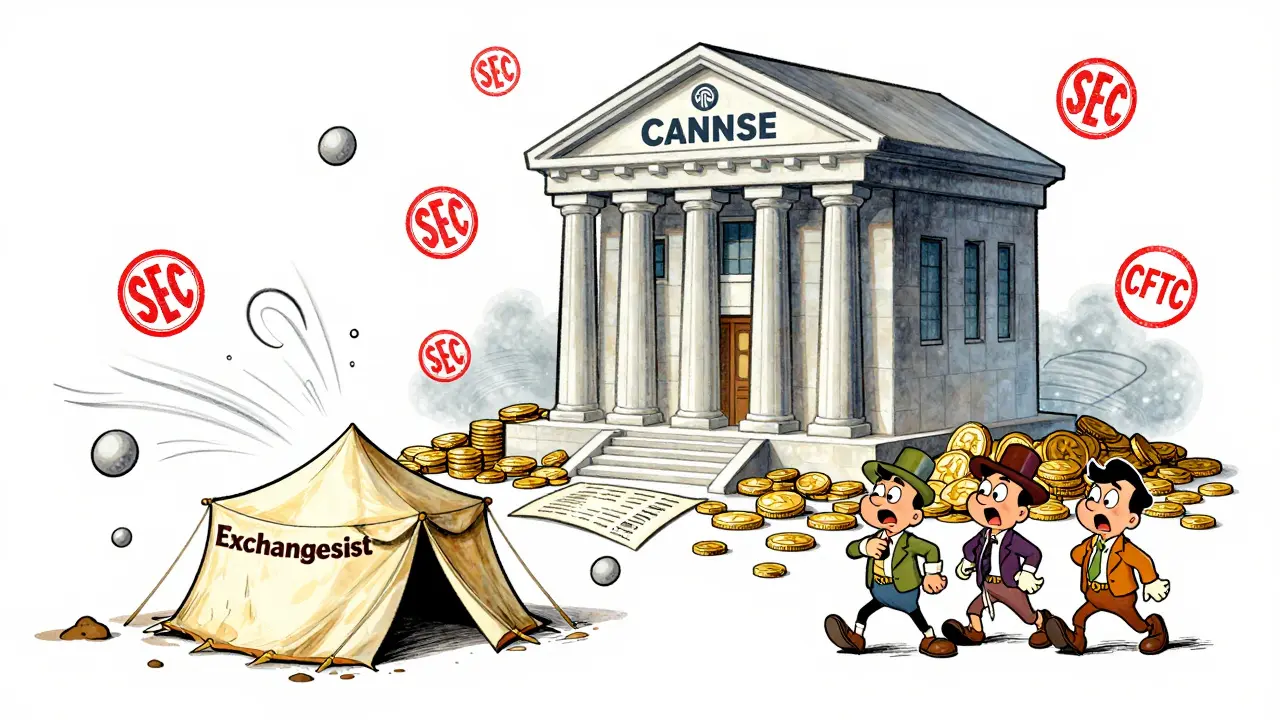
Does Exchangeist hold any such licenses? A thorough search of regulatory databases from the Securities and Exchange Commission (SEC), the Commodity Futures Trading Commission (CFTC), and the UK's Financial Conduct Authority reveals nothing. There is no record of Exchangeist being registered as a money services business or a securities dealer. Operating without a license means they are likely breaking laws in multiple jurisdictions. If regulators shut them down, your funds could be frozen indefinitely, or worse, seized as part of an illegal operation.
Security Protocols: Where Are Your Funds?
Security is not just about having a password. It is about how the exchange stores your assets. Top-tier exchanges like Kraken store 95% of user funds in cold storage-offline wallets that are immune to online hacks. They also undergo regular third-party audits, such as SOC 2 Type II certifications, to prove their systems are secure.
Exchangeist provides no public proof of reserves. They do not publish monthly attestation reports showing that they actually hold the assets they claim to own. This is a dangerous gap. Without Proof of Reserves, you have no way of knowing if your deposit is backed by actual Bitcoin or Ethereum, or if it is just a number on a screen. In 2024, several exchanges collapsed because they were running "ponzi-like" operations where new deposits paid off old withdrawals. Without transparent audits, Exchangeist falls into this high-risk category.
Fees and Hidden Costs
New exchanges often lure users with promises of zero fees. While this sounds attractive, it is rarely sustainable. How does Exchangeist make money if they charge nothing? The answer usually involves hidden costs:
- Wide Spread: The difference between the buy and sell price may be significantly larger than on regulated exchanges. If you buy Bitcoin at $60,000 but can only sell it at $59,800, you have lost money instantly.
- Withdrawal Fees: Many unregulated platforms charge exorbitant fees to move your money out. What looks like a cheap trade becomes expensive when you try to access your cash.
- Inactivity Fees: Some platforms charge monthly fees for accounts that do not trade frequently, slowly draining your balance.
Compare this to Robinhood, which offers commission-free trading but makes money through payment for order flow, a model that is transparent and regulated. Or Kraken, which charges clear, low fees (0.16%-0.26%) that are predictable and fair. With Exchangeist, you are guessing what you will pay.
User Experience and Support
A good exchange needs responsive customer support. When you face a login issue or a failed transaction, you need help immediately. Major platforms offer 24/7 live chat, email support, and extensive knowledge bases. Coinbase, for instance, has a dedicated support team with average response times under an hour for verified users.
User reviews for Exchangeist are scarce, and those that exist on independent forums often complain about delayed responses or generic automated replies. If you encounter a problem during market volatility-when every second counts-having no human support can cost you thousands. Additionally, the platform lacks community presence. There is no active subreddit, no official Discord server with verified moderators, and no social media engagement from leadership. This isolation suggests a lack of commitment to building a loyal user base.
Comparison: Exchangeist vs. Trusted Alternatives
| Feature | Exchangeist | Kraken | Coinbase |
|---|---|---|---|
| Regulatory License | None Found | Global Compliance | US State Licenses + SEC |
| Proof of Reserves | No Public Audit | Regular Attestations | Monthly Attestations |
| Founded | Unknown | 2011 | 2012 |
| Hack History | Unverified | Zero Successful Hacks | Minor Incidents (Resolved) |
| Customer Support | Limited/Slow | 24/7 Live Chat | 24/7 Email/Chat |
The Verdict: Stay Away
Based on the evidence, Exchangeist fails the basic tests of legitimacy. It lacks transparency, regulatory oversight, and proven security measures. In an industry where trust is earned through years of consistent performance, Exchangeist offers none of that. The risk of losing your entire investment is too high.
Instead of risking your capital on an unknown platform, consider sticking to exchanges that have survived multiple market cycles. Kraken is ideal for advanced traders seeking low fees and high security. Coinbase remains the best choice for beginners due to its intuitive interface and strong regulatory standing. Both platforms provide the safety net you need to trade with confidence.
Is Exchangeist a scam?
While we cannot definitively label it a scam without legal determination, Exchangeist exhibits many characteristics of fraudulent platforms, including lack of regulatory licensing, anonymous ownership, and no proof of reserves. These factors make it extremely risky and potentially unsafe for storing funds.
Can I withdraw my money from Exchangeist?
There are numerous reports from users on similar unregulated platforms claiming difficulty withdrawing funds. Without regulatory oversight, there is no guarantee that Exchangeist will honor withdrawal requests. If you have funds there, attempt to withdraw them immediately, but be prepared for potential delays or refusal.
Why is Exchangeist not listed on CoinMarketCap?
CoinMarketCap requires exchanges to meet strict criteria regarding security, liquidity, and legitimacy before listing them. The absence of Exchangeist from major tracking sites suggests it does not meet these industry standards for reliability and transparency.
What are the safest crypto exchanges in 2026?
As of 2026, the safest exchanges include Kraken, Coinbase, Binance (for international users), and Gemini. These platforms are publicly traded or heavily regulated, undergo regular audits, and have proven track records of securing user assets against hacks and insolvency.
How can I verify if a crypto exchange is legitimate?
Check for three key things: 1) Regulatory licenses in your country, 2) Publicly available Proof of Reserves audits, and 3) Transparent information about the founding team and company headquarters. If any of these are missing, proceed with extreme caution.