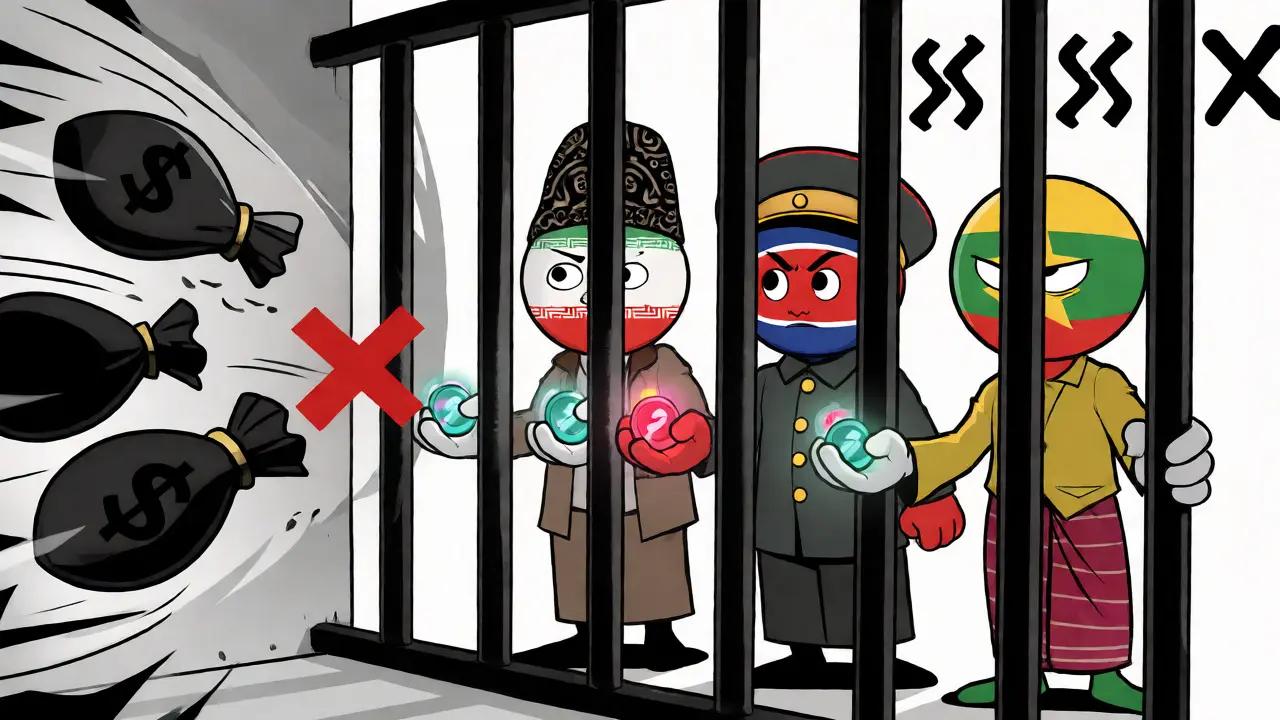
Imagine trying to send money home from abroad, but your bank refuses to touch it because your country is on a financial hit list. That is the reality for millions in Iran, North Korea, and Myanmar. These three nations sit at the top of the Financial Action Task Force (FATF) blacklist, a designation that triggers severe restrictions on how they interact with the global economy. But here is the twist: while traditional banking channels are slammed shut, cryptocurrency has become a lifeline-and a target.
You might think these bans just mean higher fees or slower transfers. In truth, they create a high-stakes game of cat and mouse between state actors and international regulators. For traders, investors, and everyday users, understanding this dynamic isn't just academic; it affects liquidity, exchange access, and the risk profile of holding digital assets linked to these jurisdictions. Let's break down why these countries are blacklisted, how crypto fits into their survival strategies, and what the enforcement crackdown looks like today.
Why Are Only Three Countries on the FATF Blacklist?
The FATF doesn't hand out "blacklist" status lightly. Technically known as "High-Risk Jurisdictions Subject to a Call for Action," this list is reserved for countries that fail to implement anti-money laundering (AML) and counter-terrorist financing (CFT) standards effectively. As of mid-2025, only Iran, North Korea, and Myanmar remain on this exclusive, infamous list.
Each country landed there for different reasons, though all share a common trait: weak oversight allowing illicit flows to thrive. Iran has been under scrutiny since February 2020, primarily due to its support for regional proxy groups and opaque financial networks used by the Islamic Revolutionary Guard Corps (IRGC). North Korea presents a unique threat, using cybercriminality to fund its nuclear program. Meanwhile, Myanmar joined the list following the military coup, where proceeds from illegal gambling, drug trafficking, and corruption flooded an unregulated banking sector.
It is worth noting that other major players like Russia or China face "enhanced monitoring" but aren't fully blacklisted. The distinction matters. Being on the blacklist means member countries are urged to apply specific countermeasures, such as requiring enhanced due diligence or even cutting off correspondent banking relationships. This isolation pushes these economies toward alternative financial systems-specifically, crypto.
North Korea’s $1.5 Billion Crypto Heist Strategy
If you thought state-sponsored hacking was just about stealing credit card numbers, think again. North Korea has evolved into one of the most sophisticated cyber-threat actors in the world, with cryptocurrency theft serving as a primary funding source for its weapons programs. The scale is staggering. In February 2025 alone, hackers linked to the regime stole approximately $1.5 billion from the ByBit exchange. This wasn't a smash-and-grab; it was a calculated operation exploiting smart contract vulnerabilities and social engineering.
According to data from Chainalysis, sanctioned jurisdictions collectively received $15.8 billion in cryptocurrency during 2024. That figure represents nearly 39% of all illicit crypto transactions globally. Why does this matter? Because it shows that for North Korea, crypto isn't a speculative investment-it's a treasury tool. They use complex mixing services and privacy coins to obscure the trail, moving funds through multiple wallets across different exchanges before cashing out via over-the-counter (OTC) desks in less regulated jurisdictions.
| Country | Primary Method | Estimated Impact (2024-2025) | Regulatory Response |
|---|---|---|---|
| North Korea | Cyberattacks & Exchange Hacks | $1.5B+ single incident (ByBit); Billions cumulative | OFAC Sanctions on Tornado Cash & Mixers |
| Iran | Sanctions Evasion & Capital Flight | Surge in CEX volume; Stablecoin adoption | FinCEN Designations of IRGC-linked entities |
| Myanmar | Gambling Laundering & Scams | High volume in Huione Group ecosystem | Proposed FinCEN rule on Huione Group |
Iran’s Crypto Lifeline Amidst Economic Isolation
For ordinary Iranians, cryptocurrency offers something banks cannot: freedom from immediate government seizure and a hedge against hyperinflation. With the rial losing value rapidly, many citizens have turned to stablecoins and Bitcoin to preserve wealth. However, this grassroots adoption creates a paradox for regulators. While the population uses crypto for legitimate survival, the state uses it to bypass SWIFT restrictions.
Recent trends show a dramatic surge in transaction outflows from Iranian centralized exchanges. This pattern suggests widespread capital flight, where residents move assets offshore to avoid domestic instability. The appeal of Bitcoin lies in its self-custodial nature-you don't need a bank account to hold it, just a seed phrase. If you need to flee the country, you can carry your entire net worth in your head.
But this flexibility comes with risks. Because Iran lacks robust AML controls, large volumes of crypto flow through informal channels. Regulators struggle to distinguish between a student buying Bitcoin for savings and a front company moving oil revenues. This ambiguity forces global exchanges to implement stricter KYC (Know Your Customer) protocols, often resulting in blanket blocks for Iranian IPs or phone numbers, further isolating legitimate users.

Myanmar and the Shadow Economy of Digital Assets
Myanmar’s situation differs significantly from Iran and North Korea. Here, the issue isn't just state-level sanctions evasion but the integration of crypto into a shadow economy driven by online scam compounds and illegal gambling. The rise of the Huione Group, a Cambodian-based conglomerate with deep ties to Myanmar’s border regions, exemplifies this problem. FinCEN has proposed designating Huione as a primary money laundering concern, highlighting how crypto facilitates billions in dirty money movement.
Unlike North Korea’s high-tech heists, Myanmar’s crypto usage is often low-tech and high-volume. Workers in scam centers receive payments in USDT (Tether), which are then converted to local currency or moved to larger exchanges. This ecosystem thrives on anonymity-enhancing technologies and lax oversight in neighboring jurisdictions. For compliance officers, tracing these funds is a nightmare because they hop across borders rapidly, often landing in Southeast Asian exchanges that may not enforce strict FATF standards.
The Global Enforcement Crackdown: OFAC and FinCEN
How do regulators fight back when the technology moves faster than the law? The United States Treasury’s Office of Foreign Assets Control (OFAC) has intensified its efforts. In 2024 alone, OFAC issued 13 designations that included specific cryptocurrency addresses-a record pace. This shift marks a move from sanctioning people or companies to sanctioning code itself.
Simultaneously, the Financial Crimes Enforcement Network (FinCEN) is pushing for broader rules. One notable proposal targets mixers like Tornado Cash, arguing they enable criminals to wash stolen funds. The Independent Community Bankers of America (ICBA) supports these measures, noting that without them, small banks face disproportionate liability for processing indirect crypto-related transactions.
Internationally, cooperation is improving but remains fragmented. FATF data reveals that as of April 2024, three-quarters of its member countries were either noncompliant or partially compliant with virtual asset standards. This gap creates safe havens where blacklisted entities can park their digital assets. When a mixer is banned in the U.S., the activity simply shifts to a jurisdiction with weaker enforcement, creating a whack-a-mole scenario for investigators.

What This Means for You as a Crypto User
You don't live in Tehran or Pyongyang, so why should you care? First, compliance friction is increasing everywhere. Exchanges are tightening their geofencing and wallet screening tools. If you interact with addresses associated with blacklisted jurisdictions-even accidentally-your funds could be frozen pending investigation. Second, the narrative around crypto regulation is shifting from "innovation vs. control" to "national security." This leads to stricter laws that may impact DeFi protocols and privacy-focused coins.
Practically, this means diversifying your custody strategy. Relying solely on centralized exchanges exposes you to regulatory risk if those platforms decide to delist certain tokens or restrict withdrawals based on new guidance. Using hardware wallets and maintaining clear records of your transaction sources helps prove the legitimacy of your holdings if questions arise.
Frequently Asked Questions
Which countries are currently on the FATF blacklist?
As of 2026, the three countries on the FATF blacklist are Iran, North Korea (DPRK), and Myanmar. These nations are classified as High-Risk Jurisdictions Subject to a Call for Action due to significant deficiencies in their anti-money laundering and counter-terrorist financing frameworks.
Why is North Korea considered a major threat to cryptocurrency security?
North Korea is responsible for some of the largest cryptocurrency thefts in history, including the $1.5 billion ByBit hack in 2025. The regime uses state-sponsored cybercriminal groups to steal digital assets, which are then laundered through mixers and OTC desks to fund its nuclear and missile programs.
Can I still trade cryptocurrency if I am connected to an Iranian IP address?
Most major global exchanges block users from Iranian IPs due to sanctions. However, some local or regional exchanges operate within Iran, though they face limited liquidity and higher risks. Users often rely on peer-to-peer (P2P) markets or VPNs, though using a VPN violates the terms of service of many Western exchanges.
What is the difference between the FATF blacklist and the grey list?
The blacklist contains countries subject to a call for action, meaning members must apply strict countermeasures. The grey list (Jurisdictions Under Increased Monitoring) includes countries working with the FATF to resolve strategic deficiencies. Countries on the grey list require enhanced due diligence but not necessarily full disconnection from the global financial system.
How do cryptocurrency mixers help blacklisted countries evade sanctions?
Mixers pool cryptocurrency from multiple users and redistribute it, breaking the link between the sender and receiver. This makes it difficult for blockchain analysts to trace the origin of funds, allowing entities in Iran, North Korea, and Myanmar to hide the source of their assets and integrate them into the global economy.