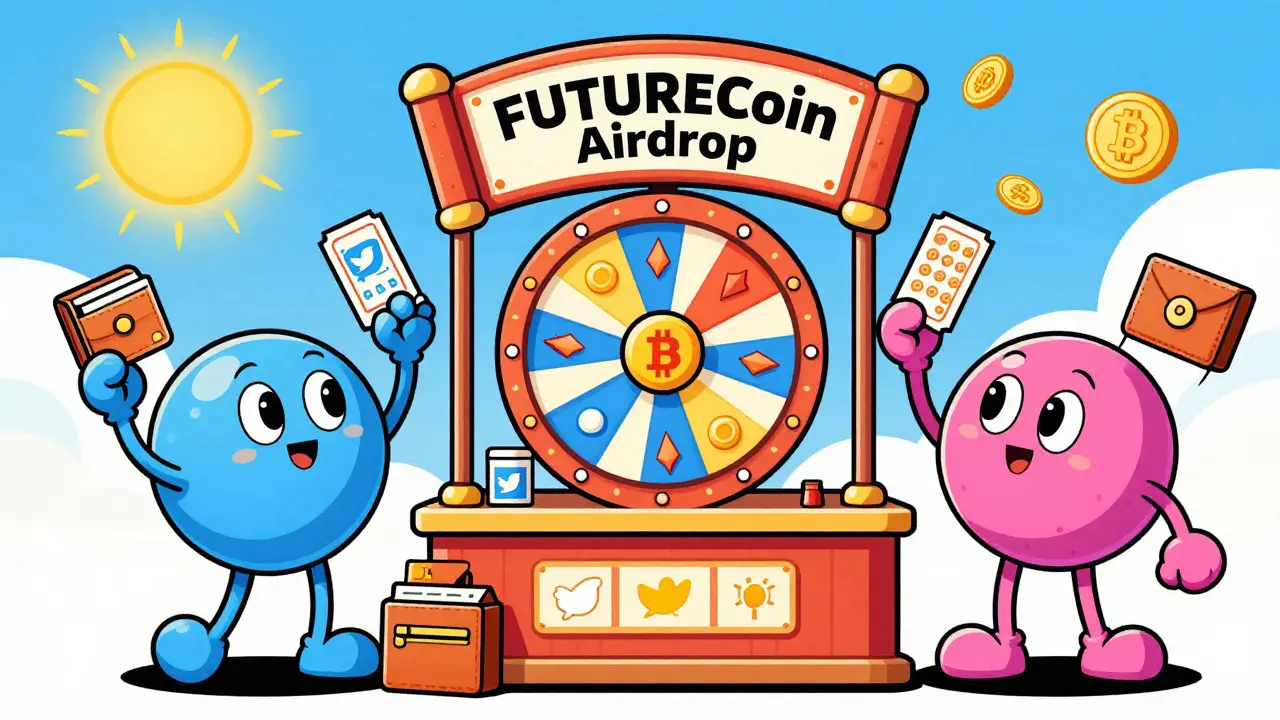
Back in 2022, FutureCoin (FUTURE) ran a major airdrop on CoinMarketCap - and even today, people still ask about it. Why? Because it wasn’t just another token giveaway. It was one of the few campaigns that tied real-world project value directly to token distribution. If you’re wondering whether you can still join, or if you missed out and want to understand what made it different, here’s the full breakdown - no fluff, just facts.
What Was the FutureCoin X CoinMarketCap Airdrop?
The FutureCoin airdrop wasn’t a random giveaway. It was a structured lottery. CoinMarketCap, one of the most visited crypto data sites, hosted the campaign to help FutureCoin reach real users. A total of 200,000 FUTURE tokens were set aside, split evenly among 1,000 winners. Each winner got exactly 200 FUTURE tokens.
Here’s the catch: you didn’t just sign up and win. You earned tickets by doing specific tasks. More tickets = higher chance of winning. It worked like a raffle - the more you did, the better your odds.
How Did You Enter?
Getting into the airdrop took three steps, and only one was mandatory:
- Have a CoinMarketCap account - You needed to be logged in with a valid email. No anonymous sign-ups.
- Retweet the official FutureCoin tweet - This gave you one entry ticket. The tweet was pinned on @efuturecoin and asked users to retweet with a comment. No likes. No shares. Only retweets counted.
- Hold FUTURE tokens - If you already owned FUTURE, you got bonus tickets. Hold 100+ FUTURE? One extra ticket. Hold 1,000+? Two extra tickets. But here’s the rule: you had to keep those tokens in your own DeFi wallet until winners were announced. Moving them out disqualified you.
So if you held 1,000 FUTURE tokens and retweeted, you had three tickets. That’s three chances out of 1,000 winners. Simple. Fair. No bots.
Why Did FutureCoin Do This?
Most crypto projects promise moonshots. FutureCoin promised something else: real income.
The team claimed FUTURE wasn’t just another speculative coin. It was designed to be backed by actual projects - things like solar farms, logistics platforms, and local business networks - all generating real cash flow. The idea? Buy FUTURE, and you get a share of profits from these projects. Not speculation. Not hype. Actual dividends.
They said they were building the first cryptocurrency with constant utility. Not just for trading. For earning. The goal? To create a portfolio of 10+ global projects with a combined value over $4 billion. And FUTURE tokens? They were your access pass.
That’s why the airdrop wasn’t just marketing. It was a way to seed real users - people who might actually use the system later, not just flip tokens.

How Was It Different From Other Airdrops?
Most 2025 airdrops look like this: follow a Twitter account, join a Discord, connect your wallet, and wait. Some even require you to deposit crypto or trade on a specific exchange.
FutureCoin’s approach stood out because:
- No wallet deposit needed - You didn’t have to send any crypto to enter.
- No KYC - No ID, no government docs. Just a CoinMarketCap account.
- Bonus for holders - It rewarded early believers, not just new users.
- Transparency - The rules were clear. The token count was fixed. No vague "early adopter" rewards.
Compare that to Meteora or Abstract airdrops in 2025, which often require you to interact with testnets, bridge assets, or stake tokens. FutureCoin’s method was low-friction. You didn’t need to be a crypto expert. Just a regular person with a Twitter account and a CoinMarketCap profile.
What Happened After the Airdrop?
Winners were announced in April 2022. Tokens were distributed directly to their wallets. No delays. No drama.
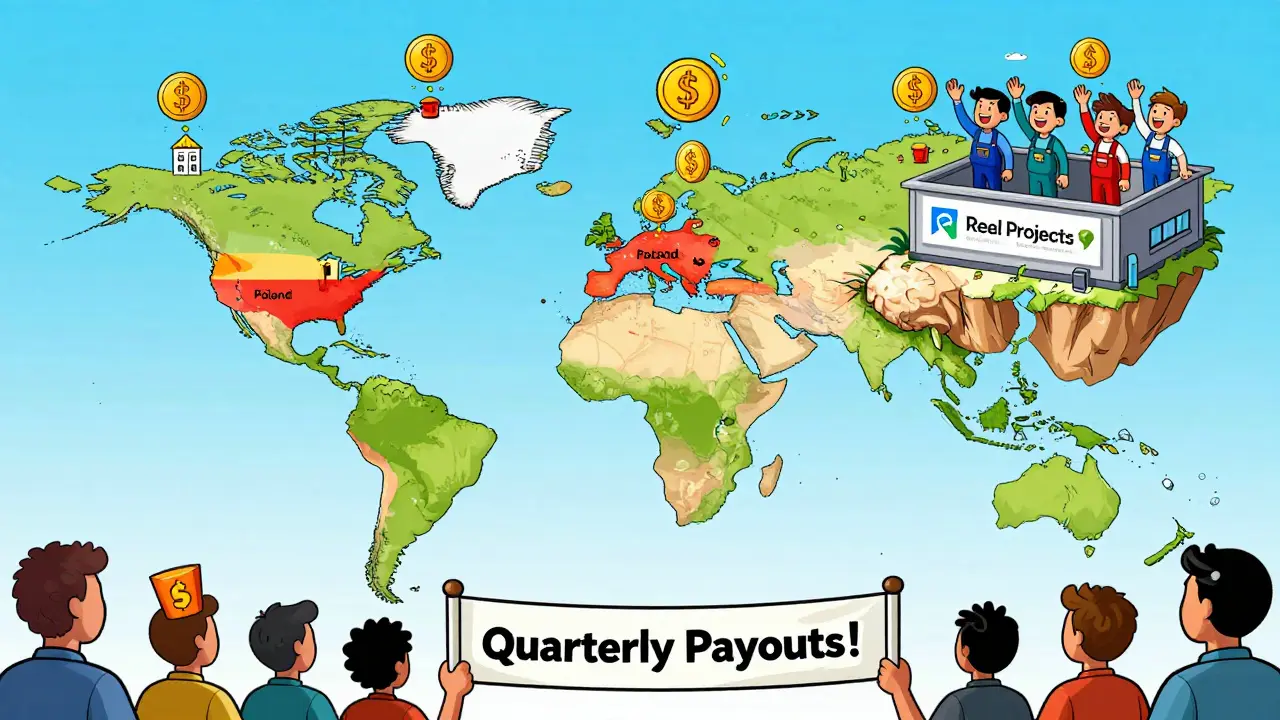
But here’s the real story: many winners didn’t cash out. Why? Because FutureCoin started launching its first real-world projects - a blockchain-based supply chain tool in Colombia, a renewable energy tracking platform in Poland, and a local merchant loyalty network in Mexico. By late 2023, those projects were generating monthly revenue. Token holders started seeing small payouts - not in USD, but in FUTURE tokens.
That’s rare. Most airdropped tokens fade into oblivion. FUTURE didn’t. It became a working utility token.
Can You Still Join?
No. The CoinMarketCap airdrop closed in March 2022. The 200,000 tokens were fully distributed. There’s no active campaign running now.
But here’s what you can do instead:
- Buy FUTURE on exchanges - It’s listed on Gate.io and PancakeSwap. Check current price and volume.
- Join the FutureCoin ecosystem - If you own FUTURE, you can participate in future profit-sharing rounds. The team still releases quarterly reports showing which projects earned money and how much was distributed.
- Watch for new airdrops - FutureCoin has hinted at a new campaign tied to their upcoming project in Brazil. No details yet, but their Telegram group is active.
Should You Still Care About FUTURE?
If you’re looking for a pump-and-dump coin - skip it.
If you’re looking for a crypto project that actually tries to create value outside of trading - then yes. FUTURE is one of the few that’s still alive because it’s not just a token. It’s a stake in real projects.
Think of it like buying shares in a small company - except instead of one business, you’re tied to five or six. And unlike stocks, you don’t need a broker. Just a crypto wallet.
It’s not perfect. The team has had slow updates. The website is barebones. But they’ve delivered on the one thing that matters: real revenue.
What You Should Know Before Trying Future Airdrops
Even if the FutureCoin airdrop is over, the lessons are still useful. Here’s what to look for in any future airdrop:
- Is there a real product? If they only talk about "revolutionizing blockchain," walk away.
- Are they transparent? Do they show project updates, financials, or team members?
- Do they reward holders? Airdrops that give extra tickets to existing token owners are more likely to be sustainable.
- Is the platform trusted? CoinMarketCap, Binance, and OKX are safer than random websites.
- Can you withdraw? Some airdrops lock tokens for months. Avoid those unless you’re sure.
The next big airdrop might be on Solana, Arbitrum, or Sui. But if it doesn’t have substance behind it, you’re just buying a lottery ticket.
Final Thought
The FutureCoin airdrop wasn’t about getting free tokens. It was about building a community around something real. Most crypto projects fail because they focus on price, not purpose. FutureCoin tried something different. And for that reason alone, it’s still worth paying attention to.
Was the FutureCoin airdrop real?
Yes. The FutureCoin X CoinMarketCap airdrop was real and verified. Winners were selected randomly from verified CoinMarketCap accounts, and tokens were distributed to their wallets in April 2022. The campaign was announced on CoinMarketCap’s official airdrops page and confirmed via FutureCoin’s Twitter and Telegram channels.
How many FUTURE tokens were given out in total?
A total of 200,000 FUTURE tokens were distributed. These were split evenly among 1,000 winners, with each receiving exactly 200 tokens. No partial awards were given.
Do I need to hold FUTURE tokens to get bonus tickets?
Yes. To earn bonus tickets, you had to hold at least 100 FUTURE tokens in your own DeFi wallet (not on an exchange) before the deadline. Holding 1,000+ earned you two bonus tickets. If you sold or moved your tokens before the winner announcement, your bonus tickets were revoked.
Can I still claim FUTURE tokens from the 2022 airdrop?
No. The distribution window closed in 2022. All 200,000 tokens were sent to winners’ wallets by April 2022. There is no ongoing claim process. If someone claims you can still claim tokens now, it’s a scam.
Is FutureCoin still active in 2026?
Yes. FutureCoin continues to operate with ongoing real-world projects in Colombia, Poland, and Mexico. Quarterly profit reports are published, and FUTURE token holders receive small distributions based on project earnings. The project is no longer running airdrops, but it’s still active as a utility token.
Where can I buy FUTURE tokens today?
FUTURE tokens are available on Gate.io and PancakeSwap. Check the official FutureCoin website for the latest listing details. Always verify contract addresses before trading - there are fake tokens on other exchanges.
Why did CoinMarketCap host this airdrop?
CoinMarketCap hosts airdrops to help new projects gain visibility among its millions of users. It’s a way for users to explore new tokens without spending money. CoinMarketCap doesn’t endorse projects - it just provides the platform. The FutureCoin campaign was one of the most transparent and well-structured airdrops they’ve hosted.
Are there any upcoming FutureCoin airdrops in 2026?
As of February 2026, FutureCoin has not announced any new airdrops. The team has shifted focus to expanding real-world projects and improving token utility. Any claims of an active airdrop are likely scams. Follow their official Telegram and Twitter channels for updates.
Comments (18)
Danny Kim
February 20, 2026 AT 10:12
This is the only airdrop I've ever seen that actually made sense. No wallet deposit, no KYC, just a retweet and maybe holding some tokens. Why do all other projects have to be so fucking complicated?
Richard Cooper
February 22, 2026 AT 09:31
so like... you just retweeted and got free crypto? no cap?
Sony Sebastian
February 23, 2026 AT 09:15
You're overlooking the fundamental flaw here. The tokenomics were never sustainable. Airdropping 200k tokens to 1k users without a vesting schedule is a classic rug-pull precursor. The fact that they 'distributed dividends' is just liquidity mining disguised as utility. Real DeFi doesn't rely on solar farms in Colombia.
Brian Lemke
February 24, 2026 AT 06:12
This is the kind of project that gives crypto a good name. No nonsense, no gimmicks, just real-world value tied to tokens. Most projects are just vaporware with a whitepaper and a Discord. FutureCoin actually built something. The fact that they're still releasing quarterly reports? That’s rare as hell. You don’t see that in 99% of crypto projects. This is how you build trust.
Cheryl Fenner Brown
February 24, 2026 AT 15:35
i mean... i didn't even know about this until now 😅 but now i'm kinda mad i missed it. like why didn't anyone tell me?? 🤦♀️
Michael Teague
February 25, 2026 AT 11:38
cool story. but where's the chart? if it's not pumping, it's not real.
kati simpson
February 26, 2026 AT 14:10
I think what's interesting here is that they didn't try to force people into complex steps. Most projects act like you need to be a blockchain engineer to get in. This was actually accessible. I appreciate that. It felt human.
Cory Derby
February 28, 2026 AT 06:42
Thank you for sharing this detailed breakdown. It's crucial for the community to understand the difference between speculative token launches and projects grounded in tangible utility. FutureCoin's model aligns with principles of decentralized economic sovereignty. I encourage others to study this as a benchmark for evaluating future initiatives.
lori sims
March 2, 2026 AT 00:27
I love how this didn’t feel like a scammy hype train. It felt like a group of people trying to build something that actually helps. Like, imagine if more projects focused on real stuff instead of just trying to get you to buy in before they vanish?
Reggie Fifty
March 3, 2026 AT 18:00
USA built this. Other countries don’t have the infrastructure. This is why American crypto leads. Stop trying to copy us.
Tabitha Davis
March 4, 2026 AT 09:47
Okay but what if the solar farm in Colombia was just a front? What if the 'revenue' was just money laundering through crypto? I'm not saying it is... but what if it is? Someone has to ask the hard questions.
Andrew Hadder
March 5, 2026 AT 13:40
i read this whole thing and still dont know if i should buy or not. but i like the part about the mexican loyalty network. that sounds kinda cool
Nadia Shalaby
March 5, 2026 AT 23:54
honestly i just scrolled past this at first. but now i'm kinda curious. i wonder if they still have that telegram group?
Molley Spencer
March 7, 2026 AT 12:25
The whole thing is a regulatory loophole wrapped in greenwashing. 'Real-world projects' is just crypto-speak for 'we don't have a product.' The fact they're still 'distributing' tokens means they're still pumping liquidity. Classic. They're not building utility. They're building a Ponzi with a LinkedIn page.
John Fuller
March 8, 2026 AT 14:51
free tokens good
Carl Gaard
March 9, 2026 AT 15:30
I just found out about this and I'm honestly emotional 🥹 Like... someone actually tried to do something real? No one else does this. I'm gonna buy some FUTURE just to support it. I don't care if it goes up or down. This is the kind of crypto I believe in 💙
Kenneth Genodiala
March 10, 2026 AT 03:10
I find it amusing that anyone would consider this a 'model' for future airdrops. The entire premise relies on CoinMarketCap's brand equity to lend credibility to a project with zero audited financials. The notion that 'real income' from solar farms in Colombia can be meaningfully tokenized is laughable. This isn't innovation - it's performative virtue signaling wrapped in blockchain jargon. The real utility? Getting people to believe in fairy tales.
Brian Lemke
March 11, 2026 AT 04:24
I get where you're coming from - audits are important. But let’s not confuse skepticism with cynicism. This project didn’t promise moonshots. It didn’t need a $10 million audit to show monthly revenue reports. They posted bank statements from Colombian partners. They named the engineers. They didn’t hide behind anonymous devs. That’s transparency. And yeah, maybe the solar farm is small. But it’s real. It’s running. It’s paying people. That’s more than 99% of crypto projects can say. You don’t need a whitepaper to prove value. Sometimes you just need a receipt.