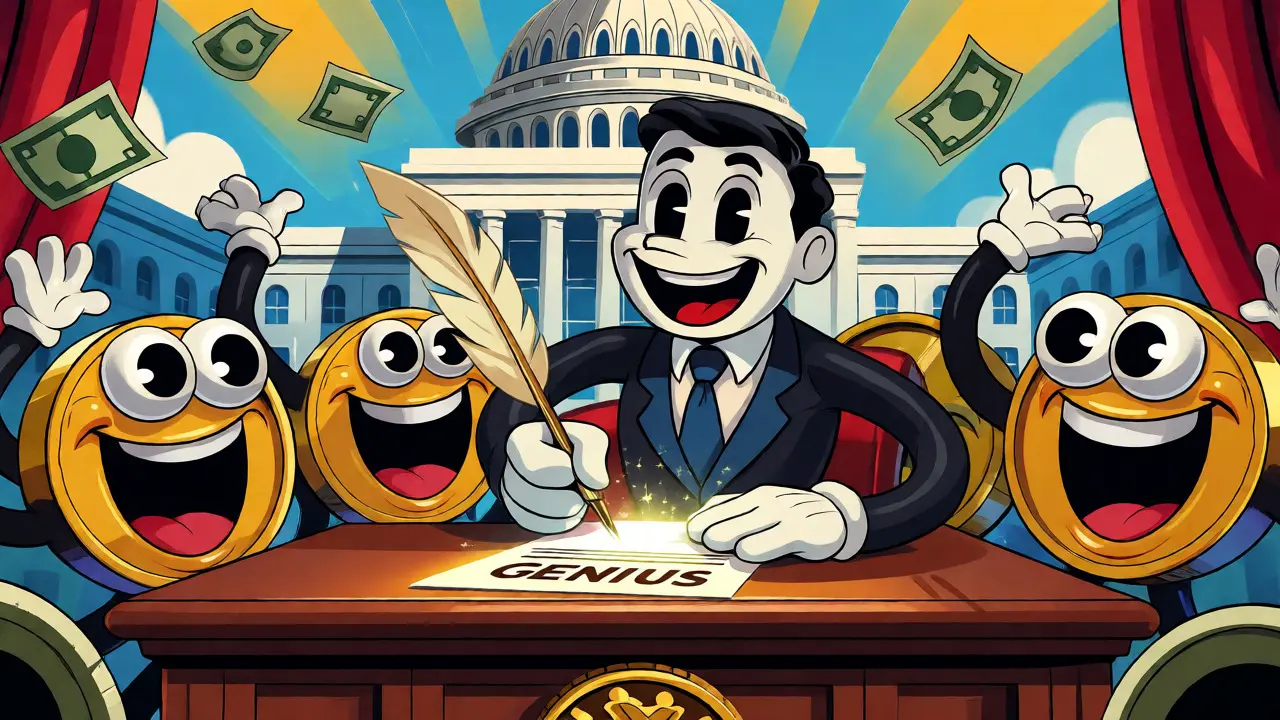
For years, the stablecoin market operated in a gray zone. You had billions of dollars moving on digital rails with no clear federal rulebook. That changed when President Trump signed the GENIUS Act into law on July 18, 2025. This isn't just another bureaucratic update; it is the first comprehensive federal regulatory framework for stablecoins in the United States. If you hold, issue, or trade stablecoins, this law directly impacts your wallet and your business model.
The act, formally known as the Guiding and Establishing National Innovation for U.S. Stablecoins Act, aims to end the confusion between state and federal rules. It creates a unified approach that treats payment stablecoins more like traditional money than speculative assets. But what does this actually mean for you? And why should you care about reserve audits and banking licenses?
What Is the GENIUS Act?
The GENIUS Act is a federal law that establishes strict operational requirements for issuers of payment stablecoins in the United States. Before this, regulations were a patchwork of state-level attempts and inconsistent federal guidance. Now, there is a single standard. The law targets "payment stablecoins," defined as digital assets designed to be used for payments or settlements, where the issuer promises to redeem them for a fixed amount of monetary value.
This definition matters. It separates utility-focused coins from those used primarily for trading or speculation. If your coin is meant to buy coffee or settle invoices, the GENIUS Act applies. If it’s a volatile asset used for leverage, it might fall under different securities laws. The goal here is clarity. No more guessing whether your favorite digital dollar is safe or just a promise on a spreadsheet.
Who Can Issue Stablecoins Now?
You can’t just wake up tomorrow and launch a new stablecoin backed by your garage full of gold bars. The GENIUS Act restricts who gets to play. Only "permitted payment stablecoin issuers" can operate. These are limited to:
- Insured depository institutions (banks).
- Credit unions.
- Bank subsidiaries.
- Nonbank financial institutions that receive approval from the Federal Reserve.
This means big players like Coinbase or Circle will need to navigate a rigorous approval process if they aren't already operating through a bank charter. Smaller startups face a higher barrier to entry. They must demonstrate compliance capability to the Fed. This shift moves the industry away from the wild west era of easy issuance toward a model closer to traditional banking.

The 1:1 Reserve Requirement
Remember the Terra/Luna collapse? Or the doubts surrounding Tether’s backing? The core fear has always been: "Is there really money behind this token?" The GENIUS Act answers this with a hard rule: issuers must maintain 1:1 reserves. For every stablecoin issued, there must be an equivalent value in specific, low-risk assets held in reserve.
Acceptable reserve assets include:
- Physical currency (cash).
- US Treasury bills.
- Repurchase agreements (repos).
- Other low-risk assets approved by regulators.
Crucially, these reserves cannot be mixed with the company’s other funds. Asset segregation is mandatory. Issuers must report their reserve composition regularly and undergo audits by registered public accounting firms. This transparency is designed to prevent fraud and ensure that if everyone wants to redeem their tokens at once, the cash is actually there.
Consumer Protection and AML Compliance
The act doesn’t just protect the balance sheet; it protects the user. All issuers must comply with the Bank Secrecy Act. This means implementing robust Anti-Money Laundering (AML) and Counter-Financing of Terrorism (CFT) measures. In plain English, stablecoin providers now have to know their customers (KYC) and monitor transactions for suspicious activity, much like a traditional bank.
For users, this might mean more friction during onboarding. You may need to provide more identification documents. But in exchange, you get greater legal recourse and consumer protections. The law explicitly prohibits commingling of assets, meaning your stablecoins aren’t being lent out to risky ventures without proper safeguards.

The Role of the Stablecoin Certification Review Committee
How do we ensure consistency across 50 states? Enter the Stablecoin Certification Review Committee (SCRC). Chaired by the Secretary of the US Department of Treasury, this body includes the Federal Reserve Chair and the FDIC Chair. Their job is to determine if state-level stablecoin frameworks are "substantially similar" to the federal standard.
This committee holds significant power. If a state’s rules don’t match the federal benchmark, the SCRC can intervene. This prevents a race to the bottom where states compete by offering laxer regulations. However, critics worry about fragmentation. Since state-issued stablecoins have certain exemptions, the path to total uniformity remains complex. The SCRC aims to harmonize these differences, but the interplay between state and federal authority will likely generate legal challenges in the coming years.
Implementation Timeline and What’s Next
The GENIUS Act was signed in July 2025, but it doesn’t take effect immediately. The law goes live on January 18, 2027, or 120 days after final implementing regulations are issued, whichever comes first. This gives the market an 18-month window to adapt. Regulators need time to write the detailed rules, and companies need time to restructure their operations.
| Feature | Pre-GENIUS Era | Post-GENIUS Act |
|---|---|---|
| Issuer Eligibility | Varied by state; unclear federal stance | Banks, credit unions, and Fed-approved nonbanks only |
| Reserves | Self-reported; often opaque | Mandatory 1:1 backing in cash, Treasuries, or repos |
| Audits | Optional or private attestations | Mandatory regular audits by registered public accounting firms |
| Compliance | Inconsistent AML/KYC standards | Full Bank Secrecy Act compliance required |
| Asset Segregation | Often commingled with corporate funds | Strict segregation mandated; no commingling allowed |
Why does this matter globally? The US dollar dominates international stablecoin markets. By creating a clear, safe framework, the US aims to strengthen the dollar’s status as a global reserve currency. Other jurisdictions, like Hong Kong with its Stablecoin Ordinance passed in May 2025, are watching closely. The GENIUS Act positions the US as a leader in digital asset innovation while maintaining national security interests.
If you’re a business owner, start preparing now. Review your current stablecoin partners. Check if they have bank charters or are applying for Fed approval. If you’re a retail investor, look for transparency reports. The days of trusting a whitepaper alone are over. Trust requires proof, and the GENIUS Act provides the mechanism for that proof.
When does the GENIUS Act go into effect?
The GENIUS Act is scheduled to take effect on January 18, 2027. However, it could become active sooner-120 days after the final implementing regulations are issued-whichever date comes first.
Can any company issue a stablecoin under the new law?
No. Only "permitted payment stablecoin issuers" can issue stablecoins. This includes insured depository institutions, credit unions, bank subsidiaries, and nonbank financial institutions that have received approval from the Federal Reserve.
What assets can back stablecoin reserves?
Reserves must be held in physical currency, US Treasury bills, repurchase agreements, or other low-risk assets specifically approved by regulators. Commingling these assets with other corporate funds is generally prohibited.
Does the GENIUS Act apply to all cryptocurrencies?
No, it specifically targets "payment stablecoins." These are digital assets designed for use as a means of payment or settlement, where the issuer is obligated to redeem them for a fixed amount of monetary value. Volatile cryptocurrencies like Bitcoin or Ethereum are not covered by this specific framework.
What is the role of the Stablecoin Certification Review Committee (SCRC)?
The SCRC, chaired by the Treasury Secretary, evaluates whether state-level stablecoin regulatory frameworks are "substantially similar" to the federal standards set by the GENIUS Act. This helps ensure consistent regulation across the country.
Comments (18)
Glenn Watts
September 15, 2026 AT 21:49
Finally some actual rules instead of the circus we've been watching for years. It is about time the US stopped letting these crypto cowboys run wild with our money and started treating digital dollars like real currency backed by real assets. I am tired of seeing billions flow through unregulated pipes while traditional banks get hammered with compliance costs that these stablecoin issuers dodged for a decade. This act puts America first in the digital finance race and ensures that when you hold a dollar token, it is actually worth a dollar and not just a promise from some guy in a hoodie who might disappear tomorrow. The reserve requirements are non-negotiable and if they cannot meet them they should not be playing bank. We need to protect the sanctity of the US dollar and this framework does exactly that by forcing transparency and accountability on every single issuer. No more funny business with opaque attestations or sketchy commercial paper holdings that nobody understands. If you want to issue money you better have the cash or treasuries sitting right there ready to redeem because that is what responsible banking looks like. I hope the Fed keeps its eye on this because one slip up could bring down the whole system again and we do not have time for another Terra Luna disaster. Let us see if these companies can actually comply or if they will lobby their way out of it like they always try to do.
Kelsey Hartwig
September 16, 2026 AT 14:28
The epistemological implications of codifying trust into law are profound. By mandating 1:1 reserves, we are attempting to bridge the gap between abstract value and tangible reality. However, one must consider whether such rigid frameworks stifle the very innovation they seek to regulate. Is security truly achieved through bureaucratic oversight, or does it merely create an illusion of safety? The philosophical underpinning here suggests that without state enforcement, the concept of 'value' in digital spaces remains inherently unstable. Yet, this instability may be a feature rather than a bug of decentralized systems. We are trading freedom for certainty, and history teaches us that such trades often yield diminishing returns. The SCRC's role introduces a new layer of interpretive ambiguity despite its goal of clarity. Are we creating a monolith that cannot adapt to rapid technological shifts? The distinction between payment utility and speculative asset is subtle yet critical. Misclassification could lead to unintended consequences across broader markets. Ultimately, the GENIUS Act represents a societal choice to prioritize institutional stability over individual liberty within the financial sphere. This choice reflects a deep-seated anxiety about the unknown nature of digital assets. Whether this anxiety is justified depends on one's view of human nature and market efficiency. The law assumes rational actors but ignores behavioral biases that drive speculative bubbles. Thus, regulation alone cannot solve the inherent volatility of human desire.
Adam Barrett
September 17, 2026 AT 14:49
This is a huge step forward for everyone involved. I love seeing clear guidelines because it helps small businesses feel safe using stablecoins for payments without worrying about sudden regulatory changes wiping out their operations. The emphasis on consumer protection is particularly encouraging as it gives users more confidence that their funds are secure and accessible. When people feel protected they are more likely to adopt new technologies which drives overall growth in the sector. The timeline also seems reasonable giving companies enough time to adjust their systems properly without rushing into mistakes. I appreciate how this balances innovation with safety ensuring that we do not lose the benefits of blockchain technology while gaining the reliability of traditional finance. This approach fosters trust which is the most valuable currency in any economy. Great job getting this done!
Samantha Du-Cell
September 18, 2026 AT 09:08
Good riddance to the Wild West days where anyone with a laptop and a dream could print fake money. Now the big boys have to play by the rules or go home. This is exactly what America needs to keep the dollar king on the global throne. If Tether wants to operate here they better show the receipts or get lost. The banks finally get a level playing field and we stop subsidizing risky behavior with taxpayer bailouts waiting to happen. It is about damn time someone stood up to the crypto elite who thought they were above the law. We are reclaiming our financial sovereignty one audit at a time. Let them cry about compliance costs while we sleep soundly knowing our money is actually backed by something real. This is a victory for common sense and hardworking Americans who just want their digital dollars to work like regular dollars. No more surprises no more scams just solid boring reliable banking standards applied to new tech. That is how you build a sustainable industry that lasts longer than a hype cycle.
Jennifer Phipps
September 19, 2026 AT 08:48
This is super exciting news! 🎉 For those of you running e-commerce stores or freelancing internationally, this means you can finally use stablecoins without losing sleep at night. 😴➡️😴
Here’s the quick breakdown:
✅ Your money is safer because issuers MUST keep 1:1 reserves.
✅ You know exactly what backs your coin (cash, Treasuries, etc.).
✅ KYC gets stricter but that’s good for fraud prevention!
I recommend checking if your current wallet provider is applying for a Fed license. If they aren’t moving fast, start looking for alternatives now so you’re ready when the law kicks in. Don’t wait until the last minute! 🚀
Tish Dalton
September 19, 2026 AT 11:30
Hey everyone, just wanted to share some thoughts on how this affects everyday users. It is great to see clearer rules coming into play. One thing I noticed is that the definition of "payment stablecoin" is pretty specific. If you are using coins mainly for trading or speculation, they might not fall under this exact umbrella. But for anyone using them to pay bills or send money to family abroad, this provides a lot of reassurance. The requirement for regular audits is a game changer too. Imagine having a public report showing exactly what backs your digital dollar. That kind of transparency builds trust slowly but surely. Also, don't forget about the AML compliance part. While it adds a bit of friction during sign-up, it protects us all from bad actors washing dirty money through clean channels. Keep an eye on your providers' announcements regarding their licensing status. Knowledge is power, especially in this shifting landscape.
Emily Sue
September 21, 2026 AT 06:10
finally some structure i was so worried about tether pulling a fast one on us again glad they made them prove they have the cash lol
Elizabeth Floyd
September 22, 2026 AT 05:34
Great post! 🌟 I have a question though, how does this interact with DeFi protocols? If a stablecoin issuer goes bankrupt, does the user become an unsecured creditor in bankruptcy proceedings? 🤔
Also, curious if this applies to algorithmic stablecoins or only fully collateralized ones. The text mentions low-risk assets, which suggests fiat-backed, but I want to be sure before moving my savings. Thanks for sharing this info! 💡
Christy Keirn
September 23, 2026 AT 17:45
Oh wow, look at us pretending we can control the uncontrollable chaos of the internet with a few laws. How quaint. The government thinks it can slap a label on magic internet money and make it behave like a treasury bond. Spoiler alert: it won't. These issuers will find loopholes faster than regulators can write them. And let's talk about the 'audit' aspect. Who audits the auditors? Because last time I checked, Big Four accounting firms have a track record of missing things the size of Texas. But hey, enjoy your peace of mind while the house of cards wobbles. We are all just dancing on the edge of a cliff calling it a platform. 🙄💅
Rebecca Frank
September 23, 2026 AT 20:34
It is morally imperative that financial instruments adhere to strict ethical standards. The previous lack of regulation allowed for exploitative practices that harmed the vulnerable. This Act restores dignity to the transaction process. However, we must remain vigilant against corporate lobbying weakening these provisions. Compliance is not optional; it is a duty to society. Those who fail to uphold these standards betray the public trust. We must demand absolute transparency without compromise.
Henry Vendiola
September 25, 2026 AT 11:05
Sensible move. Reduces risk for retail holders. Good for long-term adoption.
Anthony Fudge
September 26, 2026 AT 10:51
I am really trying to wrap my head around the practical implications of the SCRC and how it might slow down innovation in states like Wyoming or New York that already had robust frameworks. It feels like we are centralizing power in Washington D.C. potentially stifling local experimentation that could lead to better solutions. The idea that a federal committee decides what is 'substantially similar' sounds subjective and ripe for political influence rather than objective technical assessment. I worry that smaller issuers will be crushed under the weight of compliance costs designed for giants like Circle or PayPal. Where is the room for community-driven projects or DAOs that operate transparently but don't fit the traditional bank mold? The 18-month window seems generous on paper but in the fast-moving crypto world, two years is an eternity. By the time these regulations are fully implemented the technology landscape might look completely different rendering some of these rules obsolete before they even take effect. I guess we will just have to wait and see if the bureaucracy moves at the speed of light or the speed of snails.
Prince Johny
September 27, 2026 AT 09:28
You Americans think you own the future of money? Please. Africa is leapfrogging you with mobile money integrations that are faster and cheaper than your new regulated stablecoins. We don't need your permission slips to transact. Your regulations are just barriers to entry for developing nations trying to access liquidity. The US dollar dominance is crumbling and your attempt to legislate it back to life is desperate. We are building parallel systems that ignore your SEC and your Fed entirely. Watch closely as African fintechs bypass your entire framework with peer-to-peer networks that require zero banking licenses. Your 'Genius' act is a relic of a fading empire trying to hold onto relevance through red tape. We respect your innovation but we will not bow to your regulatory hegemony. The future is borderless and your borders are becoming irrelevant.
Deke Parrott
September 28, 2026 AT 03:32
This is a solid foundation for the industry. Respecting the legal boundaries is key to mainstream acceptance. I believe this will help institutions feel comfortable entering the space. It is important to maintain professionalism and adherence to the law. Let us support compliant entities as they navigate this transition. The clarity provided here is beneficial for all stakeholders involved.
Bhanu Rokkam
September 30, 2026 AT 00:53
Actually, this is not genius. It is a bailout for incumbent banks disguised as consumer protection. By restricting issuance to insured depository institutions and Fed-approved nonbanks, you are effectively creating a cartel. True decentralization is dead. The 1:1 reserve requirement ignores the fractional reserve model that powers modern banking efficiency. You are demanding full backing for digital tokens while allowing banks to lend out deposits at 10:1 leverage. That is hypocritical. The SCRC is just another layer of bureaucracy to delay competition. Innovation thrives in chaos, not in sterile regulatory environments. This law will kill the startup ecosystem and leave only the giants standing. Consumers lose choice and higher fees. Do not celebrate this as progress. Celebrate it as the end of competition. The era of open finance is over. Welcome to the oligopoly.
Katherine Rosales Maza
October 1, 2026 AT 16:08
To add to the discussion, it is crucial to understand the liability structure. Under the GENIUS Act, if an issuer fails, the segregated reserves should theoretically allow for direct redemption by holders, bypassing some bankruptcy complexities. This is a significant improvement over previous models where users were general creditors. However, the effectiveness of this protection relies heavily on the integrity of the auditing process. Regulators must ensure that audits are rigorous and frequent, not just annual snapshots. Additionally, the interaction with existing securities laws for non-payment stablecoins remains a gray area. Users holding 'yield-bearing' stablecoins might still face securities regulations depending on how the yield is generated. Clarity on tax treatment for these transactions is also pending guidance from the IRS. Staying informed on these secondary impacts is essential for comprehensive financial planning.
Claudio Gatlin
October 3, 2026 AT 03:25
Simple language for complex issues. Good. Most people do not care about the nuances of repo agreements. They care if their money is safe. This law makes it safe. That is all that matters. Stop overthinking it. Just follow the rules and everything works fine. Boring is good. Exciting is dangerous. We want boring money. This gives us boring money. Done.
Sue Long Merrill
October 4, 2026 AT 02:20
One must acknowledge that the implementation of such stringent measures serves primarily to legitimize the existing power structures within the financial sector. The exclusion of purely algorithmic models suggests a bias toward traditional collateralization methods familiar to institutional investors. Furthermore, the reliance on registered public accounting firms introduces a conflict of interest inherent in the self-regulatory organization model. History demonstrates that voluntary compliance rarely suffices in times of crisis. Therefore, skepticism regarding the efficacy of these mandates is warranted until proven otherwise through empirical stress testing. The assumption that state-level variations will harmonize seamlessly overlooks the entrenched interests of regional banking authorities. Consequently, the anticipated uniformity may prove illusory.