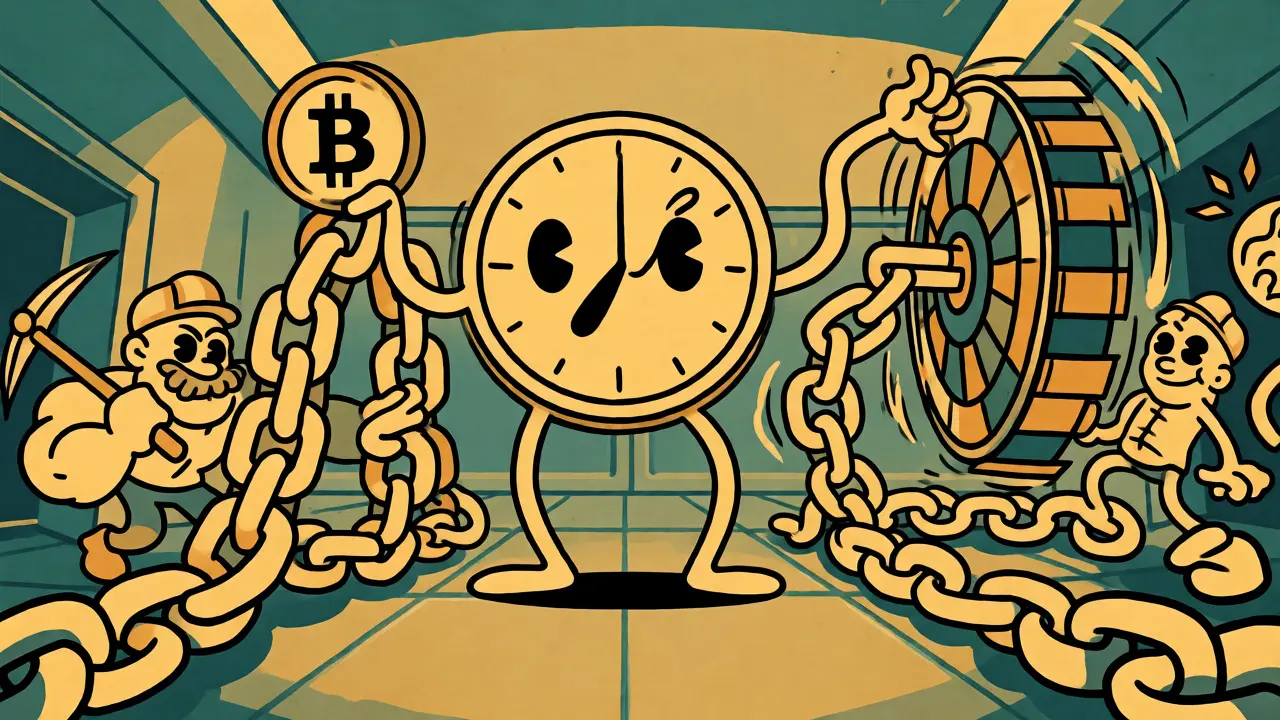
You’ve probably heard that faster is better. In the world of blockchain, however, speed often comes at a steep price. If you’re moving money or data on a decentralized network, you need to understand one critical metric: block time. This isn’t just about how long you wait for a transaction to clear; it’s the primary lever that determines whether your funds are safe from theft or vulnerable to attack.
Think of block time as the heartbeat of a network. It’s the average interval between the creation of new blocks. Bitcoin sets its heartbeat slow-about 10 minutes. Ethereum beats much faster, roughly every 12 seconds. But why did Satoshi Nakamoto choose 10 minutes? Was it laziness? No. It was a calculated security trade-off. This article breaks down exactly how this timing parameter protects (or fails to protect) your assets, using real-world data and expert insights.
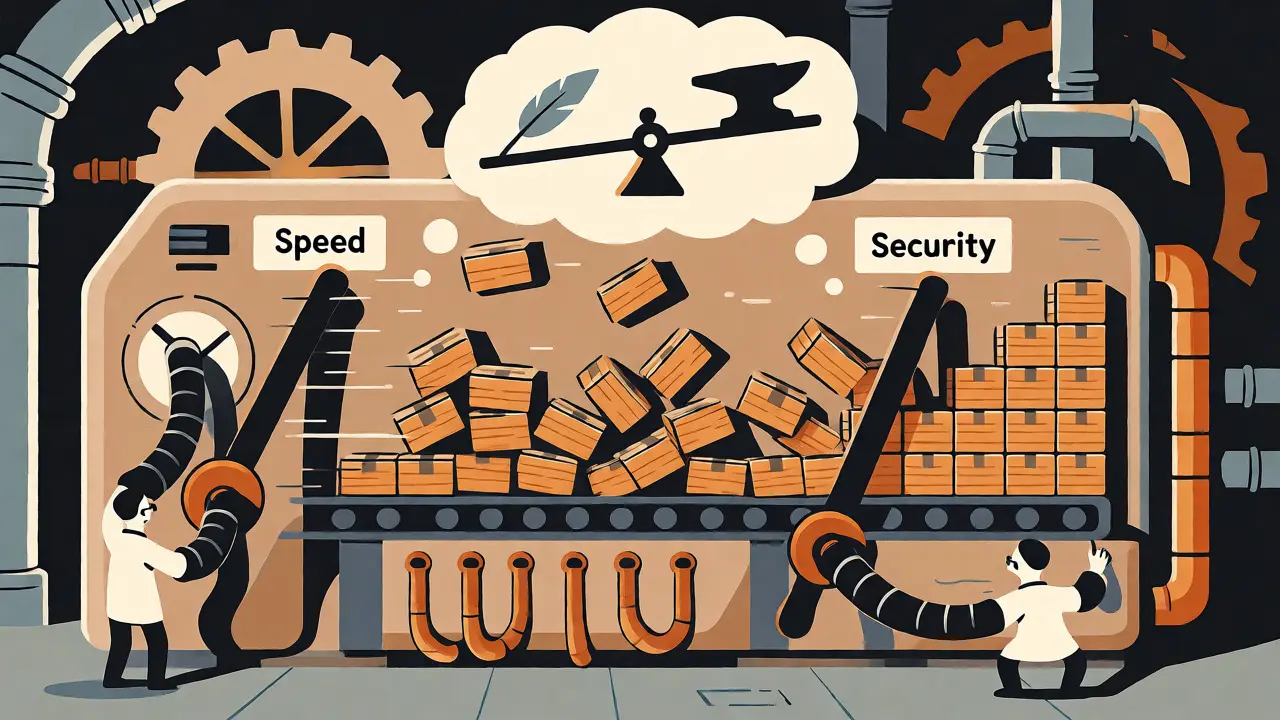
The Core Trade-Off: Speed vs. Safety
Here is the fundamental rule: shorter block times increase throughput but decrease individual block security.
When a miner solves a puzzle and creates a block, that block needs to travel across the entire global network. If the next block arrives before the first one has propagated to all nodes, you get a "fork." Two valid chains exist simultaneously. The network eventually picks a winner, but during that split second, transactions can be reversed. This is the root cause of double-spending attacks.
Longer block times give information more time to spread. They ensure that when a new block is added, nearly everyone agrees on what happened. Shorter block times create a race condition. Nodes might see different versions of reality. To compensate, networks with fast blocks require more confirmations or additional cryptographic safeguards.
| Network | Average Block Time | Consensus Mechanism | Security Risk Profile |
|---|---|---|---|
| Bitcoin | ~10 minutes | Pow | Very Low (High hash power per block) |
| Ethereum | ~12 seconds | PoS | Low (Requires GHOST protocol adjustments) |
| Litecoin | ~2.5 minutes | Pow | Moderate (Vulnerable to timejacking) |
| Solana | ~400 milliseconds | PoH + PoS | Higher (Frequent forks under load) |
Why Bitcoin Chose 10 Minutes
Satoshi didn’t pick 10 minutes out of thin air. He modeled the propagation delay of a message traveling around the globe. At the time, internet speeds were slower, and the network was smaller. Ten minutes ensured that a block would reach 99% of nodes before the next one was mined. This minimized orphaned blocks-valid blocks that aren’t part of the main chain because they arrived too late.
Today, Bitcoin’s orphan rate sits at roughly 0.38%. That sounds low, but it’s non-zero. If Bitcoin reduced its block time to 1 minute, the orphan rate would skyrocket. More importantly, each block would secure less computational work. With a 1-minute target, a single block contains only about 1/10th of the hash power currently securing a Bitcoin block. An attacker with 30% of the network’s hash power could more easily rewrite history in a fast-block system than in a slow one.
Dr. Andrew Poelstra, Director of Mathematics at Blockstream, calls the 10-minute window the "Goldilocks zone." It keeps natural chain splits below 1% while still allowing for reasonable user experience. It’s not instant, but it’s robust.
The Double-Spend Danger Zone
Double-spending is the nightmare scenario for digital cash. You send $100 to Alice, then try to spend the same $100 with Bob. In a centralized bank, the ledger prevents this instantly. In a decentralized network, there’s no central referee. You rely on consensus.
With short block times, the window for a double-spend attack widens. Consider Verge (XVG), a cryptocurrency that suffered a massive hack in 2018. Attackers exploited its multi-algorithm mining setup and relatively fast block intervals to reverse transactions with just 15% of the network’s hash power. They stole over $1 million worth of XVG. Why? Because the network accepted transactions too quickly without sufficient security depth.
Exchanges know this risk. That’s why Coinbase requires 6 Bitcoin confirmations (60 minutes) for high-value withdrawals but might accept fewer for stablecoins on faster chains. However, even on Ethereum, which has a 12-second block time, developers often wait for 30-50 confirmations (6-10 minutes) for significant value transfers. This seems counterintuitive-if blocks are fast, why wait so long? Because early blocks are prone to reorganization. The deeper a transaction sits in the chain, the more computationally expensive it becomes to undo.

Proof-of-Work vs. Proof-of-Stake Dynamics
Block time impacts security differently depending on the consensus mechanism.
In Proof-of-Work (PoW), security is tied to energy expenditure. Longer blocks mean more energy is spent per unit of time, creating a heavier chain. Shortening block time dilutes this security unless you drastically increase difficulty adjustment algorithms, which introduces instability.
In Proof-of-Stake (PoS), like Ethereum post-Merge, security relies on economic stake. Validators lock up ETH to propose blocks. Here, short block times are easier to manage because finality rules differ. Ethereum uses the LMD-GHOST algorithm to handle forks efficiently. However, Vitalik Buterin has noted that shorter times require stricter penalties for validators who equivocate (propose conflicting blocks). If the block time were 1 second, the network might struggle to reach agreement before the next slot opens, leading to temporary inconsistencies.
Real-World Implications for Users and Developers
If you’re building an app or running a business, you can’t ignore block time. It dictates your UX and your fraud detection strategy.
- Retail Payments: For buying coffee, waiting 10 minutes is unacceptable. Solutions like the Lightning Network layer off-chain to provide instant settlement, relying on Bitcoin’s base layer only for final security. Without such layers, merchants accepting Bitcoin directly must either trust unconfirmed transactions (risky) or wait (slow).
- Exchange Listings: Platforms listing assets with sub-30-second block times report 27% more complaints about "transaction reversals." Binance, for example, adjusts deposit confirmation requirements dynamically based on network congestion and block speed.
- Developer Configuration: Hardcoding "wait for 3 blocks" is bad practice. On a congested network, 3 blocks might take hours. On a quiet one, seconds. Smart contracts should check for finality thresholds, not just block counts.
A study by Chainstack found that 63% of blockchain developers needed specialized training to configure these thresholds correctly. Many defaulted to unsafe practices, accepting payments after just one confirmation on fast chains, exposing themselves to reorg risks.
Future Trends: Adaptive Block Times
The rigid approach of fixed block times is evolving. Researchers are exploring "adaptive" systems where the network automatically adjusts block intervals based on traffic and security conditions.
For instance, during low activity, a network might lengthen block times to save energy and reduce fork probability. During high demand, it might shorten them to improve throughput, compensating with enhanced gossip protocols. The MIT Digital Currency Initiative proposed "security-weighted confirmations," where exchanges calculate required confirmations based on real-time hash rate distribution rather than fixed numbers.
Ethereum’s upcoming upgrades continue to refine this balance. While maintaining ~12-second slots, improvements in data availability sampling aim to make the network more resilient to short-term inconsistencies. Meanwhile, newer Layer-1s like Aptos or Sui use different models entirely, decoupling execution order from consensus timing to achieve sub-second finality without sacrificing safety.
Key Takeaways
- Longer block times generally equal higher security per block in PoW systems due to greater accumulated work.
- Shorter block times require more confirmations or advanced fork-choice rules to prevent double-spends.
- Propagation delay is the enemy. If blocks don’t propagate globally before the next one arrives, forks occur.
- Never assume one confirmation is enough on any public blockchain for high-value transactions.
- Context matters. A 10-minute block on Bitcoin is safer than a 10-minute block on a smaller, less-hash-powered chain.
Why does Bitcoin have a 10-minute block time?
Bitcoin’s 10-minute block time was designed to minimize the chance of forks caused by network propagation delays. It ensures that a newly mined block reaches most of the network before the next block is found, thereby reducing orphaned blocks and enhancing resistance to double-spending attacks.
Does a shorter block time always mean less security?
Not necessarily, but it changes the nature of security. Shorter block times increase the frequency of potential forks. To maintain security, networks must implement robust fork-choice rules (like Ethereum’s GHOST) or require more confirmations. In PoW systems, shorter times dilute the hash power securing each individual block, making 51% attacks theoretically easier if not properly calibrated.
How many confirmations do I need for a secure transaction?
It depends on the network and transaction value. For Bitcoin, 6 confirmations (approx. 60 minutes) are standard for high-value transfers. For Ethereum, 12-30 confirmations (2.5-6 minutes) are often recommended. Always check the specific guidelines provided by the exchange or wallet provider, as they adjust these numbers based on current network conditions.
What is a double-spend attack?
A double-spend attack occurs when a user spends the same digital currency twice in two different transactions. In a decentralized network without a central ledger, this can happen if the network accepts both transactions before realizing they conflict. Short block times and low network connectivity increase the risk of successful double-spends.
Can block time be changed after a blockchain launches?
Yes, but it requires a hard fork or consensus upgrade. Changing block time affects the issuance rate of new coins and the security model. For example, Ethereum’s transition to Proof-of-Stake significantly altered its effective block production dynamics compared to its earlier Proof-of-Work days, though the slot time remained consistent.