
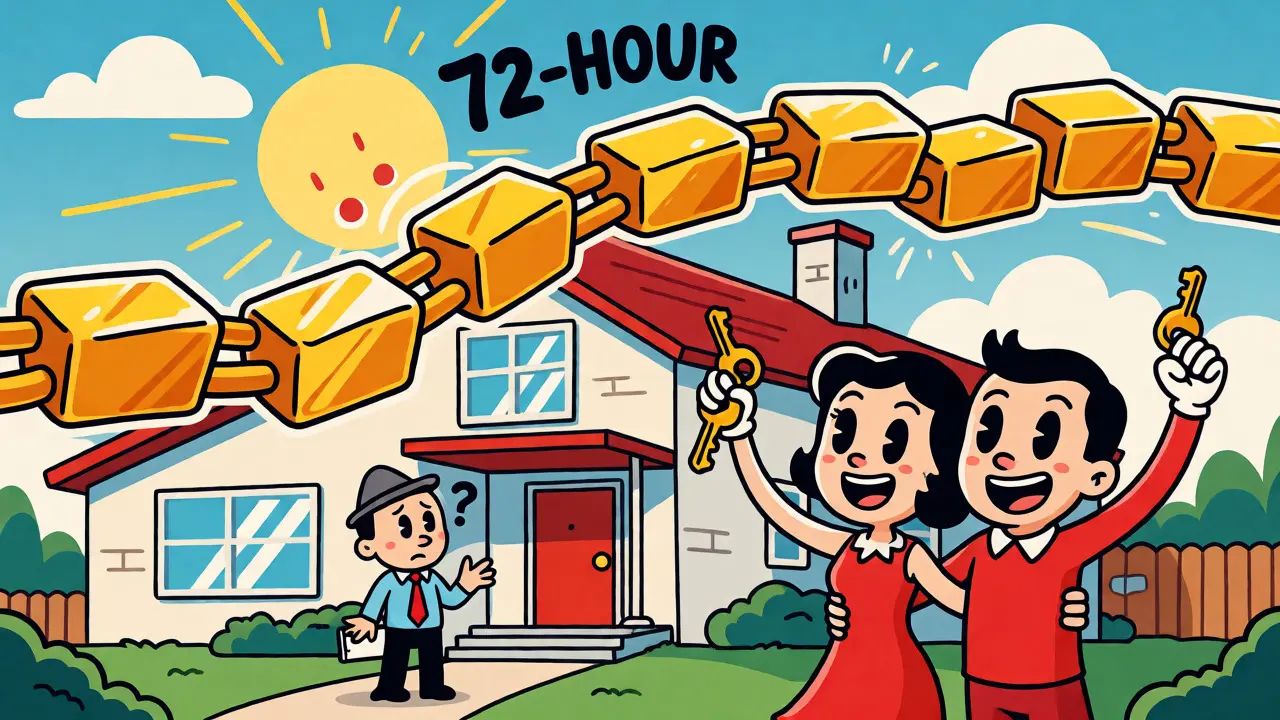
Imagine buying a house and having the keys in your hand three days after signing the offer. Sounds like a dream? For most of us, it’s a nightmare of paperwork, waiting for wire transfers, and chasing down signatures. The traditional real estate closing process is a sluggish beast, typically taking 30 to 60 days. But what if you could cut that time down to just 72 hours? That’s not science fiction; it’s the reality emerging from blockchain technology.
Blockchain in real estate isn't just about Bitcoin or NFTs. It's a fundamental shift in how we verify ownership and transfer assets. By using immutable distributed ledgers and self-executing smart contracts, this technology removes the middlemen who slow everything down. We’re talking about eliminating the need for repeated manual checks by title companies, lawyers, and escrow agents. Instead of weeks of back-and-forth emails, transactions can settle in minutes or days. This article breaks down exactly how this speed boost works, where it stands today, and why the industry is racing to adopt it.
The Bottleneck: Why Traditional Closings Take So Long
To understand the value of blockchain, you first have to appreciate the mess it replaces. A standard home purchase involves a chaotic dance of intermediaries. You’ve got realtors, mortgage lenders, title searchers, appraisers, inspectors, escrow officers, and county recorders. Each one adds friction.
Let’s look at the timeline. A typical title search alone takes 7-10 days because someone has to physically dig through public records to ensure no one else claims ownership of your future home. Mortgage processing adds another 15-21 days while underwriters manually review documents. Then there’s the money movement. Wire transfers aren’t instant; they require verification steps that can take days. If one document is missing or one signature is illegible, the whole process stalls.
This reliance on human verification creates bottlenecks. According to industry data, these manual steps are responsible for the vast majority of delays. It’s not that people are lazy; it’s that the system is designed around paper trails and trust issues rather than automated proof. Blockchain flips this model. Instead of trusting a person to check a record, you trust code that checks the record automatically and instantly.
How Smart Contracts Accelerate the Process
The engine behind this speed is the smart contract. Unlike a legal contract that needs a lawyer to enforce it, a smart contract is code stored on a blockchain. It executes actions automatically when conditions are met.
Here is how it changes the workflow:
- Identity Verification: In a traditional deal, you might prove your identity five different times-to the lender, the title company, the escrow agent, etc. With blockchain, you verify your digital identity once. Your credentials are hashed and stored securely. Every party involved can verify your identity instantly without asking for your passport again.
- Automated Title Search: Instead of a human searching physical archives, a smart contract queries the blockchain ledger. If the property’s history is clean (no liens, no disputes), the contract confirms clear title in seconds, not days.
- Instant Settlement: When funds are sent, the smart contract holds them in escrow digitally. Once the title transfer is recorded on the blockchain, the contract releases the funds to the seller and updates the ownership record simultaneously. There’s no waiting for a bank to confirm a wire.
This automation reduces the 12-15 manual verification steps found in traditional deals to just 3-4 automated ones. What used to take 24-72 hours per step now happens in under 5 minutes.
Real-World Evidence: How Fast Is It Actually?
Theory is nice, but does it work in practice? Yes, and the numbers are striking. Let’s look at some concrete examples from recent years.
In Vermont, a company called Propy completed a transaction in just 72 hours. Compare that to the state’s average closing time of 35 days. That’s a reduction of over 90%. Another case study from JLL documented a $3.5 million commercial property sale that settled in 96 hours. Their team noted that eliminating manual wire verification alone saved 11 business days.
It’s not just US-based experiments. Sweden’s land registry, Lantmateriet, piloted a blockchain solution that achieved 90% faster title transfers. These aren’t isolated glitches; they represent a consistent trend. A survey by the Real Estate Standards Organization showed that 83% of blockchain-enabled transactions closed within 7 days, compared to the traditional 30-45 day average.
However, it’s not always smooth sailing. Some users report delays when local county recorder offices still demand physical paper documents despite the digital verification. This highlights a critical point: blockchain speeds up the technical side, but regulatory compatibility is the final hurdle.

Technical Backbone: Ethereum vs. BSV
Not all blockchains are built for real estate speed. The two main contenders currently driving this space are Ethereum and Bitcoin SV (BSV).
| Feature | Ethereum | Bitcoin SV (BSV) |
|---|---|---|
| Average Block Time | 15-30 seconds | Near-instant (<1 second) |
| Throughput Capacity | Limited by network congestion | Up to 50,000 transactions per second |
| Smart Contract Support | Highly developed ecosystem | Growing, focused on enterprise use |
| Transaction Cost | Variable (Gas fees) | Very low and predictable |
Ethereum is popular because its smart contract capabilities are robust and widely understood. However, during busy periods, gas fees spike, and confirmation times can lag. Bitcoin SV, on the other hand, was specifically engineered for high-volume enterprise applications. Its ability to handle 50,000 transactions per second makes it ideal for global real estate markets where speed and low cost are paramount. For a buyer in Boulder looking to close quickly, the underlying chain matters less than the interface, but for large institutional investors moving billions, throughput is critical.
Barriers to Full Adoption
If the tech is so fast, why isn’t every home sold on blockchain yet? Three main barriers exist.
First, regulatory fragmentation. As of 2023, 28 U.S. states had passed blockchain-friendly legislation, but 22 states still required "wet signatures" (ink on paper) for deeds. In those jurisdictions, you might get the speed benefits of the smart contract but lose half the time savings dealing with physical mail and courier services. The ESIGN Act helps in 49 states, but local county rules vary wildly.
Second, legacy system integration. Real estate relies on old databases. County recorders, MLS systems, and title insurance platforms weren’t built to talk to blockchains. Integrating these systems takes time-often 6-9 months for a full rollout. Until these APIs connect seamlessly, data has to be manually entered into both systems, reintroducing human error and delay.
Third, the learning curve. Agents and brokers aren’t coders. The National Association of Realtors estimates it takes 80-120 hours of training to master these new platforms. Many professionals are comfortable with their current workflows and resist change unless the benefit is overwhelming and immediate.
The Future: CBDCs and Sub-24-Hour Closings
We are moving toward a world where closings happen in under 24 hours. The next big leap involves Central Bank Digital Currencies (CBDCs).
Currently, even with blockchain titles, moving fiat currency (dollars) between banks takes time. Project Hamilton, an experiment by the Federal Reserve, demonstrated that combining blockchain titles with CBDCs could allow simultaneous payment and settlement in under 15 seconds. Imagine clicking "buy," having the digital dollar leave your account, the title update on the ledger, and the deed record updated-all before you finish your coffee.
Industry roadmaps suggest universal sub-24-hour closings by 2026. This requires coordinated updates to recording offices and title insurance processes. Companies like Propy are already reducing average times to 58 hours. As more counties digitize their records and accept electronic signatures, the friction drops further.
Key Takeaways
- Speed Gain: Blockchain can reduce closing times from 30-60 days to 2-7 days, with best-case scenarios under 72 hours.
- Automation: Smart contracts eliminate 12-15 manual verification steps, replacing them with 3-4 automated checks.
- Platforms: Ethereum and Bitcoin SV are the primary technologies, with BSV offering higher throughput for enterprise scale.
- Regulation: Speed gains depend on local laws recognizing digital signatures; 22 U.S. states still pose barriers.
- Future Outlook: Integration with CBDCs aims for near-instant settlement, potentially making real estate as liquid as stocks.
Frequently Asked Questions
Can I buy any house with blockchain right now?
No, not yet. While the technology exists, adoption is selective. You can currently participate in specific pilot programs or use platforms like Propy in select cities (e.g., Austin, South Burlington). Most residential sales still follow traditional paths due to local registry constraints and lack of standardized interoperability across all counties.
Is blockchain real estate safe from fraud?
Yes, generally safer. Because the ledger is immutable, once a transaction is recorded, it cannot be altered or deleted without consensus. This prevents common fraud tactics like forging deeds or double-selling the same property. However, security depends on the user safeguarding their private keys; if you lose access to your digital wallet, recovering ownership can be complex.
Does blockchain lower the cost of closing?
Potentially, yes. By removing intermediaries like title agents and escrow officers, fees associated with their services drop. Additionally, reduced administrative overhead allows lenders and agents to pass some savings to consumers. However, early adopters may face premium pricing for the convenience of speed until the technology becomes mainstream and costs normalize.
What happens if the smart contract has a bug?
This is a valid concern. Code is law in smart contracts, so bugs can cause issues. To mitigate this, reputable platforms use audited contracts tested extensively before deployment. Some systems also include "pause functions" or arbitration clauses that allow human intervention if an anomaly is detected, blending code efficiency with legal safeguards.
Do I need to own cryptocurrency to buy a house on blockchain?
Not necessarily. Most current implementations allow you to pay in fiat currency (USD/EUR) which is converted or settled via stablecoins behind the scenes. You don’t need to be a crypto trader. The blockchain acts as the verification and settlement layer, not necessarily the currency you hold in your pocket.
Comments (12)
Sue Howard
October 30, 2026 AT 04:29
Great article, can't wait to see this actually work without the government slowing it down.
John Corr
October 31, 2026 AT 19:32
Because clearly, the reason closings take 60 days is because humans are too slow at typing. Not because of legal liability, insurance requirements, or local county clerks who still use fax machines in 2024. But sure, let's blame 'middlemen' and pretend code doesn't have bugs that lock up millions in escrow.
Lance Gideon
November 2, 2026 AT 12:59
wait hold on... yall really think some random computer code gonna tell me i own my house??
what happens when the internet goes out or some hacker gets into the ledger? im not trusting my life savings to a digital book that nobody physically owns. sounds like a recipe for disaster honestly. people just want easy answers but real estate is messy by nature.
Marvellous Eje
November 4, 2026 AT 07:38
It is with a heavy heart that I must point out the profound naivety of this perspective. We are attempting to solve a sociological problem with a technological band-aid. The delay in transactions is not merely bureaucratic inefficiency; it is a necessary pause for human deliberation and community verification. To rush ownership transfer to 72 hours is to strip away the gravity of acquiring shelter. One must consider the ethical implications of removing the 'friction' that allows families to truly understand what they are committing to financially. This is not progress; it is haste disguised as innovation.
melissa armstrong
November 5, 2026 AT 17:33
This is such an exciting development for the industry!
I completely agree that removing manual bottlenecks is key. Having worked in property management, seeing the frustration of clients waiting weeks for simple verifications was exhausting. Smart contracts really do offer a streamlined path forward.
However, we must remember that technology is only as good as its adoption rate. While the technical backbone of Ethereum and BSV is impressive, the regulatory landscape needs to catch up to fully realize these benefits. It’s great to see companies like Propy leading the charge!
Taylor Brockett
November 6, 2026 AT 22:47
I appreciate the detailed breakdown of the technical mechanisms involved.
From a professional standpoint, the reduction in title search time from 7-10 days to seconds is indeed significant. However, one must consider the interoperability issues between existing county record systems and new blockchain ledgers. Until there is universal acceptance of digital deeds by all municipal authorities, the '72-hour' claim remains somewhat aspirational for the average consumer.
That said, the potential for reduced fraud through immutable records is a compelling argument for early adoption.
Munesh kumar
November 7, 2026 AT 03:04
Oh, how delightful. Another tech-bro fantasy where algorithms replace lawyers. Because nothing says 'security' like handing your deed over to a decentralized network that changes rules every six months.
The author clearly hasn't dealt with a contested will or a messy divorce settlement involving property. You can't just 'smart contract' your way out of human conflict. And don't get me started on energy consumption. But please, keep dreaming about your 72-hour utopia while the rest of us deal with reality.
tamil thai
November 8, 2026 AT 01:24
Everyone is so obsessed with speed now. Fast food, fast cars, fast love... now fast houses. What happens when you buy a house in 3 days and realize the foundation is cracked? In traditional systems, the slowness gives you time to breathe, to inspect, to regret, to decide.
This rush to automate everything is making us hollow. We are becoming consumers of assets rather than inhabitants of homes. I feel sad for the future generation that won't know the weight of signing a paper deed. It feels like we are losing our souls to efficiency.
Cameron Scott
November 8, 2026 AT 14:19
Dude, this is HUGE!! Imagine telling your parents you got the keys in 3 days instead of 2 months. That is literally life-changing stuff right there.
I’ve been following the crypto space for years and this is finally a use case that makes sense for regular folks. No more waiting around for banks to process wires. Just boom, done. I’m so hyped to see this roll out globally. Who else is ready to ditch the paperwork hell?
Michelle Franscella
November 9, 2026 AT 03:47
While the potential for speed is undeniable, I think we need to be mindful of the digital divide. Not everyone has reliable access to high-speed internet or the digital literacy required to navigate smart contracts securely.
If we implement this system without proper support structures, we risk excluding vulnerable populations from the housing market entirely. It’s important to ensure that these tools are inclusive and accessible before we declare victory over traditional methods.
Sarah Noelle
November 9, 2026 AT 09:55
I hear the concerns about security and regulation, and they are valid. But I also try to stay open-minded about the possibility of improvement. Maybe it won't be perfect overnight, but incremental change is better than stagnation.
Perhaps a hybrid model could work best for a while, where blockchain handles the verification but human agents still oversee the emotional and complex parts of the transaction. It feels like a gentle step toward something better.
Elisa Gray
November 10, 2026 AT 14:07
I’ve been thinking about this philosophically. Ownership is a social construct, agreed upon by consensus. Blockchain just formalizes that consensus mathematically.
But here is the boundary: Does removing the human intermediary remove the human accountability? If a smart contract executes a sale based on flawed data input, who do you sue? The coder? The node validator?
We need to respect the complexity of trust. Speed is valuable, but certainty is priceless. Let’s not trade one for the other without understanding the cost.