
If you have been trading crypto in the U.S. for more than a year, you know the feeling of holding your breath every time the SEC issued a new press release. Was that token a security? Would your exchange get sued? Could your bank freeze your account for touching stablecoins? For over a decade, we operated in a fog of "regulation by enforcement," where the rules were written after the fact, often with heavy fines attached. That era ended in 2025.
The passage of the GENIUS Act and the subsequent push for the CLARITY Act didn't just tweak the rules; they rewrote the map. If you are a trader, an investor, or running a small fund, the ground beneath your feet has shifted. The uncertainty that kept institutional money on the sidelines is lifting, but it comes with new compliance hurdles you need to understand right now.
The End of the Howey Test Ambiguity
For years, every new crypto asset faced the same question: Is it a security? This was determined by the Howey Test, a legal standard from 1946 that fits poorly with decentralized networks. It created chaos. A token might be treated as a commodity by the CFTC one day and a security by the SEC the next, depending on which agency felt like acting that week.
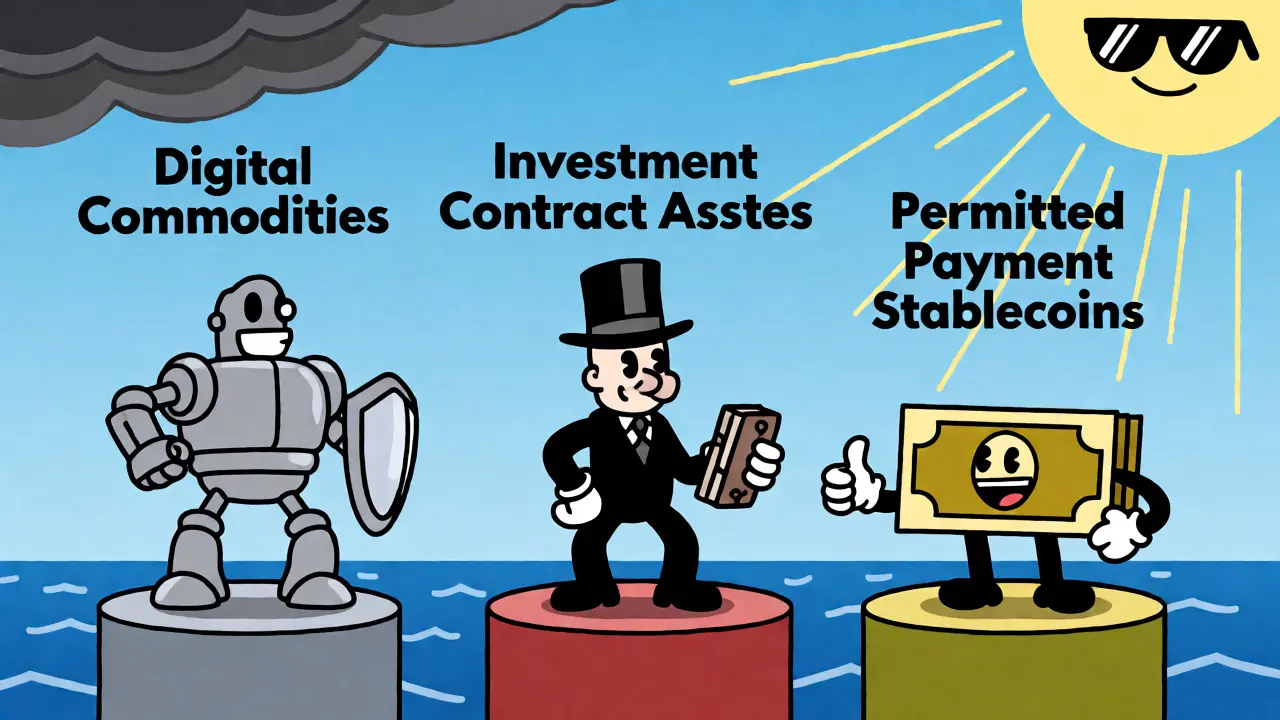
The CLARITY Act fixes this by creating three distinct categories for digital assets. You no longer have to guess. The law explicitly divides the market into:
- Digital Commodities: Assets like Bitcoin and Ethereum that function primarily as mediums of exchange or stores of value. These fall under CFTC jurisdiction.
- Investment Contract Assets: Tokens that clearly promise profits derived from the efforts of others. These remain under SEC oversight.
- Permitted Payment Stablecoins: USD-backed tokens regulated under the separate GENIUS Act.
This tripartite system removes the gray area. If your token is classified as a digital commodity, the SEC cannot sue your exchange for listing it without registration. This single change unlocks massive liquidity because exchanges can list major assets without fear of immediate shutdown orders.
Stablecoins Get a Federal License
Before 2025, stablecoins existed in a weird limbo. They weren't quite currencies, weren't quite securities, and banks were terrified to touch them. The GENIUS Act, signed into law in July 2025, changed everything for the $1.8 trillion monthly volume moving through stablecoin rails.
The Act mandates strict reserve requirements. Issuers must hold 1:1 reserves in cash or short-term U.S. Treasuries, audited monthly. But here is the big win for traders: these "permitted payment stablecoins" are now recognized as safe harbor instruments. You can move large amounts of USDC or USDT without worrying that a sudden regulatory shift will classify them as unregistered securities overnight.
Chris Rhine, head of liquid active strategies at Galaxy Asset Management, called this a "new age of financial innovation." He wasn't exaggerating. By stabilizing the foundation of crypto trading pairs, the Act allows traditional finance institutions to enter the space confidently. We are already seeing banks offer custody solutions that were previously impossible due to liability fears.
What Changes for Your Brokerage Account
If you trade through a traditional broker-dealer rather than a pure-play crypto exchange, the changes are even more significant. Previously, many brokers refused to handle crypto because their existing regulatory framework didn't fit. The new legislation requires the SEC to allow registered broker-dealers to trade and custody digital commodities and permitted stablecoins.
This means your Robinhood or Fidelity account might soon look a lot more like Coinbase, but with better insurance protections. The law prevents the SEC from barring trading platforms from exemption eligibility simply because they list digital assets alongside stocks. In plain English: hybrid platforms are now legally viable. You won't need five different apps to manage your portfolio.
| Feature | Pre-2025 (Regulation by Enforcement) | Post-2025 (Statutory Framework) |
|---|---|---|
| Asset Classification | Ambiguous; based on case-by-case Howey Test | Defined categories: Commodity, Security, Stablecoin |
| Exchange Liability | High risk of lawsuits for listing unregistered securities | Clear safe harbors for listed digital commodities |
| Stablecoin Reserves | Varied issuer practices; limited federal oversight | Mandatory 1:1 reserves with monthly audits |
| Institutional Access | Limited; banks hesitant to engage | Open; broker-dealers can custody digital commodities |
| State Laws | Complex patchwork of Blue Sky laws | Streamlined for covered securities across states |
Custody and Compliance: The Hidden Costs
Clarity is great, but it comes with paperwork. The new rules impose stricter recordkeeping requirements on broker-dealers and exchanges. If you run a Registered Investment Adviser (RIA) firm, you need to update your Code of Ethics immediately. The distinction between digital commodities and security tokens matters for employee personal trading surveillance.
Under modified Rule 204A-1, if an employee trades Bitcoin (a digital commodity), it may not trigger the same pre-clearance obligations as trading a security token. However, you must prove this classification in your compliance manual. Firms that fail to update their manuals risk fines during routine exams. Legal experts at Arnold Porter noted that while this provides "meaningful operational relief," it demands precise internal categorization.
Custody is another pain point. Spot digital assets deemed commodities operate under state custodian laws rather than federal securities rules. This creates a fragmented landscape where a trust company in Wyoming might have different capital requirements than one in New York. If you are moving large sums, ensure your custodian is qualified under both federal guidelines and relevant state trust laws.

Impact on DeFi and Smaller Projects
Not everyone is celebrating. While big exchanges and ETF providers love the clarity, smaller projects and DeFi protocols face higher barriers to entry. The requirement for clear classification means launching a new token is no longer a "move fast and break things" affair. You need legal counsel before you mint.
Some community members worry that the emphasis on centralized compliance stifles the decentralized ethos of crypto. If only compliant, audited stablecoins are allowed, do we lose the wild innovation that brought us yield farming in the first place? Time will tell. For now, the trend is toward institutional-grade infrastructure, which favors scale over experimentation.
Strategic Moves for Traders in Late 2026
So, what should you do today? First, audit your holdings. Identify which of your assets are now officially digital commodities versus investment contracts. This affects your tax reporting and potential future restrictions.
Second, diversify your custody. Don't keep all your eggs in one exchange basket. With clearer laws, reputable custodians are offering better rates. Look for providers that comply with the September 2025 SEC no-action letter regarding state trust companies.
Finally, watch the SEC's rulemaking agenda. The legislation passed, but the details are being written now. Chairman Atkins' team is currently updating custody rules to accommodate blockchain technology. Stay flexible. The framework is set, but the operational specifics are still evolving.
Does the GENIUS Act apply to all stablecoins?
No, it specifically targets USD-backed payment stablecoins. Algorithmic stablecoins or those backed by other assets may fall under different regulatory categories or remain in a transitional phase until further guidance is issued.
Will my crypto taxes change because of the new classifications?
The IRS tax treatment generally follows the economic substance of the transaction, so the primary impact is on securities laws, not tax codes. However, accurate classification helps in determining whether gains are treated as capital gains or ordinary income in complex scenarios involving staking rewards.
Can I still trade altcoins that aren't clearly commodities?
Yes, but they are likely classified as investment contract assets. This means they remain under SEC jurisdiction, requiring exchanges to register as national securities exchanges or alternative trading systems (ATSs) to list them properly.
Do state laws still apply to crypto trading?
Partially. The CLARITY Act exempts digital commodities from state-level blue sky laws by classifying them as "covered securities," streamlining interstate trading. However, consumer protection and fraud laws at the state level still apply.
Is it safer to use a bank or an exchange for custody now?
Both have improved. Banks can now offer custody services for digital commodities under clearer guidelines. Exchanges must adhere to stricter segregation of customer funds. For large balances, a multi-signature cold storage solution combined with a regulated custodian is often the most secure path.