
Ever wonder why people spend hundreds of dollars on high-end servers and electricity just to keep a computer running 24/7 in their basement? It isn't just for the love of decentralization. There is a massive financial engine driving this behavior. The economic incentives for running blockchain nodes is the system of financial rewards that motivates individuals and organizations to maintain the hardware and software necessary to keep a decentralized network secure and operational. Without these rewards, networks would collapse because nobody would have a reason to pay the electricity bill or manage the technical headaches of a node.
The Bottom Line: How You Actually Make Money
If you're looking to get into node operating, you first need to understand that not all rewards are created equal. Depending on the network, you might be earning a steady stream of new tokens or fighting for a piece of the transaction pie. Here is the quick breakdown of how the money flows:
- Transaction Fees: These are the payments users send to have their transactions processed. When you verify a block, you take a cut of these fees.
- Staking Rewards: Common in Proof of Stake (PoS) systems, these are rewards given to you for "locking up" your tokens as collateral to guarantee the network's honesty.
- Inflationary Issuance: The network literally prints new coins out of thin air and gives them to node operators to keep them interested.
- MEV (Maximal Extractable Value): This is a more advanced play. Operators can reorder or include specific transactions within a block to capture extra profit from arbitrage opportunities.
Breaking Down the Different Node Types
Before you buy hardware, you have to decide what role you want to play. A Validator Node isn't the same as a simple full node. A validator actively participates in the consensus process-meaning they vote on which transactions are valid-and they are the ones who typically receive the big payouts. In contrast, a full node keeps a complete copy of the ledger for security and verification but often doesn't earn a direct reward.
Then there are Masternodes. These are specialized servers that handle specific functions, like instant transactions or decentralized exchange services. Because they do more "work" than a standard node, they usually require a much higher initial deposit (stake) but offer more consistent returns.
| Node Type | Primary Reward Source | Entry Barrier | Risk Level |
|---|---|---|---|
| Validator | Staking + Block Rewards | Medium to High | Medium (Slashing risk) |
| Masternode | Service Fees + Fixed Rewards | High (Collateral) | Low to Medium |
| Full Node | None (usually) | Low | Very Low |
Real-World Examples: What the Yields Look Like
Let's get concrete. In 2025 and 2026, we've seen a huge shift toward making nodes more accessible. You no longer need a NASA-grade supercomputer to participate. For example, the Gnosis Chain has made it incredibly easy to enter. You can start a validator node with a minimum stake of just 1 GNO token. The annual yield has been hovering around 13%, which is quite attractive for such a low barrier to entry. They've even updated their software to Erigon 3, which drastically lowers the hardware requirements so you don't need a massive server rack.
If you prefer something more flexible, Flux offers "Titan nodes." Here, you can stake as few as 50 FLUX tokens. The cool part about Flux is the flexibility; you can choose different lock-up periods. The longer you lock your tokens, the higher your potential rewards. However, keep in mind that these rewards aren't guaranteed and often require specific tools like the Zelcore wallet to manage efficiently.

The 'King Safety' Problem: When Incentives Fail
Not every network gets its math right. Take Algorand as a cautionary tale. For a while, the network struggled because its fee structure didn't give stakers enough reason to stick around. Since there is a hard cap of 10 billion Algo tokens, the network can't just print more money forever to keep operators happy.
To fix this, they introduced "Project King Safety." The goal here is to diversify where the money comes from. Instead of just relying on inflation (printing coins), they are moving toward a mix of fee-based rewards and MEV opportunities. This is a crucial lesson for any node operator: always check if the network has a long-term plan for sustainability, or if the rewards are just a temporary honeymoon phase funded by an inflation bubble.
The Hidden Costs and Risks
It sounds like free money, but running a node is a job. If your internet goes down or your server crashes, you don't just stop earning-you might actually lose money. Many Proof of Stake networks use a process called "slashing." If your node is offline or behaves maliciously, the network takes a portion of your staked tokens as a penalty.
Then there is the technical overhead. You'll need to manage Linux servers, handle security patches, and monitor your uptime. If you aren't tech-savvy, you might spend more on a managed hosting service than you earn in rewards. Finally, there's the volatility. If you earn 15% APY in a token that drops 80% in value, your "profit" is an illusion. You are essentially betting on the long-term success of the project.

The Regulatory Shift in 2026
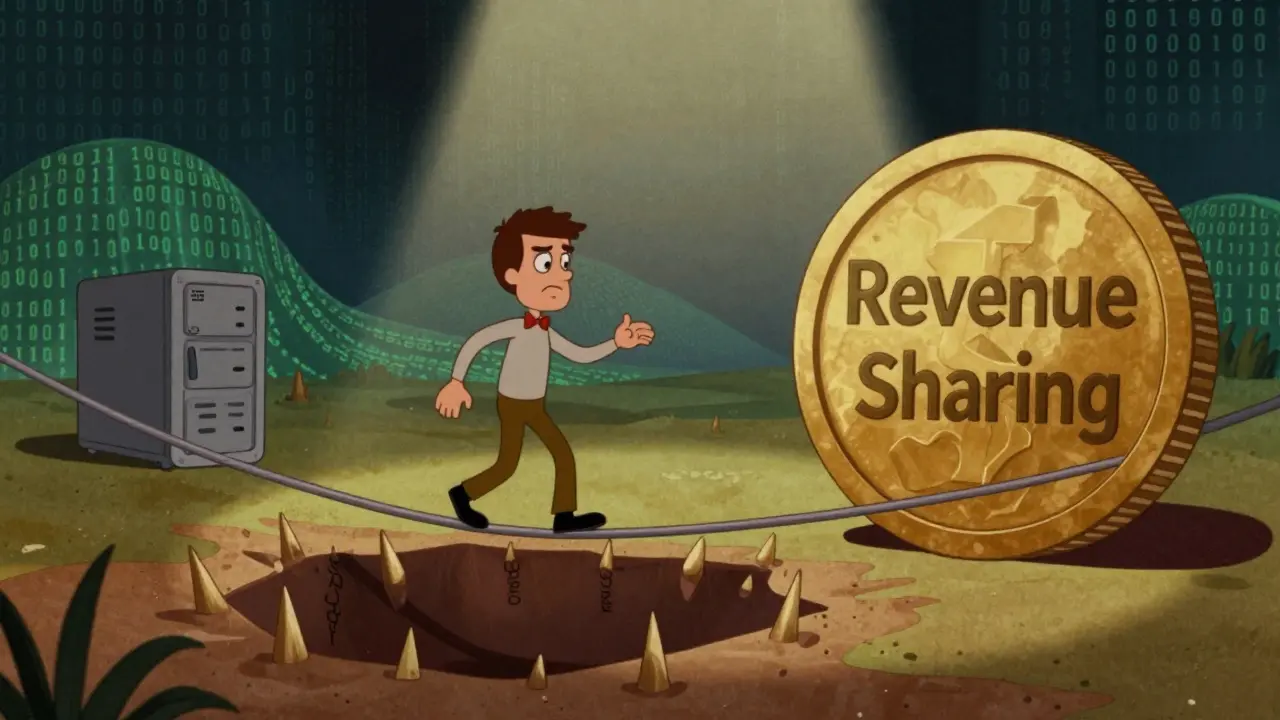
For years, many DeFi (Decentralized Finance) protocols were scared to share revenue with node operators because they didn't want the SEC to label their tokens as securities. But the tide has turned. With more collaborative leadership at the SEC and new market structure legislation passed by Congress, we are seeing a resurgence in "revenue-sharing."
This means that governance tokens are evolving into yield-generating assets. Instead of just voting on proposals, holding these tokens (or running the associated nodes) now grants you a direct share of the protocol's earnings. This alignment of interests makes the node economy much more stable because the rewards are based on actual usage and revenue, not just speculative minting.
Do I need expensive hardware to run a blockchain node?
It depends entirely on the network. Some, like Gnosis Chain with Erigon 3, are designed for low-spec hardware. Others, like Bitcoin or Ethereum, may require high-speed NVMe SSDs and significant RAM to keep up with the chain's growth. Always check the current hardware requirements in the network's official documentation before buying gear.
What is "slashing" and how do I avoid it?
Slashing is a penalty where a portion of your staked coins is taken away if your node goes offline or attempts to validate fraudulent transactions. To avoid it, use a reliable VPS (Virtual Private Server), set up automated monitoring alerts for your uptime, and ensure you have a stable internet connection.
Is running a node better than just staking through an exchange?
Running your own node gives you full control over your keys, supports the network's decentralization, and often allows you to earn higher rewards (including MEV). Staking via an exchange is easier but involves "custodial risk" (the exchange could freeze your funds) and usually involves the exchange taking a significant cut of your rewards.
Can I run multiple nodes for different blockchains on one machine?
Yes, provided your hardware has enough CPU, RAM, and disk space to handle the load. Many operators use Docker containers to isolate different nodes. However, be careful with bandwidth; if several nodes are syncing at once, you might hit your data cap or experience lag that leads to downtime penalties.
How do I calculate if a node is actually profitable?
Subtract your monthly costs (electricity, hardware depreciation, VPS fees) from your average monthly rewards. Remember to account for the "opportunity cost"-would that stake money earn more in a simple savings account or a different DeFi pool? Also, factor in the token's volatility.
Next Steps for New Operators
If you're ready to start, don't jump into the deepest end of the pool. Start with a "light node" or a low-stake validator on a chain like Gnosis or Flux to get a feel for the software. Once you're comfortable with the command line and server management, you can move toward high-stake masternodes or the competitive world of MEV extraction.
Keep a close eye on the regulatory news. As more DeFi protocols align their tokenomics with actual revenue, the most profitable nodes won't necessarily be the ones with the highest inflation, but the ones powering the most used applications. The era of "printing money" is fading, and the era of "service-based rewards" is here.
Comments (17)
Robert Smith
April 26, 2026 AT 11:54
Low entry barrier is the way! 🚀
Felix Eduardo Velasquez
April 27, 2026 AT 00:22
The transition from purely inflationary issuance to service-based revenue is the only way these protocols survive long-term. If a network relies solely on minting new tokens to pay validators, it's essentially a Ponzi scheme where early adopters are paid by the dilution of later holders. True sustainability comes from the utility of the network-meaning the transaction fees must eventually cover the cost of security. It's an elegant economic problem: how to price a transaction high enough to incentivize hardware maintenance but low enough to keep the network usable for the average person. This is why the shift toward MEV and revenue sharing is so critical. By capturing the value created by arbitrage and liquidation, the network can reward operators without destroying the token's value through hyperinflation. It turns the node operator from a passive recipient of a subsidy into a legitimate service provider in a digital economy.
Lloyd I
April 27, 2026 AT 21:19
This is such a great breakdown for anyone wanting to get started! Keep pushing forward, everyone! You've got this!
Arti Jain
April 27, 2026 AT 23:06
Indian infra is far superior. Westerns just follow.
Nitin Gupta
April 29, 2026 AT 15:49
I agree with the point on hardware requirements. Using a VPS can really help beginners avoid the initial cost of a heavy server rack.
VIVEK SINGH
April 30, 2026 AT 06:47
Oh sure, just throw your life savings into a
Emily A
May 1, 2026 AT 05:04
It is frankly exhausting that people still confuse full nodes with validators. The distinction is fundamental to understanding how consensus works, yet most amateurs treat them as interchangeable terms. If you cannot grasp the difference between maintaining a ledger and participating in the voting process, you have no business risking capital in this space. Precision in terminology is not pedantry; it is the baseline for competence in distributed systems. One provides the truth; the other agrees on it. End of story.
Harvey Alford
May 2, 2026 AT 20:38
I need to know your budget for this.
Wayne Gillis
May 3, 2026 AT 17:54
Wait, so you're saying I can just run this on my old laptop? 💻 Let's goooo! I'm definitely trying this out tonight ⚡️✨
Michael Repak
May 4, 2026 AT 05:39
Totally agree with the risk section!!! Slashing is no joke!!! Be careful everyone!!!
debra hoskins
May 4, 2026 AT 06:49
The whole 'revenue sharing' narrative is just a fancy way to dress up old-school dividends in a digital cloak. Purely ornamental.
edie rosa
May 4, 2026 AT 07:49
Another day, another 'passive income' dream. We all know the volatility will just wipe out the meager gains anyway.
Lex Harley
May 4, 2026 AT 14:42
honestly thnk the L1 sharding might affect the throughput for low-spec nodes... kinda worried about the latency in the p2p layer if we use cheap VPS
Ralph Espinosa
May 6, 2026 AT 09:10
Great point about Docker!!! It's the only way to keep the environment clean!!! Highly recommend it!!!
Mitali Rajvanshi
May 8, 2026 AT 06:56
Gnosis seems like a solid entry point for most.
AP Fisher
May 8, 2026 AT 16:39
I don't really get the MEV part, sounds a bit like cheating but it's legal in the code?
Veronica Bago
May 8, 2026 AT 17:53
This was a super helpful read, thanks for keeping it chill and easy to understand!