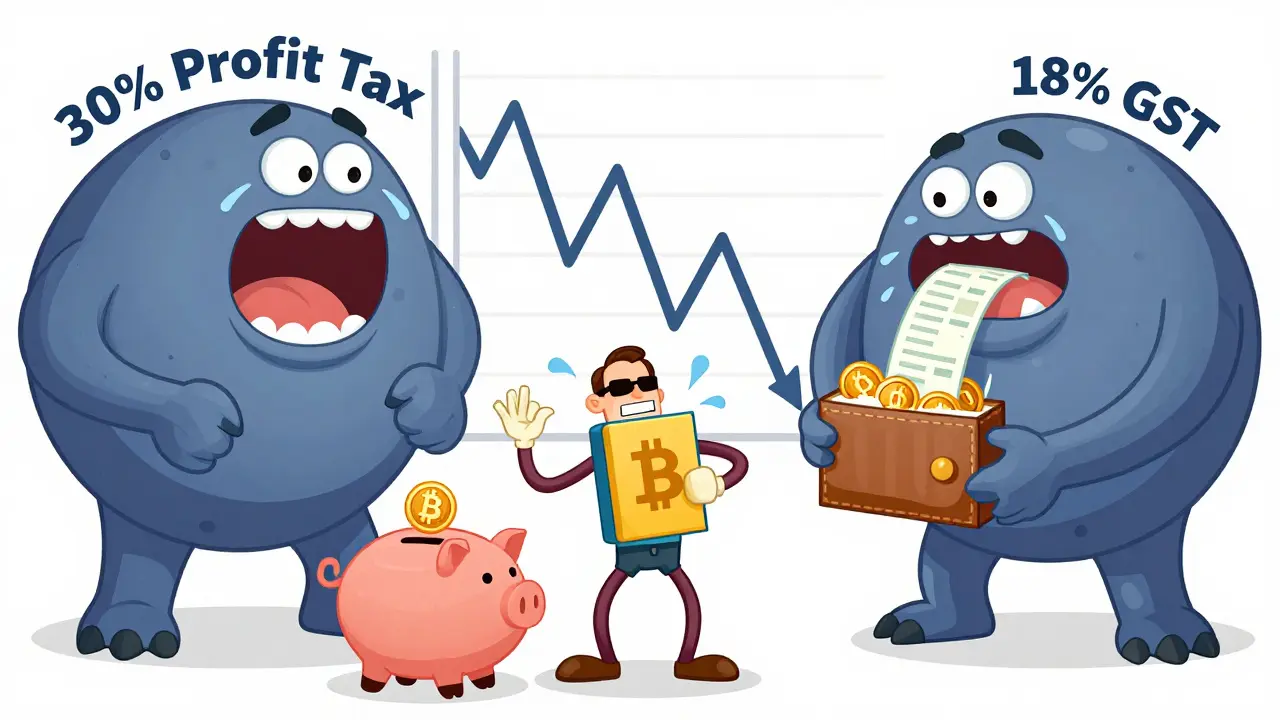
When you buy Bitcoin in India, you’re not just buying a digital asset-you’re stepping into one of the most complex tax systems in the world. Since April 2022, every trade, every sale, every transfer of cryptocurrency has been hit with a 30% tax on profits. No exceptions. No deductions. Not even if you lost money elsewhere in your portfolio. This isn’t capital gains tax like in the U.S. or Europe. This is a flat, punitive rate that treats your $100 profit the same as your $100,000 profit-with the same 30% cut. And it’s gotten worse since July 2025, when GST slapped an extra 18% on exchange fees. If you’re trading Bitcoin or any crypto in India, you need to understand exactly how this system works-before you owe more than you made.
How the 30% Crypto Tax Actually Works
The tax isn’t complicated to calculate, but it’s brutal in practice. Here’s the formula: (Selling Price - Purchase Price) × 30% = Tax Owed. That’s it. No holding period matters. Whether you held Bitcoin for 2 days or 2 years, it’s still taxed at 30%. No matter if you’re a casual buyer or an active day trader. The Indian government doesn’t care. All you can deduct is what you originally paid. No fees. No gas costs. No wallet charges. Not even the $5 you paid to transfer coins from Binance to CoinSwitch. Say you bought 0.1 BTC for ₹3,00,000 in January 2023. You sell it in March 2026 for ₹4,50,000. Your profit? ₹1,50,000. Your tax? ₹45,000. Simple. But here’s the catch: if you lost ₹1,20,000 on Ethereum the same year, you still pay ₹45,000 on the Bitcoin gain. You can’t use that loss to lower your tax. That’s the rule under Section 115BBH. Losses vanish. They don’t carry forward. They don’t offset. They just disappear.The Hidden Tax: 1% TDS on Every Sale
On top of the 30%, there’s a 1% Tax Deducted at Source (TDS) that kicks in when your total crypto transfers exceed ₹50,000 in a financial year. For most traders, that’s easy to hit. If you buy ₹10,000 of Bitcoin and sell ₹12,000 of it, that’s ₹22,000 in transfers. Do that five times, and you’re over the limit. The exchange automatically takes 1% off the sale amount before it hits your wallet. Let’s say you sell ₹2,00,000 worth of ETH. The exchange withholds ₹2,000 as TDS. That money goes straight to the government. You get ₹1,98,000. Later, when you file your return, you can claim that ₹2,000 as a credit against your 30% tax bill. But here’s the problem: if your profit is only ₹50,000, your 30% tax is ₹15,000. You already paid ₹2,000 as TDS. You still owe ₹13,000. And if your profit is less than ₹2,000? You paid TDS on money you didn’t even make. There’s no refund for that. You just lost ₹2,000 for nothing.What About GST? Yes, It Applies Now Too
In July 2025, the government added another layer: 18% GST on all crypto platform services. That means if you pay ₹500 to trade on WazirX, ₹90 of that goes to GST. If you use a P2P platform and pay a ₹200 fee, ₹36 is GST. Even if you’re not making a profit, you pay this tax. It’s on the service, not the gain. So now, every time you trade, you’re paying three taxes:- 30% on your profit
- 1% TDS on the sale amount
- 18% GST on platform fees

Why Loss Offsetting Is a Killer for Traders
This is where most traders get burned. Imagine this scenario:- You buy 1 BTC for ₹35,00,000
- You buy 5 ETH for ₹20,00,000
- You sell 1 BTC for ₹30,00,000 → Loss of ₹5,00,000
- You sell 5 ETH for ₹25,00,000 → Profit of ₹5,00,000
Record Keeping: The Burden You Can’t Ignore
The Income Tax Department now requires every crypto transaction to be tracked and reported in Schedule VDA on your ITR. That means:- Date of purchase
- Amount paid (in INR)
- Exchange used
- Wallet address
- Date of sale
- Amount received (in INR)
- Profit or loss per transaction

Who’s Getting Hurt the Most?
The tax system didn’t just affect traders-it changed the entire market. Trading volumes dropped 40-60% after the 2022 tax rollout. Retail investors fled to international platforms. Many now use Binance or Bybit, but that creates bigger compliance risks. If you trade on an offshore exchange, you’re still required to report gains to India. The government can track your transactions through bank links and KYC data. Active traders are leaving. Long-term holders are staying. Why? Because if you hold Bitcoin for 5 years and sell it once, you pay 30% once. But if you trade weekly? You pay 30% every time-and 1% TDS every sale-and 18% GST on every fee. The math doesn’t work. The system is designed to turn crypto into a savings account, not a trading asset.What’s Next? No Changes Coming Soon
As of September 2025, the government has made no moves to change the 30% rate, the TDS rule, or the loss offsetting ban. There’s no indication GST on crypto services will be removed. Experts say the system is here to stay-at least until 2027. Some analysts think the government will tweak the TDS threshold from ₹50,000 to ₹1,00,000. Others think they might allow loss offsetting between the same asset (e.g., Bitcoin loss offsets Bitcoin gain). But nothing’s official. The Reserve Bank of India and SEBI are working on a broader digital asset framework, but it’s focused on regulation, not tax relief. If you’re trading crypto in India, you’re trading under a system built to discourage you. There’s no incentive to grow. Only consequences for profiting.What Should You Do?
If you’re still trading:- Use tax software that supports India’s crypto rules (Koinly, ClearTax)
- Save every transaction receipt, even for small P2P trades
- Don’t assume your exchange’s report is accurate-cross-check with your wallet history
- Don’t try to hide trades. The government can see your bank deposits linked to crypto purchases
- If you’re a high-volume trader, hire a CA who understands crypto tax. It’s worth the cost
Comments (11)
Kelley Ramsey
January 11, 2026 AT 01:34
I can't believe India is taxing crypto like this... it's like they're punishing innovation. 😭 I know people say 'taxes fund infrastructure', but this feels like a slap in the face to anyone trying to build something new. Why not incentivize adoption instead of crushing it?
Ritu Singh
January 12, 2026 AT 21:40
This is exactly what happens when you let western ideas invade our economy they think they know better but we have our own way the government knows what is best for us even if it hurts you dont understand the long game
kris serafin
January 12, 2026 AT 22:15
Bro this is wild 🤯 I trade crypto on Binance and Coinbase and I didn't even realize TDS was being taken automatically. Just checked my history - yep, 1% gone every time. I'm using Koinly now. Life saver. 🙌
Jordan Leon
January 14, 2026 AT 15:26
The structural disincentive here is profound. By eliminating loss harvesting and imposing layered taxation on mere transactional services, the policy effectively transforms speculative activity into a liability. This is not taxation - it is expropriation disguised as fiscal prudence.
Rahul Sharma
January 15, 2026 AT 19:57
Bro, just use ClearTax. It auto-fills all your trades. And save your wallet addresses. I lost 3 months of data last year because I didn't. Now I screenshot every single transaction. Simple. No drama.
Gideon Kavali
January 17, 2026 AT 08:58
This is why America stays ahead. We don't punish people for making money. We reward it. India's government is scared of innovation - they'd rather control than collaborate. This tax is a monument to fear, not foresight.
Allen Dometita
January 18, 2026 AT 21:05
If you're still trading crypto in India, you're either brave or crazy. I'm just holding and waiting for the next bull run. No way I'm paying 30% every time I move coins. That's not finance - that's robbery with receipts.
Brittany Slick
January 19, 2026 AT 07:27
The way they treat losses like they never happened... it's like the government says, 'Your pain doesn't count unless you made money.' I just... I don't know how people sleep at night knowing this is the system they're trapped in.
Calen Adams
January 19, 2026 AT 18:31
The 1% TDS + 18% GST + 30% profit tax creates a cascading friction that fundamentally alters risk-reward calculus. This is not a tax code - it's a market suppression mechanism engineered to favor passive hoarding over active participation. The regulatory intent is clear: kill volatility, preserve control.
Sarbjit Nahl
January 20, 2026 AT 13:57
You all are overreacting. The government is not against crypto. It is against reckless speculation. If you trade like a gambler, you pay like a gambler. This is not unfair - it is logical. The system is designed to protect the common man from financial chaos
Paul Johnson
January 21, 2026 AT 00:08
Why do people think they deserve to make money off crypto anyway? Its just digital magic money. The government is doing you a favor by even letting you trade. Stop complaining and be grateful you dont get arrested for this