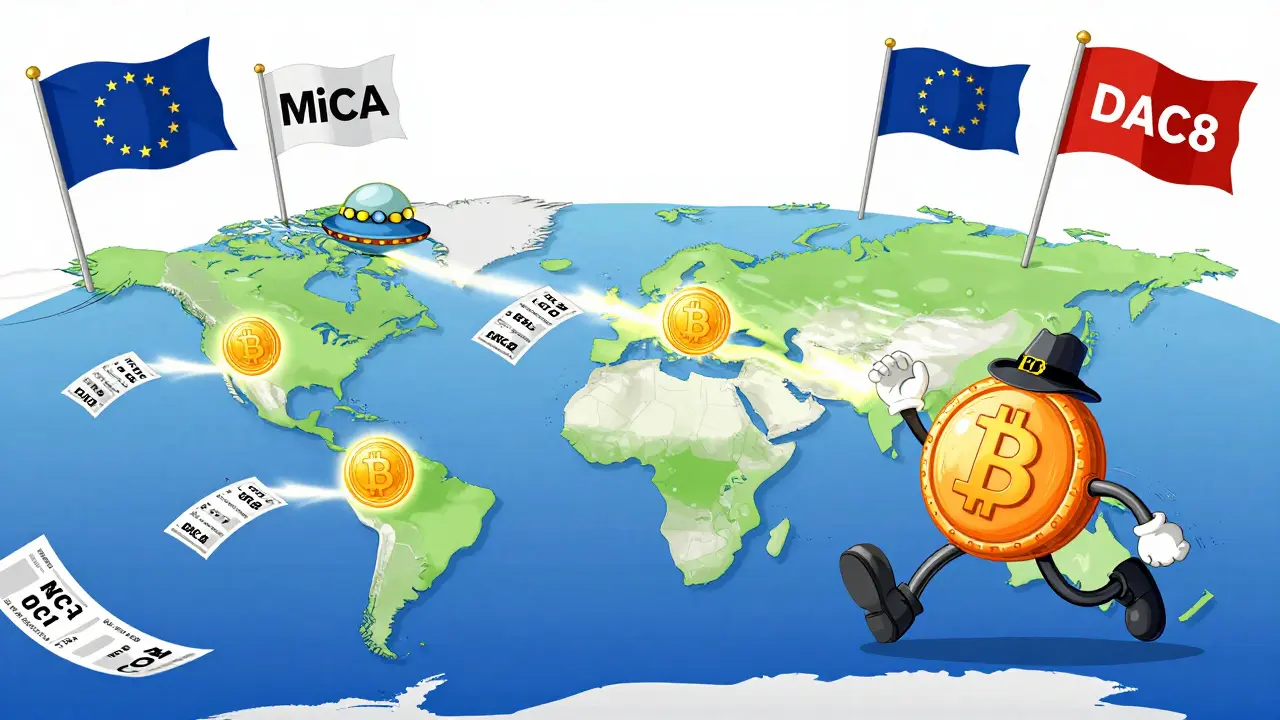
By 2026, if you own cryptocurrency, you’re almost certainly subject to tax rules that didn’t exist five years ago. What used to be a gray area-buying Bitcoin, staking Ethereum, or swapping tokens between wallets-is now tightly tracked, reported, and taxed across dozens of countries. The global system is still messy, but it’s no longer optional to understand it. Ignoring these rules can mean penalties, audits, or even legal trouble. This isn’t about speculation anymore. It’s about compliance.
How the World Is Tracking Your Crypto
The biggest shift came from the OECD a global organization that sets international tax standards. In 2022, it created the Crypto-Asset Reporting Framework (CARF), a standardized way for countries to automatically share crypto transaction data. Think of it like how banks report interest income to tax authorities-but for Bitcoin, Ethereum, and every other digital asset. By 2026, over 110 countries have agreed to use CARF. That means if you trade on an exchange in Germany, and you live in Canada, both tax agencies will eventually see your transactions.It’s not just exchanges doing the reporting. Under CARF, any platform that facilitates crypto trades-whether it’s a centralized exchange like Coinbase or a decentralized one-must collect your name, address, tax ID, birth date, and full transaction history. That includes every swap, transfer, and staking reward. The data is sent to your home country’s tax authority once a year. No more hiding behind anonymity.
United States: The New 1099-DA Rules
In the U.S., things got a lot more serious on January 1, 2025. The IRS started requiring all crypto brokers to issue Form 1099-DA for every transaction. This isn’t a suggestion. It’s the law. Brokers must report gross proceeds from sales, trades, and even crypto-to-crypto exchanges. The first reports were due in early 2026 for 2025 activity.Here’s what this means for you: if you sold 0.3 BTC for $20,000, your exchange will report that exact amount to the IRS. You’ll get a copy too. But here’s the catch: cost basis (what you originally paid) isn’t required until January 1, 2026. That creates a gap. You’ll know how much you sold, but not what your profit was-until next year. That’s why many investors are scrambling to track their own cost basis using tools like Koinly or CoinTracker. The IRS has given some relief for 2025 and 2026, but only if you’re making a good-faith effort to report. Mistakes still carry penalties.
There’s one major exception: DeFi platforms. On April 10, 2025, Congress passed the DeFi Clarity Act, which blocks the IRS from requiring reporting from decentralized exchanges. That means if you trade on Uniswap or Aave without using a custodial wallet, your transactions aren’t reported to the IRS. It’s a loophole-and one that’s causing international friction. Countries like the UK and Australia are pushing back, saying it undermines global cooperation.
Europe: MiCA and DAC8
The European Union took a different path. Its Markets in Crypto-Assets Regulation (MiCA) went live in June 2024. Alongside it came DAC8, the eighth directive on administrative cooperation in taxation. By January 1, 2026, all EU-based crypto providers must report directly to national tax authorities using standardized XML formats.Unlike the U.S., the EU requires both gross proceeds and cost basis from day one. That means if you bought 1 ETH for $3,000 and sold it for $4,500, the tax agency sees both numbers. They also report transactions over €1,000 even if they happen between non-custodial wallets-something the U.S. doesn’t do. Germany treats crypto held over a year as tax-free. France taxes all gains as income. Portugal only taxes professional traders. The EU doesn’t harmonize tax rates-it harmonizes reporting. That means you still need to know your country’s specific rules.

Asia: Japan, South Korea, and Singapore
Japan treats all crypto gains as miscellaneous income, taxed at rates up to 55%. If you made $10,000 trading in 2025, it’s added to your salary income and taxed accordingly. No capital gains rates here. South Korea introduced a flat 20% tax on crypto profits over 2 million KRW (about $1,500) starting January 1, 2025. That’s a big change from previous rules that only taxed large traders.Singapore, on the other hand, is one of the few places that doesn’t tax staking rewards unless you’re running a business. If you earn ETH from staking as an individual, it’s not taxable. That’s why many global traders still use Singapore-based exchanges-even if they live elsewhere. The tax authority, IRAS, doesn’t track personal staking activity. But if you’re running a node as a service? That’s a different story.
Key Differences Between Countries
Here’s how major jurisdictions compare on three critical issues:
| Country | Capital Gains Tax Rate | Staking Rewards Taxed? | Annual Exemption | Cost Basis Reporting Required |
|---|---|---|---|---|
| United States | 0%, 15%, or 20% (long-term); up to 37% (short-term) | Yes, at fair market value | None | Yes, starting 2026 |
| Germany | 0% if held over 1 year | Yes | €600 annual exemption | Yes |
| United Kingdom | 10% or 20% | Yes | £3,000 (2024/25) | Yes |
| Japan | Up to 55% (as income) | Yes | None | Yes |
| Singapore | No tax on personal gains | No (unless business) | None | No |
| Portugal | Only if professional trading | Yes | None | Yes |
One big takeaway: if you move between countries or use foreign exchanges, you’re likely subject to multiple tax systems. The U.S. taxes worldwide income. The UK taxes based on residency. Singapore doesn’t tax personal gains at all. You can’t assume one rule applies everywhere.

What You Need to Do Now
If you’re holding crypto in 2026, here’s what you must do:
- Track every transaction. Not just buys and sells. Transfers between wallets, staking rewards, airdrops, and even NFT trades. The IRS and EU now require this.
- Use software. Tools like Koinly, CoinTracker, or TokenTax can auto-import data from exchanges and calculate gains. But don’t trust them blindly. Cross-check with your wallet history.
- Know your cost basis. If you bought ETH in 2021 for $1,000 and sold it in 2025 for $3,500, your gain is $2,500. If you can’t prove that, the tax agency may assume your cost was $0.
- Report international activity. If you used a non-U.S. exchange, you still owe taxes in your home country. The CARF system will catch it.
- Keep records for seven years. The IRS requires documentation for seven years. That includes screenshots, transaction IDs, and exchange statements.
For active traders, this isn’t a one-time task. It’s a weekly chore. Some users report spending 30+ hours just setting up tracking systems in early 2025. Others who ignored it ended up paying penalties of $5,000 or more.
The Real Cost of Non-Compliance
Deloitte found that multinational companies spent an average of $1.2 million annually just on crypto tax compliance in 2025. For individuals, the cost is less, but still real. H&R Block charges $315 for a basic crypto return and up to $895 for international transactions. If you underreport and get caught, penalties can be 25% of the unpaid tax-plus interest.
There’s also a hidden risk: cross-border audits. If the IRS gets data from a German exchange showing you sold crypto in 2024, and you didn’t report it on your U.S. return, they’ll flag you. The same goes for the UK, Canada, or Australia. The days of flying under the radar are over.
What’s Coming Next
By 2027, over 130 countries will be fully under CARF. That means almost every crypto transaction involving a regulated exchange will be visible to tax authorities. The IRS is also considering applying the wash sale rule to crypto-meaning if you sell a coin at a loss and buy it back within 30 days, you can’t claim the loss. The EU is pushing to include non-custodial wallets in reporting. And NFTs? They’re now classified as collectibles in the U.S., taxed at 28% on long-term gains.
The system isn’t perfect. Experts warn that the complexity could push users toward unregulated platforms. But for now, the rules are clear: if you trade crypto, you’re on the tax radar. The question isn’t whether you’ll be caught. It’s whether you’re ready.
Do I have to pay taxes if I just hold crypto and never sell?
No. Holding crypto without selling, trading, or earning rewards doesn’t trigger a taxable event. Taxes only apply when you sell, trade, or receive income (like staking rewards). But you still need to track your cost basis in case you sell later.
What if I use a non-U.S. exchange like Binance or Kraken?
You still owe taxes in your home country. The OECD’s CARF system is designed to share data between tax authorities. If you’re a U.S. citizen or resident, the IRS will eventually get your transaction history from foreign exchanges. Ignoring it won’t make it disappear.
Are airdrops and forks taxable?
Yes. The IRS treats airdrops as ordinary income at the fair market value when you receive them. For example, if you get 100 tokens worth $500 on the day they’re credited to your wallet, you owe tax on $500. This applies even if you didn’t ask for them.
Can I avoid taxes by using DeFi platforms?
In the U.S., yes-for now. The DeFi Clarity Act of April 2025 prevents the IRS from requiring reporting from decentralized exchanges. But you’re still legally required to report your own gains. The IRS doesn’t get the data automatically, but they can still audit you. Other countries like the UK and Australia don’t have this exemption, so if you’re a resident, you still owe tax.
What happens if I move to another country?
You may owe taxes in both your old and new country. The U.S. taxes citizens on worldwide income, even if you move abroad. Other countries tax based on residency. You’ll need to file in both places and may qualify for tax treaties to avoid double taxation. Keep detailed records of your move date and asset values at that time.
Comments (10)
Patty Atima
March 18, 2026 AT 04:13
Honestly? I just hold and ignore. If I never sell, I don’t owe anything. Why make my life harder?
Ernestine La Baronne Orange
March 19, 2026 AT 08:03
This is why I hate the system. They track EVERYTHING now. Staking rewards? Airdrops? Even if I just move crypto between my own wallets? They want to know if I sneezed and accidentally triggered a transaction. I’m not a criminal just because I believe in decentralization. This isn’t taxation-it’s surveillance with a W-2 attached. I’ve got seven years of screenshots saved, and I still feel like I’m being interrogated by a robot with a tax form.
Tony Weaver
March 20, 2026 AT 07:38
The article is accurate, but it’s missing the real issue: the U.S. is the outlier. No other country treats crypto as a taxable event on every minor transaction. The IRS’s 1099-DA is a bureaucratic nightmare designed for accountants, not humans. And the fact that cost basis isn’t required until 2026? That’s not relief-it’s a trap. People will assume they’re ‘safe’ until they get hit with a $12,000 bill because they can’t prove they bought ETH at $800 in 2020. This isn’t compliance. It’s a revenue grab dressed up as regulation.
Lucy de Gruchy
March 20, 2026 AT 08:42
CARF? More like C.A.R.F. - Controlled Asset Reporting Framework. This is the beginning of financial fascism. The EU and U.S. are colluding to erase financial privacy. They don’t care about taxes-they care about control. And don’t even get me started on DeFi. The U.S. exempting decentralized platforms? That’s not a loophole-it’s a betrayal. They’re letting Americans play in the shadows while the rest of the world gets dragged into the system. This is a power play. And we’re all just pawns in a game we didn’t agree to.
Carol Lueneburg
March 20, 2026 AT 14:55
I just started tracking everything with Koinly and honestly? It’s not that bad. 🙌 I used to panic every time I swapped tokens, but now I just click ‘import’ and let it do the math. Yes, it’s a chore-but it’s also peace of mind. No audits. No stress. No ‘I didn’t know’ excuses. I’m not a tax expert, but I’m a responsible adult. And this? This is how you protect yourself. You don’t have to love it. You just have to do it. 💪✨
Brenda White
March 21, 2026 AT 20:03
wait so if i buy btc on binance and move it to my wallet and then sell on coinbase do they know?? like fr tho i thought non custodial was safe?? someone explain im so confused
Taylor Holloman.
March 21, 2026 AT 22:41
I’ve been in this space since 2017. I’ve seen the wild west, the ICO boom, the bear market, the FTX collapse. And now? Now we’re in the era of spreadsheets and IRS forms. It’s sad. Crypto was supposed to be freedom. Now it’s just another asset class with a 1099 attached. But here’s the thing: the people who built this ecosystem? They didn’t want this. They wanted decentralization. The regulators? They want control. And we’re stuck in the middle. I don’t have answers. But I do know this: if you’re still holding, you’re not just investing. You’re resisting. And that’s worth something.
Lauren J. Walter
March 23, 2026 AT 09:10
I read the whole thing. Then I cried. Then I deleted my wallet. Then I reinstalled it. Then I bought more ETH. I’m not ready for this. I’m not ready for taxes. I’m not ready for the world to know how much I lost on Dogecoin in 2021. I just wanted to be rich. Why did it have to get this complicated?
Tobias Wriedt
March 24, 2026 AT 16:17
If you’re not reporting your crypto gains, you’re stealing from society. You’re not ‘hacking the system’-you’re cheating on your taxes. And if you think DeFi is some magical loophole? Wake up. The IRS isn’t stupid. They’re just waiting for you to slip up. Pay your damn taxes. It’s not that hard. And if you can’t afford the software? Then don’t trade. Simple. 🇺🇸
Prakash Patel
March 25, 2026 AT 12:49
Why is everyone so scared? In India, we don’t tax crypto at all. Just hold. Don’t trade. No one cares. Why are Americans so obsessed with paperwork? Just buy. Hold. Sleep. Life is too short for 1099 forms.