
Imagine watching $1.5 billion vanish from your exchange account in seconds. That is exactly what happened to Bybit users on February 21, 2025. The culprit wasn't a random hacker in a basement or a disgruntled employee. It was the Lazarus Group, North Korea’s elite state-sponsored hacking unit, executing the largest digital asset theft in history. This wasn't just a robbery; it was a surgical strike against the heart of the cryptocurrency ecosystem, proving that even multi-signature cold wallets aren't safe if the software managing them gets compromised.
You might wonder how a single group can drain billions while under strict international sanctions. The answer lies in their relentless focus and evolving tactics. They don’t just steal for profit; they fund a nuclear weapons program. Their methods have shifted from simple phishing emails to complex supply chain attacks and social engineering that targets the humans behind the screens. If you hold crypto or run an exchange, understanding their playbook isn't optional-it's survival.
The Anatomy of the Bybit Heist
The Bybit breach stands as a masterclass in modern cyber-espionage. Unlike previous hacks that relied on brute-forcing private keys, Lazarus attacked the interface. They targeted the Safe Wallet frontend, the software used by executives to approve transactions. By injecting malicious code into this user interface, they could alter transaction details without changing the underlying cryptographic signatures. When CEO Ben Zhou approved what looked like a routine transfer, the system actually moved 401,000 Ethereum-worth roughly $1.46 billion-to attacker-controlled addresses.
This four-phase attack began with spear phishing key personnel to gain access to the signers. Next, they crafted legitimate-looking transactions. The critical failure occurred because the visual confirmation matched the intent, but the backend execution did not. Finally, they scrambled the funds through decentralized exchanges, converting some Ethereum into Bitcoin and Dai to muddy the trail. This incident highlighted a terrifying reality: your security is only as strong as the weakest link in your software stack, not just your hardware keys.
From Ronin to Bybit: A Pattern of Escalation
Bybit wasn't an isolated incident. It was the climax of a decade-long campaign. Look back at the 2022 Ronin Network hack, where Lazarus stole $620 million from the Axie Infinity gaming platform. There, they compromised a validator node using a fake job offer PDF. Fast forward to 2025, and the stakes have tripled. Between June and September 2025 alone, the group hit Atomic Wallet ($100 million), CoinsPaid ($37.3 million), Alphapo ($60 million), and Stake.com ($41 million).
What changed? The scale and speed. In the early days, they targeted South Korean exchanges with simpler malware like AppleJeus. Today, they operate with military precision. Blockchain analysis firms like Elliptic have traced cross-contamination between these hacks. Funds stolen from Stake.com often appear in the same mixing pools as assets taken from Atomic Wallet. This consolidation strategy makes it incredibly hard for law enforcement to isolate specific crimes, allowing North Korea to launder money across different blockchains simultaneously.

Technical Arsenal: Malware and Social Engineering
Lazarus doesn't rely on one trick. Their technical toolkit is diverse and constantly updated. One of their most effective tools is the TraderTraitor subgroup, which focuses on cloud platforms and supply chains. They distribute malicious trading applications that look and feel like legitimate software. Initially, the app works fine. But hidden update mechanisms connect to command-and-control servers, downloading AES-256 encrypted payloads. These payloads include MANUSCRYPT remote access trojans designed specifically to harvest wallet keys and system credentials.
Beyond code, they weaponize human psychology. Traditional phishing is dead; awareness has risen too high. Instead, Lazarus recruiters pose as headhunters on LinkedIn. They build rapport with security researchers and developers over weeks before sending a tailored phishing link. This long-con approach bypasses spam filters and lowers the victim's guard. Once inside, they don't just grab data; they monitor behavior to time their exfiltration perfectly.
Why Multi-Sig Security Failed
Many industry experts assumed multi-signature (multi-sig) wallets were impenetrable. The logic seemed sound: require multiple keys to move funds, so no single point of failure exists. However, Lazarus proved that securing the keys isn't enough if the signing process itself is vulnerable. They exploited the transition between cold storage and hot wallets during routine transfers.
| Target | Year | Amount Stolen | Primary Tactic |
|---|---|---|---|
| Bybit | 2025 | $1.5 Billion | Frontend Injection / UI Manipulation |
| Ronin Network | 2022 | $620 Million | Social Engineering / Validator Compromise |
| Atomic Wallet | 2025 | $100 Million | Supply Chain Attack |
| CoinEx | 2025 | $54 Million | Suspected Phishing / API Exploit |
The Bybit case showed that attackers could manipulate the transaction display so that the signer sees one thing while the blockchain records another. This requires deep knowledge of the specific wallet software being used. It suggests that Lazarus spends significant time reverse-engineering the infrastructure of their targets before striking. For exchanges, this means static security audits are insufficient. Continuous monitoring of the signing environment is now mandatory.
The Sanctions Loophole and Nuclear Funding
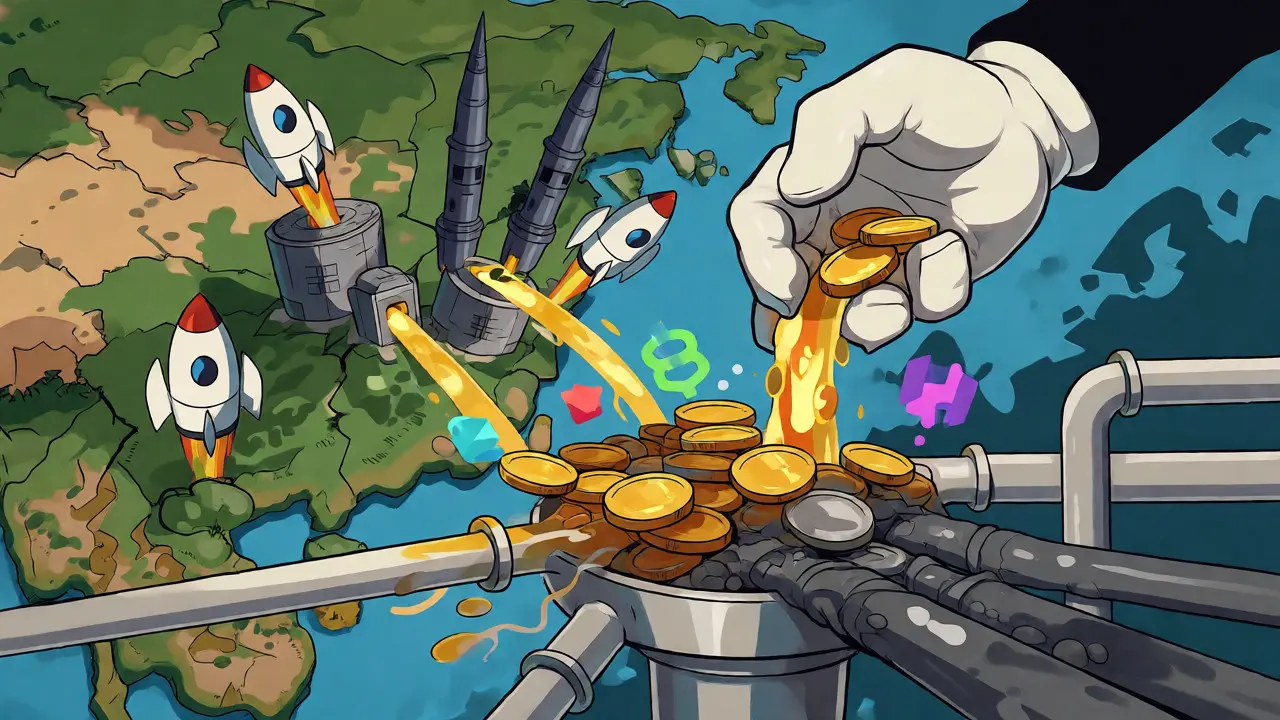
Why does North Korea bother with such risky operations? Simple economics. International sanctions choke traditional trade routes. Cryptocurrency offers a low-barrier, high-profit alternative. The regime uses stolen funds to import luxury goods, fuel, and technology, but primarily to bankroll its ballistic missile program. The Center for Strategic and International Studies notes that these operations are fundamentally different from typical cybercrime because they serve national strategic goals rather than individual greed.
Law enforcement struggles to respond effectively. Jurisdictional issues make prosecuting North Korean hackers nearly impossible. Plus, the pseudonymous nature of crypto allows funds to be mixed and moved globally within hours. By the time an investigation begins, the money has often been converted into Bitcoin or stablecoins and dispersed across thousands of addresses. This creates a persistent revenue stream for Pyongyang that is difficult to cut off without disrupting the global crypto market itself.
Defending Against State-Level Threats
If you're running a business or holding significant assets, what can you do? First, assume your frontend is compromised. Verify transactions on independent devices, not just the screen showing the approval button. Second, diversify your vendor risk. Don't let one software provider control all your signing keys. Third, train your staff to recognize sophisticated social engineering. It’s no longer about spelling errors in emails; it’s about credible personas on professional networks.
Bybit managed to recover over $40 million by working closely with blockchain analysts, restoring their reserves to 100%. This shows that rapid response matters. However, recovery is rare. Most stolen funds disappear into the ether. The industry must move toward architectural changes, such as hardware-based verification modules that physically validate transaction data outside the browser environment. Until then, we remain vulnerable to the next wave of Lazarus creativity.
How much did the Lazarus Group steal from Bybit?
The Lazarus Group stole approximately $1.5 billion from Bybit on February 21, 2025. This included around 401,000 Ethereum, making it the largest cryptocurrency theft in history at the time.
What is the main goal of the Lazarus Group's thefts?
Their primary objective is to generate foreign currency for North Korea, specifically to fund the country's nuclear weapons and ballistic missile programs, circumventing international economic sanctions.
How did Lazarus bypass multi-signature security at Bybit?
They injected malicious code into the Safe Wallet frontend interface. This allowed them to alter the transaction destination displayed to the approver, so the CEO authorized a legitimate-looking signature that actually redirected funds to attacker-controlled wallets.
Which other exchanges have been targeted recently?
Between June and September 2025, Lazarus also attacked Atomic Wallet ($100M), CoinsPaid ($37.3M), Alphapo ($60M), Stake.com ($41M), and CoinEx ($54M), demonstrating a sustained campaign against major platforms.
Can stolen cryptocurrency be recovered?
Recovery is difficult but possible. Bybit recovered over $40 million through collaboration with blockchain analysis firms. However, most funds are laundered through mixers and decentralized exchanges, making full recovery unlikely.