
You walk into a coffee shop in Denver. You pull out your phone and try to pay with Bitcoin. The barista looks at you like you just handed them a handful of poker chips. Why? Because despite the hype, cryptocurrency is not legal tender in the United States. It never has been, and as of late 2025, it still isn't.
This distinction trips up a lot of people. We hear terms like "digital dollar" or "crypto payment," and we assume the government treats Bitcoin exactly like the greenback in our wallet. It doesn't. The U.S. dollar remains the only asset the government says you *must* accept for debts. Crypto is property. That’s a huge difference for taxes, banking, and how you actually use your money. But here’s the twist: while crypto hasn’t become legal tender, the rules around it changed more in 2025 than in the previous decade combined. If you’re confused about what’s happening, you’re not alone. Let’s break down where things stand right now.
The Core Definition: What Legal Tender Actually Means
To understand why this matters, you have to know what legal tender is. It’s not just "money." It’s a specific legal status granted by the government. When the Federal Reserve issues a $20 bill, that piece of paper (or digital entry) is legal tender. If you owe someone money, offering them legal tender settles the debt. They can’t refuse it and sue you for non-payment.
Bitcoin does not have this status. Neither does Ethereum. If you try to pay your rent with Bitcoin, your landlord can legally say no. If they do say yes, they are treating it as a barter transaction-swapping goods (housing) for an asset (BTC). This means every time you spend crypto, it’s a taxable event. You’re selling an asset to buy a service. With legal tender, spending cash doesn’t trigger capital gains tax because the value is fixed by law. With crypto, if the price moved since you bought it, you owe the IRS.
This isn’t just theory. The Internal Revenue Service (IRS) treats digital assets as property, similar to stocks or gold. So, when you buy that coffee with Bitcoin, you technically sold some Bitcoin. If the price went up from when you bought it, you might owe short-term capital gains tax on that tiny fraction of a cent. It’s cumbersome, which is one reason adoption lags behind the tech.
The Game Changer: The GENIUS Act of 2025
In July 2025, President Trump signed the GENIUS Act (Guiding and Establishing National Innovation for U.S. Stablecoins Act). This was big news. For years, stablecoins like USDT and USDC lived in a gray area. Were they securities? Commodities? Bank deposits? The GENIUS Act cleared up the fog for stablecoins specifically.
Here’s the critical part: the Act explicitly states that stablecoins are **not** legal tender. Issuers cannot claim their coin is backed by the U.S. government or federally insured. If Tether or Circle tried to market their coins as "just like dollars," they’d be breaking the law. Instead, the Act requires them to hold 100% reserves in liquid assets like U.S. dollars or short-term Treasuries. They must publish monthly reports proving those reserves exist.
Why does this matter if it’s not legal tender? Because it makes stablecoins trustworthy enough for businesses to use them as a medium of exchange without fearing a collapse. It creates a regulated lane for digital payments that functions *like* money, even if it lacks the official legal tender stamp. Think of it as getting a driver’s license versus being a certified police officer. Both can drive, but one has specific legal powers. Stablecoins got their license; they didn’t get the badge.
Digital Commodities vs. Securities: The CLARITY Act
While the GENIUS Act handled stablecoins, the House passed the CLARITY Act in July 2025. It’s waiting for the Senate, but its impact is already felt. This act introduces the concept of "digital commodities." If a blockchain network is sufficiently decentralized, its native token (like Bitcoin or Ether) could be classified as a commodity under the Commodity Futures Trading Commission (CFTC), not a security under the SEC.
This shift is massive for institutional investors. Commodities trade freely on regulated exchanges with clear rules for custody and anti-money laundering checks. Securities face stricter disclosure requirements. By moving major cryptos toward commodity status, the CLARITY Act removes many barriers to entry for banks and pension funds. But again, note the language: it’s about regulatory oversight, not monetary status. A digital commodity is still property. It’s just property with clearer rules for trading.
| Feature | U.S. Dollar (Legal Tender) | Stablecoins (Regulated) | Bitcoin/Ether (Digital Commodities) |
|---|---|---|---|
| Legal Status | Official Currency | Digital Payment Instrument | Property / Commodity |
| Tax Treatment | No Capital Gains on Spend | Capital Gains Apply | Capital Gains Apply |
| Regulator | Federal Reserve | OCC / State Regulators | CFTC (Proposed) |
| Must Be Accepted? | Yes (for debts) | No | No |
| Government Backing | Full Faith & Credit | Reserve-Backed (Private) | None |
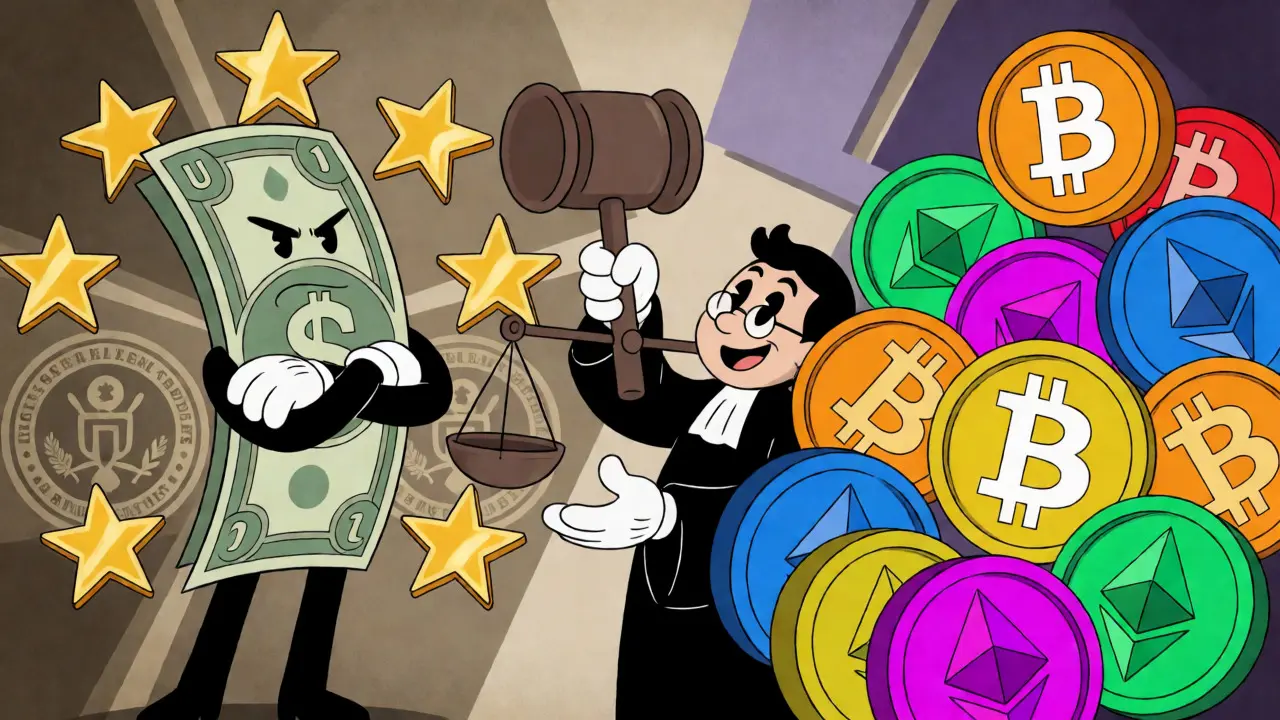
Why Banks Finally Care: SAB 122
For years, traditional banks avoided holding crypto for clients. Why? An accounting rule called Staff Accounting Bulletin 121 (SAB 121) forced banks to put custodied crypto assets on their balance sheets as liabilities. This made holding Bitcoin expensive because it increased the bank’s capital requirements. In January 2025, the SEC issued SAB 122, rescinding that rule. Now, banks can treat crypto custody like any other safekeeping service. The asset stays off-balance-sheet unless there’s a default risk.
This change unlocked the floodgates. Major institutions can now offer Bitcoin ETFs and custody services without blowing up their balance sheets. You’ll see more banks letting you buy Bitcoin directly through your brokerage account. It feels like using money, but legally, you’re buying an asset held in trust. The convenience is rising, but the legal classification hasn’t budged.
The Federal Reserve’s Stance: No CBDC Rush
You might wonder, "If crypto isn’t legal tender, will the Fed create a Central Bank Digital Currency (CBDC)?" As of 2026, the answer is a firm "maybe, but not soon." The Federal Reserve maintains exclusive authority over legal tender designation. A CBDC would likely be legal tender, unlike private cryptocurrencies. However, political resistance to a Fed-controlled digital dollar remains high. Many lawmakers worry about privacy and surveillance. Until a CBDC launches and passes Congress, the dollar remains the sole king of legal tender.
Some states have experimented with accepting crypto for taxes or fees. El Salvador made headlines earlier by making Bitcoin legal tender, but that’s outside the U.S. framework. In America, local acceptance is voluntary. A city might let you pay parking tickets in ETH, but that doesn’t make ETH legal tender for your mortgage.

Practical Implications for Users
So, what should you do with this info? First, stop expecting merchants to accept Bitcoin by law. They don’t have to. Second, track your cost basis carefully. Every swap, every purchase, every sale is a taxable event. Use software that integrates with your exchange accounts to automate this. Third, watch the stablecoin space. With the GENIUS Act, regulated stablecoins are becoming safer for everyday transactions. They aren’t legal tender, but they are the closest thing to digital cash we have.
If you’re a business owner, accepting crypto is a competitive advantage, not a compliance requirement. You need robust point-of-sale systems that convert crypto to fiat instantly to avoid volatility risk. Most consumers won’t wait for prices to settle. They want to buy the product now. Instant conversion tools bridge the gap between volatile assets and stable pricing.
Frequently Asked Questions
Is Bitcoin legal tender in the USA?
No. As of 2026, Bitcoin is classified as property or a digital commodity, not legal tender. Merchants are not legally required to accept it for debts or purchases.
Does the GENIUS Act make stablecoins legal tender?
No. The GENIUS Act regulates stablecoins and prohibits issuers from claiming they are legal tender or government-backed. It ensures stability through reserve requirements but keeps them distinct from official currency.
What happens if I pay my taxes in cryptocurrency?
The IRS generally requires tax payments in U.S. dollars. While some pilot programs allow crypto payments, they are often converted to USD upon receipt. Check current IRS guidelines, as direct payment options remain limited compared to standard banking methods.
Will a Central Bank Digital Currency (CBDC) be legal tender?
If the U.S. launches a CBDC, it would likely be designated as legal tender by the Federal Reserve. However, as of 2026, no CBDC has been launched, and political debate continues regarding its implementation.
Can I refuse to accept cryptocurrency if someone offers it to me?
Yes. Since cryptocurrency is not legal tender, private parties can set their own terms of payment. A merchant or individual can reject Bitcoin, Ethereum, or any other digital asset without violating federal law.