
You’ve probably seen the headlines. "Earn 50% APY on USDC." "Farm 1000% returns with this new token." It sounds too good to be true, doesn’t it? In the world of decentralized finance (DeFi), these numbers are real, but they come with a catch that most beginners miss. You aren't just getting free money; you're providing a service-liquidity-and you're taking on significant risk in exchange for those rewards.
Understanding Liquidity Mining is no longer optional if you want to navigate crypto markets safely. It’s the engine that powers most decentralized exchanges today. But before you lock up your capital, you need to know exactly how the rewards work, where the hidden costs lie, and why your portfolio might shrink even while your balance sheet says you’re earning.
What Is Liquidity Mining?
At its core, liquidity mining is an incentive mechanism used by DeFi protocols to attract capital. Imagine opening a new grocery store. To get customers to buy from you instead of the established supermarket down the street, you offer coupons, discounts, or loyalty points. DeFi protocols do the exact same thing, but instead of coupons, they give out newly minted cryptocurrency tokens.
Liquidity mining involves users depositing pairs of cryptocurrencies into a protocol's pool to facilitate trading, in exchange for earning additional tokens as rewards. This practice exploded in popularity around 2020 when platforms like Compound and Uniswap needed to bootstrap their ecosystems without relying on traditional venture capital funding. Instead of paying market makers with fiat currency, these protocols created their own digital assets and distributed them to anyone willing to provide liquidity.
The key difference between standard liquidity provision and liquidity mining is the source of the reward. Standard provision earns you only the trading fees generated by other people swapping tokens. Liquidity mining adds a second layer: protocol-specific tokens emitted directly from the project’s treasury or smart contract. This dual-reward structure is what creates those eye-popping annual percentage yields (APYs) you see advertised online.
How the Mechanism Works Step-by-Step
To participate, you don’t need a degree in finance, but you do need to understand the workflow. Here is the typical process:
- Select a Pool: You choose a specific trading pair on a decentralized exchange (DEX), such as ETH/USDC or SOL/USDT. Each pool has different risks and reward rates.
- Deposit Assets: You deposit equal values of both tokens. For example, if Ethereum is worth $3,000, you deposit $3,000 worth of ETH and $3,000 worth of USDC.
- Receive LP Tokens: The protocol issues you Liquidity Provider (LP) tokens. These tokens represent your share of the total pool. They are not the reward themselves; they are proof of your contribution.
- Earn Rewards: While your assets sit in the pool, two things happen. First, traders pay fees every time they swap tokens, and you earn a portion of those fees. Second, the protocol distributes its native governance or utility tokens to you based on your share of the pool.
- Claim and Withdraw: You can claim the earned rewards at any time. When you’re ready to exit, you burn your LP tokens to withdraw your original deposits plus any accumulated fee earnings.
The math behind the distribution is automated via smart contracts. If you provide 1% of the total liquidity in a pool, you generally receive 1% of the trading fees and 1% of the daily mining rewards. This transparency ensures that no central authority can arbitrarily change your payout after you’ve deposited funds.
The Hidden Cost: Impermanent Loss
If liquidity mining were purely profit, everyone would do it. The primary risk isn’t hacking or scams (though those exist); it’s a mathematical phenomenon called Impermanent Loss. This concept confuses many new investors because your wallet balance might look higher, but your actual purchasing power could be lower than if you had just held the coins in your cold storage.
Here’s how it works. Automated Market Makers (AMMs) maintain price equilibrium using a constant product formula ($x \times y = k$). When the price of one asset in your pair changes significantly compared to the other, the arbitrage bots adjust the pool composition. You end up holding more of the depreciating asset and less of the appreciating one.
| Action | Start Value | Price Change (ETH doubles) | End Value | Result |
|---|---|---|---|---|
| Holding (HODL) | $1,000 ETH + $1,000 USDC | ETH goes to $2,000 | $2,000 ETH + $1,000 USDC = $3,000 | Baseline |
| Liquidity Providing | $1,000 ETH + $1,000 USDC | Pool rebalances automatically | ~$1,414 ETH + ~$1,414 USDC = ~$2,828 | Loss of ~$172 (5.7%) |
In this scenario, you lost $172 in value compared to simply holding the assets. This loss is "impermanent" only until you withdraw. If prices revert to the original ratio, the loss disappears. If they diverge further, the loss grows. Therefore, liquidity mining rewards must exceed this potential loss to be truly profitable.
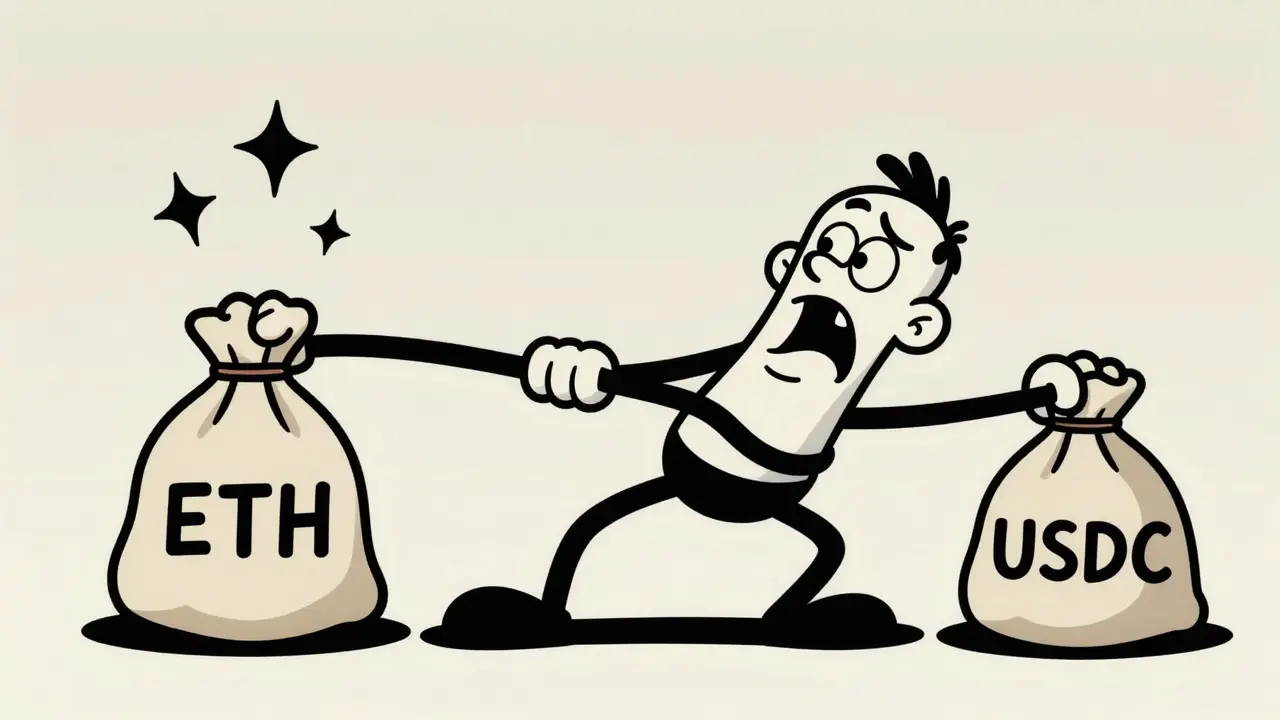
Rewards Structure: Fees vs. Token Emissions
Not all rewards are created equal. It is crucial to distinguish between sustainable income and inflationary emissions.
- Trading Fees: These are real revenue generated by user activity. If a DEX processes $1 billion in volume with a 0.3% fee, that’s $3 million in real value distributed to providers. This is sustainable and reflects actual demand for the platform.
- Token Emissions: These are newly created tokens given to you as an incentive. While they have a market price today, that price depends on future demand. If the protocol emits millions of tokens daily, supply increases, often driving the price down due to sell pressure from miners cashing out.
Many early DeFi projects relied heavily on token emissions to attract liquidity. This worked initially, but once the incentives dried up or the token price crashed, liquidity vanished. Today, sophisticated farmers look for pools where trading fees make up a significant portion of the APY, ensuring that the yield isn’t just paper gains from inflating tokens.
Strategies for Maximizing Returns
Successful liquidity mining requires active management, not a "set it and forget it" approach. Here are three strategies employed by experienced participants:
1. Stablecoin Pairs
Providing liquidity for pairs like USDC/USDT minimizes impermanent loss because the assets are pegged to the same value (the US Dollar). The risk here shifts from price volatility to smart contract risk and depegging events. However, the APYs are usually lower because the competition is fierce.
2. Concentrated Liquidity
Newer versions of AMMs, like Uniswap V3, allow you to concentrate your capital within a specific price range. If you believe ETH will trade between $2,500 and $3,500, you can deploy your funds only in that band. This increases your capital efficiency and fee earnings significantly, but if the price breaks out of that range, your position becomes inactive and vulnerable to impermanent loss.
3. Compounding Rewards
Instead of selling your mining rewards immediately, some farmers reinvest them back into the pool. This compound interest effect can boost returns over time, provided the underlying token doesn’t crash in value. Tools like auto-compounders automate this process, though they introduce additional layers of smart contract risk.

Key Risks Beyond Impermanent Loss
While impermanent loss gets all the attention, other dangers lurk in the code and the market.
- Smart Contract Risk: DeFi protocols are built on code. Bugs, vulnerabilities, or logic errors can lead to exploits where hackers drain the entire pool. Always check if a protocol has been audited by reputable firms.
- Token Volatility: If you’re farming rewards in a low-cap governance token, that token could drop 90% in a week. Your high APY becomes meaningless if the reward token loses its value.
- Regulatory Uncertainty: As governments clarify rules around securities and taxes, certain DeFi activities may face restrictions. Understanding the tax implications of receiving mining rewards in your jurisdiction is essential.
Is Liquidity Mining Right for You?
Liquidity mining is a powerful tool for generating yield in a decentralized economy, but it is not passive income in the traditional sense. It requires monitoring, understanding of market dynamics, and tolerance for risk. If you are comfortable with the possibility of losing principal due to impermanent loss or smart contract failures, and you understand the difference between fee-based yield and inflationary emissions, then liquidity mining can be a lucrative addition to your crypto strategy.
Start small. Use stablecoin pairs to learn the mechanics. Track your impermanent loss using calculators available online. And never invest more than you can afford to lose. The DeFi space moves fast, and staying informed is your best defense against volatility.
What is the difference between staking and liquidity mining?
Staking typically involves locking up a single cryptocurrency to support a blockchain network's security (Proof-of-Stake) and earning rewards in that same token. Liquidity mining requires depositing pairs of tokens into a trading pool to facilitate exchanges, earning rewards in trading fees and often a different protocol token. Staking has lower risk regarding impermanent loss, while liquidity mining offers potentially higher yields but comes with greater complexity and risk.
Can I lose all my money in liquidity mining?
Yes, it is possible to lose a significant portion of your investment. This can happen through severe impermanent loss if one asset crashes while the other stays stable, or through a smart contract exploit where hackers drain the pool. Additionally, if the reward token you are farming drops to near-zero value, your effective return becomes negative when accounting for opportunity cost and gas fees.
How do I calculate if a liquidity pool is profitable?
You need to compare the Annual Percentage Yield (APY) against the expected impermanent loss. Use online impermanent loss calculators to estimate losses based on historical price volatility of the asset pair. If the APY from fees and rewards significantly exceeds the projected impermanent loss over your intended holding period, the pool may be profitable. Always factor in transaction (gas) fees for entering and exiting the pool.
Are liquidity mining rewards taxable?
In many jurisdictions, including the United States, liquidity mining rewards are considered taxable income at the fair market value of the tokens when received. Trading fees earned are also typically taxable. It is advisable to keep detailed records of all deposits, withdrawals, and reward claims to accurately report capital gains and ordinary income to tax authorities.
What are LP tokens?
LP (Liquidity Provider) tokens are receipts issued by a DeFi protocol when you deposit assets into a liquidity pool. They represent your proportional share of the pool. You need these tokens to withdraw your original assets later. Some advanced strategies involve staking these LP tokens in other protocols to earn additional rewards, a practice known as yield stacking.